Contract Law Basics for Small Business Owners
A practical guide to understanding, drafting, and enforcing business contracts so your small business is protected at every stage.
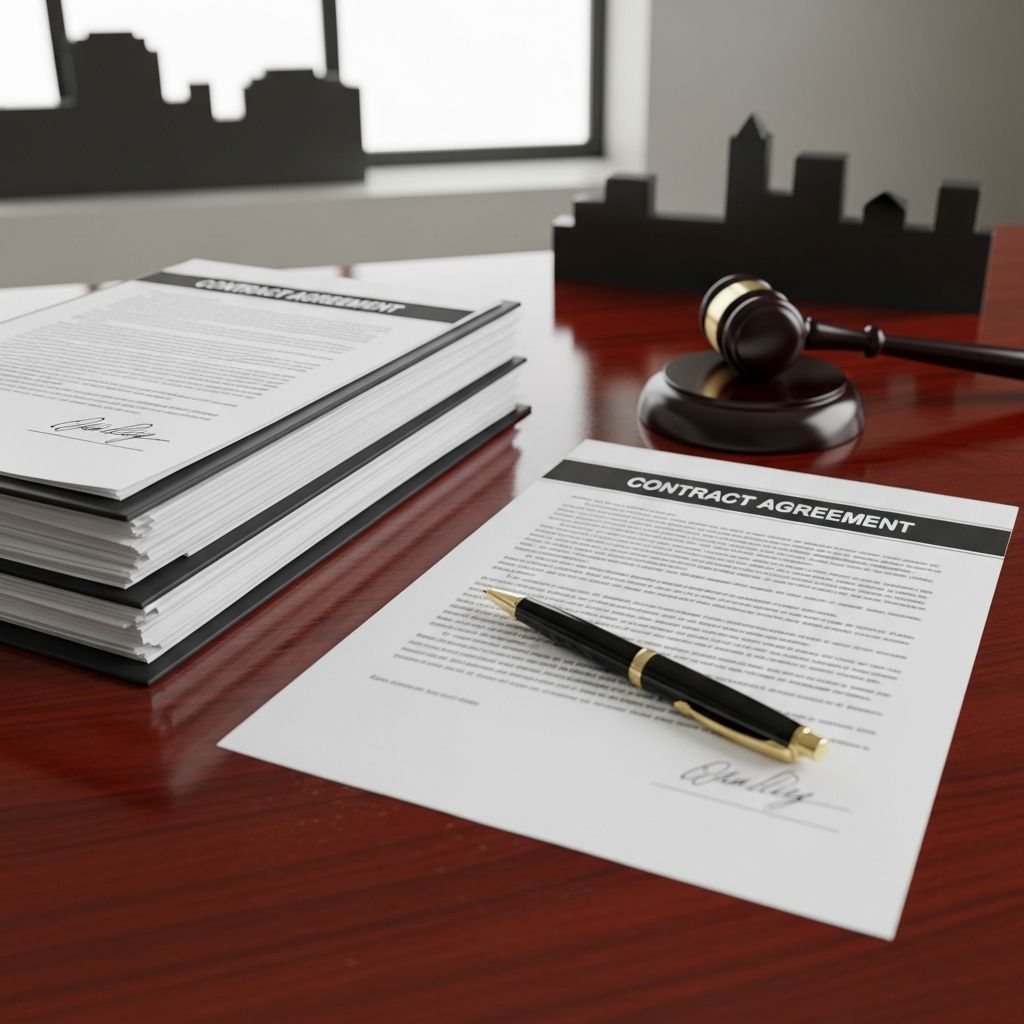
Contract Law Basics Every Small Business Owner Should Know
Running a small business inevitably involves agreements: with customers, suppliers, landlords, employees, and partners. Those agreements are governed by contract law, the body of rules that determines when promises are legally binding and what happens if someone does not follow through. Understanding these fundamentals helps you reduce risk, avoid disputes, and protect the value of your business.
What Is Contract Law in a Business Context?
Contract law is the legal framework that governs agreements between two or more parties to do (or not do) something in exchange for value. If certain conditions are met, those agreements become legally enforceable contracts. Courts then use contract law principles to interpret the terms, decide whether a breach occurred, and determine appropriate remedies.
For small businesses, contract law affects everyday activities such as:
- Signing a lease for office, retail, or warehouse space
- Agreeing to purchase inventory or equipment from a supplier
- Hiring employees or independent contractors
- Providing services or products to clients under written agreements
- Licensing software or intellectual property needed to operate
Core Building Blocks of a Valid Contract
Most legal systems recognize several common elements that must exist for a contract to be enforceable. While details vary by jurisdiction, four concepts show up consistently in business contracts.
| Element | What It Means | Example in Business |
|---|---|---|
| Offer | A clear proposal to enter into an agreement on specific terms. | A vendor sends a written quote offering to supply 1,000 units at a stated price. |
| Acceptance | Unqualified agreement to the offer’s terms, often by signature or performance. | The buyer signs the quote or issues a purchase order matching the terms. |
| Consideration | Something of value exchanged between the parties, such as money, goods, or services. | The buyer pays money; the seller delivers goods or services. |
| Intention & Capacity | The parties intend to create a legal relationship and are legally capable of doing so. | Two companies, each properly formed and represented by authorized signers, sign a written agreement. |
In addition to these basics, contracts must have a lawful purpose. Agreements to do something illegal (for example, evade taxes) will not be enforced by a court.
When Does a Contract Need to Be in Writing?
Many simple agreements can be enforceable even if they are not written down. However, business owners should understand both legal requirements and practical realities:
- Certain contracts must be written under “statute of frauds” rules, such as contracts for the sale of goods over a threshold amount, long-term leases, or transfers of interests in real property, depending on the jurisdiction.
- Written contracts are easier to prove and enforce because they document the parties, price, scope of work, and other key terms in one place.
- Electronic contracts and signatures are generally recognized as valid in many jurisdictions under modern e-signature laws, if specific conditions are met.
For most small business transactions, putting the agreement in writing is a low-cost way to reduce misunderstandings and preserve evidence if a dispute arises.
Essential Terms Every Business Contract Should Address
Once you decide to use a written contract, the next step is to ensure it covers the right topics. While no two deals are identical, well-drafted business contracts typically include several core sections.
1. Parties and Purpose
- Full legal names and business forms of each party (e.g., “ABC Consulting LLC”)
- Contact details for notices and communications
- A brief description of the overall purpose of the agreement
2. Scope of Work or Deliverables
The scope section defines exactly what is being exchanged. Clear drafting here prevents many disputes.
- Detailed description of services or goods
- Specifications, quality standards, or performance metrics
- Deadlines, milestones, and delivery schedules
- Any assumptions or responsibilities of the other party
3. Price, Payment, and Invoicing
- Total price or pricing formula
- Payment schedule (upfront deposit, progress payments, on completion)
- Accepted payment methods
- Late fees or interest on overdue amounts
- Conditions for price changes or additional work
4. Duration and Termination
The contract should make it clear how long it lasts and how it can end.
- Start date and initial term (for example, one year)
- Automatic renewal or end date
- Termination for convenience (ending without cause)
- Termination for cause (breach, nonpayment, insolvency)
- Obligations that continue after termination (such as confidentiality)
5. Intellectual Property and Confidentiality
Intangible assets are often among a small business’s most valuable resources. Contracts should address:
- Who owns work product, copyrights, trademarks, or patents created under the agreement
- Licenses granted to use existing intellectual property
- Confidentiality obligations and permitted disclosures
- How trade secrets or sensitive data will be protected
6. Risk Allocation: Warranties, Liability, and Indemnity
Contracts are also tools for deciding how risks are shared between the parties.
- Warranties: Promises about quality, performance, or legal compliance
- Disclaimers: Limits to those promises, such as “as is” provisions where allowed by law
- Limitation of liability: Caps on certain types of damages (for example, limiting damages to fees paid)
- Indemnification: One party agrees to cover specified losses suffered by the other (for example, third-party IP claims)
7. Dispute Resolution and Governing Law
Clear dispute resolution clauses can avoid costly, time-consuming litigation.
- Governing law: Which jurisdiction’s laws apply
- Forum selection: Where disputes will be resolved (specific courts, arbitration, or mediation)
- Requirement for negotiation or mediation before filing a lawsuit
- Allocation of attorneys’ fees and costs in the event of a dispute
Common Types of Contracts Used by Small Businesses
Different business relationships call for different types of contracts. Some of the most common for small enterprises include:
- Service agreements with clients or customers describing the services provided, pricing, and timelines.
- Sales contracts for selling goods, including quantity, delivery, and warranty terms.
- Independent contractor agreements for freelancers or consultants, clarifying that they are not employees and outlining scope, payment, and IP ownership.
- Employment contracts for key staff, which may address compensation, benefits, non-competition provisions where enforceable, and termination procedures.
- Vendor and supplier contracts for recurring purchases of inventory, materials, or services.
- Commercial leases for office, retail, or industrial space, covering rent, maintenance, renewals, and default.
- Confidentiality and non-disclosure agreements (NDAs) to protect proprietary information shared with employees, contractors, or partners.
- Operating or partnership agreements that set rules among business co-owners regarding decision-making, profit sharing, and exit strategies.
How Courts Interpret Business Contracts
Understanding how courts approach contract interpretation can help you draft clearer agreements from the start.
- Plain meaning rule: Courts generally give words their ordinary meaning unless the contract defines them differently.
- Reading as a whole: Judges look at the entire document, not isolated sentences, to understand the parties’ intent.
- Priority of written terms: If there is conflict between pre-printed boilerplate and negotiated handwritten language, the negotiated terms may carry more weight.
- Against the drafter: Ambiguities can be interpreted against the party who drafted the contract, especially in consumer or adhesion contracts.
Because of these principles, investing time to draft concise, consistent, and unambiguous terms can significantly reduce future uncertainty.
What Is a Breach of Contract?
A breach of contract occurs when one party fails to perform a contractual obligation without a valid legal excuse. Breaches can take several forms:
- Material breach: A serious failure that deprives the other party of the main benefit of the contract, such as delivering the wrong product entirely.
- Minor (or partial) breach: A smaller deviation that does not undermine the whole deal, like a slight delay in delivery without major consequences.
- Anticipatory breach: One party clearly indicates, before performance is due, that they will not perform; the other party may be able to treat this as a present breach.
Possible Remedies When a Breach Occurs
If a contract is valid and a breach is proven, the non-breaching party may seek several types of remedies, depending on the facts and jurisdiction.
- Compensatory damages to put the injured party in the position they would have been in if the contract had been performed.
- Consequential damages (such as lost profits) in some cases, if they were reasonably foreseeable when the contract was made.
- Liquidated damages if the contract specifies a reasonable, pre-agreed amount for certain kinds of breaches.
- Specific performance, a court order requiring performance rather than payment of money, which is more common in real estate or unique goods cases.
- Rescission, which cancels the contract and, in some situations, allows the parties to return what they received.
Practical Contract Drafting Tips for Small Businesses
Legal counsel is ideal for complex or high-value agreements, but many everyday contracts can be improved by following some practical guidelines.
- Use clear, direct language instead of dense legal jargon where possible.
- Define key terms up front so they are used consistently throughout the document.
- Address common “what if” scenarios such as delays, price changes, and early termination.
- Make sure signatures are authorized; confirm that the person signing has authority to bind the company.
- Keep an organized record system for your contracts, including signed copies, amendments, and key dates such as renewals or price adjustments.
- Review templates regularly to reflect changes in your business model, law, or risk appetite.
Frequently Asked Questions About Contract Law for Small Businesses
Do I need a lawyer for every contract?
Not necessarily. Many routine agreements can be managed with well-designed templates and careful review. However, you should strongly consider legal advice for high-value deals, long-term commitments, contracts involving intellectual property, or documents you do not fully understand.
Are verbal agreements legally binding?
In many situations, verbal agreements can form valid contracts if the usual elements (offer, acceptance, consideration, lawful purpose, and capacity) are present. However, proving the terms of an oral contract is much harder, and some types of contracts must be in writing to be enforceable, depending on applicable law.
Can I use online templates I find for free?
Generic templates can be a starting point, but they may not reflect your local law, your industry, or your specific risk profile. Over-reliance on unvetted templates can create gaps or impose unfavorable terms. At minimum, customize templates to match your situation and consider having a lawyer review them, especially for repeated use.
What is the difference between an employee and an independent contractor in contracts?
Employee and contractor status is determined primarily by law, not by what the contract calls the relationship. Misclassification can have tax, wage, and benefit consequences. Still, a clear written agreement can help document expectations regarding control, schedule, tools, and other factors that authorities consider when deciding status.
How long should I keep old contracts?
Retention periods depend on limitation statutes, tax rules, and industry regulations. Many businesses keep contracts for several years after they end, often matching or exceeding the applicable legal limitation period for potential claims. Consulting a qualified professional about record-keeping requirements in your jurisdiction is advisable.
References
- What Is Contract Law, and Why Does it Matter in Business? — Rasmussen University. 2021-08-23. https://www.rasmussen.edu/degrees/justice-studies/blog/what-is-contract-law/
- The Importance of Contracts for Small Business Success — Loft Legal. 2025-01-05. https://loftlegal.com/importance-of-contracts-for-small-business/
- Contract Law Essentials for Entrepreneurs — Ball Morse Lowe. 2023-04-11. https://www.ballmorselowe.com/blog/contract-law-essentials-for-entrepreneurs
- The Fundamentals of US Contract Law for Businesses — Ontra. 2022-10-18. https://www.ontra.ai/blog/the-fundamentals-of-us-contract-law/
- Introduction to Contracts for Small Business Owners — Harvard Law School Transactional Law Clinics. 2020-06-10. https://clinics.law.harvard.edu/tlc/introduction-to-contracts-for-small-business-owners/
- Contract Law Basics — Associated General Contractors of California. 2019-03-15. https://www.agc-ca.org/training-education/contract-law-basics/
Similar Articles








Read full bio of Sneha Tete