
Considering Chapter 13 Bankruptcy: Weighing Benefits and Risks
A detailed, plain-language guide to the practical advantages and drawbacks of reorganizing debt under Chapter 13 bankruptcy.
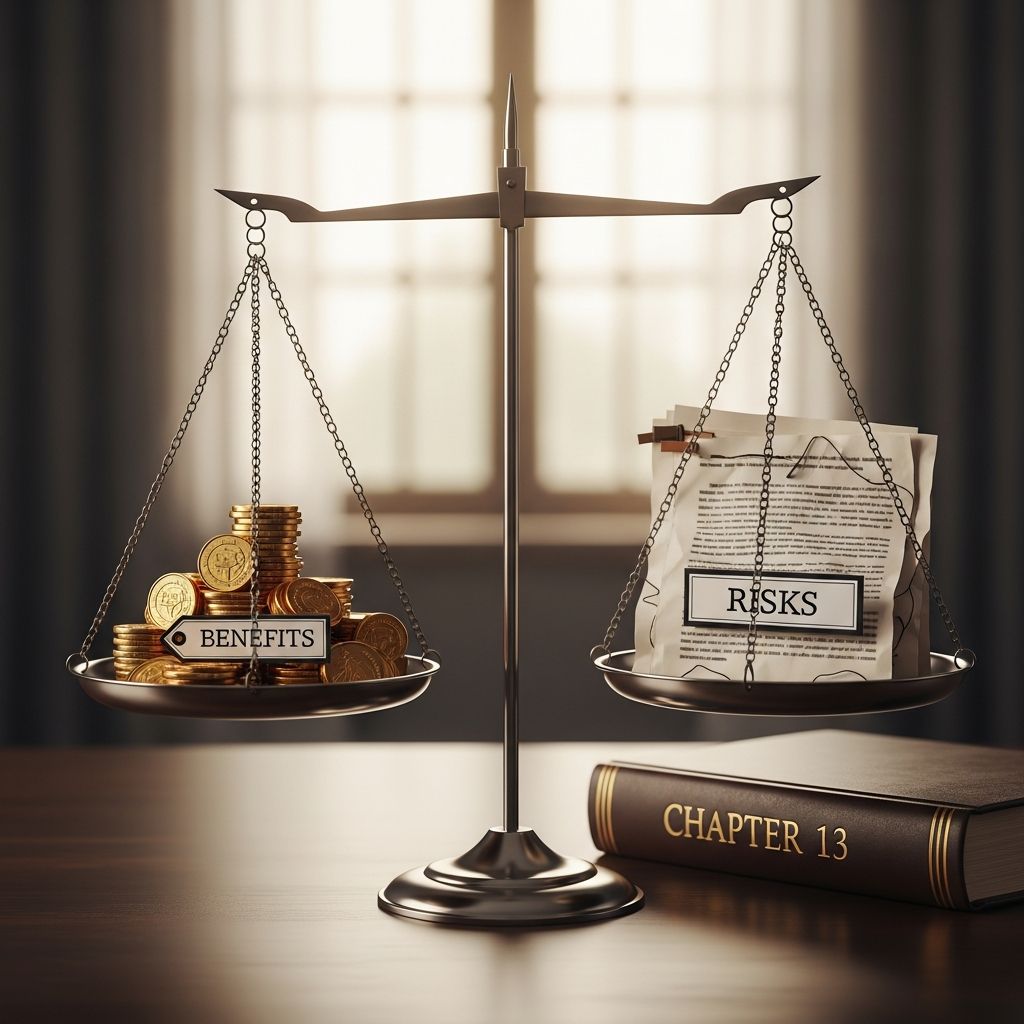
Chapter 13 bankruptcy is a powerful legal tool that allows individuals with regular income to reorganize their debts and repay them over time, typically three to five years. It can stop foreclosure, pause collection lawsuits, and provide a structured path out of overwhelming debt, but it also comes with significant commitments and long-term consequences.
This guide explains the main advantages and drawbacks of filing under Chapter 13, how it differs from other options, and the key questions to ask before deciding whether it is the right path for you.
What Is Chapter 13 Bankruptcy?
Chapter 13 is often called a “wage earner’s plan” because it is designed for people who have a steady income and can commit to a multi-year repayment plan. Instead of liquidating non-exempt property to pay creditors, you propose a court-supervised plan that repays some or all of your debts over time.
- Eligibility focus: individuals, including wage earners, self-employed people, and sole proprietors with regular income.
- Plan length: usually 36 to 60 months, depending on income and other factors.
- Who is excluded: corporations and partnerships cannot file under Chapter 13 and must use other bankruptcy chapters.
During the case, you make monthly payments to a Chapter 13 trustee, who distributes the funds to your creditors in accordance with the confirmed plan.
How a Chapter 13 Repayment Plan Works
The repayment plan is the backbone of a Chapter 13 case. Once filed, it must be reviewed and approved (or “confirmed”) by the bankruptcy court before it becomes binding on you and your creditors.
Key Features of the Plan
- Regular monthly payments: You commit to sending a set payment to the trustee every month for three to five years.
- Payment amount: Based on your income, reasonable living expenses, the types of debt you have (secured, priority, unsecured), and what property you are keeping.
- Distribution of funds: The trustee keeps a small percentage as a fee and sends the rest to creditors according to the plan.
- Plan completion: After all required payments are made, remaining balances on qualifying unsecured debts are typically discharged.
Types of Debts in Chapter 13
| Debt Type | Examples | Typical Treatment in Chapter 13* |
|---|---|---|
| Secured | Mortgage, car loan, furniture loan with collateral | Arrears can be spread out and cured over the plan; ongoing payments often continue directly to the lender. |
| Priority | Certain taxes, domestic support obligations | Generally must be paid in full during the plan, unless the creditor agrees otherwise. |
| Unsecured | Credit cards, medical bills, many personal loans | Often receive only a portion of what is owed; unpaid balances may be discharged at the end of the plan. |
*Exact treatment depends on your specific case, income, and non-exempt property.
Major Advantages of Filing Chapter 13
Chapter 13 can offer benefits that other debt relief options, including Chapter 7 bankruptcy, cannot provide. For many households, its biggest strength is the combination of asset protection and structured repayment.
1. Protection of Home and Other Key Assets
Because Chapter 13 is a reorganization rather than a liquidation, debtors usually keep their property—as long as they can afford the repayment plan and meet legal requirements. This can be especially valuable if you are behind on your mortgage or car payments.
- You can often stop foreclosure and catch up on missed mortgage payments over the length of the plan, while continuing your regular monthly mortgage payments.
- You may be able to prevent repossession of a vehicle by curing arrears through the plan and maintaining ongoing payments.
- In many cases, there is no forced sale of non-exempt property, unlike in a Chapter 7 liquidation case.
2. Automatic Stay and Relief from Collections
Filing a Chapter 13 petition immediately triggers an automatic stay, which is a court order that generally stops most collection activity.
- Foreclosure proceedings are paused.
- Most lawsuits, wage garnishments, repossessions, and phone calls from collectors must stop while the case is active.
- Creditors must work through the bankruptcy court and the trustee rather than contacting you directly.
3. Flexible, Court-Supervised Repayment
Chapter 13 allows you to restructure debts in ways that may be unavailable outside of bankruptcy.
- Consolidation into one payment: Instead of juggling multiple due dates and interest rates, you make a single consolidated payment to the trustee.
- Time to catch up: Arrears on secured debts can be stretched over several years, making them more manageable than an immediate lump-sum demand.
- Debt adjustment: For many unsecured creditors, the plan may repay only a fraction of the original balances, with the remainder wiped out at discharge.
4. Discharge of Remaining Eligible Debts
If you successfully complete the plan and meet all legal requirements, the court issues a discharge order that eliminates remaining qualifying unsecured debts.
- Credit card debt, personal loans, and many medical bills are commonly discharged.
- After discharge, creditors and collection agencies are prohibited from trying to collect discharged debts.
Some obligations—such as certain taxes, student loans, and domestic support obligations—are more difficult or impossible to discharge and must be handled according to the Bankruptcy Code.
5. Chance to Catch Up on Tax Obligations
For many filers, tax debt is a serious concern. Chapter 13 allows certain tax obligations to be paid over time in the plan rather than immediately.
- You must have filed required tax returns for the last four years to qualify.
- Certain priority tax debts typically must be paid in full through the plan, but you may gain breathing room to do so over several years.
Major Disadvantages and Risks of Chapter 13
Despite its advantages, Chapter 13 is not a simple or painless solution. It requires strict financial discipline and carries consequences that can last for years.
1. Long-Term Commitment and Tight Budget
A Chapter 13 plan usually lasts three to five years, during which your finances are tightly structured.
- You are expected to commit your disposable income to the plan, leaving little room for unexpected expenses or lifestyle upgrades.
- Missing plan payments can lead to dismissal of the case or loss of its protections, potentially putting you back where you started—sometimes worse off due to added interest or fees.
2. Impact on Credit and Future Borrowing
Bankruptcy filings are serious negative marks on your credit history.
- A Chapter 13 case typically remains on your credit report for years, which can make new credit, mortgages, or favorable interest rates more difficult to obtain.
- Some lenders may see a completed Chapter 13 as evidence of responsible follow-through, but the initial impact is still significant.
3. Complexity and Professional Costs
Chapter 13 involves detailed legal and financial requirements. Forms, schedules, and deadlines are strictly enforced by bankruptcy courts.
- Most individuals need help from an experienced bankruptcy attorney due to the complexity of the rules and paperwork.
- Attorney’s fees and court costs must be paid; in many areas, some or all of the legal fees are built into the repayment plan, increasing the monthly obligation.
4. Not All Debts Are Dischargeable
Chapter 13 does not erase every type of debt. Some must be repaid in full, while others survive even after a successful discharge.
- Many domestic support obligations (such as child support or alimony) and certain recent or priority tax debts must be paid and generally are not wiped out.
- Most student loans are not dischargeable except in rare cases of undue hardship, which requires a separate legal showing.
- Certain debts arising from fraud, willful injury, or criminal fines may also survive the bankruptcy.
5. Risk of Case Dismissal or Conversion
Failure to follow through on plan payments or other legal requirements can cause the case to be dismissed or converted to a Chapter 7 case.
- If the case is dismissed, you typically lose protection from creditors and may face renewed collection efforts and lawsuits.
- If the case is converted to Chapter 7, you could face liquidation of non-exempt assets that were protected in Chapter 13.
Chapter 13 vs. Chapter 7: Which Is Better?
Both Chapter 7 and Chapter 13 offer a path toward debt relief, but they are structured very differently.
| Feature | Chapter 7 (Liquidation) | Chapter 13 (Reorganization) |
|---|---|---|
| Typical Duration | 4–6 months for most cases | 3–5 years, depending on income and plan |
| Main Approach | Non-exempt assets may be sold to pay creditors; remaining qualifying unsecured debts discharged. | Debts reorganized into a court-approved repayment plan; remaining qualifying unsecured debts discharged at the end of the plan. |
| Asset Protection | Some property may be at risk if not exempt. | Debtor usually keeps property while making plan payments. |
| Eligibility | Subject to income and means-test limitations. | Requires regular income and compliance with debt and filing requirements, including recent tax returns. |
| Best For | Those with low income, few assets, and mostly unsecured debt. | Those seeking to prevent foreclosure or repossession and catch up on secured and priority debts. |
Key Questions to Ask Before Filing Chapter 13
Because Chapter 13 is such a long-term commitment, it is important to evaluate your goals and financial stability carefully. Consider discussing these questions with a qualified bankruptcy attorney or financial counselor.
- Can I reliably make the required monthly payment for 3–5 years?
Even a well-designed plan can fail if income is unstable or expenses are underestimated. - What property am I trying most to protect?
Your home, vehicle, or business equipment may be central reasons for choosing Chapter 13 over Chapter 7. - How much of my debt will actually be discharged?
Because some debts are non-dischargeable or must be paid in full, Chapter 13 works best when it meaningfully reduces unsecured debt. - Have I explored non-bankruptcy options?
Credit counseling, negotiated settlements, or consolidation loans may offer relief with fewer long-term consequences, though they may not provide the legal protections of bankruptcy. - Have I filed all required tax returns?
Bankruptcy law requires that you be current on filing obligations for recent years before you can proceed under Chapter 13.
Practical Tips for Succeeding in a Chapter 13 Plan
For those who do decide to pursue Chapter 13, preparation and ongoing organization greatly increase the chance of completing the plan and earning a discharge.
- Create a realistic budget: Work with your attorney or a certified counselor to list all income sources and necessary expenses. Overly optimistic budgets are a common cause of plan failure.
- Set up automatic payments: Many debtors choose wage deduction orders or automatic bank drafts to help ensure timely plan payments.
- Plan for emergencies: Build a modest emergency fund if possible before filing, and discuss with your attorney how to handle unexpected expenses during the plan.
- Stay in touch with your attorney and trustee: If your income changes or an emergency arises, immediate communication may make it possible to modify the plan rather than risk dismissal.
- Complete required financial education: Debtors must complete credit counseling before filing and a debtor education course before discharge.
Frequently Asked Questions (FAQs)
Q1: Who is eligible to file Chapter 13 bankruptcy?
A1: Chapter 13 is available to individuals, including wage earners, self-employed people, and sole proprietors, who have regular income and meet certain debt and filing requirements, such as having submitted required tax returns for the last four years. Corporations and partnerships are not eligible.
Q2: How long does a Chapter 13 repayment plan last?
A2: Most Chapter 13 plans run from 36 to 60 months (three to five years). The exact length depends on your income, debts, and the structure of the plan that the court approves.
Q3: Will I lose my house or car if I file Chapter 13?
A3: In many cases, Chapter 13 is used specifically to avoid losing a home or vehicle. By filing, you may be able to stop foreclosure or repossession and pay arrears over time within the plan, as long as you also keep up with ongoing payments and comply with the plan terms.
Q4: What happens if I cannot keep up with my plan payments?
A4: If you fall behind, the trustee or creditors can ask the court to dismiss your case or, in some situations, convert it to Chapter 7. Depending on your circumstances, your attorney may be able to seek a plan modification, but there is no guarantee the court will approve it.
Q5: Are all my debts erased at the end of Chapter 13?
A5: No. While many unsecured debts—such as credit cards and medical bills—can be discharged if you complete the plan, some obligations (for example, many taxes, student loans, and domestic support obligations) are treated more strictly and may not be dischargeable.
References
- Chapter 13 – Southern District of Alabama Bankruptcy Court — U.S. Bankruptcy Court, Southern District of Alabama. 2024-03-01. https://www.alsb.uscourts.gov/chapter-13
- Chapter 13 bankruptcy – voluntary reorganization of debt for individuals — Internal Revenue Service (IRS). 2023-02-15. https://www.irs.gov/businesses/small-businesses-self-employed/chapter-13-bankruptcy-voluntary-reorganization-of-debt-for-individuals
- What Is Chapter 13 Bankruptcy? — Experian. 2023-08-10. https://www.experian.com/blogs/ask-experian/what-is-chapter-13-bankruptcy/
- An Overview of Chapter 13 Bankruptcy — Nolo. 2024-01-05. https://www.nolo.com/legal-encyclopedia/chapter-13-bankruptcy-overview-30099.html
- Chapter 13 Bankruptcy Fact Sheet — Texas Law Help. 2023-05-20. https://texaslawhelp.org/article/chapter-13-bankruptcy-fact-sheet
- Chapter 13 Bankruptcy: How It Works & Who Qualifies — InCharge Debt Solutions. 2023-09-12. https://www.incharge.org/bankruptcy/chapter-13/
- How Chapter 13 Bankruptcies Work — National Consumer Law Center, Surviving Debt. 2022-06-01. https://library.nclc.org/book/surviving-debt/how-chapter-13-bankruptcies-work
Similar Articles








Read full bio of medha deb




