
Consequences of Too Many Traffic Tickets
Understand how repeated traffic violations can cost you money, raise insurance rates, and ultimately put your driving privileges at risk.
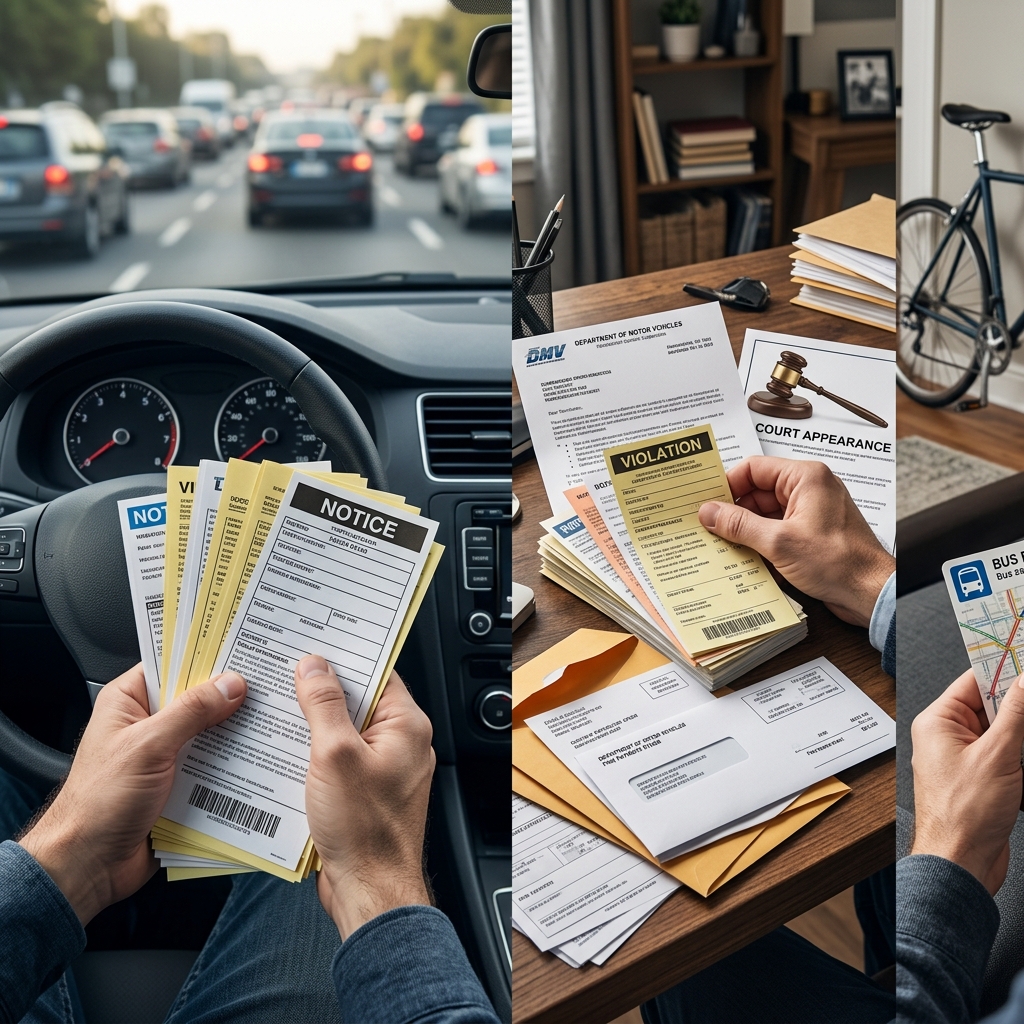
Repeated traffic violations carry far more serious consequences than a single speeding ticket or stop sign violation. Fines, court costs, higher insurance premiums, and ultimately loss of driving privileges can all follow when tickets start to pile up. Understanding how tickets affect your driving record and what happens when you reach critical thresholds is essential for protecting your ability to drive.
Why Multiple Tickets Are More Dangerous Than One
Each traffic ticket may seem minor in isolation, but they interact with your driving record, insurance, and state point systems in ways that compound over time.
- Financial impact: Every conviction adds fines and court fees, which can quickly add up.
- Record consequences: Most states track violations over several years, using points or conviction counts to trigger suspensions.
- Insurance risk: Insurers review recent violations when setting premiums and may raise rates or drop coverage for repeated offenses.
- Escalating penalties: Serious or repeated violations can shift from simple infractions to misdemeanors with potential jail time.
Because of these overlapping systems, a driver who ignores tickets or simply pays every citation without considering the long-term impact may face unexpected license suspension or revocation.
How Fines and Court Costs Add Up
Traffic tickets almost always include a base fine plus court costs or assessments. The details vary by state and by violation type, but the pattern is consistent: more tickets mean more money paid to the court system.
Key points about financial penalties include:
- Base fines vary by offense: A minor civil infraction may carry a modest fine, while more serious violations can reach hundreds or thousands of dollars.
- Court costs and assessments: Many jurisdictions impose standard court fees that are added on top of the fine; these can easily exceed the ticket itself.
- Escalation for serious speeding: In Illinois, for example, driving 26 mph or more above the limit can be charged as a misdemeanor, with fines up to $1,500 or $2,500 and potential jail time.
- Payment deadlines: Missing payment deadlines can trigger late fees, interest, or additional penalties.
Although amounts differ by location, it is common for a driver with multiple tickets to owe several hundred or even thousands of dollars over a few years, especially when serious speed or reckless driving is involved.
License Point Systems and Conviction Thresholds
Most states manage driver risk through either a point system or a count of recent convictions. When your points or conviction count exceed set thresholds, your license can be suspended or revoked.
Points-Based Approach
In point-system states, each traffic conviction adds a specific number of points to your record based on the severity of the offense. The more serious the violation, the more points are assessed.
- Minor speeding may add a small number of points, while major speeding, reckless driving, or DUI add many more.
- Accumulating too many points within a defined period (often 12 months) can trigger suspension or revocation.
- Some systems scale suspension length based on total points, with longer suspensions for higher totals.
Conviction-Based Thresholds
Other states focus on how many moving violations you are convicted of within a specific time frame. For example:
- Illinois suspends or revokes a license when an adult receives three moving violation convictions within 12 months.
- Drivers under 21 in Illinois may face suspension with only two violations within 24 months.
- Washington State suspends drivers who receive a certain number of moving violations in a year (six convictions in 12 months, for example).
This means that even if each ticket is relatively minor, what matters is the pattern over time. A driver with multiple small violations can face the same type of license action as someone with a single serious offense.
Typical Penalties by Violation Type
Not all tickets carry the same consequences. Understanding how different violations are treated helps explain why some drivers lose their licenses faster than others.
| Violation Type | Common Classification | Typical Penalties |
|---|---|---|
| Red light or stop sign (no injury) | Petty offense / civil infraction | Fine up to around $100 or more plus court costs; points or record entry. |
| Moderate speeding (1–20 mph over limit) | Minor infraction | Fine in low hundreds; small number of points; increased insurance risk. |
| High-speed violations (26+ mph over limit) | Class B or A misdemeanor (example: Illinois) | Larger fine, potential jail time, significant points; possible suspension. |
| Reckless driving, DUI | Serious misdemeanor or felony | Big fines, possible incarceration, immediate license suspension or revocation. |
| Ignored or unpaid tickets | Civil/administrative enforcement | Extra penalties, interest, warrants, and possible license suspension. |
Insurance Consequences: Premiums and Coverage
Insurance companies closely monitor your driving record because it predicts future risk. Multiple violations within a few years can substantially raise your auto insurance costs.
- Review window: Insurers commonly examine three to five years of driving history when pricing policies.
- Premium increases: Each moving violation can lead to higher premiums; multiple tickets can cause steep rate hikes.
- Coverage cancellation: Some insurers will drop a driver with too many violations, forcing them to seek higher-risk (and more expensive) coverage.
- Impact of serious offenses: DUI, reckless driving, or high-speed misdemeanors often result in the largest premium increases.
In practice, the financial impact from insurance over several years can exceed the fines and court costs associated with the tickets themselves.
How Long Traffic Violations Stay on Your Record
The length of time a ticket affects you depends on how your state records violations and points. There are usually two related timeframes:
- Point duration: Points may remain on a record for several years, but only a subset of recent points count toward suspension thresholds.
- Conviction history: Many states keep traffic convictions on record for five years or more, and some maintain permanent records.
Because insurers use three to five years of history, even a violation that no longer counts for state suspension purposes may still influence your insurance costs for a time.
Special Risks for Commercial Drivers (CDL Holders)
Drivers with a commercial driver’s license (CDL) face stricter rules and harsher penalties. Multiple violations can threaten their livelihood.
- Serious traffic violations: Speeding 15 mph or more over the limit, reckless driving, improper lane use, and certain cell phone violations are treated as serious offenses.
- Major disqualifying offenses: DUI, refusing a breath test, leaving the scene of an accident, or driving a commercial vehicle with a high blood alcohol level can cause extended or permanent disqualification.
- Pattern of violations: A CDL holder can be disqualified for committing two serious infractions or three lesser violations within three years.
- Loss of income: License disqualification not only limits driving but can eliminate the ability to work as a commercial driver.
Because of these heightened standards, CDL holders need to be especially vigilant about contesting tickets and avoiding repeat offenses.
Consequences of Ignoring or Not Responding to Tickets
Failing to respond to traffic tickets almost always makes the situation worse. Tickets do not go away on their own.
- Automatic convictions: Ignoring a ticket can lead to a default judgment, entering the violation on your record without a defense.
- Additional fees and interest: Courts may add late fees, collection costs, or interest when payments are missed.
- Bench warrants: Failure to appear in court or comply with orders can result in a warrant for your arrest.
- License suspension: Many jurisdictions suspend licenses based on unpaid fines or missed court dates.
- Vehicle impound: Some cities may impound vehicles for repeated unpaid tickets, adding towing and storage fees.
In short, non-response converts a manageable legal problem into a more serious one that affects your freedom, finances, and ability to drive.
Defensive Strategies: How to Reduce Long-Term Damage
Drivers are not powerless in the face of multiple tickets. Proactive steps can reduce or prevent the worst outcomes.
Evaluate Each Ticket Before You Pay
- Identify whether the violation is a moving or non-moving offense; moving violations usually have greater impact on points and insurance.
- Check how many recent convictions you have and whether a new ticket would push you over a suspension threshold.
- Consider consulting a traffic attorney, especially if you are approaching a critical number of violations or hold a CDL.
Use Available Court Options
Many courts offer alternatives that can reduce the impact of a ticket:
- Traffic school or defensive driving courses: Successful completion can sometimes keep a ticket off your record or reduce points.
- Plea negotiations: In some cases, prosecutors may agree to amend a charge to a lesser offense with fewer points.
- Contesting the ticket: If evidence is weak or procedures were not followed properly, challenging the citation may lead to dismissal.
Adopt Long-Term Safe Driving Habits
Ultimately, the most reliable way to avoid penalties is to reduce violations altogether.
- Observe speed limits and adjust for conditions.
- Minimize distractions, particularly mobile phone use.
- Allow extra travel time so you are not pressured to drive aggressively.
- Review state driving manuals or online resources periodically to stay current on rules.
Frequently Asked Questions
How many tickets does it take to lose your license?
The number varies by state and by age. In many jurisdictions, three moving violation convictions within 12 months can trigger a suspension for adult drivers, while younger drivers may face action after only two violations within a longer period. In point-system states, reaching a defined point total within a year can lead to suspension or revocation.
Do all tickets add points to my record?
No. Some tickets, such as certain parking or administrative infractions, may not carry points. However, most moving violations, including speeding, improper lane usage, and failing to obey traffic signals, do add points or count as convictions towards suspension thresholds.
Will my insurance premiums go up after one ticket?
Insurance companies treat violations differently. A single minor ticket may cause a small increase or no change, but multiple tickets or serious offenses can lead to substantial premium hikes or cancellation of coverage. Insurers typically review three to five years of your record when setting rates.
How long do tickets stay on my driving record?
Many states keep minor traffic convictions on record for several years, often between one and five years. Serious violations and suspensions may remain visible longer, sometimes seven years or more, and some jurisdictions keep a permanent history of all violations.
What happens if I ignore a traffic ticket?
Ignoring a ticket can result in a default conviction, additional penalties, and possible license suspension for failure to pay or appear. Courts may issue a bench warrant, and some cities may impound your vehicle for repeated unpaid tickets.
Are CDL drivers judged more harshly?
Yes. Commercial drivers face stricter standards and can be disqualified from operating commercial vehicles for a pattern of serious or even non-serious violations, as well as for major offenses like DUI or leaving the scene of an accident. Loss of a CDL can directly affect employment.
References
- What Are the Penalties for Accumulating Too Many Traffic Tickets? — Super Lawyers. 2023-06-01. https://www.superlawyers.com/resources/traffic-violations/what-are-the-penalties-for-accumulating-too-many-traffic-tickets/
- Illinois License Points: A Comprehensive Guide to Traffic Violations and Penalties — MyImprov. 2023-08-10. https://www.myimprov.com/illinois-license-points-a-comprehensive-guide-to-traffic-violations-and-penalties/
- Your Guide to Illinois Traffic Courts — Illinois State Bar Association. 2021-01-01. https://www.isba.org/public/guide/illinoistrafficcourts
- Speeding Violations in Illinois — Maksimovich and Associates, P.C. 2022-05-15. https://www.maksimovichlaw.com/speeding-violations-il
- Traffic Lawyer in Chicago Area — Venditti Law Group. 2022-09-01. https://vendittilawgroup.com/practice-areas/traffic-ticket/
- Illinois Traffic Offenses — Illinois Secretary of State. 2020-01-01. https://www.ilsos.gov/content/dam/publications/pdf_publications/dsd_dc19.pdf
- Too many traffic tickets (moving violations) — Washington State Department of Licensing. 2023-03-20. https://dol.wa.gov/driver-licenses-and-permits/suspended-driver-license/types-driver-license-suspensions/too-many-traffic-tickets-moving-violations
Similar Articles








Read full bio of Sneha Tete


