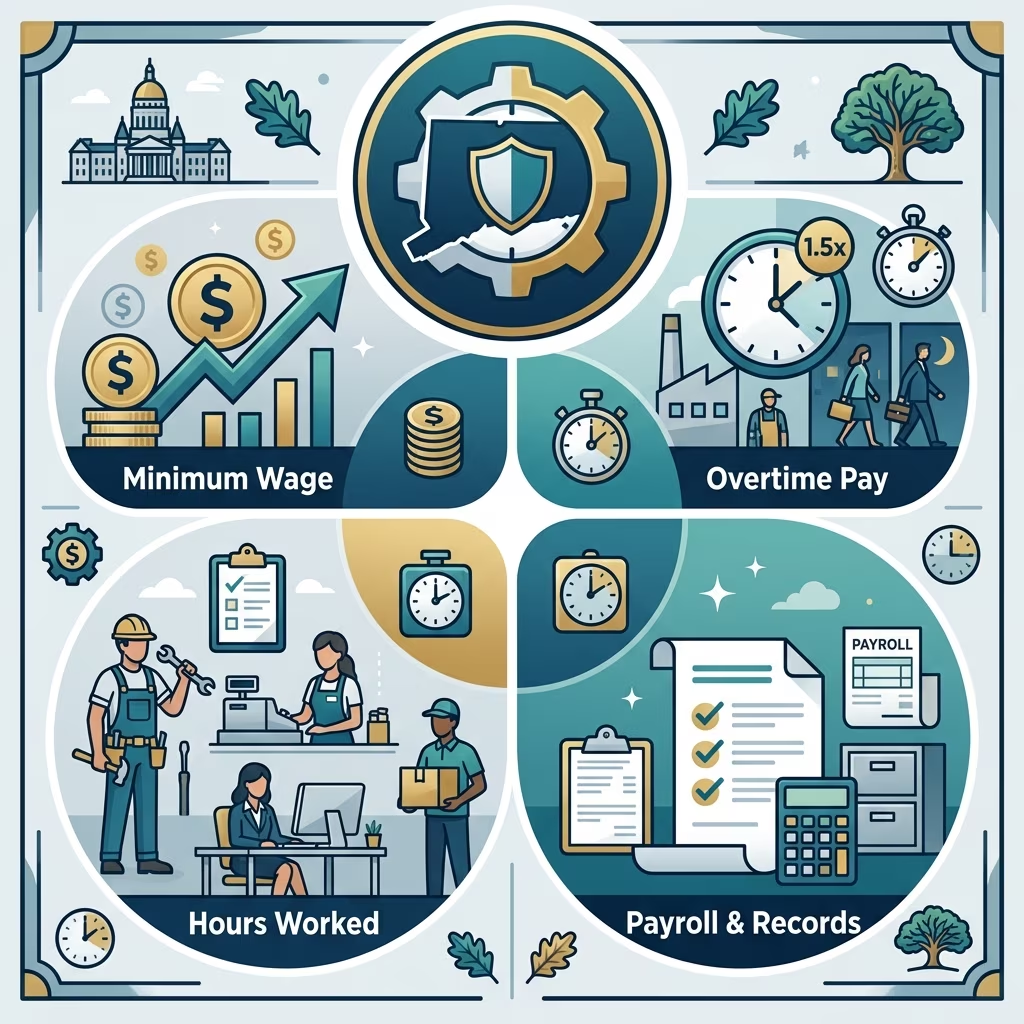
Connecticut has some of the most detailed wage and hour protections in the United States. These rules govern how much workers must be paid, when overtime is required, how and when wages must be delivered, and what breaks and leave employees are entitled to. Understanding these requirements helps employers stay compliant and gives employees a clear picture of their rights.
1. Overview of Connecticut Wage and Hour Protections
Wage and hour laws in Connecticut are primarily administered by the Connecticut Department of Labor, particularly its Wage and Workplace Standards Division. These rules operate alongside federal law, including the Fair Labor Standards Act (FLSA), but Connecticut often sets higher standards than federal minimums. When state and federal law differ, employers must follow the rule that provides the greatest benefit to the employee.
- Minimum wage – Connecticut sets a state minimum wage higher than the federal level.
- Overtime pay – Required at one and one-half times the regular rate after 40 hours in a workweek, with limited exemptions.
- Meal breaks – Mandatory unpaid meal periods during longer shifts, subject to specific conditions and exceptions.
- Wage payment and paydays – Strict requirements for how and when wages must be paid and what must appear on pay statements.
- Employment of minors – Special limits on hours and types of work for under-18 employees.
2. Minimum Wage in Connecticut
Connecticut sets its own minimum wage, which is significantly higher than the federal minimum wage of $7.25 per hour. The state minimum wage is adjusted periodically, and recent legislation has provided for ongoing annual increases based on economic conditions.
As of recent guidance from major compliance resources, the statewide minimum wage is $16.94 per hour for most workers, with certain exceptions for tipped employees. Local cities and towns in Connecticut do not set separate minimum wage rates, so the statewide rate applies across the state.
2.1 Tipped Employees and Special Cash Wage Rates
Connecticut allows a lower cash wage for some tipped workers, such as restaurant and hotel service employees and bartenders, as long as their tips bring them up to at least the full minimum wage. Employers must carefully track tips to ensure compliance.
| Category | Example Position | Approximate Cash Wage | Tip Requirement |
|---|---|---|---|
| Restaurant/Hotel Service | Server, hotel housekeeper (tipped) | About $6.38 per hour | Tips must make total pay reach at least the state minimum wage |
| Bartenders | Bartender in bar or restaurant | About $8.23 per hour | Tips must make total pay reach at least the state minimum wage |
Even when paying a lower cash wage, employers remain responsible for ensuring that the combination of wages and tips meets or exceeds the full minimum wage for every hour worked.
2.2 Federal vs. State Minimum Wage
Because Connecticut’s minimum wage is higher than the federal minimum, covered employers must follow the state standard. This means that a Connecticut employer cannot pay $7.25 per hour simply because federal law allows it; the state rate controls whenever it provides greater protection to the employee.
3. Overtime Requirements
Connecticut follows the familiar federal pattern for overtime: covered employees must receive 1.5 times their regular rate of pay for all hours worked over 40 in a single workweek. A “workweek” is a fixed, recurring period of seven consecutive 24-hour days, and employers must apply overtime to hours in excess of 40 in that period.
Key features of Connecticut overtime law include:
- Overtime applies to actual hours worked over 40 in a workweek, not simply hours paid.
- No automatic overtime premium is required for weekends or holidays unless a contract or collective bargaining agreement provides one.
- Connecticut recognizes certain exemptions similar to the FLSA, including executive, administrative, and professional employees, certain salespeople and transportation workers, and some agricultural employees.
Employers must keep accurate records of hours worked so that overtime can be calculated correctly. When state and federal definitions of exempt employees differ, Connecticut guidance and regulations should be consulted to avoid misclassification.
4. Meal Breaks and Rest Periods
Connecticut requires employers to provide meal breaks to employees who work longer shifts. Under state law, employees who work at least 7.5 consecutive hours must receive an unpaid meal period of at least 30 minutes.
The meal period must occur:
- After the first two hours of work, and
- Before the last two hours of work.
To be unpaid, the employee must be fully relieved of their duties; if the worker must remain on duty or respond to calls during the break, the time generally must be counted as hours worked.
4.1 Exceptions to the Meal Break Requirement
Connecticut law recognizes several exceptions when a 30-minute uninterrupted meal break might not be feasible. Employers may be excused from providing the standard break if:
- Stopping work would be adverse to public safety;
- The duties of the position can only be performed by one employee;
- Fewer than five employees are working on a shift at a single location;
- The employer’s operations require employees to be available for urgent or unusual conditions and the employees are paid for the meal period.
Alternatively, an employer can satisfy the law by providing at least 30 minutes of paid rest or meal time in each 7.5-hour period, effectively turning the break requirement into paid working time.
5. Wage Payment, Paydays, and Pay Statements
Connecticut regulates not only how much employees are paid, but also how and when they receive their wages. These rules are designed to ensure that workers can count on reliable paydays and clear documentation.
5.1 Permitted Forms of Wage Payment
Employers may pay wages in cash or by negotiable check, and they may also use direct deposit or electronic paycards if certain conditions are met. Employees must generally have access to their full pay without unreasonable fees or delays when electronic methods are used.
5.2 Frequency and Timing of Paydays
Connecticut employers must pay employees weekly or biweekly on regular paydays announced in advance. Paydays must occur within eight days after the close of the pay period. If a regular payday falls on a day when the business is closed, wages must be paid on the last preceding workday.
Employers may use a different pay schedule, such as semi-monthly, only if they obtain approval from the state Department of Labor. This ensures that less frequent pay arrangements do not unfairly delay employees’ access to earned wages.
5.3 Required Pay Stub Information
With each wage payment, Connecticut employers must give employees a written record containing specific details. This pay stub must show:
- Total hours worked;
- Gross earnings, with straight-time and overtime listed separately;
- Itemized deductions;
- Net earnings.
These documentation requirements allow employees to verify that they were paid correctly and help employers demonstrate compliance if questions arise.
5.4 Final Paychecks
Connecticut also regulates the timing of final paychecks. When an employee quits or is laid off, the employer must provide the final wages by the next regular payday. When an employee is involuntarily terminated, the final paycheck is typically due by the next business day. These rules prevent long delays in payment of wages owed to departing workers.
6. Employment of Minors
Connecticut imposes additional protections for workers under age 18. State law generally sets the minimum age for employment at 14 for most non-agricultural work, with stricter limits for hazardous occupations. In addition, minors must obtain appropriate “working papers” or age statements before beginning employment.
6.1 Hour Limits for Minors
Connecticut restricts the number of hours minors may work, particularly during the school year. Examples of typical limits include:
- Limits on working during school hours;
- Maximum weekly hours during school weeks (often around 18 hours);
- Higher maximum weekly hours during nonschool weeks (often up to 40 hours).
Employers hiring minors must confirm that schedules comply with both state child labor rules and any additional local school district policies. Violations can lead to penalties and restrictions on future hiring.
7. Paid Sick Leave and Other Leave Protections
Connecticut was one of the first states to require paid sick leave for certain workers. State law requires employers with 11 or more employees in Connecticut to provide eligible workers up to 40 hours of paid, job-protected sick leave each year.
7.1 Accrual and Use of Paid Sick Leave
Employees generally accrue paid sick leave at a rate of one hour of paid leave for every 30 hours worked, up to a maximum of 40 hours per year. The leave can typically be used for:
- Personal illness or injury;
- Medical diagnosis, care, or treatment;
- Care of a family member; and
- Certain reasons related to domestic violence or sexual assault, depending on the statute.
Employers must track accrual and usage, and they may set reasonable procedures for requesting leave, as long as those procedures do not effectively deny employees their statutory entitlement.
8. Recordkeeping Duties for Employers
Connecticut wage and hour law places a strong emphasis on accurate recordkeeping. Employers must keep “true and accurate” records of time and wages for each employee at the place of employment for three years. These records should typically include:
- Employee identifying information and job classification;
- Hours worked each day and each week;
- Rates of pay and basis of pay (hourly, salary, commission, etc.);
- Gross and net wages, including overtime;
- Deductions from wages.
Maintaining detailed records helps employers defend against wage claims and is often the first thing requested during a state wage and hour investigation.
9. Pay Equity and Pay Transparency
Connecticut has enacted specific laws aimed at eliminating pay discrimination and increasing transparency around compensation. Under the pay equity statute, employers may not discriminate in compensation on the basis of sex, and they are prohibited from retaliating against employees who oppose discriminatory pay practices or participate in related proceedings.
Connecticut also has a pay transparency law requiring employers to disclose wage ranges for job openings upon request or prior to making an offer and to provide existing employees with the wage range for their positions at the time of hire or when they change roles. These measures are designed to reduce unexplained pay gaps and allow workers to make more informed decisions.
10. Enforcement and Practical Compliance Tips
The Connecticut Department of Labor’s Wage and Workplace Standards Division investigates complaints and enforces wage and hour laws. Employees who believe their wages or rights have been violated may file a complaint with the Department, which can impose back pay, penalties, and other remedies when violations are found.
To reduce the risk of noncompliance, employers in Connecticut should:
- Regularly review state guidance and updates from the Department of Labor;
- Train managers and payroll staff on minimum wage, overtime, and break rules;
- Use reliable timekeeping systems to track hours worked;
- Audit pay practices, especially for tipped and exempt employees;
- Maintain and safeguard required wage and hour records for at least three years.
11. Frequently Asked Questions About Connecticut Wage and Hour Laws
Q1: If I work more than eight hours in a day, am I automatically entitled to overtime?
Not necessarily. Connecticut overtime is based on hours worked over 40 in a workweek, not on the number of hours worked in a single day. However, if your total weekly hours exceed 40, you must be paid at one and one-half times your regular rate for those excess hours, unless you fall within a specific exemption.
Q2: Can my employer require me to take my meal break at the very beginning or very end of my shift?
No. For employees working 7.5 or more consecutive hours, the required 30-minute meal period must be scheduled after the first two hours of work and before the last two hours. This rule prevents employers from placing breaks at times when they are least useful to employees.
Q3: Is my employer allowed to pay me only once a month?
Generally, no. Connecticut requires wages to be paid weekly or biweekly on regular paydays designated in advance. Employers may only use a different schedule, such as semi-monthly or monthly, if they obtain a waiver from the state Department of Labor.
Q4: Does every employer in Connecticut have to offer paid sick leave?
Connecticut’s paid sick leave law applies to employers with 11 or more employees in the state and to eligible workers in covered occupations. Smaller employers may not be subject to the paid sick leave statute, but they still must comply with any other applicable leave laws and with their own written policies.
Q5: Where can I go for official information or to file a wage complaint?
The best source of official information is the Connecticut Department of Labor website, particularly the Wage and Workplace Standards pages. Employees can also contact the Department directly to discuss concerns or file formal complaints about unpaid wages, denied breaks, or other potential violations.
References
- Wage and Hour – Minimum Wage/Overtime — Connecticut Department of Labor. 2024-01-01. https://portal.ct.gov/dol/divisions/wage-and-workplace-standards/wage-and-hour
- Wage and Workplace Standards — Connecticut Department of Labor. 2024-01-01. https://portal.ct.gov/dol/divisions/wage-and-workplace-standards
- Connecticut employment law overview — Brightmine. 2024-05-01. https://www.brightmine.com/us/resources/hr-compliance/connecticut-employment-law/
- Connecticut Employment and Labor Laws — Paylocity. 2025-01-01. https://www.paylocity.com/resources/tax-compliance/state-laws/connecticut/
- Quick and Easy Guide to Labor & Employment Law: Connecticut — Baker Donelson. 2023-06-01. https://www.bakerdonelson.com/easy-guide-connecticut
- Connecticut Employment & Labor Law Overview 2025 — Deputy. 2025-01-01. https://www.deputy.com/compliance-hub/states/connecticut
- What Employees and Employers Need to Know About Wage and Hour Laws in Connecticut — Brewer Law Firm. 2024-02-01. https://brewerlawct.com/blog/what-employees-and-employers-need-to-know-about-wage-and-hour-laws-in-connecticut/