
Connecticut Traffic Laws: Drivers’ Guide To Safety Basics 2025
A practical overview of Connecticut driving rules, penalties, and road-safety obligations.
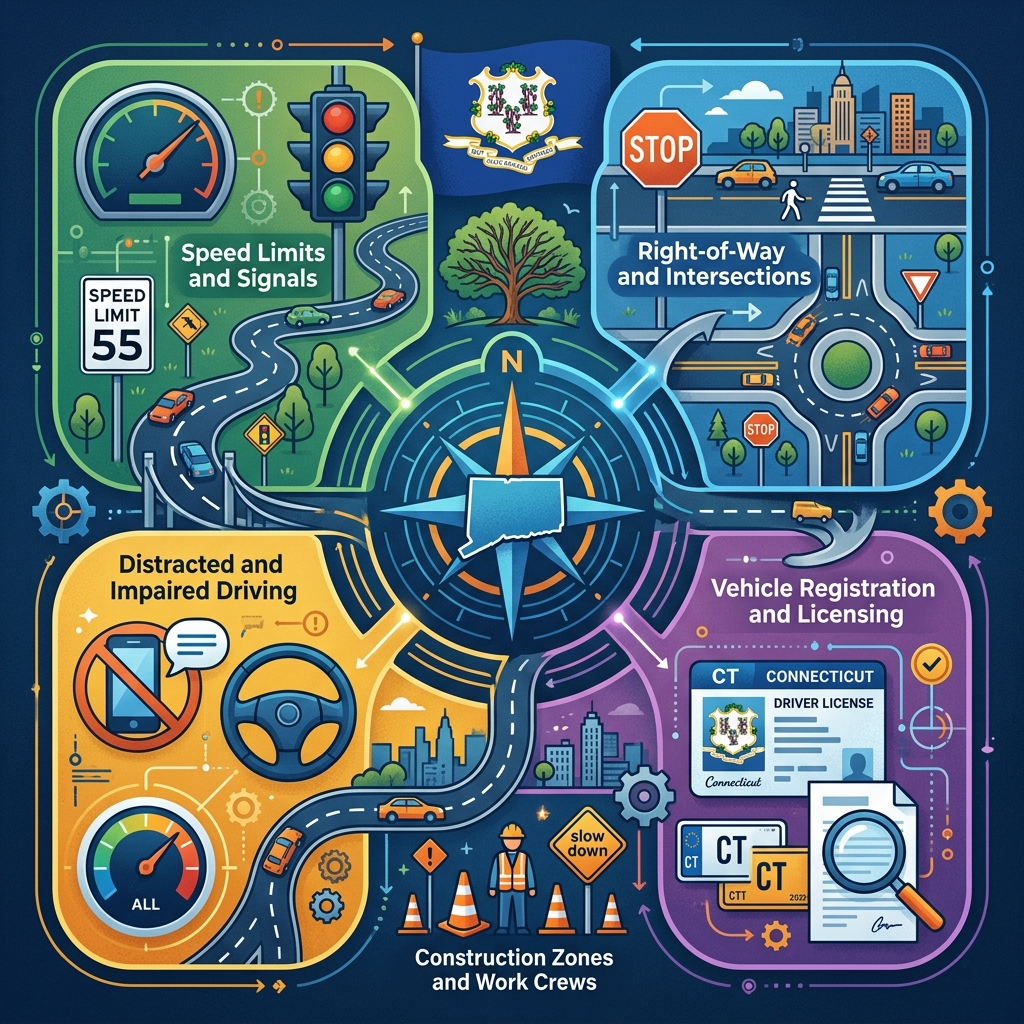
Connecticut driving rules are designed to keep traffic moving safely and to reduce crashes, injuries, and roadway confusion. The state combines everyday rules about lane use and signaling with specific penalties for speeding, distracted driving, impaired driving, and other violations. This guide gives drivers a clear, original overview of the most important Connecticut traffic laws and the consequences that can follow a citation.
What Connecticut Drivers Need to Know First
Most traffic laws in Connecticut are straightforward: obey signs and signals, drive at safe speeds, yield when required, and avoid conduct that creates unnecessary risk. The rules apply on local roads, highways, and work zones, but some locations carry additional restrictions and higher penalties. Connecticut also uses a point-based approach for many violations, which means a ticket may affect more than just the fine itself.
- Drivers must follow posted speed limits and adjust speed for weather, traffic, and road conditions.
- Lane discipline matters, especially on divided highways where slower traffic generally belongs to the right.
- Distraction, impairment, and reckless behavior can lead to more serious penalties than a routine moving violation.
- Some offenses may trigger license consequences, retraining requirements, or jail exposure in addition to fines.
Lane Use and Passing Rules
One of the most practical highway rules in Connecticut is lane positioning. Drivers are generally expected to keep to the right unless they are passing, avoiding an obstacle, or preparing to turn. The left lane is not a place to cruise when a safer right lane is available for ordinary travel. That rule helps traffic flow and reduces risky weaving between lanes.
Passing should be done carefully and only when it can be completed safely. A driver should not pass if there is limited visibility, oncoming traffic, or a no-passing zone. Before changing lanes, drivers should signal early, check mirrors, and confirm that the lane is clear. Returning to the right lane promptly after passing also helps keep traffic orderly.
Speeding, Reckless Driving, and Fast-Driving Offenses
Speeding is one of the most common traffic violations in Connecticut. The penalty depends on how far over the limit the driver was traveling and whether the violation occurred in a school zone, work zone, or another sensitive location. Higher speeds create greater stopping distance and increase the force of a crash, so Connecticut treats serious speeding as more than a minor mistake.
Reckless driving is even more serious because it reflects a disregard for the safety of others. Excessive speed can turn a speeding ticket into a reckless-driving matter when the behavior is especially dangerous. In practice, this means that driving far above the posted limit may lead to stronger fines and possible criminal consequences.
| Violation type | Typical consequence | Why it matters |
|---|---|---|
| Ordinary speeding | Fine based on speed over the limit | Can add points and increase insurance costs |
| Speeding in a work or school zone | Higher fine than standard speeding | Protected areas carry enhanced safety enforcement |
| Reckless driving | Possible criminal penalties | Signals conduct that endangers others |
Traffic Signals, Stop Signs, and Right-of-Way
Connecticut drivers must obey traffic lights, stop signs, and hand signals from law enforcement officers. A green light does not grant unlimited movement if the intersection is blocked. Drivers are expected to wait until there is enough room to pass through without obstructing cross traffic. That rule helps prevent gridlock and side-impact collisions.
At stop signs, drivers should come to a complete stop, check for vehicles and pedestrians, and proceed only when it is safe. Right-of-way rules also matter in situations involving crosswalks, turning vehicles, and pedestrians already in the roadway. Yielding properly is one of the most important habits for avoiding preventable crashes.
Turning, U-Turns, and Backing Up
Turning maneuvers create conflict points, so Connecticut expects drivers to use caution and proper signaling. Right turns on red are allowed in many situations, but only after a full stop and only when no sign prohibits the maneuver. Left turns require extra attention because oncoming traffic may have the right-of-way.
U-turns are not legal everywhere. Drivers should look for signs and avoid making a U-turn in places where visibility is limited or where the move would disrupt traffic. Backing up is also restricted because it creates unusual danger for vehicles and pedestrians behind the car. Reversing in a travel lane is generally prohibited except for limited maneuvers such as parking corrections.
Distracted Driving and Electronic Devices
Connecticut has strong rules against handheld phone use while driving. The goal is to reduce attention loss caused by texting, scrolling, calling, or other device-related behavior. Even a few seconds of distraction can cause a driver to miss braking traffic, a pedestrian, or a signal change.
The state distinguishes between handheld use and permitted hands-free activity in some situations, but the broader message is clear: drivers should keep their focus on the road. Teen drivers face stricter limits, and many work-zone violations carry extra consequences when distraction is involved. In a work zone, penalties can rise because construction workers and road crews are especially vulnerable.
- Texting while driving is a major safety risk and can trigger substantial fines.
- Device use in work zones may bring enhanced penalties.
- Young drivers may face tighter restrictions than adult drivers.
- Safe driving means using the phone only when the vehicle is fully and safely stopped.
Seat Belts, Child Safety, and Passenger Protection
Seat belt laws are an essential part of Connecticut traffic safety. Drivers and passengers should buckle up every time they ride, regardless of distance. Child passengers require special protection, including the correct car seat or booster seat based on age, weight, and height. Proper restraint use reduces the risk of severe injury in a collision and is one of the simplest ways to improve road safety.
Connecticut’s approach is practical rather than symbolic: the law expects adults to model safe behavior and ensure that children are correctly restrained. A traffic stop can expose lapses in safety restraint use, and a crash can magnify the consequences of those mistakes.
Driving Under the Influence and Other Serious Offenses
Alcohol- and drug-impaired driving is treated seriously in Connecticut because impairment affects judgment, reaction time, and coordination. DUI cases can lead to license suspension, ignition interlock requirements, fines, and even jail exposure depending on the facts and any prior history. The state’s system is designed not only to punish dangerous conduct but also to keep impaired drivers off the road.
Other serious offenses, such as racing, extreme speeding, or repeated violations, can also carry harsher outcomes than a standard citation. Some conduct may trigger vehicle impoundment, license action, or mandatory education. The more dangerous the driving behavior, the more likely the law is to treat it as a public-safety threat rather than a routine ticket.
Work Zones and Construction Areas
Construction zones deserve special attention because road layouts may change quickly and workers may be close to live traffic. Connecticut commonly increases enforcement in these areas and may impose higher fines for violations committed near road crews. Drivers should reduce speed, keep extra distance, and remain alert for lane shifts, cones, and temporary signage.
Work zones are not places for aggressive driving. Tailgating, sudden lane changes, and ignoring posted warnings can put workers and motorists at risk. If a work zone is active, the safest approach is to slow down earlier than usual and stay patient until the roadway returns to normal.
Teen and New Driver Rules
New drivers are often subject to stricter rules because they are still developing road judgment. Connecticut applies special limits during learner-permit and early licensure stages, including supervision requirements, passenger restrictions, and curfews in certain circumstances. These rules are intended to reduce high-risk driving situations while a teen gains experience.
Family involvement matters during this stage. Parents and guardians are often encouraged to set clear expectations about speed, distractions, nighttime driving, and alcohol. A teen who understands the rules is more likely to build safe habits that last beyond the licensing period.
Common Violations and What They Can Cost
Not every traffic ticket is equally serious, but even smaller violations can create lasting consequences. Fines are only part of the picture. Drivers may also face points, higher insurance premiums, driver retraining, or court dates depending on the offense. Below is a simplified view of common violations and the kinds of outcomes they can produce.
| Violation | Possible result | Notes |
|---|---|---|
| Speeding | Monetary fine | Amount depends on speed and location |
| Running a red light or stop sign | Fine and potential points | Often treated as a preventable safety offense |
| Expired license | Fine | Penalty can increase when the expiration is older |
| Handheld phone use | Higher fine and possible additional consequences | Work-zone violations may cost more |
How to Reduce the Risk of a Ticket
The best way to avoid traffic penalties is to build habits that make compliance automatic. Drivers who scan ahead, leave enough space, and obey posted signs are less likely to make quick mistakes. It also helps to remember that safe driving is not only about avoiding police attention; it is about lowering the chance of a crash in the first place.
- Check speed limits whenever the road environment changes.
- Signal early and avoid sudden lane changes.
- Keep phones out of reach while driving.
- Slow down in rain, snow, fog, and construction areas.
- Never assume you have the right-of-way without confirming it is safe to proceed.
Frequently Asked Questions
Is the left lane only for passing in Connecticut?
Drivers are generally expected to keep right unless they are passing, avoiding an obstacle, or preparing for a turn. Using the left lane for ordinary travel when a right lane is available can create congestion and conflict.
Can I use my phone at a stoplight?
Connecticut law is strict about handheld device use, and being temporarily stopped in traffic does not make distracted driving safe. The safest practice is to avoid device use until the vehicle is fully and legally parked.
What happens if I speed in a work zone?
Work-zone speeding can bring higher fines than ordinary speeding. Because these areas put workers close to moving traffic, Connecticut treats violations there as especially serious.
Do traffic tickets always mean jail?
No. Many traffic tickets result in fines or other civil penalties. However, more serious conduct such as reckless driving, DUI, racing, or extreme speeding can involve criminal consequences, including possible jail time.
Why are teen drivers treated differently?
Young drivers are more likely to face restrictions because they have less road experience and are statistically more vulnerable to risky driving situations. Limits on passengers, nighttime travel, and phone use are meant to reduce avoidable danger during the early licensing stage.
Closing Guidance for Connecticut Drivers
Connecticut traffic law is built around a simple idea: predictable, attentive driving protects everyone. Whether a driver is navigating a downtown stop sign, a rural highway, or an active construction zone, the same core expectations apply—stay alert, yield correctly, obey signals, and avoid behavior that raises crash risk. Understanding the rules before a problem happens is the best way to avoid a citation and to stay safe on the road.
References
- Connecticut Traffic Laws — FindLaw. 2026-07-09. https://www.findlaw.com/state/connecticut-law/connecticut-traffic-laws.html
- Driver’s Manual — Connecticut Department of Motor Vehicles / CT.gov. 2026-07-09. https://portal.ct.gov/dmv/-/media/dmv/dmv-pdfs/drivers-manual-english.pdf
- Department of Motor Vehicle Publications — Connecticut DMV / CT.gov. 2026-07-09. https://portal.ct.gov/dmv/resources/dmv-publications
- 2024 Connecticut General Statutes, Title 14, Chapter 249 — Connecticut General Assembly. 2024-01-01. https://law.justia.com/codes/connecticut/title-14/chapter-249/
Similar Articles








Read full bio of Sneha Tete


