
Sales Tax Vs VAT: 7 Key Differences Every Business And Consumer
An in-depth, practical guide to how sales tax and value added tax work, differ, and affect consumers and businesses worldwide.
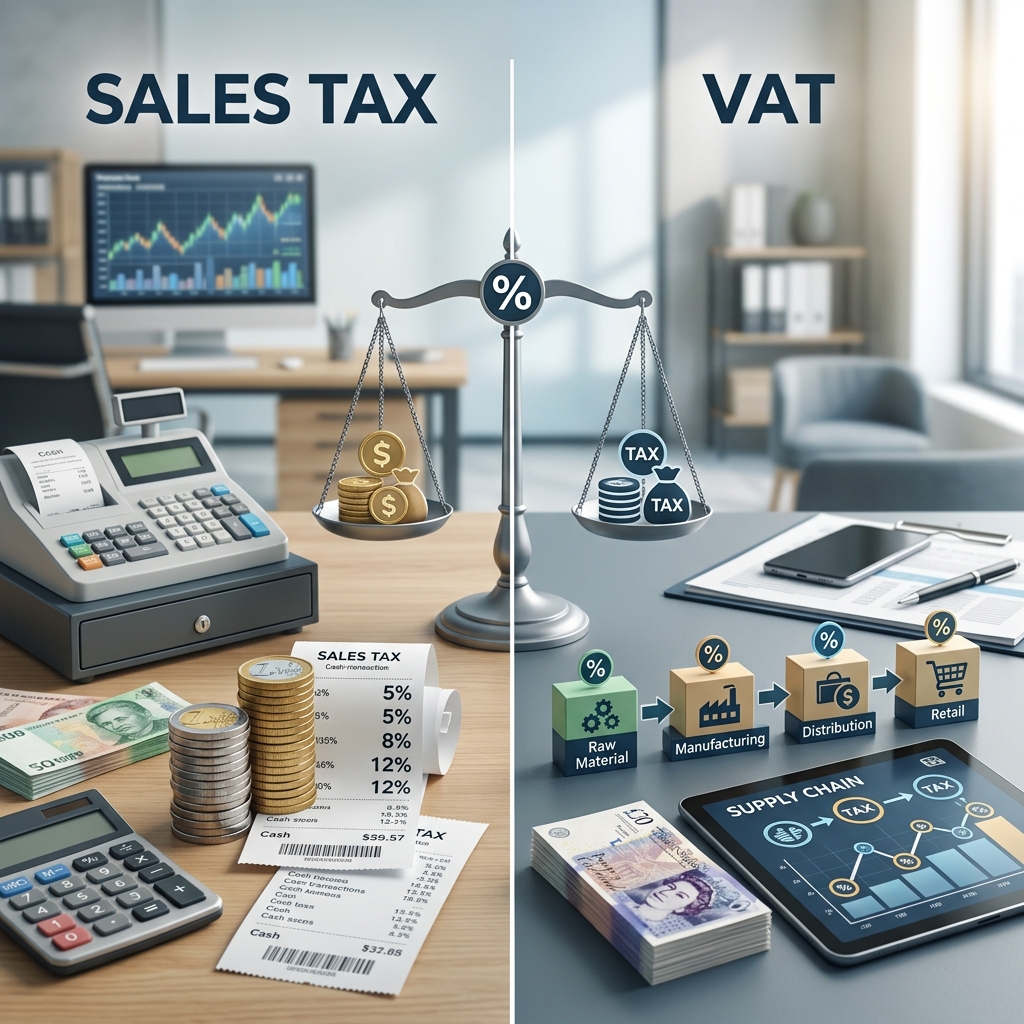
Sales tax and value added tax (VAT) are two of the most common ways governments tax consumption. Both are indirect taxes, meaning the tax is collected by sellers and passed on to the government rather than paid directly by consumers. Yet, the way these systems operate, the stages at which the tax is collected, and their impact on businesses and consumers differ significantly. This article explains how each system works, compares their main features, and explores what they mean in practice for everyday purchases and business operations.
Core Ideas: What Sales Tax and VAT Are Trying to Achieve
At a high level, both sales tax and VAT are designed to tax final consumption, not the income or profits of a person or business. When you buy goods or services, part of what you pay represents tax. The seller collects that amount and remits it to the tax authority. Although the mechanisms differ, both systems aim to:
- Raise revenue for governments without directly taxing income or wealth.
- Tax spending by consumers rather than the production of goods and services.
- Embed the tax in the price paid by the final user of the product or service.
Despite these shared objectives, the practical application is quite different. Sales tax focuses on the final retail sale, while VAT tracks value creation at each stage of production and distribution.
How Sales Tax Works in Practice
Sales tax is typically a single-stage tax. It is collected only when the product or service is sold to the end consumer. In jurisdictions using sales tax, such as the United States, the tax is added at checkout and shown as a separate line on the receipt.
Key features of a typical sales tax system include:
- Tax point: The tax is imposed at the final retail sale, when the product or service is sold to a consumer.
- Single collection stage: Only the retailer (or other final seller) collects and remits the tax.
- Use of exemptions: Businesses purchasing items for resale often use resale or exemption certificates so they do not pay sales tax on business inputs.
- No input tax credit: If a business pays sales tax on non-exempt purchases, there is generally no formal mechanism to recover that tax.
- Rate and jurisdiction complexity: In systems like U.S. sales tax, rates and rules vary widely among states and localities.
Under this structure, the government collects tax only when the product reaches the final consumer, and the legal obligation to collect and remit falls largely on the retailer.
How Value Added Tax (VAT) Operates
VAT is a multi-stage consumption tax applied at each point along the supply chain. Suppliers, manufacturers, distributors, and retailers all charge VAT on their sales. Each business then deducts the VAT it paid on purchases from the VAT it collected on sales and remits the difference.
Core elements of a VAT system include:
- Tax at every stage: VAT is applied whenever value is added to a product or service, from raw materials to final retail.
- Input and output tax: VAT collected on sales is often called output tax, while VAT paid on purchases is input tax. Businesses remit only the net amount.
- Recovery of tax on business inputs: Most VAT systems allow businesses to recover VAT paid on inputs used for taxable business activities, ensuring the tax burden falls on the final consumer.
- Broad geographic use: VAT is used in over 170 countries and is generally set at the national level.
- Visible or embedded pricing: In many VAT jurisdictions, prices displayed to consumers already include VAT, although this practice can vary.
Because VAT is tied to the value added at each stage, it is sometimes seen as more robust administratively. If a seller fails to remit VAT, the chain of invoices and credits makes it easier for tax authorities to detect discrepancies.
Side-by-Side Comparison of Sales Tax and VAT
The table below highlights the most important structural differences between sales tax and VAT.
| Feature | Sales Tax | Value Added Tax (VAT) |
|---|---|---|
| Tax type | Single-stage retail tax on final sale | Multi-stage tax on value added at each step |
| Point of collection | Final consumer purchase only | Every taxable transaction along the supply chain |
| Business inputs | Typically exempt via resale certificates | Taxed, but recovered through input tax credits |
| Administrative structure | Often decentralized (e.g., U.S. state and local) | Typically national-level, standardized rates |
| Visibility to consumers | Tax usually shown separately at checkout | Tax often included in displayed price |
| Revenue timing | Revenue collected only at final sale | Revenue collected throughout production and distribution |
| Error and evasion detection | Focused on final sellers | Supported by invoice chain and cross-checks |
Where Each System Is Used
Geography plays a central role in determining whether consumers encounter sales tax or VAT. The United States is the most prominent example of a country relying primarily on sales tax for consumption taxation. Individual states and local governments set their own sales tax rates and rules, leading to thousands of distinct tax jurisdictions.
By contrast, VAT is the dominant consumption tax system across Europe, much of Asia, Latin America, and many African countries. For example:
- European Union: All EU member states operate VAT systems under common EU rules with country-specific rates.
- United Kingdom: Uses VAT as its main consumption tax, with standard and reduced rates governed by national legislation.
- Canada, Australia, and others: Use VAT-like systems often referred to as Goods and Services Tax (GST), which function similarly to VAT.
Consumers traveling between jurisdictions may notice different pricing practices: in many VAT countries, shelf prices are tax-inclusive, while in sales-tax jurisdictions, tax is more visible at the register.
Impact on Consumers: Who Ultimately Pays?
Although the collection mechanics differ, both systems are structured so that the economic burden falls on the final consumer. Businesses may temporarily bear the cost of tax on inputs in a VAT system, but they usually recover it through credits, so the tax does not persist as a cost at intermediate stages.
For consumers, the practical differences include:
- Price perception: In sales tax systems, the listed price is often lower than the amount paid after tax; in many VAT systems, consumers see the tax-inclusive price.
- Cross-border shopping: When consumers buy from foreign sellers, rules determining where VAT or sales tax applies (“place of supply” rules) can affect the final price.
- Self-reporting obligations: In sales tax jurisdictions, consumers sometimes owe “use tax” on untaxed purchases from out-of-state or foreign sellers; in VAT systems, import VAT can be charged by customs or by the seller.
Despite these differences, from the consumer perspective both taxes operate similarly: they increase the price paid for goods and services and are triggered by spending rather than income.
Impact on Businesses: Compliance and Cash Flow
For businesses, the choice of system matters enormously. Compliance obligations, invoicing practices, and cash-flow effects under VAT and sales tax can differ in ways that influence corporate structure, pricing strategies, and even where companies choose to locate operations.
Business Obligations Under Sales Tax
In a sales tax regime, retailers and certain service providers are responsible for:
- Registering with relevant state or local tax authorities where they have sufficient nexus (connection) to be required to collect tax.
- Charging tax at the correct rate on taxable sales to consumers.
- Maintaining documentation, including exemption and resale certificates for sales to other businesses.
- Filing periodic returns and remitting tax collected to the authorities.
Because exemptions play a large role, retailers must carefully manage certificates and determine which transactions are taxable and which are exempt.
Business Obligations Under VAT
Under VAT, more businesses participate directly in the tax collection process. Obligations commonly include:
- Registering for VAT once turnover exceeds specified thresholds or when engaging in certain cross-border activities.
- Issuing VAT invoices showing the tax charged on each sale, often including a VAT identification number.
- Tracking input VAT on purchases and output VAT on sales to calculate the net amount owed.
- Submitting VAT returns regularly and reconciling amounts of input and output tax.
This multi-stage structure can increase the volume of recordkeeping, but it also provides a systematic way for governments to cross-check information and reduce opportunities for evasion.
Administrative and Policy Considerations
From a tax policy perspective, the choice between VAT and sales tax involves trade-offs in efficiency, enforcement, and distributional effects. Research and policy analysis often emphasize that VAT is administratively more robust than a pure retail sales tax because revenue is collected at multiple points in the supply chain.
Important considerations include:
- Revenue security: With VAT, tax authorities receive revenue at each stage, not just from final sellers. This limits revenue loss if retail-level compliance is weak.
- Audit trails: The invoice and credit system associated with VAT creates an inherent cross-checking mechanism, helping to detect under-reporting.
- Rate design: Both systems can be adjusted with standard, reduced, or zero rates to target specific policy goals, such as lower tax on essentials.
- Equity concerns: As consumption taxes, both VAT and sales tax can be regressive (heavier relative burden on lower-income households). Governments sometimes use exemptions or reduced rates to address this.
Because of these features, many countries have chosen VAT or VAT-like systems for broad-based consumption taxation, while others, like the U.S., continue to rely on sales tax for reasons tied to federalism and legislative history.
FAQs: Common Questions About Sales Tax and VAT
Is VAT the same as sales tax?
No. Although both tax consumption and are collected by sellers, VAT is applied at every stage of the supply chain with credits for tax paid on inputs, while sales tax is usually charged only once, at the final retail sale.
Why do most countries use VAT instead of sales tax?
Many policy experts consider VAT administratively superior because it collects revenue at multiple points and uses invoice chains to deter evasion. Over time, numerous countries have replaced retail sales taxes with VAT to improve revenue stability and enforcement.
Does the United States have VAT?
No. The United States does not operate a federal VAT system. Instead, it relies on state and local sales taxes as the main form of consumption tax. U.S. residents encounter VAT mainly when purchasing goods or services in countries that use VAT.
Who ultimately bears the cost of VAT?
Although VAT is charged at each stage, businesses typically recover the VAT they pay on inputs through credits or refunds. As a result, the final consumer—who cannot claim input credits—ultimately bears the tax cost.
Are VAT and GST different taxes?
In many countries, “Goods and Services Tax” (GST) is essentially a VAT by another name. Both are multi-stage consumption taxes collected along the supply chain with mechanisms to recover tax on business inputs.
References
- Value-added tax (VAT) — European Commission. 2024-03-01. https://taxation-customs.ec.europa.eu/business/vat_en
- Value-Added Tax — University of Wisconsin–Madison Business Services. 2022-11-10. https://businessservices.wisc.edu/accounting/tax-compliance-and-reporting/value-added-tax/
- What is the difference between sales tax and VAT? — Thomson Reuters Tax & Accounting. 2023-08-15. https://tax.thomsonreuters.com/blog/what-is-the-difference-between-sales-tax-and-vat/
- VAT vs Sales Tax: Key Differences Explained — Fonoa. 2024-05-20. https://www.fonoa.com/resources/blog/vat-vs-sales-tax-where-the-difference-hides
- 6 differences between VAT and US sales tax — Avalara. 2025-05-08. https://www.avalara.com/blog/en/europe/2025/05/6-differences-between-vat-and-us-sales-tax.html
- Why is the VAT administratively superior to a retail sales tax? — Tax Policy Center. 2010-06-01. https://taxpolicycenter.org/briefing-book/why-vat-administratively-superior-retail-sales-tax
Similar Articles








Read full bio of medha deb




