
Comparing Private and Government Bidding Processes
Understand how private and public-sector bidding differ, and what contractors must do to compete successfully in each environment.
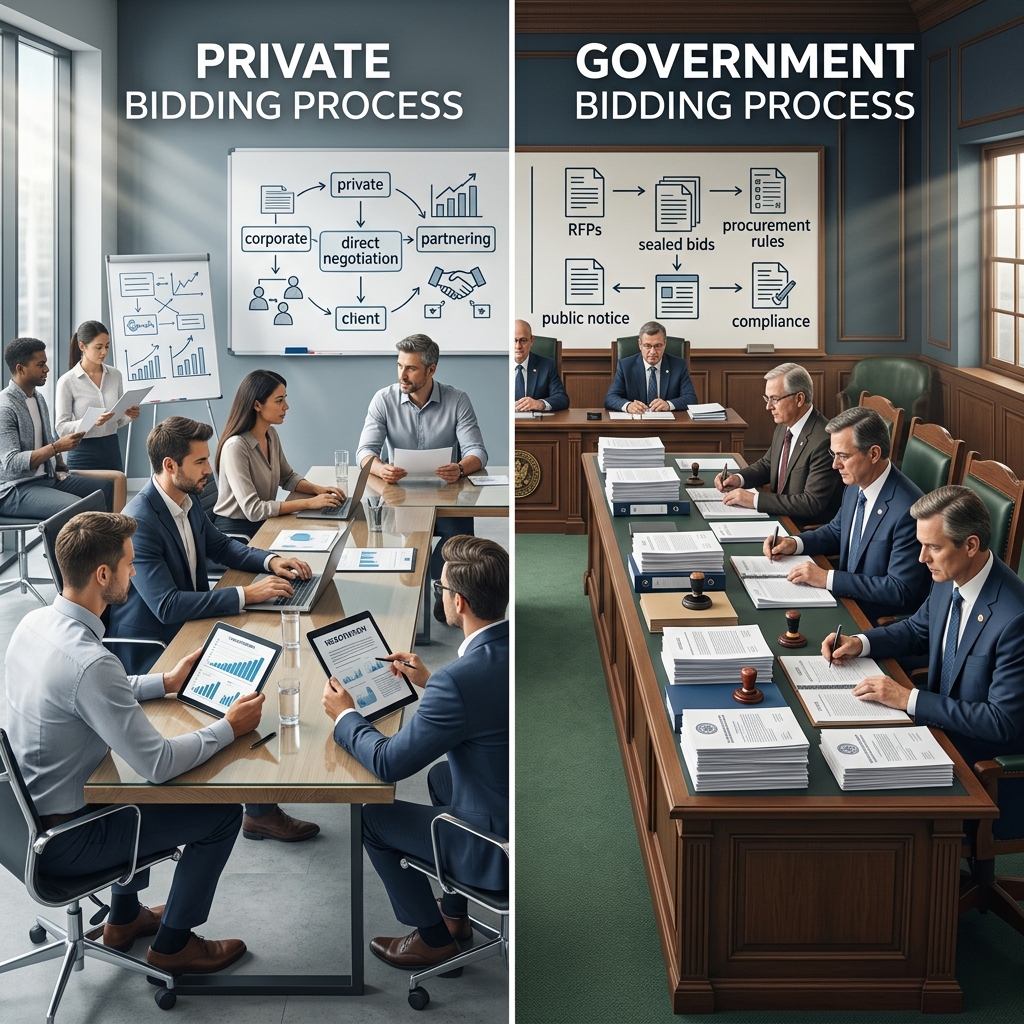
Businesses that want to grow through contracts must understand how private-sector bidding and government bidding work, and why they differ. Both aim to obtain value and quality, but public procurement is built on formal rules, transparency, and accountability, while private contracting emphasizes flexibility and business relationships.
Private vs. Government Contracts: Core Concepts
When a buyer seeks proposals from businesses, the process can involve two broad categories of contracts:
- Government or public contracts: A government agency or public entity is the purchaser, and the procurement is subject to specific laws and regulations.
- Private contracts: The buyer is a private company or individual, and the process is mainly governed by contract law and negotiated terms rather than detailed procurement rules.
Understanding which type of contract you are pursuing affects how you prepare bids, the documentation required, and the level of scrutiny you will face.
Objectives and Legal Foundations
Both private and public buyers use competitive bidding to obtain goods, services, and construction work at favorable terms, but the underlying objectives differ.
| Aspect | Government / Public Contracts | Private Contracts |
|---|---|---|
| Primary Objective | Promote value, fairness, transparency, and responsible use of public funds. | Obtain favorable commercial terms, speed, and strategic advantages for the business. |
| Legal Framework | Procurement laws, regulations (e.g., Federal Acquisition Regulation in the U.S.), and agency-specific rules. | General contract law, corporate policies, industry practices, and negotiated agreements. |
| Public Accountability | High: decisions may be subject to audits, public records laws, and bid protests. | Limited primarily to internal governance and stakeholders such as owners or shareholders. |
| Flexibility in Awarding | Constrained by rules, evaluation criteria, and documentation requirements. | Greater discretion to choose based on relationships, reputation, or negotiated terms. |
Government Bidding: Structured and Regulated
Government bidding, often called public bidding or public procurement, follows a defined sequence designed to ensure fair competition and proper use of taxpayer funds.
Typical Steps in a Public Bidding Process
- Needs assessment and planning: The public entity analyzes what is required, sets a budget, and determines whether a bidding process is necessary.
- Solicitation issuance: The agency publishes a request for proposal (RFP), invitation for bid (IFB), or similar notice describing the project, scope, and evaluation criteria.
- Access to procurement documents: Interested contractors obtain detailed bid documents and specifications, sometimes for a fee or with registration requirements.
- Pre-bid meetings or site visits: For many construction or complex service projects, the agency may hold meetings and site tours to clarify requirements.
- Bid preparation: Contractors assemble technical proposals, pricing, compliance certifications, and evidence of qualifications.
- Sealed bid submission: Bids are submitted before a deadline, often under sealed or secure conditions to prevent collusion and protect competition.
- Public opening or formal evaluation: Bids may be opened at a designated time, and prices and key terms can be read aloud or recorded for public review.
- Selection and award: Contracts are commonly awarded to the lowest responsive and responsible bidder or to the proposal offering the best value based on published criteria.
- Contract implementation and oversight: Agencies monitor performance, enforce contract terms, and conduct audits or inspections to ensure compliance.
These stages are governed by formal rules and require meticulous adherence to instructions, making accuracy and documentation critical for bidders.
Competitive vs. Sole-Source and Set-Aside Awards
Most government contracts are awarded through competitive bidding, but there are important exceptions.
- Competitive bidding: Multiple suppliers submit offers, and the agency evaluates them according to objective criteria.
- Sole-source contracts: Certain contracts may be awarded without competition when only one supplier is capable of meeting the needs, such as for specialized technology or in emergency circumstances.
- Set-aside contracts for small businesses: Under U.S. federal programs, some opportunities are reserved for qualifying small businesses, including those in specific socio-economic categories such as 8(a), HUBZone, women-owned, and service-disabled veteran-owned businesses.
To compete for many of these opportunities, businesses must register in government systems such as the System for Award Management (SAM) and complete any required certifications.
Private Bidding: Flexible and Relationship-Driven
In the private sector, the bidding process is generally less formal, and companies have greater freedom to design procurement methods that fit commercial needs and strategies.
Common Features of Private Contracting
- Negotiated contracts: Instead of rigid sealed bidding, many private projects are awarded after direct negotiation between the owner and selected contractors.
- Selection criteria: Reputation, past performance, technical expertise, and existing relationships often carry more weight than price alone.
- Custom processes: Private owners can invite a limited number of bidders, adjust timelines, or modify requirements without reference to statutory procurement rules.
- Confidential terms: Contract details, including pricing and margins, are usually confidential and not subject to public disclosure.
While this flexibility can speed up contracting and allow tailored risk allocation, it also means that standards and expectations can vary widely from one project or buyer to another.
Key Differences in Evaluation and Award
Although both sectors seek qualified contractors and reasonable prices, the way bids are evaluated and awarded differs significantly.
Government Evaluation Practices
- Formal criteria: Agencies often use predefined scoring systems based on price, technical compliance, past performance, and other factors.
- Responsiveness and responsibility: A bid must comply with all instructions (responsive) and the bidder must demonstrate capacity and integrity (responsible) to be eligible for award.
- Transparency: Evaluation procedures and award decisions may be recorded in official procurement files and can sometimes be reviewed by oversight bodies or in bid protests.
Private-Sector Evaluation Practices
- Holistic judgment: Owners may weigh subjective factors such as trust, perceived innovation, and cultural fit alongside price and capability.
- Negotiation leverage: Bids can serve as starting points for negotiations over scope, schedules, and risk-sharing arrangements.
- Flexible timelines and terms: Award decisions may be adjusted quickly based on market conditions or changing business priorities.
Compliance, Documentation, and Risk
Compliance obligations are typically heavier in government contracts, but private projects also involve meaningful risks and responsibilities.
Compliance in Government Bidding
- Regulatory adherence: Contractors must follow procurement regulations, labor laws, and often specific clauses regarding reporting, ethics, and data security.
- Registration and certification: Many agencies require vendors to register in centralized systems and obtain certifications before bidding.
- Potential bid protests: Competing contractors may challenge awards, which can delay projects and require detailed justification from the agency.
Risks in Private Bidding
- Contractual risk allocation: Liability, warranty, and indemnity provisions may be heavily negotiated and can significantly affect a contractor’s exposure.
- Payment and performance risk: Private owners may have more latitude to delay payments or alter projects, increasing financial risk for contractors.
- Limited recourse to formal protests: Disputes are generally resolved through negotiation, litigation, or arbitration rather than structured bid protest mechanisms.
Strategic Considerations for Contractors
Choosing whether to pursue private or public contracts—or a mixture of both—requires a strategic assessment of your company’s strengths, resources, and tolerance for administrative requirements.
Advantages of Government Contracts
- Potentially large and long-term projects, especially in infrastructure, defense, and public services.
- More predictable processes due to standardized rules and published criteria.
- Opportunities reserved for small and disadvantaged businesses through set-aside programs.
Challenges of Government Contracts
- Extensive administrative burden and compliance documentation.
- Longer lead times and potential delays from review, oversight, and protests.
- Public scrutiny and the need to meet high standards for ethics and performance.
Advantages of Private Contracts
- Negotiation flexibility over price, scope, and risk allocation.
- Ability to build strategic relationships that lead to repeat work and preferred supplier status.
- Potentially faster decision-making and contract awards.
Challenges of Private Contracts
- Selection processes may be less transparent, making it harder to understand why a bid was not chosen.
- Greater dependence on reputation and networks, which can disadvantage newer firms.
- More variability in contract terms and payment practices.
Practical Tips for Successful Bidding
Regardless of sector, strong bidding practices increase your chances of winning work and performing successfully.
Preparing to Bid on Government Contracts
- Register early: Complete any required registrations (such as SAM in the U.S.) and keep profiles up to date.
- Study solicitation documents carefully: Pay close attention to technical requirements, evaluation factors, and submission instructions.
- Use accurate cost estimation: Conduct thorough market research and internal estimating to ensure your prices are realistic and competitive.
- Document qualifications: Provide clear evidence of experience, safety performance, and capacity to meet project demands.
Improving Competitiveness in Private Bids
- Cultivate relationships: Engage with potential clients, understand their priorities, and maintain strong communication.
- Highlight value beyond price: Emphasize innovation, reliability, and service quality, not just cost.
- Tailor proposals: Customize each bid to address the buyer’s specific needs, risk concerns, and timelines.
Frequently Asked Questions (FAQs)
Is the bidding process identical for private and government contracts?
No. While both involve competition between suppliers, government bidding is typically more formal, regulated, and transparent, whereas private bidding allows more flexibility in how buyers request and evaluate proposals.
Why do government agencies use sealed bids?
Sealed bidding helps prevent collusion and ensures that companies cannot adjust their offers based on competitors’ prices. Bids are kept confidential until the official opening, which supports fair competition and taxpayer protection.
Can a government contract be awarded without competitive bidding?
Yes, in specific circumstances. Some contracts may be sole-source when only one supplier can meet the requirements, and certain small-business set-aside programs may limit competition to qualified firms. These exceptions are nonetheless governed by legal rules and justifications.
Do private owners have to follow procurement laws?
Private owners are generally not bound by public procurement laws, but they must comply with general contract, labor, and safety laws. Their bidding processes are shaped more by business strategy and industry practice than by statute.
What should a small business do before bidding on government work?
A small business should confirm its business classification, complete required registrations, review eligibility for any small-business programs, and carefully study solicitations to ensure it can meet all technical and compliance requirements.
References
- Is the Bidding Process the Same for Private and Government Contracts? — FindLaw. 2023-05-12. https://www.findlaw.com/smallbusiness/business-contracts-forms/is-the-bidding-process-the-same-for-private-and-government.html
- Public vs. Private Construction Contracts: Key Differences Explained — American Institute of Architects (AIA). 2022-08-10. https://learn.aiacontracts.com/articles/understanding-the-key-differences-in-public-vs-private-construction-contracts/
- The Differences Between Government, Public & Private Procurement — Government Procurement. 2021-11-03. https://www.governmentprocurement.com/news/the-differences-between-government-public-private-procurement
- What is Public Bidding? Everything You Need to Know — Mercell. 2023-02-15. https://info.mercell.com/en/procurement-insights/what-is-public-bidding/
- Bidding on Government Contracts — Diener & Associates. 2020-09-01. https://www.diener.org/gov-contract/management/bidding/
- Types of Contracts — U.S. Small Business Administration. 2023-04-20. https://www.sba.gov/federal-contracting/contracting-guide/types-contracts
- Types of Contracts — Office of Contracting and Procurement, District of Columbia. 2019-06-30. https://ocp.dc.gov/page/types-contracts
Similar Articles








Read full bio of medha deb


