
Comparing Long-Term and Short-Term Disability Insurance
Understand how long-term and short-term disability insurance work so you can protect your income when illness or injury keeps you from working.
When an injury or illness makes it impossible to work, disability insurance can be the difference between financial stability and serious hardship. Understanding how short-term and long-term disability policies differ is essential before you rely on them after a life-changing event.
This guide explains the major differences between long-term and short-term disability insurance, how benefits are calculated, common legal and employment issues, and practical steps for choosing the right protection. It is designed for workers, business owners, and anyone who wants clear, legally informed information about income protection.
Why Disability Insurance Matters
Most people depend on their paycheck to cover basic living expenses. If a medical condition suddenly prevents you from working, your income can drop to zero overnight, while your bills continue. Disability insurance exists to replace a portion of your earnings so you can focus on recovery, not on how to pay rent or the mortgage.
- Income replacement: Both short-term and long-term disability policies replace a portion of your pre-disability income, typically between 40% and 80%, depending on the policy.
- Non-work-related conditions: Many private disability policies cover illnesses or injuries that are not related to work (work-related injuries are often covered by workers’ compensation).
- Broader medical events: Covered conditions can include surgeries, pregnancy complications, cancer, heart disease, serious injuries, and other health events that prevent you from performing your regular job duties.
Without disability coverage, you may have to rely on emergency savings or high-interest credit, which can be quickly exhausted. That is why understanding the specifics of short-term and long-term policies is so important.
Core Differences Between Short-Term and Long-Term Disability
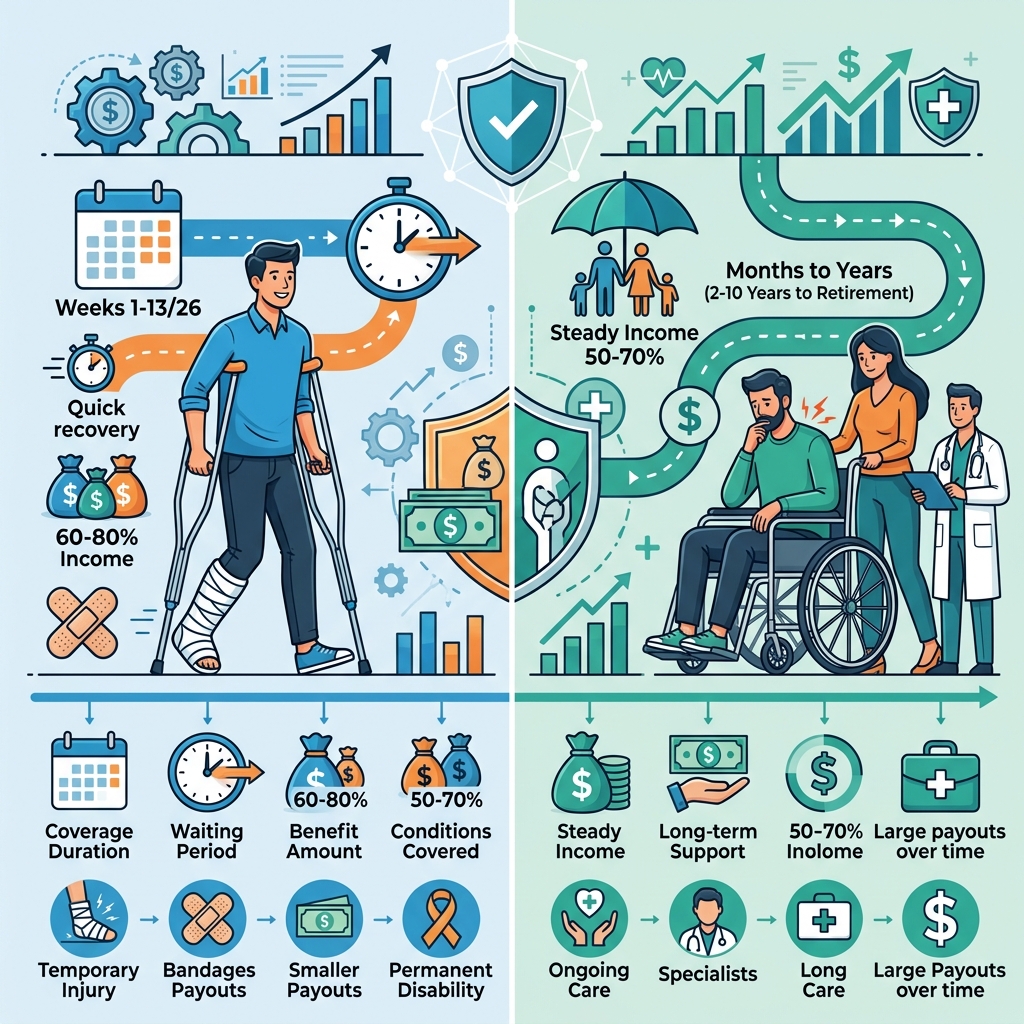
Short-term and long-term disability insurance share a common purpose—replacing income when you cannot work—but they function differently in key ways: duration of benefits, waiting periods, and how they fit into your broader financial plan.
| Feature | Short-Term Disability Insurance | Long-Term Disability Insurance |
|---|---|---|
| Typical benefit period | About 3–12 months, sometimes up to a year, depending on the policy. | Several years; often 2–10 years or up to retirement age, depending on the contract. |
| Elimination (waiting) period | Short; often 0–14 days, or roughly one to four weeks. | Longer; commonly around 90 days, and may be as long as 6–12 months. |
| Income replacement percentage | Typically 40–80% of pre-disability income, depending on plan design. | Typically 40–70% of pre-disability income, but for a longer period. |
| Primary purpose | Cushion short, temporary loss of income while you recover from a temporary condition. | Protect long-term financial stability if you develop a serious or permanent disability. |
| Common funding source | Often employer-sponsored; sometimes provided as a standard employee benefit. | Employer-sponsored or individually purchased policy; underwriting can be stricter. |
In practice, short-term disability often covers the initial months after a medical event, and long-term disability takes over if the condition continues beyond that period.
Short-Term Disability: How It Works
Short-term disability insurance is designed to handle temporary interruptions to your ability to work. It provides weekly or biweekly payments for a relatively brief period, allowing you to meet household expenses while you recover.
Typical Coverage Details
- Coverage duration: Many policies pay benefits for 3–6 months; some extend up to about 12 months.
- Waiting period: The elimination period is often very short, sometimes from the first day up to about two weeks.
- Benefit level: Payments usually range from roughly 40% to 80% of your pre-disability income.
For example, an employee who is temporarily unable to work after surgery or childbirth may rely on short-term disability benefits to cover rent, utilities, groceries, and loan payments until they can safely return to work.
Common Conditions Covered
Specific coverage depends on the policy language, but short-term disability often applies to:
- Serious but temporary injuries, such as fractures or soft-tissue injuries requiring recovery time.
- Non-work-related surgeries, including major orthopedic or abdominal procedures.
- Pregnancy and postpartum recovery, including complications that temporarily prevent work.
- Short-term illnesses such as severe infections or acute medical episodes, provided they meet the policy’s disability definition.
Because benefit periods are relatively short, insurers expect that you will return to your occupation once you are medically cleared and able to perform your job duties.
Long-Term Disability: How It Works
Long-term disability insurance provides income replacement when a medical condition lasts beyond the short-term benefit period or is expected to be permanent. These policies protect against serious, long-lasting disabilities that can reshape your career and financial future.
Typical Coverage Details
- Coverage duration: Common benefit periods include 2, 5, or 10 years, or coverage continuing until a stated retirement age such as 65.
- Waiting period: Benefits usually begin only after a longer elimination period, frequently around 90 days and sometimes up to one year.
- Benefit level: Long-term disability typically replaces about 40–70% of your pre-disability earnings, depending on the policy.
Because these benefits may be paid for many years, insurers often use more detailed medical underwriting and documentation requirements before approving a claim.
Conditions Long-Term Disability Often Addresses
- Chronic illnesses such as advanced heart disease, severe rheumatoid arthritis, or progressive neurological disorders.
- Cancer treatments and complications that prevent sustained work over months or years.
- Serious injuries with a long recovery horizon or permanent functional limitations.
- Mental health conditions that meet the policy’s disability definition and result in lasting work limitations.
Once approved, long-term disability benefits typically continue until you recover sufficiently to return to work, reach the maximum policy period, or no longer satisfy the policy’s disability criteria.
Elimination Periods and Benefit Timing
The elimination period—also called the waiting period—is the time between the onset of disability and the start of benefit payments. This timing is a critical part of planning.
- Short-term disability: Often has elimination periods ranging from zero days to about two weeks. Benefits may start quickly and are usually paid weekly.
- Long-term disability: Common elimination periods are around 90 days, but can extend up to one year. During this time, you receive no benefits from the long-term policy.
Because of this gap, many people use a combination of emergency savings, sick leave, and short-term disability benefits to cover income needs until long-term coverage becomes active.
Stacking Short-Term and Long-Term Coverage
Short-term and long-term disability insurance are often most effective when used together. A coordinated approach can provide continuous protection from the first day of disability through many years afterward.
How Policies Can Complement Each Other
- Short-term benefits cover the immediate period after your disability begins, when your expenses are unchanged but you are unable to work.
- Long-term benefits begin once the short-term coverage ends or once you pass the long-term elimination period.
- Some group plans are designed so that short-term benefits fill the gap until long-term coverage starts, reducing or eliminating income interruptions.
It is important to recognize that approval for short-term disability does not automatically guarantee approval for long-term benefits; these are usually separate contracts with their own eligibility criteria.
Legal and Employment Considerations
While disability insurance is primarily a financial product, it often intersects with employment law and benefit regulations. Although the specifics vary by jurisdiction and policy, several common issues frequently arise.
Relationship to Employer Benefits
- Employer-sponsored plans: Many employers offer short-term and/or long-term disability coverage as part of their benefits package. Eligibility, premiums, and benefit levels are often defined in employment contracts or benefits handbooks.
- Continuation of employment: Receiving disability benefits does not necessarily guarantee job protection; separate employment laws and company policies govern leave and job reinstatement.
- Coordination with other benefits: Policies may interact with sick leave, family and medical leave, or retirement plans, and could offset payments from other sources such as Social Security disability benefits or workers’ compensation.
Policy Definitions and Disputes
Disagreements often arise around how an insurer interprets its own policy language:
- Definition of disability: Some policies focus on your inability to perform your own occupation, while others use an any occupation standard that is stricter.
- Documentation requirements: Detailed medical records, test results, and professional evaluations are often required to support a claim, especially for long-term benefits.
- Appeal procedures: If a claim is denied or benefits are terminated, policies usually specify an internal appeal process. In complex cases, people sometimes seek legal advice to interpret policy terms and advocate for their rights.
Because policies are contracts, disputes may lead to formal complaints or litigation if parties cannot resolve disagreements through internal procedures.
How to Evaluate Your Disability Insurance Needs
Choosing the right mix of short-term and long-term disability coverage requires an honest look at your finances, health risks, and job situation.
Key Questions to Ask Yourself
- How long could my savings cover living expenses? If you have limited emergency funds, short-term disability may be crucial to bridge the first weeks or months of a disability.
- What benefits does my employer already provide? Review your employee handbook or benefits summary to see if you already have short-term and/or long-term coverage, and at what levels.
- What is my family’s medical risk profile? A history of chronic illnesses or high-risk activities might make long-term coverage more important.
- How essential is my income to others? If your earnings support dependents or major financial obligations, higher benefit levels or longer coverage periods may be appropriate.
Practical Steps for Better Protection
- Compare policy terms from different insurers, focusing on definitions of disability, elimination periods, and benefit durations.
- Calculate how much of your income each policy replaces and how long those benefits last.
- Consider coordinating short-term and long-term policies so that benefits flow without gaps during the waiting period.
- Consult a qualified insurance or financial professional for individualized advice, especially if you have complex health or employment circumstances.
Frequently Asked Questions (FAQs)
1. Do I need both short-term and long-term disability insurance?
Many people benefit from having both, because short-term policies cover immediate income loss and long-term policies handle extended disabilities. However, your decision should depend on your existing savings, employer benefits, and personal risk tolerance.
2. How much of my income will disability insurance replace?
Short-term policies often replace a higher percentage of income for a shorter time—sometimes up to about 70–80%—while long-term policies commonly cover about 40–70%, but over a longer period. Exact percentages depend on your specific plan.
3. What happens when short-term disability benefits run out?
If you remain disabled after short-term benefits end, you may transition to long-term disability coverage if you have such a policy and meet its eligibility criteria. Approval for short-term benefits does not automatically guarantee long-term coverage because they are typically governed by separate contracts.
4. Are disability benefits taxable?
Whether benefits are taxed often depends on who pays the premiums and how they are treated for tax purposes. For example, if your employer pays the premiums and does not include them in your taxable income, benefits may be taxable. Because tax rules are complex and jurisdiction-specific, it is wise to consult authoritative tax guidance or a tax professional.
5. How do elimination periods affect my finances?
Elimination periods determine how long you must wait before benefits begin. Short elimination periods may reduce the amount of savings you need to cover expenses during the first phase of disability, while long elimination periods require more robust emergency funds or short-term coverage to prevent income gaps.
6. Can I change my coverage after a disability occurs?
Once a disabling event has occurred, it is generally too late to purchase new coverage for that specific event. Insurers typically require you to enroll while you are actively at work and before a disabling condition arises, and may use medical underwriting for long-term policies.
References
- Short-Term vs. Long-Term Disability Insurance — Paychex. 2023-06-15. https://www.paychex.com/articles/employee-benefits/short-vs-long-term-disability-insurance
- Long Term vs Short Term Disability Insurance – What’s the Difference? — Guardian Life. 2023-05-10. https://www.guardianlife.com/disability-insurance/long-term-vs-short-term
- Short-Term vs. Long-Term Disability Insurance Differences — Aflac. 2022-11-01. https://www.aflac.com/resources/short-term-disability-insurance/short-term-vs-long-term-disability-insurance.aspx
- Short-Term vs Long-Term Disability Insurance — Mutual of Omaha. 2023-04-20. https://www.mutualofomaha.com/advice/financial-planning/financial-planning-basics/short-term-vs-long-term-disability-income-insurance
- A Guide to Short-Term vs. Long-Term Disability Insurance — U.S. Chamber of Commerce CO. 2022-09-30. https://www.uschamber.com/co/run/finance/short-term-vs-long-term-disability
- Short vs Long-Term Disability Benefits — Fields Law Firm. 2021-03-01. https://www.fieldslaw.com/answer/short-term-and-long-term-disability/
- What Is Short-Term Disability Insurance? — MetLife. 2023-02-14. https://www.metlife.com/stories/disability-insurance/what-is-short-term-disability/
- Short Term vs. Long Term Disability Insurance — Stolly Insurance Group. 2022-08-12. https://www.stolly.com/resource-center/insurance/short-term-vs-long-term-disability-insurance
Similar Articles








Read full bio of Sneha Tete




