
Understanding Common-Law Marriage Across US States
Discover which states recognize common-law marriage and what legal requirements apply.
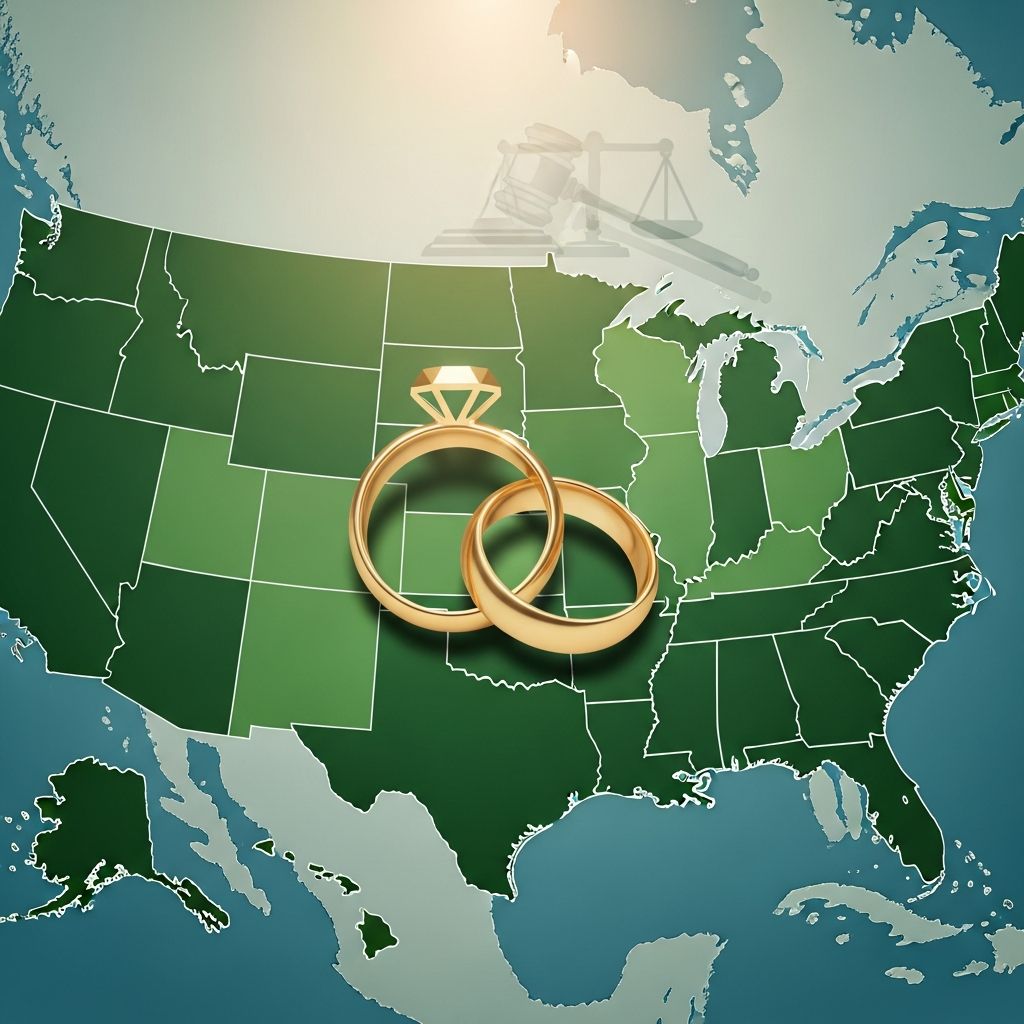
The Nature and Legal Framework of Common-Law Marriage
Common-law marriage represents a distinct category of matrimonial union that exists outside the traditional ceremonial framework. Unlike conventional marriages that require a formal license, religious officiant, or civil ceremony, a common-law marriage emerges through the mutual agreement of two individuals to enter into a spousal relationship, coupled with their cohabitation and public representation as a married couple. This type of marriage derives its legitimacy from long-standing legal principles rather than statutory formalities, creating binding marital relationships without the prerequisite documentation or ceremonial elements traditionally associated with marriage.
The fundamental distinction between common-law and ceremonial marriages lies in their formation process. Where conventional marriages involve government-issued licenses, official witnesses, and documented ceremonies, common-law marriages depend entirely on the intentions, behaviors, and declarations of the parties involved. Despite this lack of formal procedure, jurisdictions that recognize common-law marriage accord these unions the same legal status, rights, and obligations as any other marriage. This recognition stems from the principle that the substance of a marital relationship—mutual commitment and shared domestic life—supersedes the formality of its creation.
Essential Elements Required for Valid Common-Law Marriage
Establishing a valid common-law marriage requires satisfying multiple interconnected legal elements that courts examine when determining whether two individuals have genuinely entered into a marital relationship.
Capacity and Legal Qualification
Both parties must possess the legal capacity to marry. This capacity encompasses several requirements: each individual must have reached the minimum age required for marriage in their jurisdiction, typically eighteen years old, though some states permit younger individuals to marry with parental consent. Additionally, neither party may be currently married to another person, as this would create an impedermissible bigamous relationship. Mental capacity is equally important—both individuals must possess the cognitive ability to comprehend the nature, significance, and consequences of entering into a marital relationship. Any legal impediments to marriage, such as consanguinity or affinity restrictions, must not exist between the parties.
Mutual Agreement and Intent
Perhaps the most critical element involves the mutual, contemporaneous agreement of both parties to be married. This agreement must be a present, immediate intention to establish a marital relationship, not merely a future promise or intention to marry at some later date. Courts emphasize that both parties must simultaneously intend to be spouses, not simply roommates or romantic partners. The agreement need not be explicit or formal; it can be demonstrated through conduct, declarations, and the totality of circumstances, but both individuals must genuinely share this understanding. If one party intends marriage while the other does not, the legal requirement is not satisfied.
Cohabitation Requirements
The couple must live together continuously as a married couple, demonstrating a shared domestic life. This requirement extends beyond mere occupancy of the same residence; cohabitation must be voluntary and conducted as spouses rather than as roommates or unrelated individuals sharing quarters. Most jurisdictions recognize that cohabitation inherently includes a sexual relationship reflecting marital intimacy. Importantly, the couple must cohabitate continuously rather than intermittently—occasional visits or weekend stays do not satisfy this requirement. However, most states do not mandate a specific duration of cohabitation; instead, courts evaluate whether the length and nature of cohabitation demonstrate a genuine marital union. New Hampshire represents a notable exception, establishing a minimum cohabitation period as part of its statutory requirements.
Public Representation and Holding Out
The couple must present themselves to society and the broader community as a married couple. This involves making representations to friends, family members, employers, financial institutions, and other parties that they are married. Evidence of holding out includes adopting a common surname, referring to each other as spouse or husband and wife, filing joint tax returns, designating the other as a beneficiary on insurance policies, purchasing property jointly, and representing marital status on official documents. While assuming a common surname provides persuasive evidence, it alone does not establish a common-law marriage; courts require comprehensive evidence demonstrating public recognition of the relationship as matrimonial.
State Recognition and Jurisdictional Variations
Common-law marriage recognition varies substantially across American jurisdictions, with some states fully embracing this form of marriage, others recognizing only marriages validly contracted in other jurisdictions, and some states entirely prohibiting new common-law marriages altogether.
States Actively Recognizing Common-Law Marriage
Approximately a dozen states continue to recognize the formation of new common-law marriages when the requisite elements are satisfied. These jurisdictions maintain statutory provisions or rely on established common law principles permitting couples to marry without formal ceremony or licensure. Examples include Colorado, Iowa, Kansas, Montana, New Hampshire, South Carolina, Texas, and Utah. Each of these states has developed specific jurisprudence and procedural guidelines for establishing common-law marriages within their borders.
Recognition of Out-of-State Common-Law Marriages
The Full Faith and Credit Clause of the United States Constitution requires states to recognize legal acts and judgments from sister states. Consequently, virtually all American jurisdictions recognize common-law marriages that were validly established in states where they are recognized, even if those same jurisdictions do not permit new common-law marriages to form within their borders. This creates a situation where couples may establish a common-law marriage in a recognizing state and subsequently relocate to a non-recognizing state while retaining the validity of their marriage. However, proving the validity of an out-of-state common-law marriage can present significant evidentiary challenges, particularly if the marriage was established decades earlier without formal documentation.
States That Have Abolished Common-Law Marriage
Some states have formally eliminated the possibility of creating new common-law marriages through legislative action. Indiana provides an illustration, having abolished common-law marriage in 1958, eliminating the capacity for couples within that state to establish marriage through cohabitation and mutual agreement after that date. However, even states that have abolished common-law marriage formation typically recognize marriages validly established before the abolition date and marriages validly established in other jurisdictions.
Proof and Documentation Challenges
A significant practical disadvantage of common-law marriage lies in the burden of proof it imposes. Because no marriage license or formal certification documents the union, couples must prove the existence of their marriage through circumstantial evidence when their marital status is challenged or when establishing rights after death or divorce.
Courts typically accept various evidentiary categories in evaluating common-law marriage claims. Testimony from the parties themselves regarding their agreement and intentions carries substantial weight. Testimony from third parties who witnessed the couple’s public representation as married—such as family members, friends, neighbors, or business associates—provides corroborating evidence. Documentary evidence includes joint tax returns, joint bank accounts and credit accounts, joint property deeds and lease agreements, life insurance policies designating the other party as beneficiary, wills or estate documents reflecting marital status, children’s birth certificates listing both parties as parents, and any declaration of marriage filed with state authorities in jurisdictions permitting such registration.
The person asserting the existence of a common-law marriage bears the initial burden of presenting sufficient evidence to establish its validity. In litigation contexts, opposing parties may challenge the marriage’s validity, particularly in divorce proceedings, inheritance disputes, or when determining spousal benefits eligibility. The evidentiary burden can prove substantial, especially for older couples who established marriages decades earlier when documentary evidence may be unavailable or deteriorated.
Legal Rights and Marital Benefits
Where recognized, common-law marriages confer the identical rights, privileges, and obligations as formal ceremonial marriages. Spouses in valid common-law marriages possess inheritance rights, succession claims, and testamentary rights identical to ceremonially married spouses. They enjoy spousal privilege protecting certain communications from disclosure in legal proceedings. They may petition for spousal support or alimony upon divorce. They possess decision-making authority regarding the other spouse’s medical treatment and end-of-life decisions. They qualify as beneficiaries under Social Security programs and veterans’ benefits. They may designate the other spouse as beneficiary under life insurance and retirement accounts. They obtain property rights through state equitable distribution or community property frameworks upon dissolution.
However, accessing these benefits requires proving the marriage’s existence through acceptable evidence. Government agencies, employers, insurance companies, and financial institutions may demand substantiation of common-law marital status before granting benefits or recognizing spousal rights. This documentation requirement creates practical complications that formal marriages avoid.
Comparison Table: Common-Law Marriage Recognition Patterns
| Recognition Category | Characteristics | Example States |
|---|---|---|
| Active Recognition | Permits formation of new common-law marriages; maintains statutory or common law framework for creation | Colorado, Iowa, Kansas, Texas, Utah |
| Recognition of Out-of-State Marriages | Does not permit new common-law marriages within jurisdiction but recognizes valid out-of-state common-law marriages | New York, California, Florida |
| Abolished Common-Law Marriage | Legislatively eliminated common-law marriage formation; may recognize pre-abolition marriages | Indiana, Ohio, Georgia |
Procedural Mechanisms for Registration and Proof
Certain states that recognize common-law marriage offer formal registration mechanisms allowing couples to document their marital status without traditional ceremonies. These registration options provide an intermediate formality that simplifies subsequent proof of the marriage’s validity. Couples may file affidavits or declarations of marriage, signed by both spouses and notarized, creating official records with state authorities. While such registration does not transform the nature of the marriage, it creates documentary evidence that substantially eases the burden of proving marital status in subsequent disputes or benefit eligibility determinations.
Registration represents a pragmatic solution to the evidentiary problems inherent in proving common-law marriage. Couples establishing common-law marriages in states offering registration should seriously consider utilizing these mechanisms to create institutional documentation supporting their marital status claims.
Common Misconceptions and Clarifications
Numerous myths surround common-law marriage, creating confusion about its actual requirements and validity. A prevalent misconception holds that merely living together for a specified duration—frequently cited as seven years—automatically creates a common-law marriage. In reality, cohabitation duration alone proves insufficient; the couple must satisfy all required elements including mutual agreement, continuous cohabitation as spouses, and public representation as a married couple. No automatic threshold duration triggers marriage; courts examine whether the length and nature of cohabitation demonstrate genuine marital intent.
Another widespread misunderstanding suggests that assuming a common surname automatically establishes marriage. While adopting a spouse’s surname provides valuable evidence of holding oneself out as married, it constitutes only one factor among many. Couples need not adopt identical surnames to establish common-law marriage validity, and conversely, name adoption alone cannot create marriage absent the other requisite elements.
Some individuals believe that expressing intentions to be married verbally to a few witnesses creates common-law marriage validity. The requirement instead demands continuous public representation to the broader community, not merely isolated statements to selected individuals. The couple’s overall conduct and representations across multiple social and institutional contexts must demonstrate marital status.
Frequently Asked Questions
Q: Does my state recognize common-law marriage?
A: Approximately a dozen states actively recognize new common-law marriage formation, including Texas, Colorado, Iowa, and Utah. However, virtually all states recognize common-law marriages validly established in other jurisdictions through the Full Faith and Credit Clause. You should consult your specific state’s laws or an attorney to determine your jurisdiction’s precise requirements.
Q: How can I prove a common-law marriage exists?
A: Gather documentary evidence including joint tax returns, joint bank accounts, joint property deeds, life insurance policies listing the other party as beneficiary, children’s birth certificates, and testimony from witnesses who observed your public representation as a married couple. Consider filing a declaration of marriage in states permitting registration.
Q: If we move to a state that doesn’t recognize common-law marriage, is our marriage still valid?
A: Yes. Under the Full Faith and Credit Clause, states must recognize common-law marriages validly established in other jurisdictions. However, you should maintain documentation proving the marriage’s validity in the original state.
Q: Can I establish a common-law marriage in one state and file for divorce in another?
A: Generally, yes. Most states will recognize your common-law marriage for divorce purposes even if they don’t permit new common-law marriages within their borders, provided you can prove the marriage was validly established. Divorce procedures typically follow the state where you file for dissolution.
Q: Are we automatically a common-law marriage after living together for seven years?
A: No. This is a common misconception. Simply living together for any duration—whether seven years or longer—does not automatically create marriage. You must satisfy all required elements: mutual agreement to be married, continuous cohabitation as spouses, and public representation as a married couple.
Q: What benefits am I entitled to in a recognized common-law marriage?
A: Valid common-law marriages confer identical rights and benefits as formal marriages, including inheritance rights, Social Security spousal benefits, decision-making authority in medical emergencies, and equitable property division upon divorce. However, you may need to provide documentation proving the marriage’s validity to access these benefits.
References
- Common-law marriage — Wikipedia. Accessed February 2026. https://en.wikipedia.org/wiki/Common-law_marriage
- Common Law Marriage — National Paralegal College. https://www.nationalparalegal.edu/public_documents/courseware_asp_files/DomRelImmig/Marriage/CommonLawMarriage.asp
- Common-Law Marriage Handbook — U.S. Department of Labor, Office of Workers’ Compensation Programs. https://www.dol.gov/sites/dolgov/files/owcp/energy/regs/compliance/PolicyandProcedures/CommonLaw_Marriage.pdf
- Misconceptions About Common Law Marriage — Iowa Legal Aid. https://iowalegalaid.org/resource/misconceptions-about-common-law-marriage/
- Common Law Marriage by State — National Conference of State Legislatures. https://www.ncsl.org/human-services/common-law-marriage-by-state
- Understanding Common-Law Marriage in Indiana: What You Need to Know — Common Law Marriage Guide. https://ciyoulaw.com/common-law-marriage-indiana/
Similar Articles








Read full bio of Sneha Tete


