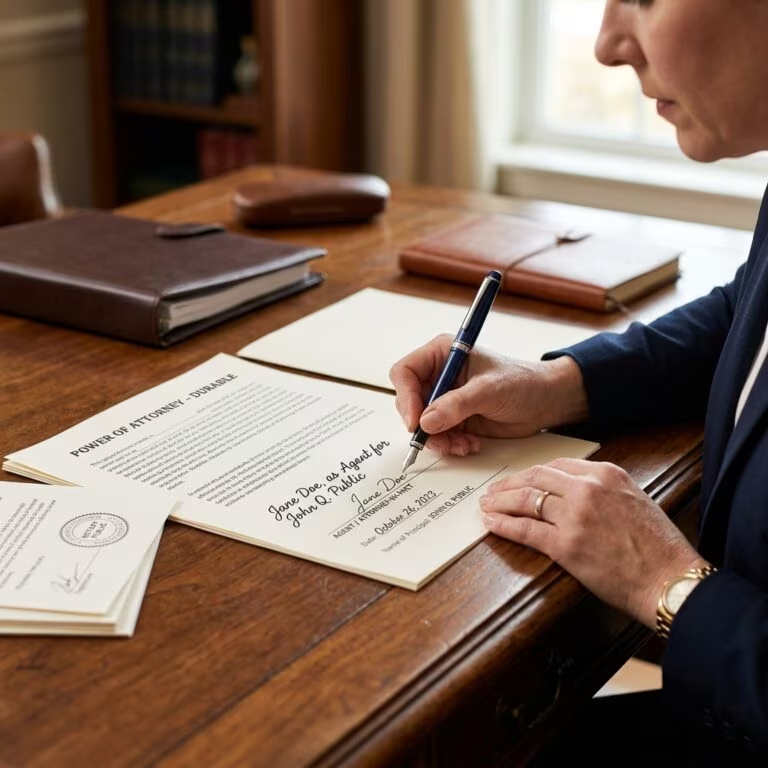
Estate disputes arise when family members, beneficiaries, or creditors challenge how a deceased person’s property is managed or distributed. These conflicts can be emotionally draining and legally complex, often unfolding in probate court or through trust litigation.
Understanding the common causes of estate disputes, knowing who is allowed to bring a claim, and learning practical ways to avoid conflict can help families protect both relationships and assets. This guide explains typical grounds for challenging wills and trusts, the role of executors and trustees, and strategies to prevent and resolve disagreements.
What Is an Estate Dispute?
An estate dispute is any legal disagreement related to the management or distribution of a deceased person’s assets, whether there is a formal estate plan (such as a will or trust) or not. Disputes frequently arise during the probate process, when a court oversees the administration of the estate according to state law and the decedent’s documents.
Estate disputes can involve:
- Contesting the validity of a will or trust
- Challenging how assets are interpreted or distributed
- Questioning the conduct of executors or trustees
- Conflicts among heirs, beneficiaries, and creditors
- Guardianship and conservatorship disputes involving minors or incapacitated adults
While every family situation is unique, several patterns appear repeatedly. The sections below examine the most frequent categories of estate disputes and the legal principles that govern them.
Who Can Challenge an Estate Plan? Understanding Legal Standing
Not everyone who is unhappy with an estate outcome can sue. To bring an estate-related claim, a person must have legal standing, meaning a concrete interest in the estate and its distribution.
Interested Parties
Courts generally restrict estate challenges to individuals known as interested parties. These typically include:
- Named beneficiaries in a will or trust who stand to receive property
- Heirs at law who would inherit if there were no valid will
- Creditors with legitimate claims against the estate, such as unpaid lenders or service providers
If a person has no financial stake in the estate, courts usually dismiss their claim for lack of standing. This rule helps prevent frivolous lawsuits that could delay administration and consume estate resources.
Time Limits to Bring a Claim
Estate and probate disputes are subject to strict deadlines known as statutes of limitations. In many U.S. states, interested parties have only a few months to contest a will after receiving notice of the probate proceeding. Missing these deadlines can bar the claim entirely.
Because the timeframe is short, individuals who suspect problems with a will or trust should consult legal counsel promptly to understand their rights and obligations.
Frequent Grounds for Challenging Wills and Trusts
Many estate disputes focus on whether a will or trust is legally valid. Courts rely on established grounds to decide whether to uphold or invalidate a testamentary document.
1. Drafting Defects and Improper Execution
A will or trust must comply with specific state law requirements to be enforceable. Common defects include missing signatures, lack of required witnesses, or documents that do not satisfy formal statutory criteria.
For example, many states require wills to be in writing, signed by the testator (the person making the will), and witnessed by two people who are not beneficiaries. If these elements are absent or if procedures are flawed—such as a witness signing after the testator’s death—the will may be declared invalid.
Drafting defects can also involve:
- Ambiguous or contradictory provisions
- Improper notarization or missing dates
- Use of forms or templates inappropriate under the applicable state law
2. Lack of Testamentary Capacity
To create a valid will, the testator must have testamentary capacity: an understanding of the nature and extent of their property, the identity of potential heirs, and the legal effect of signing the document.
Adults are generally presumed capable, so the party contesting the will bears the burden of proving incapacity. Evidence may include medical records, expert testimony, and witness accounts showing that the person suffered from significant cognitive impairment—such as advanced dementia or severe mental illness—at the time the will was executed.
3. Undue Influence and Coercion
Undue influence occurs when a person exerts excessive pressure on a vulnerable testator, causing them to change their estate plan in a way that does not reflect their free and independent wishes.
Examples include:
- A caregiver persuading a patient to leave them most of the estate
- An adult child pressuring an aging parent to disinherit siblings
- A relative isolating a testator from others and controlling access to legal documents
Proving undue influence often requires demonstrating a confidential or dependent relationship, the beneficiary’s active involvement in preparing the will, and an outcome that strongly favors the influencer over natural heirs.
4. Fraud, Forgery, or Misrepresentation
A will or trust can also be challenged if it was procured through fraud or forgery. This may involve signing a document the testator did not understand, altering pages after the testator’s signature, or forging signatures.
Fraud-based disputes frequently require forensic examination of documents, testimony from witnesses, and detailed investigation into the circumstances surrounding the signing.
5. Conflicting or Multiple Wills
Over a lifetime, individuals may create several wills as family situations and finances change. When multiple documents exist, questions arise about which is the controlling instrument.
Courts typically give effect to the most recent valid will that properly revokes prior versions. Litigation can occur when different parties argue that one document is fraudulent, invalid, or unintentionally superseded.
Disputes Over Executors, Trustees, and Fiduciary Duties
Executors and trustees are fiduciaries—individuals who must manage estate or trust assets with loyalty and prudence, for the benefit of beneficiaries. When they fail to meet these obligations, disputes and potential liability can follow.
Common Complaints Against Fiduciaries
- Mismanagement of assets: Poor investment decisions, failure to diversify, or neglect of real estate maintenance
- Self-dealing: Using estate property for personal benefit, such as selling assets to themselves at below-market prices
- Lack of transparency: Refusal to provide accountings or updates to beneficiaries
- Failure to follow the will or trust terms: Ignoring distribution instructions or delaying payouts without justification
Beneficiaries who believe a fiduciary has breached their duties can seek remedies including court-ordered accountings, removal of the executor or trustee, restitution, and in serious cases, civil or criminal penalties.
Inheritance Conflicts and Family Relationship Strains
Not all estate disputes are strictly legal; many stem from longstanding family tensions aggravated by grief and financial insecurity. Nonetheless, these emotional conflicts often become formal legal disputes.
Types of Inheritance Disagreements
- Perceived unfairness in unequal distributions among children or relatives
- Disputes over sentimental items like heirlooms, artwork, or jewelry
- Confusion caused by vague or ambiguous language in testamentary documents
- Resentment when stepfamilies, new spouses, or non-relatives receive significant shares
Clear communication during life, explicit explanations in the estate plan, and professional drafting can reduce misunderstandings and minimize emotional fallout.
Non-Probate Assets and Beneficiary Designations
Some property passes outside of probate through beneficiary designations or contract terms—for example, life insurance, retirement accounts, and payable-on-death (POD) bank accounts.
Disputes related to non-probate assets can involve:
- Outdated beneficiary forms that no longer match the person’s intentions
- Conflicts between will provisions and designated beneficiaries
- Allegations of undue influence in changing designations shortly before death
Because these assets usually transfer directly to the named beneficiary, they can bypass will terms. Regularly reviewing and updating designations is critical to avoid surprises and litigation.
Guardianship and Conservatorship Disputes
Estate-related litigation also arises when families disagree over who should serve as guardian for a minor or conservator for an incapacitated adult. Courts must balance the individual’s best interests with competing claims from relatives.
Common disagreements include:
- Competing petitions from relatives seeking control of a person and their finances
- Accusations that a current guardian is neglectful or financially irresponsible
- Concerns about conflicts of interest when guardians stand to benefit from estate assets
Naming preferred guardians in advance within a will, and discussing that choice with family members, can reduce the likelihood of such conflicts.
Strategies to Prevent Estate Disputes
While no plan can guarantee a conflict-free estate administration, thoughtful preparation significantly lowers the likelihood of litigation. Several strategies are consistently recommended by practitioners and legal commentators.
Use Clear, Precise Estate Planning Documents
- Work with experienced counsel rather than relying solely on generic forms
- Define key terms (for example, “children” including stepchildren or not) to avoid ambiguity
- Specify how to divide both major assets and sentimental items
Clear drafting minimizes disputes over interpretation, one of the most common causes of inheritance conflicts.
Document Rationale for Unequal Distributions
If a testator intends to treat beneficiaries differently, explaining the reasons can reduce shock and resentment. This may be done directly in the will, in a separate letter, or during family discussions.
- Explain major disparities (e.g., business succession plans or prior gifts).
- Consider professional valuations for businesses or real estate.
- Use tools like no-contest clauses where allowed by law to discourage frivolous challenges.
Keep Beneficiary Designations Aligned with the Estate Plan
Regularly reviewing retirement accounts, life insurance, and transfer-on-death designations ensures that non-probate transfers do not accidentally override or conflict with the will or trust.
Select Responsible Fiduciaries and Provide Guidance
Choosing executors and trustees who are organized, impartial, and financially literate can decrease the risk of mismanagement and disagreements with beneficiaries.
- Consider appointing a professional or institutional fiduciary if family dynamics are complex.
- Provide written instructions or letters of intent to clarify expectations not covered in the documents.
- Ensure fiduciaries understand accounting and reporting obligations.
Utilize Trusts to Reduce Probate Exposure
Properly structured trusts can bypass probate for many assets, provide detailed management instructions, and offer privacy and flexibility. This can help reduce disputes that would otherwise arise within the probate court system.
Resolving Estate Disputes: Litigation and ADR Options
When conflicts emerge despite planning efforts, families and interested parties have several methods for resolution. These range from negotiated settlements to full-scale litigation.
| Method | Key Features | Advantages | Limitations |
|---|---|---|---|
| Negotiation | Informal discussions among parties and counsel | Flexible, private, often inexpensive | Relies on goodwill; may not resolve deep conflicts |
| Mediation | Neutral mediator facilitates voluntary agreement | Less adversarial, preserves relationships, tailored solutions | Non-binding unless parties reach and sign a settlement |
| Arbitration | Arbitrator issues a binding decision | Usually faster than court, more private | Limited appeal rights; may still be adversarial |
| Probate Litigation | Formal court process before a judge | Clear, enforceable rulings; useful for complex disputes | Public, time-consuming, costly; may intensify family tensions |
Many practitioners recommend attempting mediation or negotiated settlements before resorting to trial, to preserve family relationships and limit legal expenses.
Estate Disputes FAQ
FAQ 1: What is the most common type of estate dispute?
One of the most common disputes involves contesting the validity of a will, often based on alleged lack of testamentary capacity, undue influence, or drafting defects.
FAQ 2: Can a creditor challenge a will or trust?
Yes. Creditors with legitimate claims against the estate are typically considered interested parties with standing to participate in probate proceedings and, in some circumstances, challenge aspects of the estate administration.
FAQ 3: Are handwritten wills valid?
Some jurisdictions recognize handwritten or “holographic” wills, but they must still meet the state’s legal requirements, which may include specific language, dates, and signatures. Failure to satisfy these formalities can lead to litigation over validity.
FAQ 4: How long do I have to contest a will?
Deadlines vary by state, but many require challenges to be filed within months of receiving notice that the will has been submitted to probate. Missing the deadline can prevent you from raising objections later.
FAQ 5: Do all estates go through probate?
No. Assets held in trust, jointly owned property with rights of survivorship, and certain accounts with beneficiary designations often pass outside of probate. However, disputes can still arise relating to these assets and their interaction with the overall estate plan.
References
- Understanding Estate Disputes: Common Issues and Legal Remedies — McCarthy & McCarthy Law Firm. 2023-05-15. https://www.mccmlaw.com/news-and-articles/articles/understanding-estate-disputes-common-issues-and-legal-remedies
- 7 Most Common Probate Disputes in Arizona — TSK Law Firm. 2022-11-10. https://tsklawaz.com/blog/common-probate-disputes/
- Probate Litigation: Common Probate Disputes & How to Resolve Them — The Florida Lawyers. 2023-08-21. https://thefloridalawyers.com/blog/probate-litigation-common-probate-disputes-how-to-resolve-them/
- Some of the Most Common Estate Disputes — Jas Estate Law. 2021-09-30. https://www.jasestatelaw.com/blog/some-of-the-most-common-estate-disputes/
- Common Causes of Estate Litigation — Dworken & Bernstein Co., L.P.A. 2020-04-14. https://dworkenlaw.com/common-causes-of-estate-litigation/
- Common Inheritance Disputes and Effective Prevention Strategies — Pardalis & Nohavicka LLP. 2024-06-12. https://www.pcslawnyc.com/blog/2024/june/common-inheritance-disputes-and-effective-preven/
- What Is an Estate Dispute? — Hardie Alcozer. 2022-03-05. https://hardiealcozer.com/article/what-is-an-estate-dispute/