
College Arrests for Peaceful Protest: Legal Fallout Explained
How a nonviolent protest arrest in college can affect criminal records, campus discipline, immigration status, and your future career options.
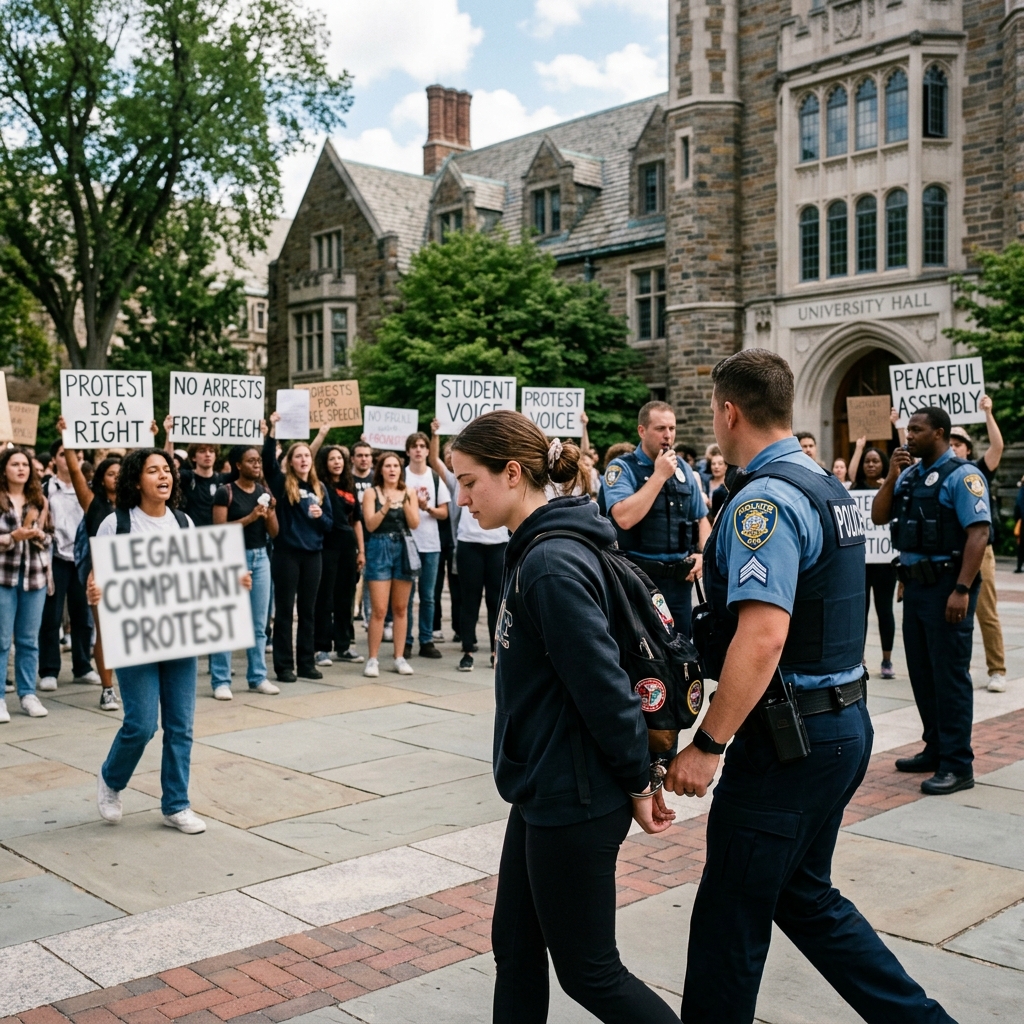
Peaceful protest is a longstanding feature of campus life in the United States, and the First Amendment protects students at public colleges who choose to demonstrate and speak out on public issues. However, those protections do not give anyone a free pass to violate criminal laws or campus rules, and a nonviolent protest can still end with handcuffs, citations, and long-term consequences.
This guide walks through what college students need to know about the legal and practical fallout of being arrested during a nonviolent campus protest. It is educational information, not legal advice, and students should consult a licensed attorney for guidance on specific situations.
1. Free Speech Rights on Campus: The Starting Point
Before examining arrests and consequences, it helps to understand what protections students actually have when they protest.
1.1 First Amendment protections at public colleges
At public colleges and universities, the institution is considered a government actor and is generally required to respect students’ free speech rights under the First Amendment. That means:
- Students at public institutions can usually engage in peaceful protest in outdoor campus spaces that are open to student use, such as quads or sidewalks.
- Administrators cannot punish students simply because they dislike the viewpoints being expressed, as rules must be viewpoint-neutral.
- However, the First Amendment does not protect unlawful conduct, such as assault, vandalism, or serious disruption of campus operations.
1.2 Time, place, and manner rules
Even when speech is fully protected, public colleges may impose reasonable, narrowly tailored limits on the time, place, and manner of protests. These rules are meant to keep the campus functioning and can include:
- Limits on overnight encampments or building occupations when they disrupt normal operations or safety.
- Requirements to reserve certain spaces in advance for large events.
- Noise restrictions near classrooms, libraries, or exams.
These regulations are permissible when they apply equally regardless of viewpoint, and when they address when and how protest happens, not what is being said. When students ignore such rules, they can face both school discipline and exposure to criminal charges such as trespassing or disorderly conduct.
2. How Peaceful Protest Leads to Arrest
Many campus protests remain completely peaceful and end without any police involvement. But even when students are committed to nonviolence, several common scenarios can still produce arrests.
2.1 Typical protest-related charges
Across recent campus protests, the majority of arrests have involved relatively low-level offenses rather than serious violent crimes. Common charges include:
- Trespassing – refusing to leave a building or restricted area after being told to depart by campus officials or police.
- Disorderly conduct or disturbing the peace – engaging in conduct that authorities claim seriously disrupts public order, such as blocking traffic or access to buildings.
- Obstructing governmental administration or resisting arrest – interfering with police officers or refusing to comply with lawful orders.
- Public nuisance or unlawful assembly – participating in a gathering deemed unlawful under local statutes.
These are often charged as misdemeanors or even lower-level violations, though the precise classification varies by state.
2.2 When conduct crosses into more serious offenses
Peaceful civil disobedience is usually associated with minor charges, but a protest can also lead to felony charges if certain lines are crossed. Examples include:
- Assaulting or threatening an officer – physical contact with law enforcement or credible threats can be charged as felonies in many states.
- Serious vandalism or property damage – extensive damage or damage to critical infrastructure can elevate charges.
- Rioting or inciting a riot – where statutes define group violence or dangerous disruption as a riot, participation or encouragement may become a felony.
In practice, most students engaged in nonviolent civil disobedience are charged at the misdemeanor level, but the risk of more serious charges increases as protests become larger or more confrontational.
3. What Typically Happens After an Arrest
Students often worry about what the immediate legal process looks like after an arrest at a protest. While procedures vary by jurisdiction, there are some common stages.
3.1 Detention, citation, or release
Depending on local law and the circumstances, police may:
- Issue a citation or appearance ticket and release the student at the scene or after brief processing.
- Take the student to a police station or local jail for booking—fingerprints, photographs, and basic personal information.
- Hold the student until an initial court appearance, usually within a short period, especially if bail decisions must be made.
Some jurisdictions treat minor protest-related offenses as violations or infractions, which may result in fines and potentially community service rather than jail time.
3.2 Prosecutorial discretion and outcomes
Prosecutors have substantial discretion in how they handle protest cases. Outcomes can include:
- Declining to prosecute – charges may be dropped if the conduct is minor or there are public interest concerns.
- Plea agreements – students may plead to a lesser offense in exchange for community service, restitution, or educational programs.
- Trial – if charges are contested, a trial may occur weeks or months after the arrest, requiring preparation and potentially legal representation.
For law students, bar authorities often look less at the mere fact of an arrest and more at whether the student is honest and forthcoming about it.
4. Criminal Record Consequences
An arrest during college can follow a student long after graduation, particularly through criminal record checks conducted by employers, licensing boards, and government agencies.
4.1 Arrests versus convictions
There is an important distinction between an arrest and a conviction:
- An arrest means law enforcement believed there was probable cause to charge a person with a crime, but it does not prove guilt.
- A conviction occurs after a guilty plea or finding of guilt, and it is the event that most directly affects background checks and collateral consequences.
Some states restrict how employers may use arrest information, while allowing consideration of convictions. In addition, certain minor offenses can sometimes be sealed or expunged, but the rules differ significantly from state to state.
4.2 How background checks may see protest-related offenses
Many private employers, government agencies, and professional licensing bodies use background checks that reveal at least some criminal history. Depending on the jurisdiction and the level of check, they may see:
- Open charges and recent convictions.
- Older convictions, including misdemeanors.
- In some cases, dismissed charges or even arrests, especially for positions requiring security clearances or trust with vulnerable populations.
Some states limit how far back employers can look or restrict questions about criminal history until a conditional job offer is made, part of so-called “ban the box” reforms.
| Type of outcome | Likely appearance on basic background check | Potential long-term impact |
|---|---|---|
| Arrest, no charges filed | May appear on some checks, often absent on basic screens | Limited, but may matter for security clearance or government jobs |
| Misdemeanor conviction (e.g., trespass) | Usually visible on standard checks | Can affect employment, licensing, and housing, depending on state law |
| Felony conviction | Almost always visible | Severe impact on jobs, professional licensing, voting rights in some states |
5. Campus Disciplinary Risks
Separate from the criminal justice system, colleges maintain their own disciplinary processes. A single event can therefore trigger both a criminal case and campus discipline.
5.1 Public vs. private institutions
- Public universities must generally respect First Amendment rights, but they may enforce neutral rules about disruption, safety, and use of facilities.
- Private universities are not bound by the First Amendment in the same way, but many have their own policies promising free expression, which can create contractual or policy expectations.
In both settings, refusing to comply with a dispersal order, occupying buildings beyond permitted hours, or damaging property can be treated as violations of student conduct codes.
5.2 Possible disciplinary sanctions
Each institution’s code of conduct is different, but common sanctions include:
- Formal warning or reprimand in the student’s file.
- Probation, which may limit ability to hold leadership roles or study abroad.
- Suspension for a semester or longer.
- Expulsion in more serious or repeated cases, particularly involving safety risks or violence.
Disciplinary findings may need to be disclosed in graduate school applications or certification processes, especially in regulated professions.
6. Special Considerations for Law, Medicine, and Licensed Fields
Students preparing for careers with strict character and fitness requirements—such as law, medicine, teaching, or financial services—must pay particular attention to the implications of protest-related arrests.
6.1 Law students and bar admission
State bar examiners typically conduct a detailed character and fitness review and may ask about:
- Any criminal convictions, including misdemeanors.
- In some states, even arrests or tickets related to civil disobedience.
- Disciplinary actions taken by any educational institution.
Legal ethics materials emphasize that full and honest disclosure is usually more important than the underlying conduct itself. An applicant who engages in nonviolent civil disobedience but is candid, reflective, and shows respect for the law may still be admitted, whereas failing to report incidents can create serious problems.
6.2 Other licensed professions
Many professions require state licenses or certifications, and licensing boards often ask about criminal history and academic discipline. Examples include:
- Physicians and nurses.
- Teachers and school counselors.
- Certified public accountants and financial professionals.
Licensing authorities generally focus on honesty, current fitness to practice, and whether any past conduct suggests risk to the public. A single minor protest-related conviction may not be disqualifying, but nondisclosure can be.
7. Immigration and International Student Issues
Non–U.S. citizens face a unique set of risks when arrested, even for nonviolent offenses. Immigration consequences can arise at the arrest, conviction, or travel stages.
7.1 Arrests and immigration status
For many noncitizens, including lawful permanent residents and students on visas, a single arrest can trigger immigration scrutiny. Potential impacts include:
- Increased questioning at airports or consular interviews.
- Possible delays or complications when renewing visas or applying for permanent residency.
- In rare cases, exposure to removal (deportation) proceedings if the conduct fits certain categories of offenses.
Immigration law is highly technical, and even low-level offenses can have outsized effects, making early consultation with an attorney who understands both criminal and immigration law essential for international students.
7.2 Travel and future opportunities
Students hoping to work or study abroad may also encounter difficulties when another country requests criminal history information. Some nations scrutinize even minor convictions when considering visa applications or work permits. Planning for these possibilities is particularly important for students in globally mobile careers.
8. Security Clearances and Government Jobs
Many federal and state positions, as well as jobs with government contractors, require a security clearance or suitability review. These processes often involve an in-depth look at an individual’s past conduct, including arrests that did not lead to convictions.
8.1 Disclosure obligations
Security clearance forms typically ask applicants to list:
- Arrests, charges, and convictions, sometimes regardless of outcome.
- Use of aliases, prior disciplinary actions, and foreign contacts.
Investigators are less concerned with minor, well-explained incidents than with patterns of dishonesty or concealment, so full disclosure is critical.
8.2 How protest arrests are evaluated
Guidance for security clearance adjudications notes that an arrest or even a conviction does not automatically disqualify someone from receiving a clearance. Decision-makers often weigh:
- The nature and seriousness of the conduct.
- How much time has passed.
- Evidence of rehabilitation and responsible behavior since the incident.
A nonviolent protest-related misdemeanor, particularly one that occurred during college and has been openly disclosed, is often less concerning than more recent or serious offenses, though outcomes depend on individual circumstances.
9. Practical Steps for Students Considering Protest
Students who wish to demonstrate while minimizing legal risk can take proactive steps before, during, and after a protest.
9.1 Before protesting
- Review campus policies on demonstrations, including any time, place, and manner rules.
- Learn the local laws governing trespass, disorderly conduct, and assemblies in your state.
- Write down contact information for a local attorney or legal hotline that assists protesters.
- Discuss with organizers whether the event may involve civil disobedience and the possibility of arrest.
9.2 If an arrest seems likely
- Remain calm and avoid physical confrontation.
- Follow lawful orders where consistent with your plans and safety.
- Assert your right to remain silent and your right to an attorney when appropriate.
- Be especially cautious if you are an international student or planning to enter a licensed profession.
9.3 After an arrest
- Contact a qualified criminal defense attorney promptly to understand your options.
- Ask about the possibility of diversion programs, reduced charges, or record-sealing, consistent with local law.
- For law students or those in other regulated fields, determine when and how to disclose the arrest to relevant authorities or schools.
- International students should consult an immigration attorney as soon as possible to assess potential consequences.
10. FAQs About Nonviolent Campus Protest Arrests
Does the First Amendment guarantee I won’t be arrested if my protest is peaceful?
No. The First Amendment protects peaceful speech and assembly at public universities, but it does not protect unlawful conduct like trespass, vandalism, or serious disruption of campus operations. Even nonviolent protests can lead to arrest if they violate neutral laws or campus regulations.
If I am arrested but not convicted, will employers still find out?
Some background checks only show convictions, while more extensive checks—such as those for certain government jobs or security clearances—may reveal arrests. Several states limit how employers may use arrest records, but rules vary, so the impact depends on where you live and work.
Can my university expel me for participating in a protest?
Universities generally cannot punish students solely for expressing a viewpoint, especially at public institutions. However, they may discipline students for violating conduct codes, including refusing lawful orders to leave a building, damaging property, or substantially disrupting campus operations, and in serious cases that discipline may include suspension or expulsion.
How might an arrest affect my chances of becoming a lawyer?
Bar admission authorities typically require disclosure of arrests, charges, convictions, and academic discipline. A minor, nonviolent protest-related offense does not automatically bar admission, but failing to disclose it or misrepresenting it can create significant problems. Character and fitness committees often focus on honesty, insight, and rehabilitation.
What should international students do if they are arrested at a protest?
International students should seek advice from both a criminal defense lawyer and an immigration attorney as soon as possible, because even low-level offenses can have immigration implications. They should also consult their university’s international student office about maintaining visa status.
References
- FAQ: Student Protests on Campus — Foundation for Individual Rights and Expression (FIRE). 2024-02-01. https://www.thefire.org/research-learn/fires-faq-student-protests-campus
- The Legal Consequences of Getting Arrested in College for Nonviolent Protesting — FindLaw. 2024-05-01. https://www.findlaw.com/legalblogs/law-and-life/the-legal-consequences-of-getting-arrested-in-college-for-nonviolent-protesting/
- A Guide for Law Students Considering Nonviolent Civil Disobedience — NYU School of Law, Center for Human Rights and Global Justice (Harbinger). 2020-03-01. https://socialchangenyu.com/harbinger/a-guide-for-law-students-considering-nonviolent-civil-disobedience/
- What Laws and Rules Did Student Protesters Break? — McIntyre Thanasides. 2024-05-01. https://mcintyrefirm.com/what-laws-and-rules-did-student-protesters-break/
- US Protest Law Tracker — International Center for Not-for-Profit Law (ICNL). 2024-01-15. https://www.icnl.org/usprotestlawtracker/
- With Student Protesters Arrested, Disciplinary Actions Vary — NPR. 2024-04-29. https://www.npr.org/2024/04/29/1247761719/campus-protests-arrests-suspensions
Similar Articles








Read full bio of Sneha Tete




