
Cohabitation Agreements vs Domestic Partnerships
Understand how cohabitation agreements and domestic partnerships differ so you can choose the right legal framework for your relationship.
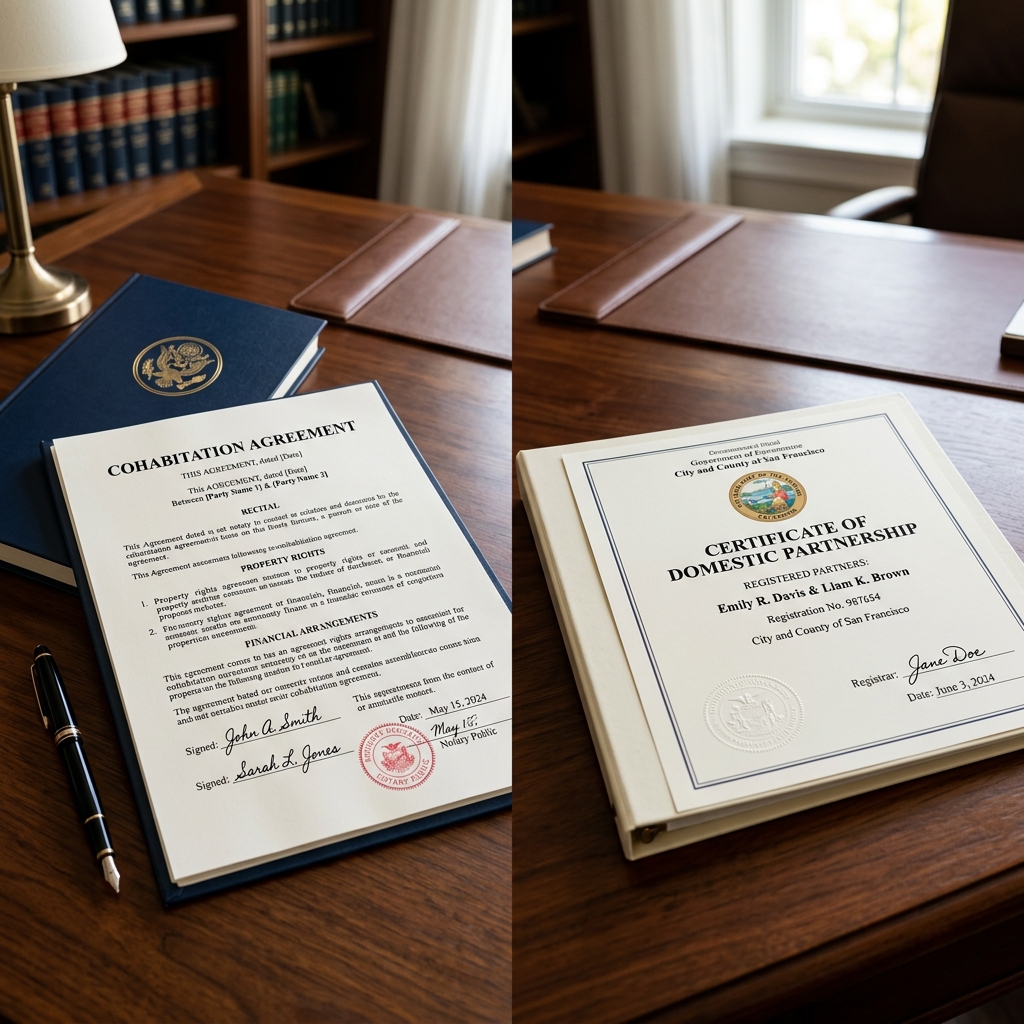
Many couples live together without getting married, but few realize that the way they formalize their relationship can dramatically affect property rights, healthcare decisions, tax treatment, and what happens if they separate or one partner dies. Understanding the difference between cohabitation agreements and domestic partnerships is essential for protecting both partners and avoiding costly disputes later on.
This article explains how these two legal tools work, what each can and cannot do, and practical factors to consider when deciding which option fits your situation.
Core Concepts: What Each Relationship Structure Means
What Is a Cohabitation Agreement?
A cohabitation agreement is a private contract between two people who live together but are not married, setting out their financial arrangements, property rights, and responsibilities during the relationship and if it ends. These agreements are typically enforced under general contract law rather than specific family-law statutes.
Common features of cohabitation agreements include:
- How existing assets are owned and titled
- Division of property if the relationship ends
- Responsibility for debts and ongoing bills
- Arrangements for support or expense sharing
- Rules around jointly acquired assets (e.g., a house or car)
Because they are contracts, cohabitation agreements are highly customizable. Couples can tailor the terms to their particular financial and personal situation, subject to general requirements for valid contracts (such as voluntary consent and legality of the terms).
What Is a Domestic Partnership?
A domestic partnership is a legally recognized relationship created under state or local law between two adults who live together in a committed, intimate relationship but are not married. In jurisdictions that recognize them, domestic partnerships can grant certain rights and benefits that resemble those available to married couples, such as hospital visitation, some health insurance access, and limited tax or employment-related advantages.
Key features of domestic partnerships typically include:
- Formal registration or filing with a government office
- Recognition by state or local law as a family-like unit
- Access to specific benefits (e.g., health insurance, leave rights) where permitted
- Defined rules for dissolution, often through court or administrative processes
Unlike cohabitation agreements, domestic partnerships are not simply private contracts. They exist because a statute, ordinance, or administrative rule explicitly creates them and specifies the rights, obligations, and procedures involved.
Side-by-Side Comparison
The following table highlights major differences between cohabitation agreements and domestic partnerships. Specific outcomes vary by jurisdiction, but the general contrasts are similar across many U.S. states.
| Feature | Cohabitation Agreement | Domestic Partnership |
|---|---|---|
| Legal basis | Private contract, enforced under general contract law | Relationship status created by statute or regulation |
| Government recognition of couple | No independent recognition as a family unit | Recognized as a domestic unit for specific legal purposes |
| Creation process | Drafting, signing, and execution of written agreement | Registration or filing with designated government office |
| Scope of rights | Property, debts, financial arrangements, some support terms | Benefits similar to marriage in limited areas (health, leave, some inheritance) depending on jurisdiction |
| Healthcare decision-making | Can designate rights via powers of attorney or separate documents | Often recognized for hospital visitation and possibly medical decision-making |
| Parental status | Does not automatically confer parentage; must follow family-law rules | May support recognition of parental rights in certain states |
| Dissolution | Typically ends by mutual agreement, termination clauses, or court enforcement of contract terms | Requires formal termination or dissolution process |
| Availability across states | Generally available wherever contract law applies | Only some states and cities recognize domestic partnerships |
| Interaction with federal law | Limited; treated as contract, not marital status | Federal government does not treat domestic partners as married, limiting federal benefits |
Rights and Benefits: What You Actually Get
Property and Financial Matters
Cohabiting couples who do not marry and do not have any legal protections can face significant uncertainty when a relationship ends. Cohabitation agreements aim to prevent disputes by clearly stating who owns what and how assets and debts will be divided if the partners separate.
- Ownership of existing assets: Agreements often list which assets belong to each partner individually.
- Joint purchases: Couples can specify how jointly acquired property is titled and what happens on breakup or death.
- Support and expenses: Terms can outline how rent, mortgage payments, utilities, and other ongoing costs will be shared.
Domestic partnerships, by contrast, may grant property-related rights automatically, similar to marriage, depending on the jurisdiction. Examples may include:
- Presumption of joint ownership of certain property
- Limited inheritance rights if one partner dies without a will
- Eligibility for certain benefits from employers, such as health insurance coverage for a partner
Because domestic partnership rules vary widely, couples should review the specific statute or local ordinance that applies in their area.
Healthcare, Hospital Visitation, and End-of-Life Issues
Domestic partnerships are often used to secure hospital visitation rights and recognition for medical decision-making when one partner is incapacitated. Some jurisdictions treat domestic partners similarly to spouses when determining who can act for a patient who cannot communicate, though details differ by state.
Cohabitation agreements alone typically do not grant medical decision-making authority. Couples generally need separate documents, such as healthcare powers of attorney or advance directives, to ensure each partner can make medical decisions if the other is incapacitated.
Employment and Tax Benefits
In some states and for certain employers, domestic partners may be eligible for benefits such as health insurance coverage, family or sick leave, or death benefits. However, these benefits are more limited than those available to married spouses, and federal tax law does not treat domestic partners like married couples.
Cohabitation agreements do not themselves create tax or employment benefits. They may indirectly affect tax and financial planning by clarifying ownership and obligations, but the federal government and most states will not treat cohabiting partners as married for tax purposes.
Legal Recognition and Enforceability
How Domestic Partnerships Are Created and Terminated
Domestic partnerships come into existence through registration procedures established by a state or municipality, such as filing forms with a secretary of state, vital records office, or family court. Dissolution usually requires a similar formal process, which may include waiting periods or court proceedings.
For example, some U.S. states require domestic partners to file termination papers with a state agency or bring a dissolution action in court, particularly if children or joint property are involved. These requirements make domestic partnerships more formal and structured than simple cohabitation.
How Cohabitation Agreements Are Formed
Cohabitation agreements must meet the basic requirements of contract law: they generally must be in writing, signed by both parties, and entered into voluntarily without coercion. Many states recommend or require each party to have an opportunity to seek independent legal advice and understand the terms before signing.
Courts are more likely to enforce cohabitation agreements that:
- Use clear language and specific terms
- Are not unconscionably one-sided
- Do not violate public policy (for example, by attempting to waive child support obligations)
- Were executed with full disclosure of relevant financial information
Because there may be no specific statute governing cohabitation agreements, enforcement typically relies on general contract principles and case law.
When Might You Prefer One Over the Other?
Situations Favoring a Cohabitation Agreement
A cohabitation agreement may be more appropriate if:
- You live in a state that does not recognize domestic partnerships.
- You want a flexible arrangement tailored to your unique financial situation.
- One or both partners have significant premarital assets or business interests and want clarity around ownership and division.
- You prefer not to undergo a formal registration or court-based process but still want enforceable rules governing property and expenses.
Situations Favoring a Domestic Partnership
A domestic partnership may be more suitable if:
- Your state or city offers meaningful legal benefits to registered domestic partners, such as health insurance access or leave rights.
- You want governmental recognition of your relationship without marrying.
- You seek a legal framework that approximates marriage in limited ways but are not ready or able to marry.
- Your employer or local government offers specific benefits only to registered domestic partners.
In practice, some couples use both tools together: they register a domestic partnership and also sign a cohabitation or partnership agreement addressing property, support, and other financial matters. This layered approach can provide both state recognition and explicit contractual protections.
Practical Steps to Protect Your Relationship
Assess Your Legal Landscape
The legal options available to you depend heavily on your jurisdiction. Some states recognize domestic partnerships, some rely primarily on marriage and cohabitation agreements, and others have hybrid approaches. Before deciding, couples should:
- Check whether domestic partnerships are recognized in their state or municipality.
- Review local rules on dissolution and benefits.
- Consider how courts in their jurisdiction treat cohabitation agreements and “living together” contracts.
Consult Legal and Financial Professionals
Because these arrangements affect property, tax, and long-term planning, it is wise to involve professionals:
- Family-law attorneys: to draft or review any agreement and explain local rules on domestic partnerships and contract enforcement.
- Financial planners: to help align property and ownership structures with long-term goals.
- Estate planning lawyers: to coordinate wills, powers of attorney, and beneficiary designations with your chosen arrangement.
Frequently Asked Questions
Do cohabitation agreements replace the need for a will?
No. A cohabitation agreement focuses primarily on property division and financial arrangements between partners. It does not replace a will or other estate planning tools. Couples should still create wills and, where appropriate, trusts and beneficiary designations to ensure assets pass as intended on death.
Can domestic partners receive the same federal tax benefits as married couples?
Generally not. The federal government recognizes marriages but does not treat domestic partnerships as equivalent to marriage for federal tax purposes. Domestic partners may be eligible for certain state-level or employer-based benefits, but federal tax rules and many federal programs still distinguish between married and unmarried individuals.
Are cohabitation agreements enforceable everywhere?
In many jurisdictions, cohabitation agreements are enforceable under general contract law, provided they meet standard requirements and do not violate public policy. However, details may vary, and some courts scrutinize these contracts closely, especially regarding support and child-related provisions. Local legal advice is essential.
What if our state does not recognize domestic partnerships?
If your state does not recognize domestic partnerships, you can still use private tools such as cohabitation agreements, healthcare powers of attorney, and wills to protect your relationship and clarify your rights. Some municipalities may offer limited domestic partner registries, but their effect is typically narrower than state-level recognition.
Is it possible to move from a domestic partnership to marriage?
Yes. In most jurisdictions, domestic partners may later choose to marry. The process typically involves dissolving or converting the domestic partnership according to local rules and then completing the standard marriage procedures. Couples should review how their property and benefits will be treated during this transition.
References
- Everything You Need to Know About Cohabitation Agreements — DBMA Law. 2022-05-12. https://dbmalaw.com/blog/everything-you-need-to-know-about-cohabitation-agreements
- Massachusetts Law About Unmarried Couples and Domestic Partnerships — Massachusetts Trial Court Law Libraries. 2023-08-01. https://www.mass.gov/info-details/massachusetts-law-about-unmarried-couples-and-domestic-partnerships
- What is a Domestic Partnership? — LawDepot. 2023-04-10. https://www.lawdepot.com/us/resources/family-articles/what-is-a-domestic-partnership/
- Domestic Partnership — Overview of Domestic Partnerships. 2021-06-01. https://en.wikipedia.org/wiki/Domestic_partnership
- Cohabitating Couples and Domestic Partnerships — Smith Strong, PLC. 2022-03-15. https://www.smithstrong.com/library/cohabitation-and-domestic-partnerships.cfm
- What Unmarried Couples in Tennessee Need to Know About Cohabitation Agreements — Casey, Simmons & Bryant, PLLC. 2023-06-20. https://www.caseysimmonsandbryant.com/blog/2023/june/what-unmarried-couples-in-tennessee-need-to-know/
Similar Articles








Read full bio of medha deb


