
When a Cocktail Napkin Becomes a Million‑Dollar Contract
How handwritten promises on bar napkins can turn into real, enforceable contracts worth hundreds of thousands or even millions of dollars.
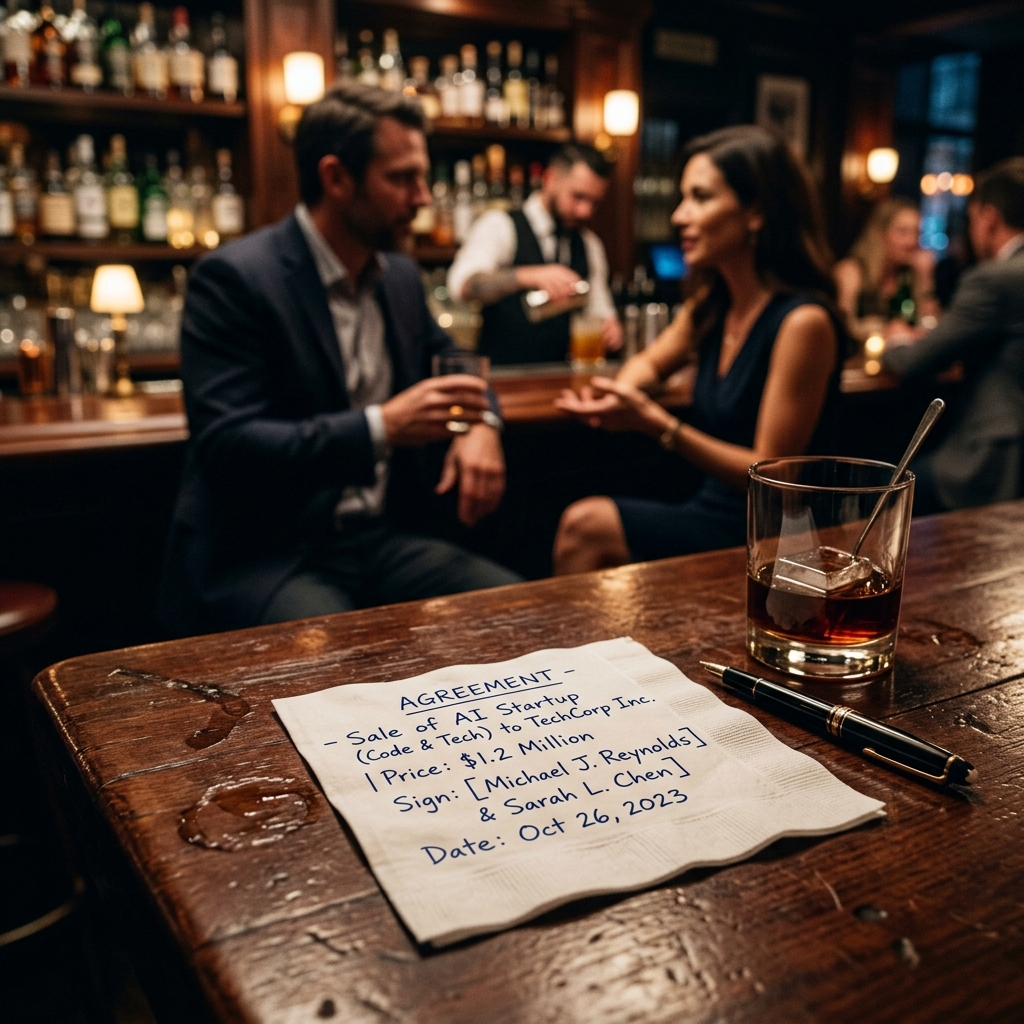
Stories of contracts written on cocktail napkins are more than law school folklore. At times, they become real lawsuits involving hundreds of thousands or even millions of dollars, forcing courts to answer a simple but high-stakes question: can those hastily scribbled words really form a binding contract? Courts have repeatedly held that the answer can be yes when basic requirements of contract law are satisfied.
From Casual Promise to Courtroom Battle
Informal agreements often start with friendly conversations, optimism, and trust. In one Alaska dispute, a newspaper owner allegedly wrote on a napkin that she would pay a former editor $100,000 at the end of each calendar year for ten years—a total of $1 million. The first payment was made, but a later falling-out led to disagreement over whether the remaining promise was enforceable, landing the parties in court.
That Alaska case is far from unique. Contract law includes other examples where important deals were recorded on a napkin or similar scrap of paper—yet courts treated them seriously when:
- The writing contained clear financial terms.
- Both parties signed the document.
- The circumstances showed that the parties were acting seriously, not joking.
Understanding why courts sometimes enforce these agreements requires a look at the core elements of contract formation.
Core Legal Requirements Behind Informal Contracts
For any contract to be enforceable—whether written on fine stationery or a bar napkin—courts look for a familiar set of elements: offer, acceptance, consideration, mutual assent, and capacity.
| Element | What It Means | How It Appears in Napkin Cases |
|---|---|---|
| Offer | A clear proposal to enter a deal on specific terms. | A written promise like “I agree to pay $100K each year for 10 years.” |
| Acceptance | Unambiguous agreement to the offer. | The other party signing the napkin or otherwise agreeing. |
| Consideration | Each side gives or promises something of value. | Money in exchange for services, ownership, or rights. |
| Mutual assent | “Meeting of the minds” judged by outward conduct. | Serious negotiation, writing terms, and signing—even if written on a napkin. |
| Capacity | Legal ability to contract (e.g., not severely impaired). | Participants must be sufficiently sober and competent to understand the deal. |
When these elements are present, courts can conclude that an enforceable contract exists—regardless of the document’s physical form.
Why the Medium Usually Does Not Matter
A recurring lesson from contract cases is that the medium of the writing is usually irrelevant. Judges focus on the content and context, not the type of paper. This principle extends beyond napkins to emails, text messages, and handwritten notes.
In the American legal system, the dominant approach is the objective theory of contracts. Under this theory, courts decide whether a contract exists by looking at what a reasonable observer would conclude from the parties’ words and actions—not their secret thoughts.
As one influential court explained, the law attributes to a person an intention that matches the reasonable meaning of his or her words and acts. Jokes and offhand comments can be ignored, but if someone writes out detailed terms, negotiates those terms, and signs the paper, a reasonable person might see that as a serious agreement—even in a social setting.
Classic Precedent: The Barroom Farm Sale
The famous case often cited in law schools, involving a farm sale agreed in a bar on a piece of paper, illustrates how courts approach these situations. Two men discussed selling a farm while drinking. They wrote out the purchase terms, rewrote the agreement to correct details, and had both spouses sign. One later argued it was a joke and that he was too intoxicated for the agreement to count.
On appeal, the state’s highest court disagreed. Applying objective theory, it emphasized:
- The parties spent meaningful time discussing specific terms.
- The seller rewrote the agreement to ensure accuracy.
- Both spouses signed, signaling seriousness.
- The buyer took steps afterwards to enforce the deal.
The court held that a person cannot escape a contract by claiming it was made in jest when their outward behavior would lead a reasonable person to believe the agreement was genuine. Importantly, the outcome reinforced that a contract can be valid even if drafted on a simple piece of paper in a casual environment.
Napkin Promises in Modern Business Disputes
Recent disputes show that napkin agreements are not just historical curiosities. In Alaska, a handwritten promise involving a ten-year payout to a former newspaper executive triggered litigation after the parties’ relationship deteriorated. The napkin allegedly contained specific payment amounts and timing, and the first installment was paid, supporting the argument that the agreement was taken seriously at least initially.
In other reported matters, napkins have been used to memorialize:
- Licensing arrangements for intellectual property such as brand names.
- Joint venture profit-sharing understandings.
- Preliminary deal terms later incorporated into more formal contracts.
In one example discussed by practitioners, the words on a napkin were found to contain everything needed for a license agreement: permission to use a name, clear limitations, and a fee based on profits. Even without the word “license,” the court treated the writing as a valid contract because all the essential elements were present.
Key Risks of Informal Napkin Contracts
Although a napkin can function as a contract, doing business this way invites significant risk. Common problem areas include:
- Missing essential terms
Important details like timing, performance standards, dispute resolution, and termination conditions might be omitted, leading to ambiguity and litigation. - Statute of Frauds concerns
In many jurisdictions, certain contracts must be in writing and signed, especially agreements that cannot be performed within one year or those involving real estate, but the writing still has to show clear terms. - Interpretation disputes
Vague language on a napkin can leave room for competing interpretations about what was intended. - Evidence problems
Napkins can be lost, damaged, or challenged as inauthentic. If the original document disappears, proving its content can be difficult. - Informal tone
Jokes, side comments, and an overall casual atmosphere make it easier for one side to argue there was no serious intent.
Because of these risks, lawyers frequently acknowledge that while a napkin can theoretically be a contract, relying on one is far from best practice and often ill-advised.
Practical Lessons for Business Owners and Professionals
Entrepreneurs, executives, and professionals can learn several practical lessons from napkin cases:
- Take written commitments seriously
If you write and sign specific terms, a court may treat them as binding even if you never speak to a lawyer or draft a formal document. - Clarify whether discussions are preliminary
Use language like “non-binding” or “subject to formal agreement” when you want to prevent casual notes from becoming contracts. - Document follow-up communications
Emails or letters that confirm or contradict what was written on a napkin can affect how a court interprets intent. - Be cautious about combining alcohol and negotiations
Intoxication rarely excuses performance unless capacity is severely impaired, and courts focus on outward behavior. - Involve counsel sooner rather than later
Lawyers can convert rough notes into clear written contracts that reflect actual intentions and reduce the chance of costly disputes.
How Courts Evaluate Intent in Social Settings
When agreements arise in social environments such as bars, restaurants, or private gatherings, courts pay close attention to context. They ask whether a reasonable observer would believe that a serious contract was being formed.
Factors that can support a finding of genuine intent include:
- Negotiation of detailed terms rather than casual banter.
- Rewriting or revising the document to correct mistakes.
- Obtaining signatures from all relevant parties or spouses.
- Subsequent actions consistent with the agreement, such as making initial payments or hiring counsel.
On the other hand, courts are more skeptical when:
- The language is obviously humorous or exaggerated.
- No money or performance follows the alleged agreement.
- Witnesses testify that the conversation was understood as a joke.
The objective theory does not require that all parties be stone sober or in a boardroom; it requires that their words and actions would convey serious intent to an impartial observer.
Comparing Napkin Deals with Formal Contracts
| Feature | Napkin Agreement | Formal Written Contract |
|---|---|---|
| Level of detail | Often limited to key financial terms and basic promises. | Comprehensive clauses covering rights, obligations, remedies, and contingencies. |
| Risk of ambiguity | High—phrases are often vague or incomplete. | Lower when drafted carefully, using defined terms. |
| Evidence quality | Physical fragility; easier to lose or damage. | Multiple originals and digital backups typically available. |
| Litigation likelihood | Higher, because parties may interpret bare-bones terms differently. | Still possible, but disputes are framed by detailed provisions. |
| Professional involvement | Usually no lawyers present. | Commonly drafted and reviewed by counsel. |
This comparison highlights why napkin agreements are legally possible yet practically hazardous. They capture ideas quickly but rarely provide the clarity and protections that complex transactions require.
FAQs About Cocktail Napkin Contracts
Can a cocktail napkin really be a legally binding contract?
Yes, a cocktail napkin can be a legally binding contract if it contains clear terms, is signed or otherwise accepted, and reflects mutual assent and consideration. Courts focus on substance, not the type of paper.
Do I need the word “contract” or “license” written on the napkin?
No. A contract can exist without using formal labels. In at least one case, a napkin contained all the elements of a license agreement even though the word “license” never appeared; the court enforced it based on the actual terms.
What if I was drinking when I signed the napkin?
Moderate intoxication usually does not invalidate a contract. Courts consider whether you understood what you were doing and whether your outward behavior suggested serious intent. Claims of being “too drunk” rarely succeed without strong evidence of incapacity.
Can I avoid enforcement by saying it was just a joke?
Not if your words and actions would lead a reasonable person to believe the agreement was genuine. Courts applying objective theory reject attempts to escape contracts by recharacterizing them as jokes after the fact.
What should I do if I already signed a napkin agreement?
Gather all related documents and communications, including emails and payment records, and consult an attorney promptly. Legal counsel can assess whether the writing likely qualifies as a contract and advise on potential strategies in negotiation or litigation.
References
- Real Cocktail Napkin Contract Trial Underway — FindLaw Legal Blogs. 2017-09-22. https://www.findlaw.com/legalblogs/strategist/real-cocktail-napkin-contract-trial-underway/
- Trial Over Million-Dollar Cocktail Napkin Contract Underway in Alaska — FindLaw Legal Blogs. 2017-09-22. https://www.findlaw.com/legalblogs/legally-weird/trial-over-million-dollar-cocktail-napkin-contact-underway-in-alaska/
- Can Words Scrawled On A Cocktail Napkin Be An Enforceable License Agreement Worth Millions? — Foley & Lardner LLP. 2023-05-04. https://www.mondaq.com/unitedstates/contracts-and-commercial-law/1331208/can-words-scrawled-on-a-cocktail-napkin-be-an-enforceable-license-agreement-worth-millions
- How AI Could Have Solved the Famous “Bar Napkin” Contract Case — CS Disco Blog. 2023-08-15. https://csdisco.com/blog/ai-solves-bar-napkin-case
- The Peculiar Case of Lucy v. Zehmer — Legal Research Club, University of Alabama. 2020-01-27. https://legalresearchclub.ua.edu/blog/2020/01/27/the-peculiar-case-of-lucy-v-zehmer/
- Can a Napkin Technically Be a Contract? — The Weaver Law Firm (Video Transcript). 2017-06-19. https://www.facebook.com/TheWeaverLawFirm/videos/%EF%B8%8F-can-a-napkin-technically-be-a-contract-yeswould-attorney-richard-weaver-ever-r/1529245295065735/
Similar Articles








Read full bio of medha deb


