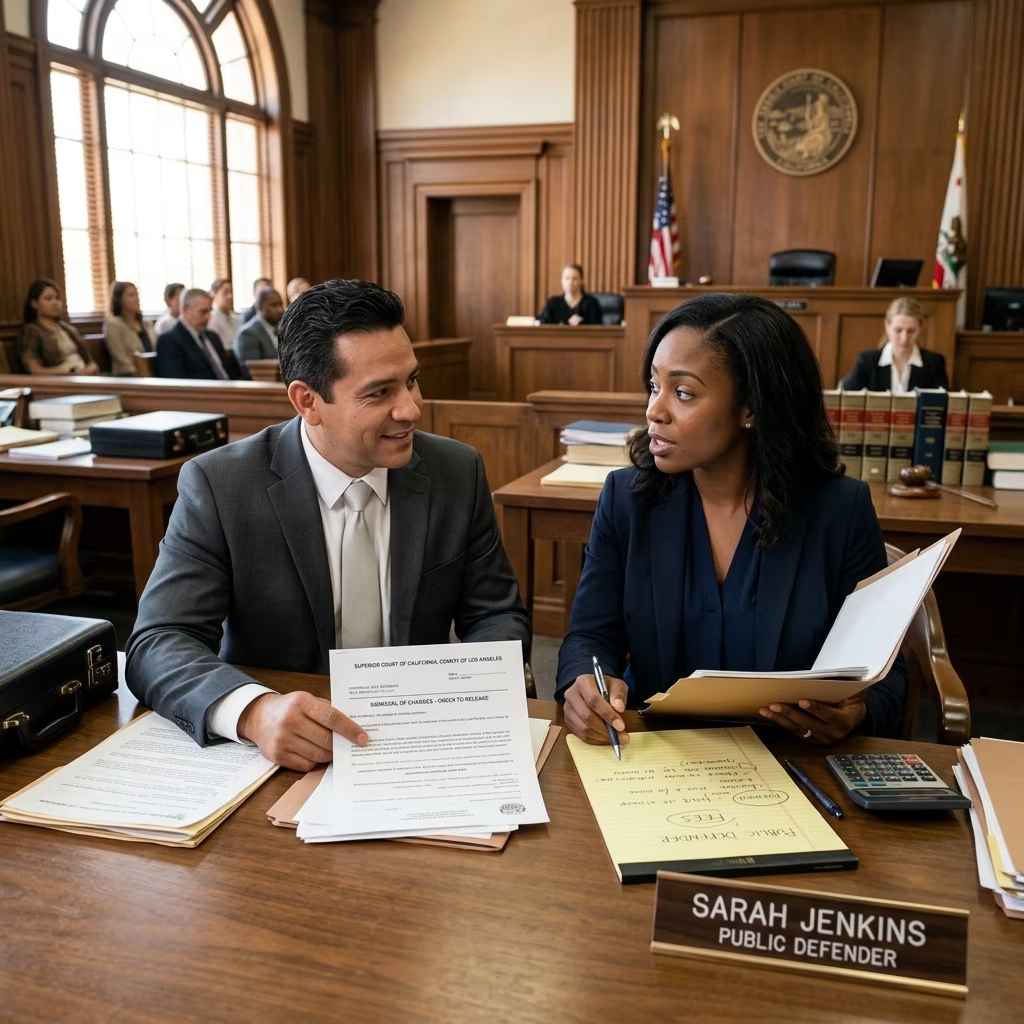
Being charged with a crime in California is stressful enough without worrying about the cost of a lawyer. Many people rely on a public defender because they cannot afford private counsel. But what happens to those fees when you are acquitted or your case is dismissed? This article explains how California handles public defender costs, when fees can be waived, and what it means to be found “not guilty” for your wallet.
Understanding Public Defender Representation in California
Public defenders are government-funded attorneys who represent people accused of crimes and who cannot afford to hire private counsel. The right to appointed counsel stems from the U.S. Supreme Court’s decision in Gideon v. Wainwright, which held that indigent defendants facing serious criminal charges must have access to a lawyer at no cost if they cannot pay.
In California, public defenders generally represent:
- Individuals charged with criminal offenses in state court who meet financial eligibility requirements.
- Persons facing civil commitment or contempt related to certain orders, such as child support, when incarceration is a possible consequence.
While the constitutional right to counsel is clear, the question of who pays for that representation is more complex. Many states impose fees on defendants for public defense services; California has historically allowed certain local fee practices but is also moving toward limiting or eliminating these costs.
Key Concepts: Registration Fees, Attorney Costs, and Court Assessments
Across the United States, jurisdictions may charge different types of fees connected to public defender representation:
- Upfront registration or application fees for requesting a public defender.
- Reimbursement of attorney costs after the case, based on a defendant’s ability to pay.
- Court fines and costs, including costs of prosecution, which are separate from public defender expenses.
In California, a county may historically have used a registration fee for public defenders, often capped at a relatively low amount, such as $25 or $50. However, the collection of these fees must respect state law and constitutional limits—especially the requirement that a defendant’s ability to pay be considered before costs are imposed.
Ability-to-Pay Hearings: How Courts Decide Whether You Owe
California courts commonly use an ability-to-pay hearing to determine whether a defendant should reimburse some or all of the costs of appointed counsel.
At this hearing, the judge may consider factors such as:
- Your income and sources of financial support.
- Necessary living expenses, including housing, food, and medical costs.
- Whether you support dependents or have other obligations.
- Any assets or savings that realistically could be used to pay fees.
Depending on this evaluation, the court can order:
- No payment, if you lack the present ability to pay.
- Partial payment, reflecting a share of the costs within your means.
- Full payment, in relatively rare situations where a defendant has sufficient resources.
Both California law and constitutional doctrine require that fees cannot be imposed in a way that effectively penalizes indigent defendants for exercising their right to counsel. This is especially important for people whose cases end without a conviction.
Acquittal, Dismissal, and “Found Innocent”: What These Outcomes Mean
In common language, people often say they were “found innocent” if a jury returns a not guilty verdict or the state drops charges. In legal terms, there are several different favorable outcomes:
| Outcome | What It Means | Typical Impact on Fees |
|---|---|---|
| Not guilty verdict | A jury or judge concludes the prosecution did not prove its case beyond a reasonable doubt. | No criminal conviction; courts generally do not impose fines or prosecution costs based on the charges. |
| Case dismissal | The prosecution or court terminates the case before trial, often for lack of evidence or legal defects. | |
| Conviction | The defendant pleads guilty or is found guilty at trial. | May trigger fines, restitution, prosecution costs, and possible consideration of public defender reimbursement. |
These distinctions matter because many cost obligations are tied directly to a conviction. When you are acquitted or your case is dismissed, you typically are not responsible for court fines or costs associated with a conviction in that case.
What Happens to Public Defender Fees When You Are Not Convicted?
In California, if you win your case—either through a not guilty verdict or a dismissal—the financial picture usually looks better than if you are convicted.
Key points:
- You are not ordered to pay criminal fines or prosecution costs tied to a conviction, because there is no conviction.
- Any consideration of public defender reimbursement must still go through an ability-to-pay assessment and cannot be imposed automatically regardless of your finances.
- Some counties have historically used small registration fees, but state-level reforms and constitutional concerns have led to restrictions or elimination of these fees.
In practice, many indigent defendants in California who are represented by public defenders and later not convicted do not end up paying significant amounts toward attorney fees. When courts apply ability-to-pay rules, a person with no meaningful income or assets will generally not be required to reimburse those costs.
California’s Evolving Approach to Public Defender Fees
The landscape of public defender fees is changing nationwide, and California has become one of the states more protective of indigent defendants.
Research on public defense systems shows:
- Most states still authorize some form of fee or cost recovery from defendants who use appointed counsel.
- Upfront application fees and post-conviction cost assessments can discourage people from seeking legal help or create long-term debt.
- California is among a small group of states that have moved to limit or remove statutory authority for these fees, making it harder for local systems to charge indigent defendants simply for exercising their right to counsel.
For example, policy analysis has highlighted that California is one of only a handful of jurisdictions without statewide statutes authorizing public defense fees against defendants officially deemed too poor to hire counsel. At the same time, county-level practices—such as modest registration fees—have been scrutinized for compliance with constitutional rules requiring ability-to-pay determinations.
Advocacy groups and researchers argue that eliminating or curbing these fees is crucial for ensuring public defenders remain truly accessible to the poor.
Local Practices: Illustrative Example from a California County
Although California has restricted statewide fee authority, local courts may still conduct ability-to-pay hearings to decide whether any cost recovery is appropriate. One county description of practice provides a helpful illustration:
- Defendants represented by appointed counsel may be asked to pay a registration fee up to a small statutory maximum, but not if they cannot afford it.
- When the case ends, the judge conducts a hearing to determine whether the defendant has the present ability to pay all or some of the costs of their court-appointed attorney.
- If the defendant does not have the ability to pay, the court does not order reimbursement—whether or not the case resulted in conviction.
This example underscores that, in practice, indigent defendants who truly lack financial resources will often bear little or no direct financial burden for public defender services. That protection is even stronger when a case ends in acquittal or dismissal, because the separate layer of conviction-based fines and costs is removed.
Misconceptions About “Free” Public Defenders
It is a common misconception that public defenders are either always free or, conversely, that you will automatically owe large sums anytime you use one. The reality lies somewhere in between:
- Public defender services are funded by government budgets and are not billed like private attorney invoices.
- However, many jurisdictions—though less frequently in California—have mechanisms that seek partial repayment from defendants, especially after a conviction.
- Constitutional law requires that access to counsel not be conditioned on payment a defendant cannot afford, and that any fees be compatible with the right to effective assistance of counsel.
For defendants in California who are ultimately not convicted, public defender representation tends to function much closer to the ideal of “free counsel”—subject to the court’s assessment of ability to pay.
Practical Steps If Your Case Was Dismissed or You Were Found Not Guilty
If your California criminal case has ended favorably and you are concerned about public defender fees, consider the following practical steps:
- Review the final court orders: Check whether the judge issued any order concerning reimbursement of attorney fees or court costs.
- Ask about an ability-to-pay hearing: Confirm whether such a hearing took place, or whether one is scheduled, and prepare financial information if needed.
- Document your finances: Collect evidence of your income, expenses, and debts to show the court you lack capacity to pay substantial fees.
- Speak with your public defender: They can explain local practice in your county and advise how to present your situation to the court.
- Monitor mail and court notices: Make sure you do not miss any hearing where fees might be addressed.
For most people who were truly unable to afford private counsel and whose cases ended in acquittal or dismissal, the likelihood of significant public defender fee obligations in California is low—especially when courts follow the required ability-to-pay standards.
Frequently Asked Questions (FAQs)
Do I have to pay public defender fees in California if my case was dismissed?
If your case was dismissed, you typically will not owe fines or prosecution costs based on a conviction because there is no conviction. Any question of reimbursing public defender costs depends on a court’s ability-to-pay assessment, and if you cannot afford to pay, you should not be required to do so.
Are public defenders truly free for indigent defendants?
The constitutional right to counsel guarantees representation without upfront payment when you cannot afford an attorney, but many states use mechanisms to recover some costs later. California has limited statewide authority for such fees, and courts must consider your ability to pay before ordering reimbursement.
What is an ability-to-pay hearing?
An ability-to-pay hearing is a court proceeding where a judge examines your financial situation to decide whether you can reasonably contribute to the costs of your court-appointed attorney. The court may order no payment, partial payment, or full payment based on your income, expenses, assets, and obligations.
If I am found not guilty, can the court still charge me anything?
When you are found not guilty, the court generally does not impose conviction-based fines or prosecution costs related to that charge. However, issues like preexisting payment plans, separate civil obligations, or other cases may still be relevant. For public defender fees, any reimbursement is subject to an ability-to-pay determination.
Does every state treat public defender fees like California?
No. Research shows that most U.S. states authorize some form of public defense system fees, including upfront application fees or post-conviction cost recovery. California stands out as one of the states that restricts or eliminates statutory authority for such fees against indigent defendants.
References
- Paying for a Public Defender — County of Napa. 2024-01-01. https://www.napacounty.gov/1809/Paying-for-a-Public-Defender
- FAQs – Los Angeles County Public Defender — Los Angeles County Public Defender. 2023-11-01. https://pubdef.lacounty.gov/faqs/
- PAYING FOR JUSTICE: The Human Cost of Public Defender Fees — Yale Law School Liman Center. 2016-10-01. https://law.yale.edu/sites/default/files/area/center/liman/document/pdfees-report.pdf
- State Laws Authorizing the Assessment of Public Defense System Fees — National Legal Aid & Defender Association. 2022-06-01. https://www.nlada.org/public-defense-system-fees
- A Constitutional Right, But Public Defense Comes with a Fee — Institute for Innovation in Prosecution. 2022-03-01. https://www.innovatingjustice.org/updates/public-defender-fees/
- Public Defender Fees Must Go — ACLU of Southern California. 2017-06-27. https://www.aclusocal.org/news/public-defender-fees-must-go