
Civil Litigation Threatens First Amendment Assembly Rights
Explore how novel negligence theories in tort law threaten the right to protest.
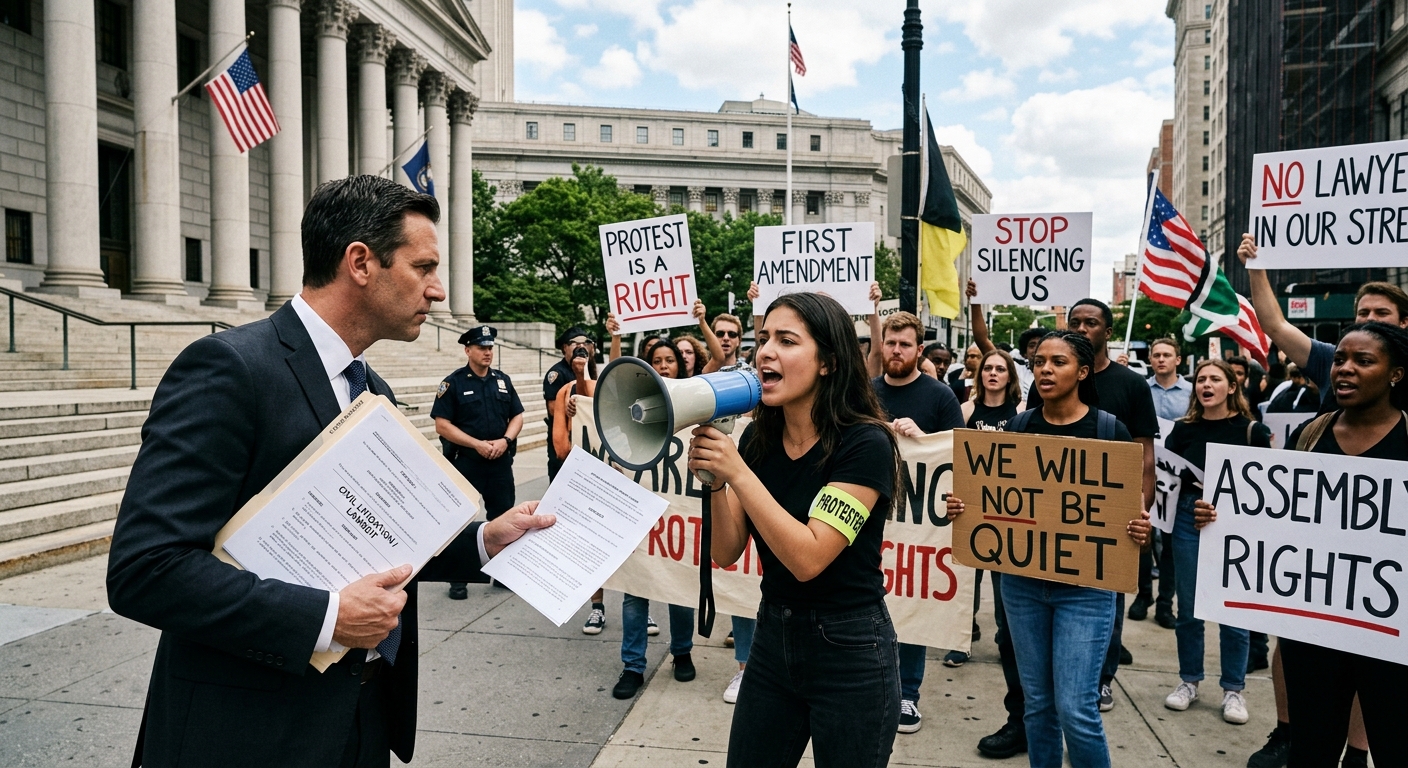
The Foundation of Assembly Rights and the New Legal Threat
American democracy has always relied on the robust, sometimes messy, exercise of the First Amendment. The freedom of speech and the right of the people to peaceably assemble are not merely theoretical concepts etched into constitutional parchment; they are the practical engines of social, political, and cultural change. From the women’s suffrage movement and labor rights strikes to contemporary mass mobilizations advocating for racial justice and environmental protections, protests have served as a vital mechanism for citizens to voice their grievances and demand accountability from their government.
However, these foundational constitutional guarantees are currently facing a sophisticated and potentially devastating legal challenge. The contemporary threat to free assembly no longer comes solely from riot police, legislative bans, or tear gas, but from the quiet, calculating, and financially ruinous realm of civil tort law. Across the nation, novel legal theories are being tested in federal courts that could fundamentally alter the landscape of public dissent by weaponizing the financial risks of organizing.
At the very heart of this modern legal battle is a profound question of liability: Can the organizer of a peaceful protest be held financially responsible if a single, unaffiliated attendee commits an illegal or violent act? This question, recently debated extensively in federal appellate courts and brought to the doorstep of the United States Supreme Court, carries staggering implications for the future of activism in America. If organizers face the constant threat of civil lawsuits and bankruptcy due to the unpredictable actions of rogue individuals, the constitutionally protected right to protest may rapidly become a luxury that very few citizens can afford to exercise.
The Genesis of the Legal Battle: The Baton Rouge Incident
To fully comprehend the current jeopardy facing protest rights, one must examine the specific, highly publicized legal conflict that brought this civil liability issue to the forefront of constitutional jurisprudence. In July 2016, following the fatal police shooting of Alton Sterling, large-scale protests erupted in Baton Rouge, Louisiana. Among the many organizers and participants present was DeRay Mckesson, a well-known civil rights activist associated with the Black Lives Matter movement.
The demonstration was largely peaceful, but tensions escalated rapidly when law enforcement moved to clear protesters who were allegedly obstructing a public highway in violation of local ordinances. In the ensuing chaos and confrontation between police and the crowd, an unidentified individual threw a heavy object—described in official court documents as a rock or a piece of concrete—which struck and severely injured a local police officer. To protect his privacy, the officer was identified in the subsequent lawsuit only as “Officer Doe.”
Crucially, the injured officer did not sue the individual who threw the rock, as that person fled the scene and was never positively identified. Instead, the officer filed a sweeping civil lawsuit against Mckesson and the broader Black Lives Matter movement. The plaintiff’s lawsuit did not allege that Mckesson threw the object himself, nor did it claim that he explicitly directed, encouraged, or paid anyone else to commit acts of violence against law enforcement. Instead, the legal claim rested on a highly controversial application of state tort law: negligence. The officer’s legal team argued that by organizing a protest that illegally blocked a highway, Mckesson created an inherently dangerous environment where a violent clash with law enforcement was a “foreseeable” outcome. This legal maneuver successfully shifted the focus away from individual criminal culpability and placed the burden of crowd control directly on the shoulders of the protest organizer.
Deciphering the “Negligent Protest” Theory
The concept of holding organizers liable under a theory of “negligent protest” represents a seismic shift in how the judicial system evaluates First Amendment activities. Historically, the legal threshold for holding a political leader or organizer responsible for the actions of a massive crowd has been incredibly high, generally requiring proof of specific intent to incite imminent violence. However, the United States Court of Appeals for the Fifth Circuit—which holds jurisdiction over federal cases originating in Louisiana, Mississippi, and Texas—took a markedly different approach to the dispute.
To establish negligence in a standard tort case, a plaintiff must typically prove four elements: duty, breach, causation, and damages. The Fifth Circuit ruled that the officer’s lawsuit against Mckesson could proceed to trial, effectively endorsing the idea that an organizer has a duty to not provoke a police response that could predictably lead to third-party violence. The majority opinion argued that because Mckesson allegedly led protesters onto a public highway in clear violation of state law, it was entirely predictable that police would respond to clear the obstruction, and equally predictable that such a tense confrontation could turn violent.
By applying a standard negligence framework to a political demonstration, the Fifth Circuit effectively bypassed the robust First Amendment safeguards that typically shield political speech and assembly from civil liability. This ruling sent shockwaves through civil rights organizations, journalists, and legal advocacy groups. Under the Fifth Circuit’s logic, any individual who plans, organizes, or even shares a flyer for a political rally could face catastrophic financial ruin if a single person in the crowd decides to act unlawfully. Because the “foreseeability” standard is notoriously broad, one could argue that almost any altercation at a highly charged political event is technically foreseeable, creating a legal weapon designed to suppress dissent by making the financial risks of organizing completely untenable.
The Crucial Precedent: NAACP v. Claiborne Hardware Co.
To fully grasp why civil liberties advocates view the Fifth Circuit’s decision as so dangerous, it is necessary to revisit a landmark Supreme Court ruling that has protected activists for over four decades: NAACP v. Claiborne Hardware Co. (1982). During the 1960s, the NAACP organized a massive boycott of white-owned businesses in Mississippi to protest systemic racial discrimination. During the lengthy boycott, some unaffiliated individuals engaged in acts of violence and intimidation against those who refused to honor the boycott. The targeted merchants sued the NAACP and its local leaders for massive financial damages, arguing that the organizers were inherently responsible for the economic harm and the associated violence.
The Supreme Court unanimously ruled in favor of the NAACP, establishing a clear and historically robust standard for protest liability. The Court decreed that civil liability cannot be imposed on an individual or organization for the violent acts of others within the context of a political demonstration unless there is definitive proof that the organizer “authorized, directed, or ratified” the specific tortious activity. The Justices recognized that holding leaders broadly liable for the spontaneous, unauthorized actions of a sprawling crowd would impose a crippling burden on the right to free expression. Claiborne effectively immunized organizers from “guilt by association” and the exact type of negligence claims that the Fifth Circuit recently permitted, making the current legal battle a fundamental clash over constitutional precedent.
The Supreme Court’s Complex Stance in 2024
Given the glaring, high-stakes conflict between the Fifth Circuit’s ruling and the decades-old precedent set by Claiborne, many legal observers expected the United States Supreme Court to intervene rapidly and decisively strike down the “negligent protest” theory. Mckesson, supported by numerous civil liberties organizations and First Amendment scholars, petitioned the Supreme Court to review the case and formally reaffirm his constitutional protections. However, in April 2024, the Supreme Court issued an order denying certiorari, meaning it declined to hear the case.
At first glance, this denial caused widespread alarm. Various commentators and media outlets mistakenly claimed that the Supreme Court had effectively abolished the right to protest in Texas, Louisiana, and Mississippi. However, a denial of certiorari is not a stamp of approval or an endorsement of a lower court’s ruling; it simply means the Supreme Court chose not to take up the issue at that specific time for procedural or strategic reasons. Crucially, Justice Sonia Sotomayor issued a rare statement accompanying the denial, clarifying the Court’s position to prevent widespread panic. She explicitly emphasized that the denial of review “expresses no view about the merits of Mckesson’s claim.”
Furthermore, Justice Sotomayor used her statement to point lower courts toward a recent 2023 Supreme Court decision, Counterman v. Colorado, which dealt with the threshold for unprotected “true threats.” In Counterman, the Court ruled that a purely objective standard of negligence is insufficient to punish speech; instead, the state must prove the speaker had some subjective understanding of the threatening nature of their words. Sotomayor strongly suggested that the lower courts must apply this heightened standard of intent to cases involving protest organizers. While Sotomayor’s statement provided a roadmap for future defense arguments, the stark reality remains: the Fifth Circuit’s dangerous precedent was left standing, forcing organizers in the South to operate under a massive cloud of legal jeopardy.
The Chilling Effect on Grassroots Mass Mobilization
The failure of the Supreme Court to immediately strike down the Fifth Circuit’s ruling has created a highly tangible “chilling effect” on social activism across the United States. In constitutional law, a chilling effect occurs when individuals self-censor or completely refrain from exercising their guaranteed rights due to the paralyzing fear of severe legal, penal, or financial consequences. In the realm of community organizing, this fear is now acute and deeply disruptive.
Imagine a local community group wanting to organize a peaceful march demanding clean water protections, or a student coalition planning a sit-in for educational funding. These are typically grassroots efforts, driven by passionate volunteers operating on shoestring budgets. If these organizers know that they could be sued personally—and potentially face millions of dollars in liability damages—because an unknown agitator throws a water bottle at a police officer, the decision to proceed with the event becomes incredibly fraught. Organizers are not law enforcement officers; they do not have the legal authority to search attendees, physically restrain rogue actors, or guarantee absolute peace in a massive, open public gathering.
By threatening organizers with ruinous civil litigation, the legal system inadvertently empowers bad-faith provocateurs. A single individual, seeking to intentionally undermine a movement, can attend a rally, commit a minor act of violence, and single-handedly trigger a lawsuit that permanently bankrupts the leadership of the movement. This dynamic disproportionately impacts marginalized communities who rely on mass mobilization as their primary tool to combat systemic injustice. Without the financial buffer of massive corporate legal teams, grassroots movements are uniquely vulnerable to this form of legal warfare, which threatens to silence the voices that democratic systems need the most.
Looking Ahead: The Future of the First Amendment in the Courtroom
The battle over protest rights and civil liability is far from over. While the Supreme Court bypassed the opportunity to resolve the conflict cleanly in 2024, ongoing and future litigation will serve as a critical crucible for First Amendment law. Defense attorneys and civil rights organizations are now tasked with utilizing Justice Sotomayor’s judicial roadmap, arguing fiercely that recent rulings regarding intent and the enduring legacy of the Claiborne decision render any “negligence” standard unconstitutional when applied to speech and assembly.
In the interim, the legislative branches of state governments will also play a crucial role. While some states may attempt to codify stronger statutory protections for assembly organizers, others might introduce even more stringent anti-protest legislation, accelerating the inevitable collision course between state power and individual liberty. Ultimately, the health of a democracy is measured by its tolerance for dissent. Ensuring that citizens can assemble, speak, and petition their government without the paralyzing fear of retaliatory lawsuits is absolutely essential to maintaining the integrity of the American experiment.
Frequently Asked Questions (FAQs)
Does the Supreme Court’s 2024 decision mean protesting is illegal in the South?
No. The Supreme Court’s decision to deny certiorari did not make protesting illegal anywhere in the United States. It simply allowed a lower court’s procedural ruling to stand temporarily. Citizens still maintain a First Amendment right to peaceably assemble in Texas, Louisiana, and Mississippi. However, the lower court’s ruling dramatically increases the financial risk for those who organize protests in those specific states, potentially opening them up to civil lawsuits if third-party violence occurs.
What is the exact difference between “negligence” and “incitement” at a protest?
“Incitement” requires a very high legal bar: the organizer must intentionally direct, encourage, or urge the crowd to commit imminent violent or illegal acts. “Negligence,” as controversially applied by the Fifth Circuit, is a much lower bar. It suggests that if an organizer acts carelessly (such as leading a march onto a street without a proper permit) and violence is deemed a “foreseeable” result of that carelessness, the organizer can be held financially liable for injuries, even if they explicitly advocated for peace and never intended for violence to happen.
How does the historic Claiborne ruling protect modern organizers?
The 1982 Supreme Court case NAACP v. Claiborne Hardware Co. established a vital precedent that an individual cannot be held legally or financially liable for the violent acts of others at a political protest unless it can be definitively proven that they specifically authorized, directed, or ratified those violent acts. This ruling is the primary shield that protects peaceful organizers from being punished for the unpredictable actions of rogue individuals within a large crowd.
Can an organizer be sued if a counter-protester starts a fight?
Under traditional First Amendment standards, an organizer is strictly not liable for the actions of a counter-protester or an unaffiliated rogue attendee. However, the controversial “negligent protest” theory attempts to argue that if an organizer created a highly charged situation where a physical altercation was “foreseeable,” they might face civil litigation for the resulting injuries. Civil liberties groups strongly oppose this theory due to its potential to bankrupt activists for the actions of their opponents.
References
- Mckesson v. Doe, 592 U.S. 1 (2020) — U.S. Supreme Court / Justia. 2020-11-02. https://supreme.justia.com/cases/federal/us/592/1/
- Order List: 592 U.S. (Mckesson v. Doe Certiorari Denial & Statement) — Supreme Court of the United States. 2024-04-15. https://www.supremecourt.gov/orders/courtorders/041524zor_9m10.pdf
- Doe v. Mckesson – Fifth Circuit Court of Appeals — United States Court of Appeals for the Fifth Circuit. 2023-06-16. https://www.ca5.uscourts.gov/opinions/pub/17/17-30864-CV2.pdf
- A Right of Peaceable Assembly — Columbia Law Review. 2025-08-18. https://columbialawreview.org/content/a-right-of-peaceable-assembly/
- US Supreme Court ‘Effectively Abolished’ the Right To Protest in Texas, Louisiana and Mississippi? — Snopes. 2024-04-18. https://www.snopes.com/fact-check/supreme-court-protest-texas-louisiana-mississippi/
Similar Articles








Read full bio of medha deb


