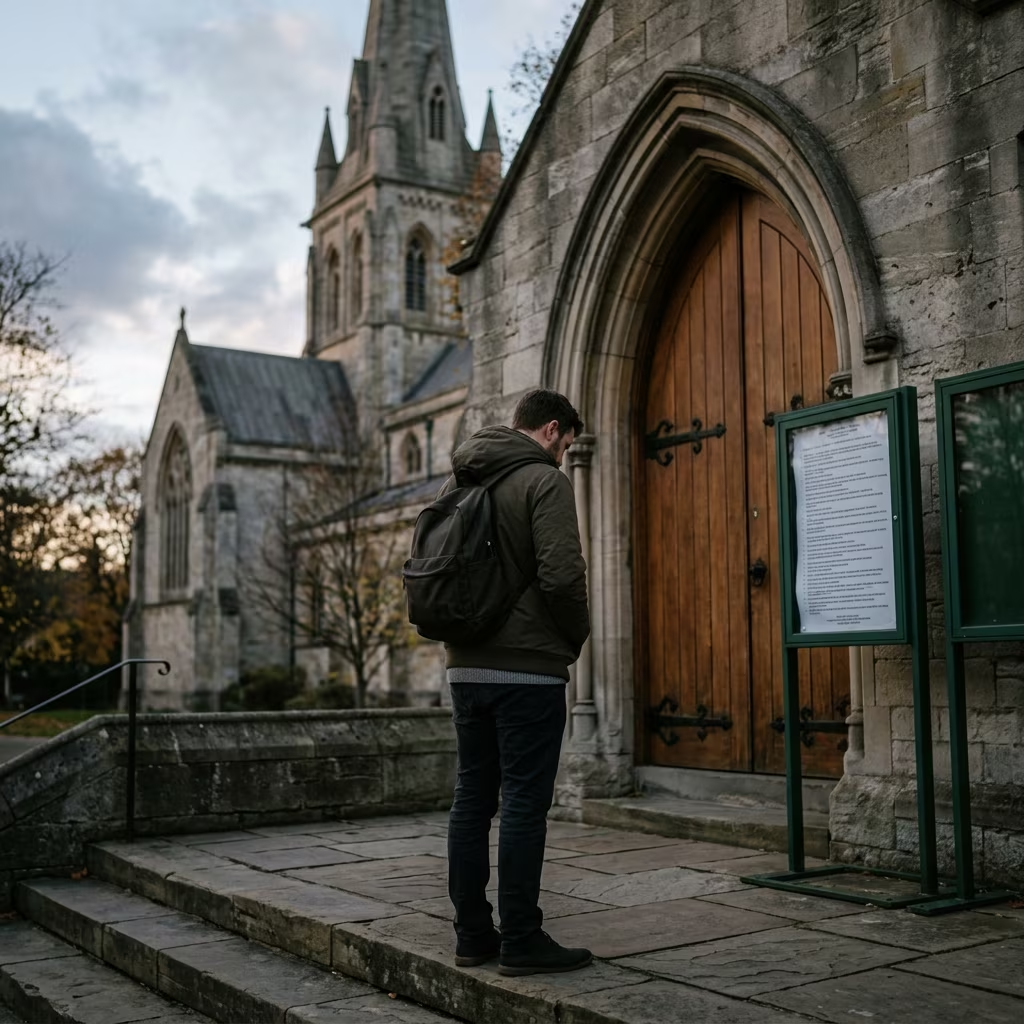
When a registered sex offender wants to attend church after release from prison, congregations face a difficult question: how can they honor religious freedom and ministry goals while protecting children and vulnerable adults? This article explains the legal landscape, common church practices, and practical steps for creating safe, lawful, and compassionate responses to these requests.
1. Why Church Attendance Raises Unique Concerns
Places of worship are designed to be welcoming, but they are also settings where families, youth groups, and children's ministries gather in close proximity. That mix creates both opportunity for spiritual care and risk for potential harm, especially when a person has a history of sexual offenses.
Some key tensions that churches must navigate include:
- Religious freedom: Offenders retain constitutional rights to practice their faith, subject to lawful restrictions such as probation conditions and safety-related statutes.
- Duty of care: Church leaders have moral and sometimes legal responsibilities to provide a reasonably safe environment for minors and vulnerable adults, and may face liability if they ignore known risks.
- Community trust: Congregations expect leaders to act decisively when safety issues arise, yet many also value redemption and second chances.
Because these interests can conflict, churches increasingly adopt structured policies rather than handling each case informally.
2. Legal Framework: What the Law Can and Cannot Do
The legal rules governing church attendance by registered sex offenders vary significantly between states and, sometimes, municipalities. However, several consistent themes appear across jurisdictions.
2.1 Registration and Presence Near Children
Sex offender registration laws generally require individuals convicted of qualifying sexual crimes to appear on a public or law-enforcement database and to follow a set of ongoing obligations. These may include reporting addresses, employment, and other information to authorities.
Some jurisdictions also impose presence restrictions, such as prohibiting offenders from entering school grounds, child-focused parks, or specific areas where minors are the primary audience. Churches do not automatically fall into those categories, but local ordinances sometimes add religious or community facilities to restricted zones.
Because rules are highly localized, church leaders are advised to:
- Verify the individual's status using official registries, such as the National Sex Offender Public Website (NSOPW).
- Consult state statutes and municipal codes to identify any location-based restrictions that might cover worship spaces.
- Document findings to guide subsequent decisions and show due diligence.
2.2 Probation, Parole, and Supervised Release
Many offenders leaving prison remain under probation, parole, or other forms of supervised release for years. These supervision orders often contain specific conditions about where the person can go and what activities are allowed.
Common supervision conditions related to church attendance may include:
- An obligation to inform church leadership of past sexual convictions before attending services.
- Prohibitions against going where children congregate unless explicit permission is granted by supervising officers.
- Requirements for chaperoned attendance or limited participation in group activities.
Violating such conditions can lead to revocation of probation or parole, regardless of whether the church itself welcomes the offender. Consequently, churches should seek direct communication with probation or parole officers before approving regular attendance.
2.3 Religious Freedom and Constitutional Limits
In the United States, both the Free Exercise Clause of the First Amendment and federal and state religious freedom statutes protect a person's ability to practice religion. Courts have recognized that outright blanket bans on worship for all sex offenders may raise constitutional questions, particularly when less restrictive alternatives exist.
Legal scholarship notes that reasonable restrictions—such as requiring supervised attendance, limiting access to youth programs, or focusing worship in settings without children—are more likely to survive constitutional scrutiny than categorical prohibitions.
For churches, this means they usually retain discretion to set attendance rules based on safety, but they should avoid unnecessary restrictions that bear no rational connection to legitimate protective concerns.
3. How Churches Commonly Respond
In practice, congregations take several different approaches when confronted with a known sex offender who wishes to attend worship. Insurance carriers and church safety organizations often recommend that leaders discuss options and document the chosen path before a specific case arises.
| Approach | Key Features | Advantages | Risks or Limitations |
|---|---|---|---|
| Full exclusion | Offender is prohibited from attending any services or activities. | Maximizes perceived safety; simplest to enforce. | May raise legal or ethical questions about religious freedom and ministry obligations. |
| Unrestricted access | Offender attends like any other member, with no special rules. | Affirms equality and grace. | May expose church to significant liability and safety concerns, especially regarding minors. |
| Conditional attendance | Offender can attend under a written agreement specifying limits. | Balances inclusion and protection; widely recommended by risk-management experts. | Requires ongoing oversight and clear communication. |
| Off-site or limited ministry | Offender receives ministry in settings without children, such as off-campus meetings or adults-only groups. | Reduces risk while still offering spiritual care. | May feel isolating to the offender; logistics can be challenging. |
Many churches eventually settle on some form of conditional attendance supported by a written policy and a case-specific agreement when an offender requests participation.
4. Building a Safe and Lawful Response Plan
A thoughtful response plan allows leaders to make consistent, defensible decisions regardless of who the offender is or how the request arises. Below is a typical workflow drawn from guidance issued by church insurers and safety organizations.
4.1 Step 1: Confirm Facts and Legal Limits
Before making any promises, leaders should gather basic information:
- Verify that the person is in fact a convicted sex offender by checking official public registries and, where appropriate, requesting criminal record information.
- Identify current supervision status (probation, parole, or other) and request written conditions from supervising officers.
- Review state and local laws concerning presence restrictions around children and religious facilities.
At this stage, many churches also consult legal counsel or denominational risk-management staff to interpret ambiguous rules.
4.2 Step 2: Form a Leadership or Response Team
Best practices recommend that decisions about sex offender participation not rest on a single individual. Instead, churches often assemble a small team that may include:
- The senior pastor or rector.
- A board member or elder with governance experience.
- A representative of the children's or youth ministry.
- Where possible, a member with legal or law-enforcement background.
This group can evaluate the offender's risk level, consult external experts, and draft attendance conditions that align with both legal obligations and the church's mission.
4.3 Step 3: Develop a Written Policy for the Congregation
Rather than reacting case-by-case, many churches adopt a general policy on registered sex offenders. Such policies typically:
- Explain that the church may permit or restrict attendance by registered offenders based on safety considerations.
- Describe the role of the response team and its authority to set conditions.
- Outline minimum requirements, such as cooperation with law enforcement and compliance with church rules.
- Address confidentiality and communication protocols within the leadership group.
Approving the policy at a membership meeting can help congregants discuss the issue calmly and understand the rationale behind future decisions.
4.4 Step 4: Meet with the Offender
Once the offender requests attendance and leaders have basic information, a meeting is usually scheduled to discuss expectations and boundaries.
During this conversation, leaders commonly:
- Clarify the person's spiritual goals and reasons for attending.
- Review legal restrictions and supervision requirements.
- Explain that any participation will occur under clearly defined conditions based on safety concerns.
- Invite the offender to ask questions and express concerns about proposed limitations.
The tone of the meeting should combine pastoral care with firm commitment to protecting the congregation.
4.5 Step 5: Implement a Conditional Attendance Agreement
If the response team concludes that monitored attendance is permissible, they will typically draft a written attendance agreement or covenant that the offender must sign as a condition of participating in worship or related activities.
Common terms include:
- A commitment to avoid all contact with minors except in narrowly defined circumstances and under supervision.
- A prohibition against volunteering or working with children's or youth ministries in any capacity.
- Restrictions on attending events primarily focused on children, such as vacation Bible school or youth retreats.
- Requirements to remain with a designated chaperone while on church property, including during services, classes, and breaks.
- A clear statement that any violation of these conditions may result in immediate revocation of attendance privileges.
Some churches also include clauses about information sharing between the church, supervising officers, and treatment providers to ensure consistent oversight.
4.6 Step 6: Monitor Compliance and Review Periodically
After the agreement is in place, the church must follow through. This can involve:
- Creating a chaperone team trained to accompany the offender and report any concerns.
- Keeping attendance logs and noting any deviations from agreed-upon patterns.
- Reviewing conditions periodically, especially if legal status or risk assessments change.
- Updating policies and agreements when new laws or best-practice guidance emerges.
Consistency is critical: if leaders ignore violations or apply rules unevenly, they may increase both risk and potential liability.
5. Balancing Ministry and Safety: Practical Tips
Churches that wish to minister to offenders while prioritizing safety often adopt additional safeguards beyond formal agreements. The following practical measures can reduce risk while preserving opportunities for spiritual growth.
- Strengthen child-protection protocols: Implement robust screening, training, and supervision for all volunteers and staff working with minors, regardless of whether a known offender is present.
- Limit access to sensitive areas: Adjust building use so that offenders do not enter children's classrooms, nurseries, or playgrounds, and establish clear "no-go" zones on church maps.
- Coordinate with insurers: Inform the church's insurance carrier about policies and specific cases; some insurers require notification before allowing offenders to attend.
- Offer alternative ministry formats: When full integration is not safe or lawful, consider adults-only small groups, off-site discipleship meetings, or online worship options.
- Communicate carefully with the congregation: Share only necessary information with appropriate leaders to protect privacy while ensuring key people are aware of safety plans.
6. Frequently Asked Questions
Can registered sex offenders legally attend church?
In many jurisdictions, there is no automatic legal ban on church attendance for all registered sex offenders. However, individual offenders may face restrictions under state law, local ordinances, or specific probation and parole conditions that limit their presence near children or certain facilities. Churches must therefore evaluate each case in light of applicable law.
Are churches required to allow offenders to worship?
Churches generally retain discretion to set attendance rules, particularly as private religious organizations. Nonetheless, constitutional protections for religious exercise and anti-discrimination principles encourage churches to consider less restrictive alternatives—such as supervised attendance or off-site ministry—before imposing blanket bans.
What liability risks do churches face?
If leaders knowingly permit a high-risk offender to attend without reasonable safeguards, and abuse occurs, the church may face negligence claims for failing to protect minors or vulnerable adults. Adopting and consistently enforcing written policies, consulting legal counsel, and coordinating with insurers can significantly reduce these risks.
Who should know that an offender is attending?
Best practice is for information to be shared with a limited group of leaders who are directly responsible for safety and implementation of the attendance agreement, such as pastors, children's ministry heads, selected elders, and designated chaperones. Broad public disclosure within the congregation is usually handled cautiously to balance privacy and safety.
Can an offender ever serve in leadership or volunteer roles?
Most risk-management guidance strongly advises against allowing registered sex offenders to work in any capacity with children or youth. Some churches also prohibit them from holding formal leadership positions to avoid conflicts of trust and safety. Exceptions, if any, are typically limited to roles that involve no contact with minors and are subject to strict oversight.
References
- Dealing With Sex Offenders — GuideOne Insurance. 2019-06-01. https://www.guideone.com/resources/safety-resource-library/dealing-sex-offenders
- Registered Sex Offenders in Ministry Activities — Brotherhood Mutual Insurance Company. 2018-01-01. https://www.brotherhoodmutual.com/uploads/ikfk3u21a0beyloqdyw4vtb9/attachments/yqn83ickvay8xmjc3zfeaazk-registered-sex-offenders-in-ministry.pdf
- Q&A: How Do We Deal With Sex Offenders Who Attend Church? — ChurchLawAndTax.com. 2014-03-01. https://www.churchlawandtax.com/keep-safe/abuse-prevention/qa-how-do-we-deal-with-sex-offenders-who-attend-church/
- Sample Policy on Registered Sex Offenders — Anglican Church in North America. 2024-08-01. https://anglicanchurch.net/wp-content/uploads/2024/08/TEMPLATE-Registered-Sex-Offender-Protocol-ADP.docx
- Sex Offenders and the Free Exercise of Religion — Notre Dame Law Review. 2013-01-01. https://scholarship.law.nd.edu/cgi/viewcontent.cgi?article=4948&context=ndlr
- Registered Sex Offenders: Should Your Church Accommodate Known Offenders? — MinistrySafe / Church Executive. 2011-09-01. https://ministrysafe.com/wp-content/uploads/2021/11/ChurchExecutiveRegisteredSexOffenders.pdf