
Choosing Between Civil and Criminal Court
Understand the key differences between civil and criminal courts so you can better evaluate where your legal dispute truly belongs.
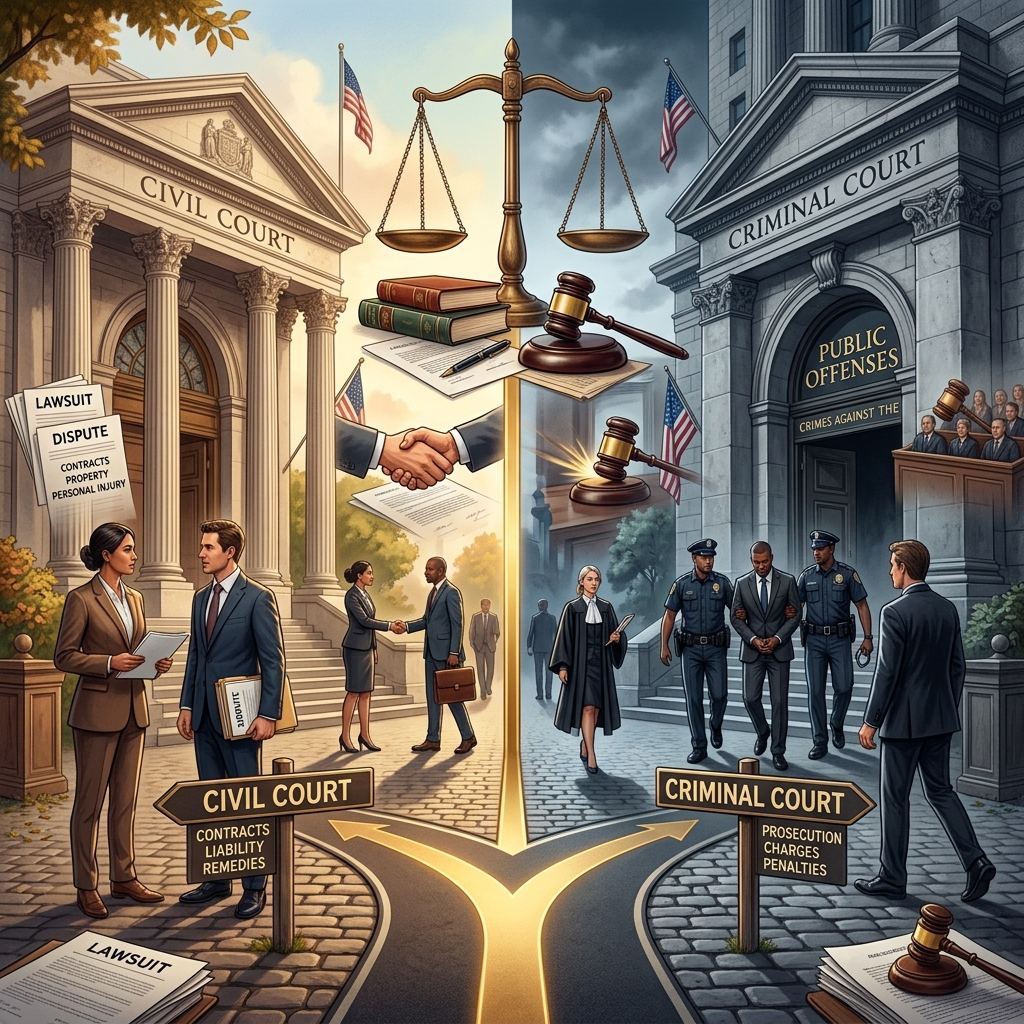
When a serious dispute or harmful incident occurs, one of the first legal questions is whether it belongs in civil court or criminal court. Understanding the differences between these two systems helps you recognize your rights, the potential outcomes, and when you may need legal representation.
Although both civil and criminal courts operate within the same broader judicial system, they serve very different purposes, follow different rules, and can lead to very different consequences. This article explains those distinctions in accessible terms and offers practical guidance for people dealing with conflicts in New York or elsewhere in the United States.
Core Purpose: What Each Type of Court Tries to Achieve
At the most basic level, the difference between civil and criminal courts lies in what the law is trying to accomplish.
Criminal Court: Protecting Public Safety
Criminal law addresses conduct that society has decided is so harmful that it deserves punishment—such as assault, robbery, or fraud. A criminal case is fundamentally a dispute between the government and an individual or organization accused of breaking a criminal statute.
- Purpose: To determine whether the accused committed a crime and, if so, to impose a penalty.
- Focus: Public safety, deterrence, and accountability for violating criminal laws.
- Key question: Did the defendant commit the charged offense beyond a reasonable doubt?
Civil Court: Resolving Private Disputes
Civil law deals with disagreements between people, businesses, and sometimes government agencies over rights, obligations, or injuries. Instead of punishing wrongdoing on behalf of society, civil courts aim to fairly resolve disputes and provide remedies such as money damages or enforceable orders.
- Purpose: To settle private conflicts and compensate for harm or enforce legal rights.
- Focus: Restoring balance between parties rather than imposing punishment.
- Key question: Is one party legally responsible to the other under civil law, and what remedy is appropriate?
Who Starts the Case and Who Is Involved?
Another important distinction is who brings each type of case and how the parties are described.
| Feature | Civil Court | Criminal Court |
|---|---|---|
| Initiates the case | Individual, business, or government agency files a lawsuit as the plaintiff. | Government prosecutor files charges on behalf of the state or federal government. |
| Opposing party | The person or entity being sued is the defendant. | The person or entity accused of a crime is the defendant. |
| Primary interest | Private rights and obligations between the parties. | Public interest in enforcing criminal laws and protecting society. |
In New York and other jurisdictions, the same event can sometimes give rise to both civil and criminal proceedings. For example, a violent assault may lead to criminal charges filed by a prosecutor and a separate civil claim for compensation filed by the injured person.
Standards of Proof: How Much Evidence Is Enough?
The standard of proof determines how convincing the evidence must be before a judge or jury can decide in favor of one side. This is one of the most critical differences between civil and criminal cases.
Criminal Cases: Beyond a Reasonable Doubt
In criminal court, the prosecutor must prove the defendant’s guilt beyond a reasonable doubt, the highest standard in the legal system. This reflects the serious consequences of criminal conviction, which can include incarceration and long-term collateral effects.
- Jurors must be firmly convinced of the defendant’s guilt before voting to convict.
- Any reasonable uncertainty about whether the defendant committed the crime requires a verdict of not guilty.
- This heightened protection arises from constitutional principles safeguarding liberty.
Civil Cases: Preponderance of the Evidence
Civil cases usually apply a lower standard called preponderance of the evidence. This means the plaintiff must show that their version of events is more likely than not true—often described as tipping the scales slightly in their favor.
- Think of it as proving at least a 51% likelihood that the claim is correct.
- Some civil matters, like certain family cases, may require a higher standard known as “clear and convincing evidence,” but this is still below the criminal standard.
- The lower standard reflects that civil outcomes typically involve money or orders, not loss of liberty.
Types of Problems Each Court Handles
While there is some overlap, civil and criminal courts generally handle different categories of disputes.
Examples of Criminal Matters
Criminal courts deal with violations of criminal statutes such as:
- Violent offenses: assault, homicide, robbery.
- Property crimes: burglary, theft, arson.
- Sex offenses: sexual assault and related crimes.
- Financial and fraud crimes: embezzlement, major theft schemes.
- Drug offenses and other regulatory crimes.
Examples of Civil Matters
Civil courts address disputes including, but not limited to:
- Personal injury claims, such as car accidents and slip-and-fall incidents.
- Contract disputes between individuals or businesses.
- Family law issues, including divorce, child support, and custody.
- Housing matters such as landlord–tenant conflicts.
- Consumer problems, employment claims, and civil rights actions.
In New York, specialized civil courts (such as the Civil Court of the City of New York) handle many everyday disputes within set dollar limits, while higher courts hear more complex and high-value cases.
Possible Outcomes and Remedies
What you can gain—or lose—from each type of case is often the deciding factor in choosing the right court.
Results in Criminal Court
If a defendant is convicted in criminal court, the judge may impose one or more penalties, depending on the seriousness of the offense and applicable law.
- Incarceration in jail or prison.
- Probation or supervised release with conditions.
- Fines payable to the government.
- Restitution to victims in some cases.
- Other consequences such as mandatory treatment programs or community service.
Even after the criminal sentence ends, a conviction can affect employment, housing, professional licensing, immigration status, and other aspects of life.
Results in Civil Court
Civil judgments aim to address private harm. A judge or jury may award or order:
- Money damages to compensate for injuries, lost wages, property damage, or other losses.
- Injunctions, which are court orders requiring someone to do or stop doing something (for example, stopping infringement or enforcing a contract).
- Declaratory judgments clarifying the parties’ legal rights and obligations.
- Changes in legal status, such as divorce decrees or custody orders.
Civil judgments generally do not result in incarceration. However, failure to follow civil court orders can lead to additional legal consequences, including contempt proceedings.
How Proceedings Unfold: A Simplified Look at Procedure
Both types of cases follow formal procedures, but they differ in important ways.
Criminal Case Process (Overview)
While details vary by jurisdiction, a typical criminal case might include these stages:
- Investigation and arrest: Law enforcement investigates and may arrest a suspect if there is probable cause.
- Charging decision: A prosecutor decides whether to file formal charges under criminal statutes.
- Initial appearances: The defendant is advised of charges and rights in early court hearings.
- Plea negotiations: Many cases resolve through guilty pleas or other negotiated dispositions.
- Trial: If no agreement is reached, the case may proceed to trial before a judge or jury.
- Sentencing: If convicted, the court imposes a sentence consistent with law and guidelines.
- Appeals: Defendants may challenge errors through appellate courts.
Civil Case Process (Overview)
Civil cases typically move through a different path:
- Filing a complaint: The plaintiff files a written claim describing the dispute and requested relief.
- Service of process: The defendant is formally notified of the lawsuit.
- Answer and motions: The defendant responds and may seek dismissal or other rulings.
- Discovery: Each side gathers evidence through documents, depositions, and written questions.
- Negotiation and settlement: Many civil disputes are resolved through settlement before trial.
- Trial: If settlement fails, a judge or jury hears the evidence and issues a decision.
- Judgment and enforcement: Courts may enter orders for payment or other relief; parties can seek enforcement if necessary.
When Can Both Civil and Criminal Cases Arise from the Same Event?
It is possible—and often legally permissible—for the same conduct to lead to both criminal prosecution and civil litigation.
Common examples include:
- A drunk driving incident that results in criminal charges and a civil personal injury lawsuit.
- A fraudulent business scheme that triggers criminal fraud charges and civil claims for financial losses.
- A physical assault prosecuted in criminal court while the victim seeks damages in civil court.
Because criminal and civil cases serve different purposes and apply different standards of proof, the outcome in one does not automatically control the other, though a criminal finding can influence how a civil court views the facts.
New York Court Structure: Where Civil and Criminal Cases Are Heard
In New York State, the court system is complex, but it can be divided into major levels and subject-matter courts that handle civil and criminal issues.
- Trial courts: These include the Supreme Court (which, despite its name, is a trial-level court) and specialized courts such as the Civil Court of the City of New York and local criminal courts.
- Intermediate appellate courts: The Appellate Divisions review decisions from trial courts.
- Court of Appeals: New York’s highest court reviews selected cases on important questions of law.
Within this structure, civil and criminal cases are assigned to appropriate courts based on factors such as the type of dispute, potential penalties, and the amount of money at stake.
Practical Considerations: Deciding Where Your Case Belongs
If you are facing a legal problem, you may not immediately know whether it is civil, criminal, or both. Consider the following practical points:
- Nature of the harm: Was there a violation of a criminal law (such as assault or theft), or is the issue primarily about money, contracts, property, or family rights?
- Who is involved: Are you dealing with a private party, a business, or law enforcement?
- Desired outcome: Are you seeking compensation, a court order, or protection from punishment?
- Government involvement: If you have been arrested or formally charged, your matter is in the criminal system. If you have received a summons or complaint from another person or business, it is likely civil.
Because misplaced assumptions can have serious consequences, people facing serious disputes often consult an attorney to understand whether civil, criminal, or both types of proceedings may apply. Legal aid organizations and bar association referral services can help connect individuals with appropriate legal assistance.
Common Misconceptions About Civil and Criminal Court
- “If the government does not prosecute, I have no legal options.” In many situations, you can still pursue a civil claim even if criminal charges are never filed.
- “A civil case is always less serious.” While civil cases do not involve incarceration, they can affect finances, family relationships, and housing in major ways.
- “Losing a civil case is the same as being convicted of a crime.” Civil liability is not the same as criminal guilt, though both can carry long-term effects.
- “Every dispute belongs in court.” Many conflicts are better resolved through negotiation, mediation, or other alternative dispute resolution methods.
FAQs: Civil vs. Criminal Court
Can I be sued in civil court and charged in criminal court for the same incident?
Yes. The same conduct can support both criminal charges brought by the government and civil claims brought by an injured party. The two cases are legally distinct and may proceed on different timelines.
Do I need a lawyer in both types of cases?
Criminal defendants facing possible jail or prison sentences generally have a constitutional right to counsel and may be entitled to a court-appointed lawyer if they cannot afford one. In civil cases, parties typically must arrange their own representation, although legal aid organizations and pro bono programs may assist eligible individuals.
Will I go to jail if I lose a civil case?
Civil judgments do not directly impose incarceration. However, failing to comply with court orders or engaging in related misconduct can lead to separate legal consequences, so all court directives should be taken seriously.
How do juries differ in civil and criminal cases?
Criminal juries must reach a verdict based on the high standard of proof beyond a reasonable doubt, and unanimity is often required. Civil juries generally apply the lower preponderance standard, and some jurisdictions allow decisions even if the vote is not unanimous.
Where can I learn more about the court system in New York?
Official court and legal assistance websites provide overviews of the New York court structure, including distinctions between civil and criminal courts and information for self-represented litigants.
References
- The Differences Between Criminal Court and Civil Court — LawHelpNY. 2019-01-01. https://www.lawhelpny.org/resource/the-differences-between-criminal-court-and-ci-1
- Differences Between Criminal Court and Civil Court — LawHelpNC. 2018-01-01. https://www.lawhelpnc.org/resource/differences-between-criminal-court-and-civil/download/0D483DF9-4EB3-4D5B-84A8-9153AFDCD6DE.pdf
- Guía Experta Sobre el Sistema Judicial de Nueva York — Block O’Toole & Murphy. 2022-06-01. https://www.blockotoole.com/espanol/sistema-judicial-de-nueva-york/
- Las Diferencias Entre el Tribunal Penal y el Tribunal Civil — LawHelpNY. 2019-01-01. https://www.lawhelpny.org/resource/the-differences-between-criminal-court-and-ci-1
- Descripción General de un Proceso Penal — Federal Defenders of New York. 2017-01-01. https://www.federaldefendersny.org/descripcin-general-de-un-proceso-penal
- Diferencia entre jurisdicción civil y penal — Tirant lo Blanch España. 2021-05-10. https://tirant.com/curiosidades-mundo-juridico/noticia-diferencia-entre-jurisdiccion-civil-y-penal/
- Diferencia entre el derecho penal y el derecho civil — Ramos Law. 2020-03-01. https://www.ramoslaw.com/es/la-diferencia-entre-el-derecho-penal-y-el-derecho-civil/
Similar Articles








Read full bio of medha deb




