
Children’s Voices in Minnesota Custody Cases
How Minnesota law allows children to participate in custody decisions and work with their own lawyers when disputes affect their lives.
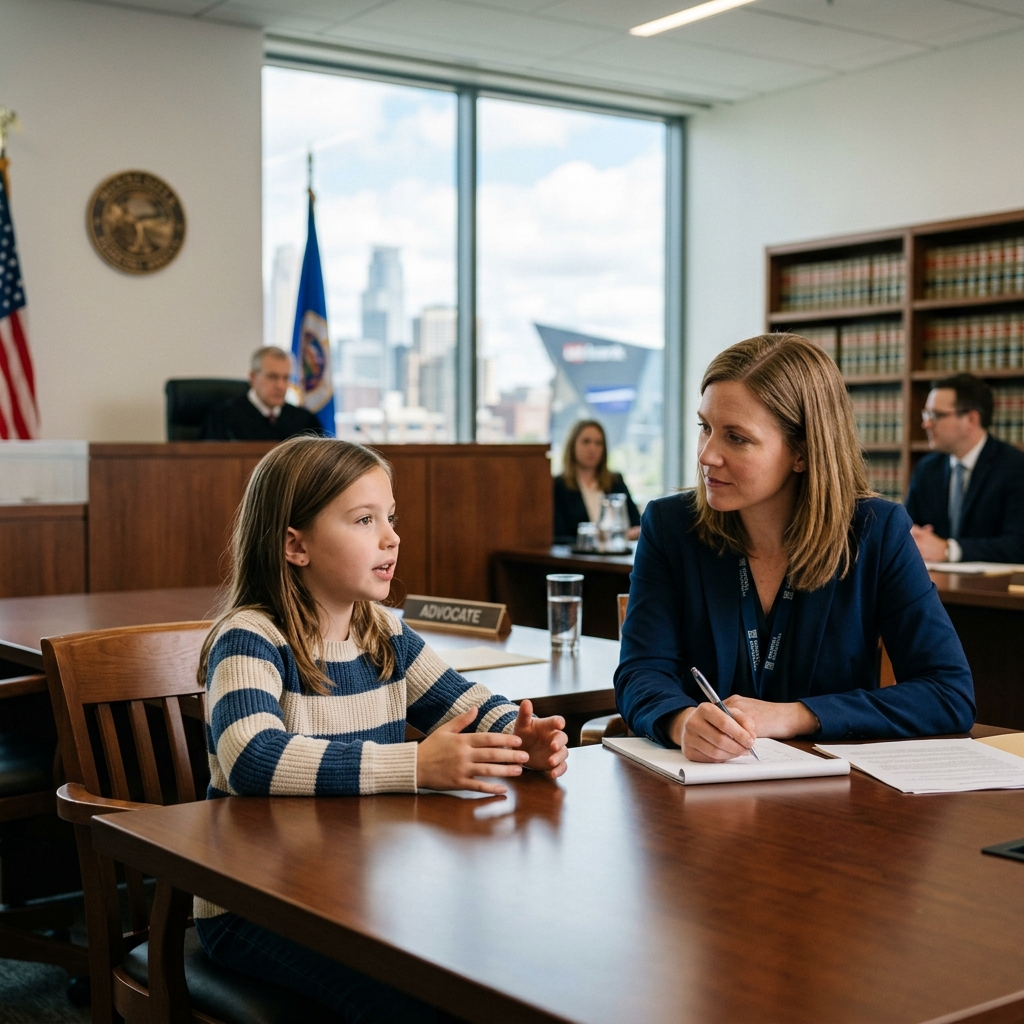
When parents separate or divorce in Minnesota, decisions about where children will live, who will make important choices for them, and how much time they spend with each parent are governed by child custody and parenting time laws. While many people assume custody is only a matter between parents and judges, Minnesota law recognizes that children themselves have a stake in the outcome and should be heard in appropriate ways.
This article explains how children’s voices are considered in Minnesota custody cases, when they may have their own lawyers, and how courts balance parental rights with the legal standard known as the best interests of the child. It is based on Minnesota statutes and official guidance, but written in accessible language for families navigating a difficult time.
Core Concepts: Custody, Parenting Time, and Legal Authority
To understand how children participate in custody disputes, it helps to start with the basic legal terms Minnesota uses.
Legal custody vs. physical custody
Under Minnesota law, there are two main types of custody: legal custody and physical custody.
- Legal custody is the authority to make major decisions about a child’s upbringing, including education, health care, and religious training.
- Physical custody refers to where the child lives and who provides daily care, routines, guidance, and protection.
Both forms of custody can be awarded to one parent (sole custody) or shared between parents (joint custody). In joint legal custody, both parents have equal decision-making authority; in joint physical custody, they share residential and day-to-day responsibilities according to an agreed or court-ordered schedule.
Parenting time
Custody is closely related to, but distinct from, parenting time, which is the actual time a parent spends with their child. A parenting time order can address:
- Weekly and holiday schedules
- Transportation between homes
- Where the child will sleep on school nights and weekends
Minnesota law presumes that a parent should have at least 25% of the parenting time with their child, unless there are strong reasons to limit contact, such as safety concerns.
The Best Interests of the Child: The Court’s Guiding Standard
When parents disagree about custody or parenting time, Minnesota courts apply a clear standard: decisions must serve the best interests of the child. This principle is codified in Minnesota Statutes section 518.17 and directs judges to evaluate a range of factors rather than prioritizing parental preference or gender.
Key best interests factors
Minnesota law lists multiple factors that a judge must consider in custody and parenting time decisions. These include:
- The child’s physical, emotional, cultural, and spiritual needs
- Any special medical, mental health, developmental, or educational needs
- The child’s reasonable preference, if mature enough to express one independently
- Any history of domestic abuse between parents
- Each parent’s physical and mental health as it relates to parenting
- The history of each parent’s caregiving role
- The stability of the child’s home, school, and community
- The importance of maximizing parenting time with both parents
- Each parent’s willingness to support the child’s relationship with the other parent (absent abuse)
- The parents’ ability to cooperate and reduce conflict
These factors help courts make individualized decisions tailored to each child’s circumstances rather than relying on rigid rules or assumptions.
How the child’s preference fits into the analysis
One of the most direct ways children’s voices are heard is through their stated preference about where they want to live or how they want their time divided between parents. Minnesota law explicitly allows courts to consider the child’s reasonable preference if the child is of sufficient age, maturity, and ability to express an independent view.
However, the child’s wishes are only one factor and do not automatically control the result. Judges look for evidence that the child is not being pressured or coached and that the preference aligns with their overall well-being.
| Aspect | How Courts Approach It |
|---|---|
| Age and maturity | The court must first decide if the child is mature enough to express an independent, reliable preference. |
| Independence of preference | Judges look for signs the child is speaking freely, not simply repeating one parent’s wishes. |
| Weight given to preference | Preference is weighed alongside other best interests factors, such as safety, stability, and relationships. |
| Potential pressure | Court may discount a preference if there is evidence of manipulation or coaching. |
Children’s Rights to be Represented by Their Own Lawyers
In some situations, children involved in custody disputes may have their own attorney separate from either parent’s lawyer. While Minnesota statutes do not guarantee a lawyer for every child in custody cases, courts have tools to ensure children’s interests and voices are represented.
Forms of representation for children
Depending on the case, a Minnesota court might:
- Appoint a guardian ad litem (GAL) to investigate the child’s situation and make recommendations about their best interests. GALs are not the child’s personal attorney, but they act as an independent voice focused on the child’s welfare.
- Appoint an attorney to represent the child, particularly in complex or high-conflict cases where an independent legal advocate is needed.
- Rely on information gathered through custody evaluations, interviews, or reports from professionals who meet with the child.
The specific approach will depend on the court’s assessment of the case and the resources available. The central goal is to ensure the child is not simply a passive subject of litigation but an individual whose rights and needs are actively considered.
Why children may benefit from their own lawyer
Appointing an attorney for a child can be particularly helpful when:
- The parents’ positions are strongly opposed and neither fully aligns with what seems best for the child.
- There are allegations of abuse, neglect, or substantial conflict.
- The child is old enough to have a clear, sustained preference that deserves independent advocacy.
- Complex issues like relocation, special medical needs, or cultural considerations are in dispute.
A child’s lawyer can help the court separate the child’s true perspective from the emotional and strategic positions of the adults, thereby improving the quality of the decision-making process.
Special Situations: Unmarried Parents and Domestic Abuse
Not all custody disputes arise from divorce. Many involve unmarried parents or families affected by domestic abuse. In these contexts, children’s rights and safety require particular attention.
Custody when parents are unmarried
Under Minnesota law, when parents are unmarried, the mother who gives birth has sole legal and sole physical custody by default until a court orders otherwise. An unmarried father does not automatically have custody rights, even if he is named on the birth certificate, and may need to initiate a court case to establish custody and parenting time.
This framework can directly affect children because it determines which parent has the legal authority to make decisions and where the child primarily lives. As disputes arise and courts become involved, children may again benefit from mechanisms that ensure their voices and best interests are heard clearly.
Domestic abuse and limits on joint custody
Minnesota law treats domestic abuse as a critical factor in any custody decision. If there is evidence of abuse between parents, the court must weigh its impact on the child’s safety, emotional health, and relationships.
There is a rebuttable presumption that joint legal or joint physical custody is not in the child’s best interests when domestic abuse has occurred. This means the court starts from the position that shared custody is likely unsafe or inappropriate, unless the evidence shows otherwise.
From the child’s perspective, this protection is vital. It helps ensure that their living arrangements do not expose them to ongoing violence or coercion. In these cases, the presence of a guardian ad litem or child’s attorney may be especially important to advocate for safety-focused outcomes.
How Children’s Views Reach the Court
Even when children do not have their own lawyer, there are several ways their perspectives, experiences, and preferences can reach the judge.
Common pathways for children’s voices
- Interviews or testimony: In some cases, older children may speak directly with the judge, either in chambers (privately) or in a more formal setting, depending on the court’s practices and the child’s comfort.
- Guardian ad litem reports: GALs may interview the child, observe interactions with each parent, and report their impressions and recommendations to the court.
- Custody evaluations: Mental health professionals or evaluators may meet with the child and parents, conducting assessments that help the judge understand family dynamics.
- School and medical records: Teachers, counselors, and health professionals may provide information relevant to the child’s well-being and stability.
These channels reduce the burden on children to participate like adult litigants while still giving the court insight into their lives.
Balancing participation with protection
Judges must balance the value of hearing from children with the need to protect them from emotional harm. Over-involving children in courtroom drama can create pressure or force them to appear to choose between parents, which many experts consider psychologically harmful.
Therefore, courts aim to:
- Limit direct exposure to adversarial hearings
- Use neutral professionals to gather information
- Encourage parents to avoid placing children in the middle of disputes
- Focus on stable, supportive arrangements rather than short-term wishes shaped by conflict
Navigating the Legal Process: From Petition to Order
For families in Minnesota, understanding the basic steps in a custody case can help them anticipate when and how children’s interests will be addressed.
Starting a custody case
Custody disputes typically begin when one parent files a petition in the appropriate court, usually in the county where the child lives. In some situations, parents first attempt to reach an agreement out of court. If they can agree on custody and parenting time, they may submit a proposed order to the judge for approval.
If they cannot agree, the case proceeds through stages that may include mediation, temporary orders, custody evaluations, and ultimately a trial at which the judge makes final decisions.
The judge’s role at trial
At trial, the judge listens to evidence from both parents, professionals, and potentially a guardian ad litem or child’s lawyer. The court must then apply the best interests factors and issue orders on legal custody, physical custody, and parenting time.
The judge cannot favor one parent solely because of gender, and must avoid assumptions based on traditional roles. Instead, the focus remains squarely on the child’s safety, stability, relationships, and developmental needs.
Practical Tips for Parents Who Want Their Children Heard
Parents play a major role in how smoothly children move through custody disputes. While the court has formal mechanisms to consider children’s views and needs, parental choices can significantly influence the process.
Supporting children during custody disputes
- Encourage honest but pressure-free conversations: Let children express feelings and preferences without steering them toward one parent.
- Avoid asking children to take sides: Telling children to choose can create guilt and long-term emotional strain.
- Work with professionals: Therapists, mediators, and lawyers with family law experience can help safeguard children’s well-being.
- Respect court-imposed boundaries: Follow orders about communication, schedules, and conduct around the child.
- Seek legal advice: An experienced family law attorney can explain when a GAL or child’s lawyer may be appropriate and how to request one.
Recognizing when additional advocacy may be needed
Parents should pay attention to signs that their child needs stronger representation in the legal process, such as:
- Persistent anxiety or distress about the custody dispute
- Clear and stable preferences that differ from both parents’ positions
- Safety concerns in one home, including emotional or physical mistreatment
- Complex medical, educational, or cultural issues that require specialized knowledge
In these situations, discussing the possibility of a guardian ad litem or child’s attorney with a family law lawyer can be an important step.
Frequently Asked Questions (FAQs)
At what age can a child decide which parent to live with in Minnesota?
No specific age gives a child full control over custody decisions. Minnesota courts consider a child’s reasonable preference if the child is mature enough, but this is only one factor among many in the best interests analysis.
Can my child have their own lawyer in a custody case?
Yes, in some cases a court may appoint an attorney for the child, particularly in complex or high-conflict disputes. This is not automatic and often depends on the judge’s assessment of the case and the recommendations of professionals.
What is the difference between a guardian ad litem and a child’s attorney?
A guardian ad litem (GAL) is appointed to advocate for the child’s best interests, which may or may not match the child’s expressed wishes. A child’s attorney advocates for the child’s legal position, similar to how an attorney represents an adult client.
Do unmarried fathers have custody rights in Minnesota?
Unmarried fathers do not automatically have custody rights. The birthing mother has sole legal and physical custody until a court issues a different order, although fathers can petition the court to establish custody and parenting time.
How does domestic abuse affect custody decisions?
Domestic abuse is a major factor in Minnesota custody cases. If abuse has occurred between parents, there is a presumption that joint legal or joint physical custody is not in the child’s best interests, and courts focus strongly on safety and stability.
References
- Child Custody & Parenting Time – Help Topics — Minnesota Judicial Branch. 2024-01-01. https://mncourts.gov/help-topics/child-custody
- Minnesota Statutes § 518.17 – Custody and Parenting Time — Minnesota Office of the Revisor of Statutes. 2023-01-01. https://www.revisor.mn.gov/statutes/cite/518.17
- Understanding Custody and Parenting Time — Messick Law, PLLC. 2022-05-10. https://www.messicklaw.com/news/resources/understanding-custody-and-parenting-time-messick-law-pllc/
- Minnesota Custody — WomensLaw.org. 2023-06-01. https://www.womenslaw.org/laws/mn/custody/all
- Rights and Responsibilities of Unmarried Parents — LawHelpMN. 2023-03-15. https://www.lawhelpmn.org/self-help-library/booklet/rights-and-responsibilities-unmarried-parents
Similar Articles








Read full bio of Sneha Tete


