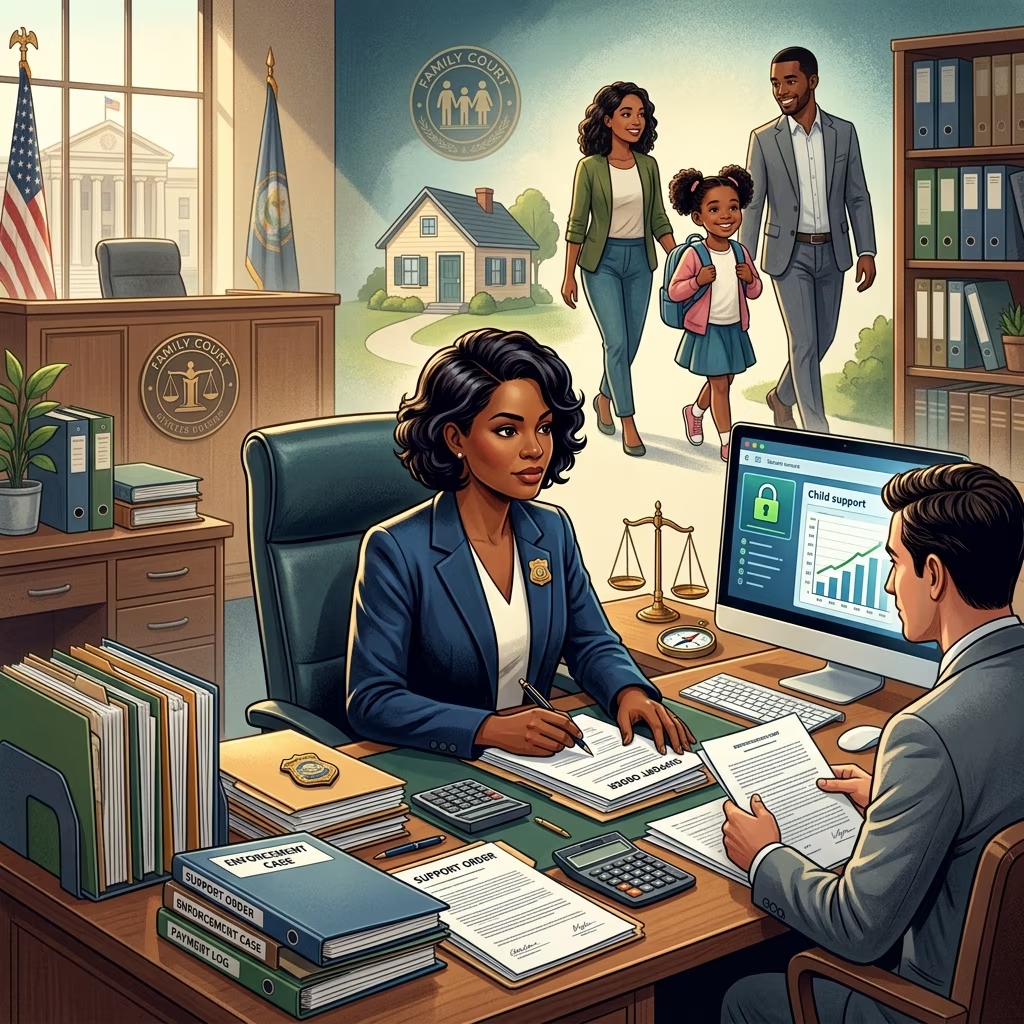
Child support enforcement is the system states use to make sure court-ordered support is actually paid. In the United States, most child support matters are handled by state and local authorities, while federal involvement is limited to specific circumstances defined by law.
The purpose of the enforcement system is practical rather than symbolic: it helps parents and caregivers secure regular financial support for children, and it gives governments tools to locate parents, establish orders, collect payments, and pursue nonpayment when necessary.
What child support enforcement is designed to do
Enforcement is only one part of the larger child support program. The broader program includes locating parents, establishing paternity, setting support orders, reviewing orders when circumstances change, and collecting and distributing payments.
When those functions work together, the process becomes more efficient for families and more predictable for courts and agencies. A child support order is most effective when it is realistic, legally enforceable, and supported by reliable income information.
- Find a parent when their location is unknown.
- Confirm legal parentage when needed.
- Set a payment amount based on governing guidelines.
- Collect payments through state systems.
- Use enforcement tools when support is overdue.
Why states handle most cases
Most child support cases never become federal matters. State family courts and state child support agencies handle the great majority of disputes, collections, and enforcement actions.
This state-centered structure exists because child support is usually tied to state court orders, state procedures, and local facts about income, custody, and parenting time. Federal law steps in only in narrow situations, such as certain interstate cases or cases that meet the elements of federal criminal statutes.
The role of Title IV-D agencies
Every state has agencies commonly called Title IV-D agencies. These agencies are required by federal law to offer child support enforcement services to people who request them.
Title IV-D agencies do more than collect overdue support. They also help locate parents, establish paternity, obtain or modify orders, and coordinate collection through centralized state systems.
| Function | What it means in practice |
|---|---|
| Location services | Searches for a parent using employment, address, and other records. |
| Paternity establishment | Determines legal parentage when a child’s legal father is not already established. |
| Order establishment | Creates a court-ordered support amount based on state rules. |
| Enforcement | Uses collection and legal remedies when payments are not made. |
How modern enforcement grew out of federal law
Federal child support enforcement developed through a series of laws intended to address chronic nonpayment across state lines. The Child Support Recovery Act of 1992 created a federal criminal approach for certain willful failures to pay support.
Congress later strengthened that framework with the Deadbeat Parents Punishment Act of 1998, which created additional federal felony categories for the most serious cases. Those laws were designed to deter the most egregious conduct, not to replace ordinary state enforcement.
That distinction remains important today. Federal prosecution is available only in limited circumstances, while ordinary enforcement remains primarily a state responsibility.
Common civil enforcement tools
States use a range of civil remedies before, or alongside, more serious legal action. These remedies are intended to collect past-due support without necessarily involving a criminal case.
- Income withholding from wages.
- Intercepting tax refunds in appropriate cases.
- Placing liens on property.
- Reporting overdue amounts to credit bureaus when authorized.
- Suspending licenses or other privileges in qualifying cases.
State systems also rely on a centralized collection and disbursement unit. Federal materials describe this as a required part of the program, designed to route payments efficiently from obligors to custodial parents.
Why support orders need to be realistic
A child support order is easiest to enforce when it reflects actual income and the real circumstances of the parents. Guidance used in the child support system emphasizes that courts and agencies should consider reliable income data, existing support obligations, and other facts that affect the parent’s ability to pay.
Orders that are too high may quickly become uncollectible, which can create long-term arrears and reduce compliance. Orders that are clear, numerically precise, and legally complete are more likely to be enforced successfully.
- Use actual income whenever possible.
- Account for other support obligations.
- Include termination dates or clear ending events.
- Specify how payment should be made.
- State whether interest or penalties apply to arrears.
When federal criminal law can apply
Federal criminal law does not cover every unpaid support obligation. It applies only when the legal requirements of the statute are met, and those requirements are narrow.
In general, the federal approach is aimed at willful nonpayment in circumstances serious enough to justify criminal prosecution, especially where state enforcement is not enough and the case meets the federal jurisdictional thresholds.
Because of that limited scope, someone with a child support issue should normally begin with state and local agencies, not federal investigators.
How parents and caregivers can seek help
The most direct route for most families is the state child support agency. These agencies are the first point of contact for routine collection problems, order establishment, and enforcement questions.
Families can also ask the state agency about the status of a case, how payments are being processed, or whether a support order needs to be updated because of job loss, custody changes, or other changed circumstances.
- Contact the state child support office for ordinary enforcement concerns.
- Ask whether income withholding is already in place.
- Request a review if the order no longer fits current facts.
- Provide updated address, employment, and income information.
What happens when payments are missed
Missed payments do not automatically lead to a federal case. In many situations, the state first tries administrative collection methods, case review, or court enforcement.
If nonpayment continues, the case may move into stronger remedies such as contempt proceedings, income withholding, property liens, or license-related enforcement. In the most serious cases and only when statutory requirements are met, federal criminal prosecution may be considered.
What makes enforcement more effective
Enforcement works best when the system is coordinated and the order is workable. Federal and state materials alike show that clear procedures, accurate records, and realistic orders improve collection outcomes.
Equally important is the separation between collection policy and punishment. A support program that is too rigid can create debt that never gets paid. A program that is too weak can leave children without dependable support. The strongest systems balance those concerns by using administrative tools first and reserving criminal prosecution for serious, willful, and legally qualifying violations.
Frequently asked questions
Is every unpaid child support case a federal crime?
No. Most cases are handled by states, and federal criminal law applies only in limited situations.
Who should I contact about a missed payment?
In most cases, the state child support agency or other state and local authorities are the right starting point.
Can support orders be changed?
Yes. Support orders can be reviewed and modified when circumstances change, such as income, custody, or other relevant facts.
Why does the amount in the order matter so much?
An order that matches real income and legal guidelines is more likely to be paid consistently and less likely to produce unmanageable arrears.
What if the parent who owes support moves to another state?
States still have enforcement tools, and interstate issues are one reason the child support system includes federal coordination and federal statutes.
References
- Making Child Support Orders Realistic and Enforceable — National Council of Juvenile and Family Court Judges. 2025-01-01. https://www.ncjfcj.org/bench-cards/a-practice-guide-making-child-support-orders-realistic-and-enforceable/
- Office of Child Support Enforcement (OCSE) — Administration for Children and Families, U.S. Department of Health and Human Services. 2026-01-01. https://acf.gov/css
- About the Child Support Enforcement Program — HHS Office of Inspector General. 2026-01-01. https://oig.hhs.gov/fraud/child-support-enforcement/about/
- Child Support Enforcement – Criminal Division — U.S. Department of Justice. 2026-01-01. https://www.justice.gov/criminal/criminal-ceos/child-support-enforcement
- Child Support Tutorial — National Conference of State Legislatures. 2025-07-01. https://www.ncsl.org/human-services/child-support-tutorial