
Undefined Custody Process In Washington, D.C.: Complete Guide
A clear guide to filing, serving, and resolving custody matters in Washington, D.C.
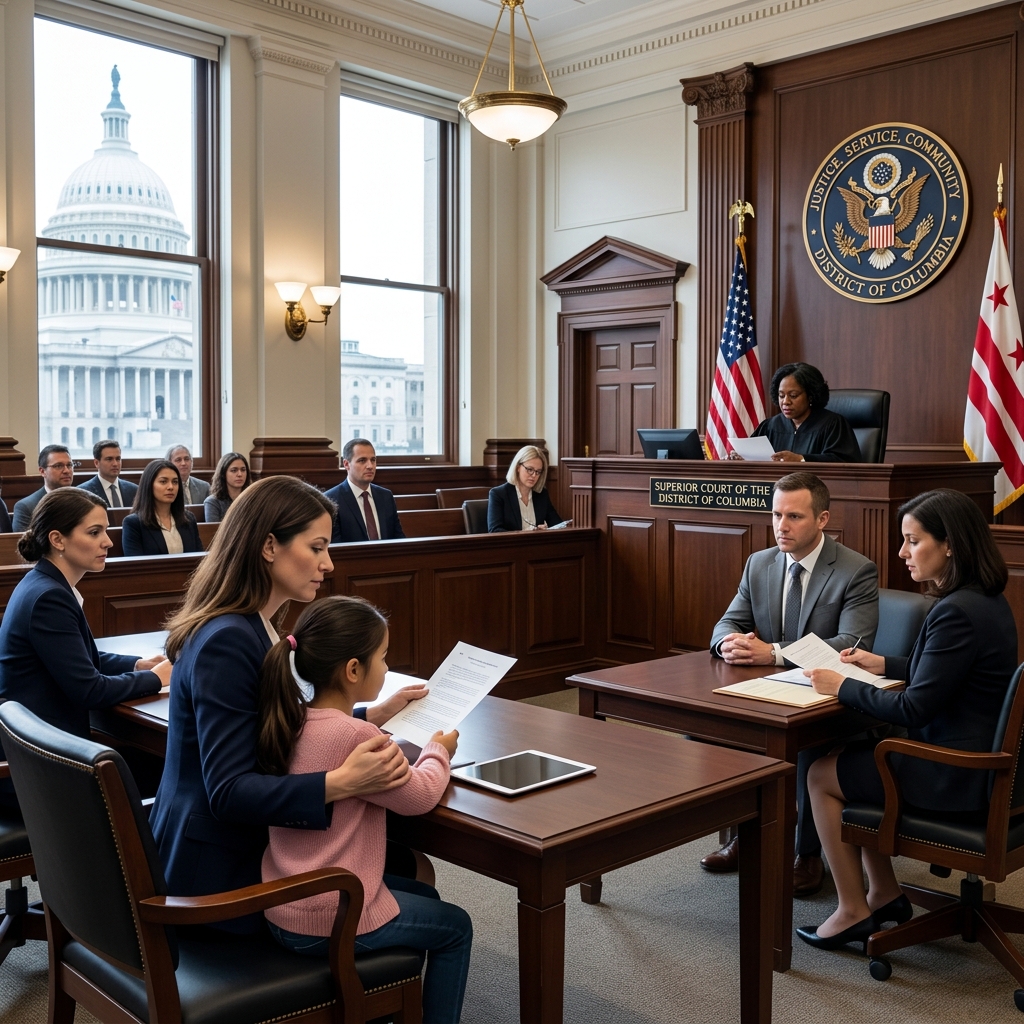
Understanding the Custody Process in Washington, D.C.
Child custody disputes in Washington, D.C. are handled in the Family Court of the Superior Court, where the judge’s main concern is the child’s best interest. The process usually begins when one parent files a custody complaint, but the path from filing to final order can include service of papers, temporary hearings, parenting plans, mediation, and, if necessary, a trial. The court may also address custody within a divorce case, but unmarried parents generally begin with a separate custody complaint.
Although many families hope to settle custody privately, D.C. courts can make binding orders when parents cannot agree. Those orders may cover where the child lives, how major decisions are made, how holidays are shared, and how parents communicate about school, health care, and other important matters.
- The court focuses on the child’s welfare, not on rewarding or punishing either parent.
- Parents may resolve custody by agreement, but a judge must approve any court order.
- If parents disagree, the court can require detailed parenting plans and schedule further hearings.
Who Can Bring a Custody Case
Before filing, a parent should make sure D.C. is the proper place to hear the case. In general, custody is filed where the child has lived for at least six consecutive months before the case starts. If the child no longer lives in D.C., the court may still have authority in some situations, especially when D.C. was the child’s recent home state and a parent continues to live in the District.
This jurisdiction rule matters because custody orders are only effective when the court has power to decide the case. If another state is the more appropriate forum, the D.C. court may decline to proceed or defer to the other court.
| Issue | General D.C. Approach |
|---|---|
| Home-state rule | The child usually must have lived in D.C. for at least six months before filing. |
| Recent residence | D.C. may still qualify if it was the child’s home state within the prior six months and a parent remains in the District. |
| Other-state involvement | The court may consider whether another state should handle the case instead. |
Starting the Case
A custody case begins with a formal complaint or petition filed in Family Court. The filing asks the court to decide legal custody, physical custody, visitation, or related parenting issues. Parents who are going through divorce may address custody in that matter, while parents who are not married usually file a standalone custody case.
In many cases, the filing parent should be prepared to explain basic facts about the child, the parents, the child’s living situation, and why the proposed arrangement serves the child’s best interest. If the case involves immediate safety concerns or urgent stability concerns, a parent may also ask for temporary relief.
- A custody complaint starts the court process.
- Temporary requests may be available when immediate court action is needed.
- Parents should be ready to provide facts about the child’s care, schooling, and routines.
Serving the Other Parent and Moving Forward
After filing, the other parent must be formally served with the complaint and summons. Service is not a technical formality; it gives the responding parent notice of the case and an opportunity to participate. Proof of service must be filed with the court so the judge knows the other parent received the papers properly.
The responding parent then has a limited time to answer. If an answer is filed, the case continues through the court’s scheduling process. If no answer is filed, the case may proceed without that parent’s active participation, although the judge will still look for evidence supporting the requested custody arrangement.
Proper service is important because custody decisions can significantly affect a child’s life. The court generally wants both parents to have notice and a meaningful chance to be heard before entering a long-term order.
What the Court Wants to Know
D.C. law requires judges to focus on the best interest of the child. That standard is broad, but it is not vague. Courts look at the full picture of the child’s life, including relationships, stability, health, schooling, and each parent’s ability to meet the child’s needs. No single factor controls every case.
Some of the most important issues often include the child’s relationship with each parent, the child’s adjustment to home and school, the mental and physical health of everyone involved, and the practical ability of each parent to support a stable routine. The court may also consider the child’s preference when appropriate, along with any history of cooperation or conflict between the parents.
- The child’s daily stability matters.
- The quality of each parent’s relationship with the child matters.
- The child’s wishes may be considered when appropriate.
- The court may examine how well parents communicate and share responsibilities.
Parenting Plans and Shared Decision-Making
When parents cannot agree on custody terms, the court may require each parent to submit a parenting plan. A parenting plan is more than a visitation calendar. It is a detailed proposal that shows how the parents would divide time, make decisions, and handle day-to-day issues affecting the child.
A strong parenting plan usually addresses where the child will live, how weekday and weekend time will work, how holidays and vacations are divided, how transportation is handled, and how the parents will share information about school, medical care, and extracurricular activities. It may also explain how the parents will communicate and resolve disagreements.
Parenting plans are useful because they force each side to think through the practical realities of co-parenting. Even when parents do not agree on every issue, the plans can help the court identify areas of overlap and determine whether a workable shared arrangement exists.
| Parenting Plan Topic | Typical Content |
|---|---|
| Physical schedule | Weekdays, weekends, holidays, school breaks, and vacations |
| Decision-making | Education, medical care, religion, and extracurricular activities |
| Communication | Parent-to-parent contact and information-sharing methods |
| Transportation | Pickups, drop-offs, and exchange locations |
Mediation, Hearings, and Trial
D.C. courts often encourage parents to resolve disagreements through mediation before proceeding to a full trial. Mediation can reduce conflict and help parents build a schedule that fits the child’s needs better than a strictly imposed order. It is especially helpful when the dispute is about logistics rather than safety.
If mediation does not lead to agreement, the case moves forward to court hearings and possibly trial. At trial, the judge hears evidence from the parties and may review documents, school records, medical information, or other relevant materials. The final order will reflect the judge’s view of what arrangement best protects the child’s well-being.
Not every case ends with a dramatic court contest. Many cases are resolved through settlement, especially when parents can agree on a basic framework and leave only a few details for the judge to approve.
Types of Custody the Court May Order
D.C. custody orders can address both legal custody and physical custody. Legal custody refers to the authority to make major decisions about the child’s life. Physical custody refers to where the child lives and how time is shared between parents. Either type can be sole or shared, depending on the facts of the case.
In a sole arrangement, one parent has primary authority or residence. In a shared arrangement, the parents divide responsibilities or parenting time. Shared custody does not necessarily mean equal time; it means the court recognizes both parents’ roles in the child’s life and assigns duties accordingly.
- Legal custody involves decision-making authority.
- Physical custody concerns the child’s living arrangements.
- Sole custody places primary authority with one parent.
- Shared custody allows both parents to participate in key aspects of the child’s life.
When a Custody Order Needs to Change
Custody orders are not always permanent in practice. As children grow, school schedules change, parents move, and family circumstances evolve. If an existing arrangement no longer works, a parent may ask the court to modify the order.
A request to modify custody usually requires showing that the change is justified and that the revised arrangement better serves the child. Parents can also reach a new agreement on their own and ask the court to approve it. That option often saves time and reduces conflict, especially when both sides remain focused on the child’s routine and stability.
Modification requests are common when there are changes in work schedules, relocation issues, health concerns, or ongoing problems with communication between the parents. The court remains guided by the child’s best interest, not by either parent’s convenience alone.
Practical Tips for Parents Preparing a Case
Parents who are considering a custody filing should organize the facts before going to court. Records about school attendance, medical care, transportation, communication, and prior parenting responsibilities can help present a clearer picture of the child’s life. Keeping a calm and detailed record is often more persuasive than making broad accusations.
It is also important to think realistically about what schedule can work over time. Courts generally prefer arrangements that are practical, stable, and centered on the child’s routine. A proposal that looks ideal on paper but does not fit the child’s actual life may be less convincing than one that is balanced and workable.
- Gather school, medical, and schedule records.
- Focus on the child’s daily needs and routines.
- Prepare a parenting proposal that is specific and realistic.
- Keep communication respectful and documentation organized.
Frequently Asked Questions
Can custody be decided without going to trial? Yes. Many D.C. custody cases are resolved by agreement, mediation, or court-approved parenting plans before trial becomes necessary.
Does one parent automatically have a better claim? No. D.C. courts do not favor mothers or fathers simply because of gender. The judge evaluates what arrangement best serves the child.
Can the child’s opinion matter? Yes. The child’s preference may be considered when appropriate, although it is only one factor among many.
What if the parents already agree? Parents can submit their agreement as a parenting plan and ask the court to approve it. The judge will review whether the proposed arrangement is in the child’s best interest.
Can custody be changed later? Yes. If circumstances change, a parent may seek modification or the parents may file an updated agreement for approval.
Why the Process Matters
The custody process in Washington, D.C. is designed to balance parental rights with the child’s need for stability. Because custody decisions can shape housing, education, health care, and family relationships, the court requires a careful process rather than a quick decision. Filing, service, parenting plans, mediation, and hearings all serve a larger purpose: helping the court gather enough information to make a thoughtful order.
For parents, understanding the process can make a difficult situation more manageable. It also helps them focus on what the court values most—clear evidence, thoughtful planning, and a genuine commitment to the child’s well-being.
References
- D.C. Code § 16–914, Custody of children — D.C. Law Library. 2026-07-09. https://code.dccouncil.gov/us/dc/council/code/sections/16-914
- The custody process — WomensLaw.org. 2026-07-09. https://www.womenslaw.org/laws/dc/custody/custody-process
- Child Support and Custody FAQs — Legal Aid DC. 2026-07-09. https://www.legalaiddc.org/legal-info/child-support-and-custody-faqs
- Family Court — District of Columbia Courts Forms Help Online. 2026-07-09. https://www.probono.net/dccourts/familycourt/
- How to File for Custody in Washington D.C. — YouTube. 2026-07-09. https://www.youtube.com/watch?v=e4mAxRmDEzE
Similar Articles








Read full bio of medha deb


