
Chapter 13 Bankruptcy and Student Loans: Understanding Your Options
How Chapter 13 bankruptcy interacts with federal and private student loans, repayment plans, and the narrow path to relief.
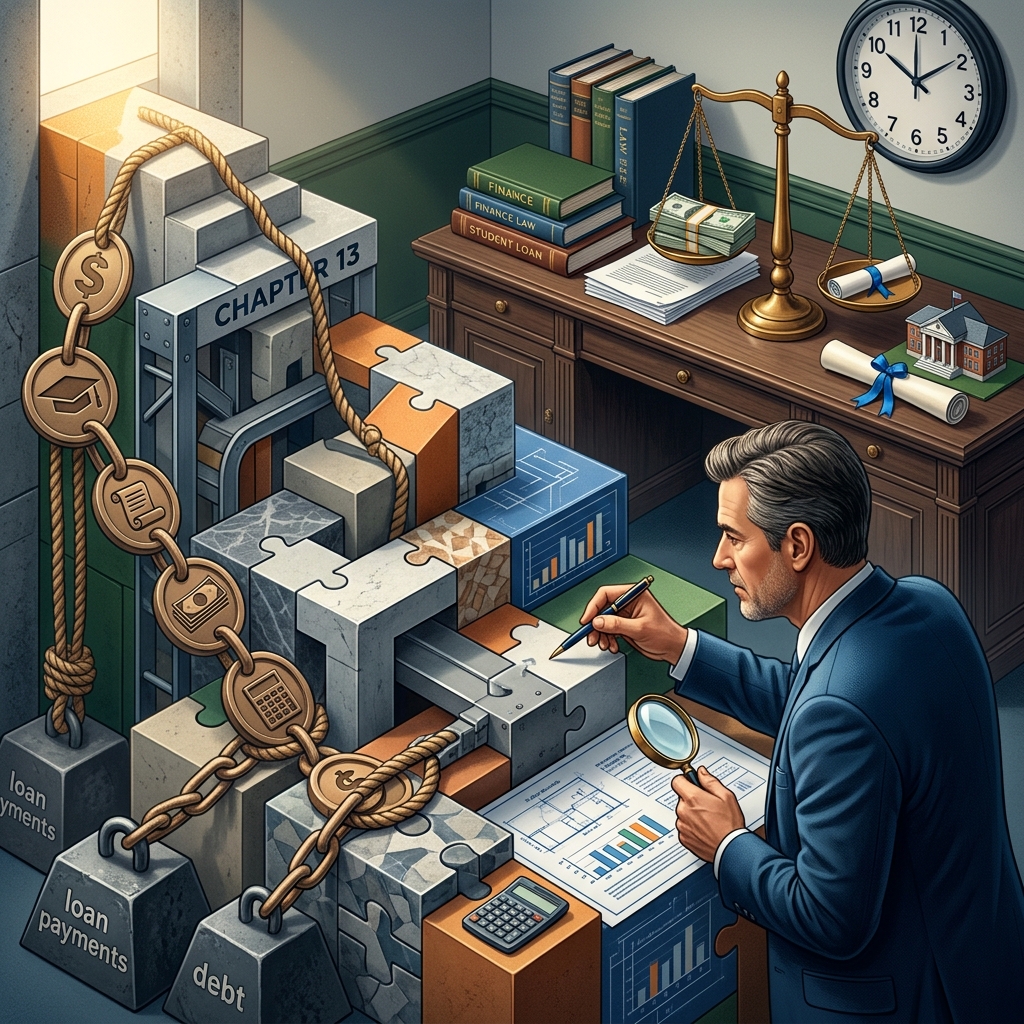
Student loan debt is one of the most challenging financial burdens for many borrowers, and bankruptcy law does not make it easy to escape. While Chapter 13 bankruptcy can provide meaningful relief by reorganizing debts and offering court-supervised payments, it rarely wipes out student loans entirely. Instead, it changes how they are paid, how they interact with other obligations, and, in some limited circumstances, how they may eventually be forgiven.
This article explains how Chapter 13 bankruptcy treats student loans, the concept of undue hardship, recent regulatory developments affecting loan forgiveness credit, and practical strategies for borrowers who are overwhelmed by both student debt and other bills.
Chapter 13 Bankruptcy in Context: How It Works
To understand how student loans fit into Chapter 13, it helps to start with the basics of Chapter 13 itself. Chapter 13 is often called a “wage earner’s plan” because it is designed for individuals with regular income who want to repay debts over time rather than liquidate assets.
- Repayment plan: Debtors propose a plan, typically lasting three to five years, that commits disposable income toward paying creditors.
- Court supervision: A bankruptcy judge reviews, and if appropriate, confirms the plan under federal bankruptcy law, including 11 U.S.C. §§ 1322 and 1325.
- Chapter 13 trustee: Debtors make a single monthly payment to a trustee who distributes funds to creditors according to the plan.
- Discharge: At the end of the plan, qualifying unpaid debts listed in the plan are discharged under § 1328(a) if the debtor completes required payments.
Most unsecured debts, such as credit card balances or medical bills, are fully dischargeable at the end of a successful Chapter 13 plan. Student loans, however, occupy a special category.
Student Loans as Nonpriority, Generally Nondischargeable Debts
Student loans are usually treated as nonpriority unsecured debts, meaning they do not receive the special priority status reserved for certain taxes or domestic support obligations. However, unlike ordinary unsecured debts, federal student loans are generally not discharged at the end of a Chapter 13 case unless a court makes a specific finding of undue hardship under 11 U.S.C. § 523(a)(8).
In practice:
- No automatic discharge: Simply completing a Chapter 13 plan does not eliminate most student loans.
- Continuing liability: Debtors typically remain responsible for unpaid student loan balances plus accrued interest after the case concludes.
- Plan payments: Student loans may receive partial payment through the plan, along with other unsecured creditors.
As a result, many borrowers use Chapter 13 primarily to manage other pressing debts while temporarily stabilizing their overall financial situation, even though their student loans survive the bankruptcy.
Undue Hardship: The Narrow Path to Discharging Student Loans
Federal student loans can be discharged in bankruptcy only if repayment would impose an undue hardship on the debtor and their dependents, as required by § 523(a)(8). Courts often apply a demanding test, commonly known as the Brunner standard, which evaluates whether the debtor faces more than ordinary financial difficulty.
Although formulations vary slightly, three recurring factors are:
- The debtor cannot maintain a minimal standard of living if forced to continue paying student loans.
- The debtor’s financial situation is likely to persist for a significant portion of the repayment period.
- The debtor has made good-faith efforts to repay the loans.
Because this test is strict, courts rarely grant full discharges. Many borrowers either do not pursue undue hardship litigation, or they settle for partial relief, modified repayment terms, or simply the restructuring benefits of Chapter 13.
Federal vs. Private Student Loans in Bankruptcy
Not all student loans are treated identically under bankruptcy law. The distinction between federal and private loans can matter significantly.
| Loan Type | Typical Treatment in Chapter 13 | Discharge Possibility |
|---|---|---|
| Federal Direct Loans | Nonpriority unsecured debt; usually not discharged without undue hardship; may be subject to income-driven repayment outside bankruptcy. | Possible only with a specific undue hardship finding under § 523(a)(8). |
| Private Student Loans | Often treated as nonpriority unsecured debt; some may not qualify as protected “educational benefit” loans. | In certain cases, courts have held that specific private loans are dischargeable without showing undue hardship if they fall outside the statute’s protected categories. |
Recent appellate decisions have concluded that particular private loans, especially those functioning more like general consumer credit, may be discharged as ordinary unsecured debt. In one such case, a federal court of appeals found that loans not meeting the statutory definition of an “educational benefit” could be discharged in Chapter 13 without an undue hardship showing. This area of law is evolving, and outcomes depend on the loan’s structure and governing contract.
How Student Loans Are Paid During a Chapter 13 Case
The way student loans are treated during the plan period can vary by jurisdiction and by the debtor’s strategy. Bankruptcy courts have considerable discretion in confirming plans, and different judges may view separate treatment of student loans differently.
Common approaches include:
- Pro-rata treatment with other unsecured debts: Student loans receive the same percentage distribution as credit cards and medical bills. Interest may continue to accrue on unpaid balances.
- Continuing regular payments: Some courts allow debtors to keep making their normal student loan payments (including income-driven amounts) while also paying other creditors through the plan, provided this does not unfairly discriminate against similar unsecured creditors.
- Forbearance during the case: Servicers often place loans in administrative forbearance during bankruptcy, which can pause payments but allow interest to accrue.
From a debtor’s perspective, the key trade-off is between short-term relief and long-term cost. Using Chapter 13 to stop collection actions and lower total monthly obligations can be valuable, but interest accumulation may leave the student loan balance higher after the case.
Income-Driven Repayment Plans and Chapter 13
Many federal student loan borrowers are enrolled in income-driven repayment (IDR) plans, which cap monthly payments based on income and offer eventual forgiveness after 20 or 25 years, depending on the program. Historically, entering Chapter 13 could disrupt IDR participation because servicers sometimes treated Chapter 13 similarly to Chapter 7 and placed loans in forbearance.
This approach created several problems:
- Borrowers lost monthly credit toward long-term forgiveness while in bankruptcy.
- Interest continued to accrue during forbearance, increasing total debt.
- Debtors could emerge from Chapter 13 with a longer path to forgiveness and a higher balance than when they filed.
Because bankruptcy law does not itself require federal loans to be placed in forbearance during Chapter 13, this practice reflected regulatory gaps and servicer policies rather than explicit statutory commands.
New Regulatory Rule: Forgiveness Credit for Chapter 13 Debtors
Recent regulatory changes from the U.S. Department of Education significantly alter how Chapter 13 interacts with loan forgiveness. Effective July 1, 2024, a new rule grants borrowers in Chapter 13 credit toward IDR forgiveness for months in which they make required plan payments under a confirmed plan.
Specifically, under 34 C.F.R. § 685.209(k)(4)(iv)(K):
- A borrower receives a month of IDR forgiveness credit for each month they comply with required payments on a confirmed Chapter 13 plan, even if the loan itself is in bankruptcy forbearance.
- The credit is based on Chapter 13 plan payments, not direct IDR payments to the servicer.
- The Department of Education may award this credit even if it does not file a proof of claim or receive distributions under the plan.
This rule aims to ensure that borrowers are not penalized for using Chapter 13 to manage overall debt. A debtor can now obtain both bankruptcy protections and continued progress toward federal forgiveness, which reduces one of the major historic downsides of filing Chapter 13 while on IDR.
Impact of Supreme Court Precedent on Student Loan Plans
Supreme Court decisions have shaped how bankruptcy courts must handle attempts to discharge student loans through Chapter 13 plans. In United Student Aid Funds, Inc. v. Espinosa, the Court considered a plan in which the debtor sought to discharge student loan interest without going through the usual adversary proceeding required for undue hardship determinations.
The Court held that a confirmed Chapter 13 plan, even one that contains legal error, is not automatically void so long as the bankruptcy court had jurisdiction and afforded creditors due process, such as proper notice. However, the ruling also underscored that courts must follow the statutory requirement that student loans can be discharged only after an undue hardship finding under § 523(a)(8).
Practically speaking, this means:
- Debtors cannot circumvent the undue hardship standard simply by inserting discharge language into a Chapter 13 plan.
- Proper procedures, including adversary proceedings, are required for student loan discharge.
- Creditors must receive adequate notice and an opportunity to object to any proposed modification of student loan rights.
The Espinosa decision thus reinforces the formal barriers to student loan discharge while clarifying the finality of properly noticed and confirmed plans.
Strategic Considerations for Borrowers
Deciding whether to file Chapter 13 when student loans are a major part of overall debt requires weighing several strategic considerations:
- Primary goal: Is the main objective to stop immediate collection activity, restructure other unsecured debts, or attempt an undue hardship discharge?
- Income level: Borrowers with stable income might benefit from Chapter 13’s structured plan while staying on or benefiting from IDR credit, especially under the new rule.
- Loan type: The treatment of private loans might offer more flexibility in some jurisdictions, particularly where courts have found certain nontraditional student loans dischargeable like other unsecured debts.
- Time horizon: Long-term consequences, including interest accrual and forgiveness timelines, should be considered alongside short-term relief.
Professional advice from an experienced bankruptcy attorney and, for federal loans, a student loan counselor or legal aid organization can help borrowers choose a path that aligns with their financial reality and legal options.
Frequently Asked Questions (FAQs)
Can Chapter 13 bankruptcy completely erase my federal student loans?
In most cases, no. Federal student loans are generally nondischargeable unless a court finds that repaying them would create undue hardship under § 523(a)(8). Such findings are rare and require separate litigation and evidence.
Will my student loan balance go down during Chapter 13?
Your balance may decrease to the extent that your Chapter 13 plan pays principal on the loans, but interest often continues to accrue, especially if the loans are in forbearance during the case. The net effect depends on how much is paid and how long the case lasts.
Does Chapter 13 help with private student loans?
Chapter 13 can restructure payments on private loans and treat them as nonpriority unsecured debts. In some circumstances, particular private loans may be dischargeable if they do not meet the statutory definition of protected educational loans. This is highly fact-specific and depends on evolving case law.
Can I stay on an income-driven repayment plan while in Chapter 13?
Some courts allow debtors to continue making regular student loan payments, including IDR amounts, so long as this does not unfairly discriminate against other unsecured creditors. However, servicers have often placed loans in forbearance, which complicates participation. The new Department of Education rule now grants forgiveness credit based on Chapter 13 plan payments, even during forbearance.
Will I still make payments directly to my student loan servicer in Chapter 13?
Typically, you make a single monthly payment to the Chapter 13 trustee, who then distributes funds to creditors according to the confirmed plan. In some plans, direct payments to the student loan servicer are permitted, but this depends on local practice and the court’s approach.
Is filing Chapter 13 worth it if my student loans are my main problem?
It depends. If most of your debt is student loans and you cannot meet the undue hardship standard, Chapter 13 may offer limited long-term relief, although it can temporarily stop collection efforts and normalize payments. If you also have substantial other unsecured debts, Chapter 13 may significantly improve your overall situation even though student loans survive.
References
- United Student Aid Funds, Inc. v. Espinosa — Supreme Court of the United States / Oyez. 2010-03-23. https://www.oyez.org/cases/2009/08-1134
- United Student Aid Funds, Inc. v. Espinosa, 559 U.S. 260 — Supreme Court of the United States / Justia. 2010-03-23. https://supreme.justia.com/cases/federal/us/559/260/
- New Rule Gives Chapter 13 Bankruptcy Debtors Credit Toward Student Loan Forgiveness — National Consumer Law Center. 2024-05-15. https://library.nclc.org/article/new-rule-gives-chapter-13-bankruptcy-debtors-credit-toward-student-loan-forgiveness
- Certain Private Student Loans May Be Dischargeable in Bankruptcy — American Bankruptcy Institute. 2020-09-18. https://www.abi.org/member-resources/blog/certain-private-student-loans-may-be-dischargeable-in-bankruptcy
- Guidance Needed From Department on Repaying Student Loans in Chapter 13 Bankruptcy — National Consumer Law Center / Student Loan Borrower Assistance. 2015-03-10. https://studentloanborrowerassistance.org/guidance-needed-department-repaying-student-loans-chapter-13-bankruptcy/
- How Student Loans Are Treated in Chapter 13 Bankruptcy — Goodbye2Debt (Law Firm Resource). 2023-08-01. https://www.goodbye2debt.com/how-student-loans-are-treated-in-chapter-13-bankruptcy/
- Can You File Bankruptcy for Student Loans? — Randolph Law Firm. 2022-11-10. https://randolphlawfirm.com/blog/can-you-file-bankruptcy-for-student-loans/
Similar Articles








Read full bio of medha deb




