
Changing Vehicle Ownership: How to Transfer a Title with the DMV
Learn how to legally transfer vehicle ownership, avoid costly mistakes, and complete a smooth title change through your DMV.
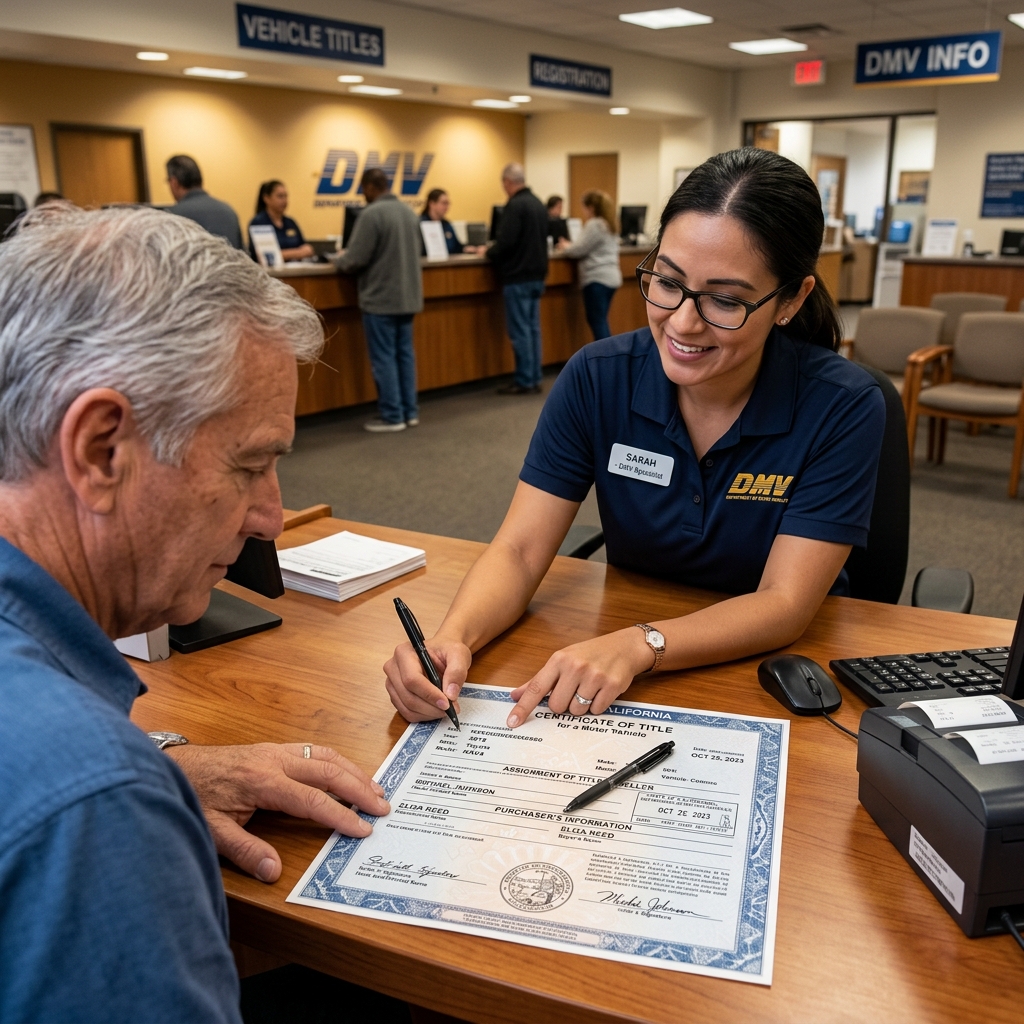
Transferring vehicle ownership is more than handing over the keys. To legally change who owns a car, truck, or motorcycle, you must update the title and registration through your state’s motor vehicle agency, often called the Department of Motor Vehicles (DMV) or motor vehicle administration. Failing to do this correctly can leave you responsible for tickets, accidents, or unpaid taxes linked to a vehicle you thought you no longer owned.
This guide explains how vehicle ownership changes work, what documents you need, and how to complete a title transfer for common situations such as private sales, gifts, divorce, inheritance, and moving to another state.
Understanding Vehicle Titles and Registration
When you transfer ownership, two closely related records matter: the title and the registration.
- Vehicle title: The legal document that identifies the owner, the vehicle, and any lienholder. It proves who owns the vehicle.
- Vehicle registration: The authorization to operate the vehicle on public roads in a specific state, linked to license plates and insurance.
Most states require issuing a new title whenever ownership changes, except for some dealer‑to‑dealer transfers. The registration usually must also be updated or replaced so that the new owner is properly recorded and insured in the state’s system.
Key Steps in Any Title Transfer
Although each state has its own forms and fees, the core process is similar across the United States.
- Seller signs over the title
The current owner signs the title to release their interest. If the title lists multiple owners, state law determines whether all must sign, and some states require notarization. - Buyer or new owner applies for a new title
The new owner takes the signed title and required documents to the appropriate agency (DMV, motor vehicle administration, or equivalent) and files an application for a new title. - Fees and taxes are paid
Title fees, registration fees, and any applicable sales or use tax must be paid before the new title is issued. - Agency issues the new title
The motor vehicle agency processes the paperwork and issues a new paper or electronic title in the new owner’s name. This may take several weeks depending on the state.
| Requirement | Purpose |
|---|---|
| Signed original title | Shows the previous owner transferred ownership to the buyer. |
| Driver’s license or ID | Verifies the identity of the new owner and seller. |
| Odometer reading | Required for federal mileage disclosure on newer vehicles. |
| Proof of insurance | Demonstrates that the vehicle is insured before registration. |
| VIN verification or tracing | Confirms the vehicle identification number matches the title. |
Transferring a Title in a Private Sale
Private sales are one of the most common reasons to transfer a vehicle title. Both the seller and the buyer have legal responsibilities to ensure the transfer is complete and accurate.
Seller’s Responsibilities
- Complete and sign the title: Fill in the buyer’s name, sale date, sale price, and odometer reading where required, then sign in the designated area.
- Provide a bill of sale: While not required in all states, a written bill of sale summarizing the transaction, including both parties’ details, vehicle information, and purchase price, can help avoid disputes.
- Remove license plates (if required): Some states require sellers to remove plates and return them or transfer them to another vehicle.
- Notify the state of sale: Many states require sellers to file a notice of sale or release of liability within a set period (for example, 10 days), so they are no longer responsible for incidents involving the vehicle.
Buyer’s Responsibilities
- Verify the title: Confirm the vehicle identification number (VIN), owner name, and any liens match the seller’s statements before paying.
- Apply for a new title and registration: Bring the signed title and any other required documents (ID, insurance, odometer disclosure, VIN verification, bill of sale) to the DMV or equivalent office.
- Pay taxes and fees: Buyers generally pay sales or use tax, title fees, registration fees, and sometimes emissions or safety inspection fees.
Until the buyer completes the title and registration transfer, the state may still treat the seller as the vehicle’s legal owner, which is why prompt reporting and careful documentation are critical.
Title Transfers for Gifts and Family Transactions
Vehicle ownership often changes without money changing hands, such as when a parent gives a car to an adult child or spouses rearrange title during divorce or estate planning. These transfers still require proper documentation.
- Gifts
The donor signs the title to the recipient. States may classify the transaction as a gift, which can affect whether sales tax applies. Some agencies require a special form or affidavit stating that no payment was exchanged. - Transfers between spouses or immediate family
Some states offer reduced fees or simpler procedures when transferring titles between close family members, and may allow registration to be transferred at a low cost. - Divorce or separation
When a court awards a vehicle to one spouse, that person may need a copy of the divorce decree and the other spouse’s signature or a court‑ordered title change process to complete the transfer through the DMV.
Handling Liens and Loans During a Transfer
A lienholder, usually a bank or finance company, may appear on the title if the vehicle was financed. When a lien exists, transferring ownership is more complex.
- Releasing a lien
Before the title can fully transfer to a new owner, the lienholder often must release its interest. This is typically done through a lien release document or by updating the title record once the loan is paid off. - Transferring a financed vehicle
If the buyer is taking over a financed vehicle, the lender may require a new loan agreement. The title may be issued in the buyer’s name but sent directly to the lender until the loan is repaid. - Electronic titles
Increasingly, states issue electronic titles. In these systems, transferring ownership may involve digital records rather than physical documents, though some states allow you to request a paper title for a fee.
Inheritance: Transferring a Vehicle After Death
When a vehicle owner dies, the title often must be updated to reflect the new owner, whether that is a surviving spouse, heir, or the estate itself. States provide detailed rules based on the value of the estate and the presence of surviving family members.
- Surviving spouse or partner
Some states allow a surviving spouse or civil union partner to transfer the title more easily when the estate is below a specified value. The spouse may need to present an affidavit or certificate from a local probate court and the current title. - Next of kin
If there is no surviving spouse and the estate is relatively small, heirs may be able to transfer the title using an affidavit of next of kin and the original title. - Formal estate administration
For larger estates, a court‑appointed administrator or executor usually signs the title and provides legal documentation (such as letters of administration or surrogate certificates) to the motor vehicle agency.
Whenever inheritance is involved, it is wise to consult both probate rules and DMV guidance to ensure the correct documents are submitted.
Moving to a New State: Out‑of‑State Titles
Relocating to another state often requires retitling and registering your vehicle within a specified time frame. The new state must confirm that your vehicle is legally owned and meets local requirements before issuing plates.
Typical Requirements When You Move
- Apply for a new state title and registration: Many states require you to apply within a short period after establishing residency, such as 20 days.
- Provide your out‑of‑state title: The original title from the previous state is submitted along with the new state’s title application form.
- Show proof of new‑state insurance: Insurance must meet local minimum liability requirements, and you typically must provide an ID card or declarations page.
- VIN verification or tracing: Inspectors or notaries may be authorized to confirm or trace your vehicle identification number to prevent fraud.
In some states, if you owned the vehicle for a certain period before moving (for example, six months), you may be exempt from paying sales tax again, provided you document the exemption on the title application.
State‑Specific Examples of Ownership Transfer
To illustrate how requirements can vary, consider examples from several states.
- New Jersey
New Jersey’s Motor Vehicle Commission directs buyers to visit an agency to transfer the title, complete a registration application, and obtain plates, with specific fees depending on whether the vehicle is financed. Special affidavits are used to transfer titles in inheritance situations, such as surviving spouse or next of kin affidavits when the estate is below certain thresholds. - Pennsylvania
Pennsylvania requires new residents to apply for a state title and registration within 20 days of moving, submitting their out‑of‑state title, proof of insurance, and VIN verification, along with applicable fees and taxes. Forms such as MV‑1 (Application for Certificate of Title) are used to document the transfer and verify ownership and tax status. - General guidance on seller and buyer roles
Across states, motor vehicle agencies and reputable financial organizations emphasize that the seller must sign the title and that the buyer must file for a new title promptly and pay applicable fees and taxes.
Common Mistakes to Avoid When Transferring a Title
Mistakes in title transfers can cause delays, unexpected fees, or even legal disputes. Watch out for these frequent issues:
- Leaving sections blank: Failing to complete the odometer reading, buyer information, or sale price can lead to rejection of your application.
- Ignoring notarization requirements: In states that require notarized signatures, a title without proper stamps may be unusable until corrected.
- Not reporting the sale: If the seller does not notify the state promptly, they may still be associated with the vehicle in state records and risk liability for incidents.
- Overlooking liens: Attempting to transfer a vehicle without addressing an active lien can prevent the new owner from receiving a clear title.
- Missing deadlines: Many states impose deadlines for registration after purchase or relocation, with penalties or additional fees if you wait too long.
Frequently Asked Questions About Vehicle Title Transfers
Do both the buyer and seller need to be present at the DMV?
Many states allow the seller to sign the title elsewhere and let the buyer visit the DMV alone, but some jurisdictions or practical services (such as notaries) prefer or require both parties to appear together for verification and notarization. Check your local requirements before the sale.
How long does it take to receive a new title?
Processing times vary widely. Some motor vehicle agencies issue titles within a few days, while others may take several weeks. States that use electronic titles may process ownership changes faster, though you may need to pay a fee if you want a paper copy.
Can I drive the car before the title transfer is complete?
Usually the buyer may drive the vehicle if it is properly insured and registered. In many private sale situations, plates and registration must be updated quickly to avoid violations. Some states allow temporary permits or tags during the transition; verify local rules before driving extensively.
What happens if I lose the title before the sale?
If the title is lost or damaged, the current owner typically must request a duplicate title from the motor vehicle agency before the sale can proceed. The agency may issue a replacement that can then be used to transfer ownership.
Is a bill of sale always required?
Not all states mandate a bill of sale, but it is often recommended as written evidence of the transaction. Some agencies or courts rely on bills of sale to help resolve disputes about purchase price, ownership, or the date the vehicle was sold.
References
- How to Transfer a Car Title — LendingTree. 2023-04-25. https://www.lendingtree.com/auto/how-to-transfer-a-car-title/
- NJ MVC | Transferring Vehicle Ownership — New Jersey Motor Vehicle Commission. 2024-01-10. https://www.nj.gov/mvc/vehicles/transowner.htm
- Transfer Vehicle Registration from Another State — Commonwealth of Pennsylvania. 2023-08-15. https://www.pa.gov/services/dmv/transfer-vehicle-registration-from-another-state
- Transfer of Ownership — Tennessee County Clerk Vehicle Services Guide. 2022-06-01. https://tnclerks.zendesk.com/hc/en-us/articles/360000360026-Transfer-of-Ownership
- How Do You Transfer Ownership Of A Car In New York State — Lexus of Mt Kisco. 2022-09-10. https://www.lexusofmtkisco.com/how-do-you-transfer-vehicle-ownership-in-new-york-state
Similar Articles








Read full bio of medha deb


