
Changing Immigration Status After Marriage
A practical guide to marriage-based adjustment of status, eligibility rules, key forms, evidence requirements, and interview preparation.
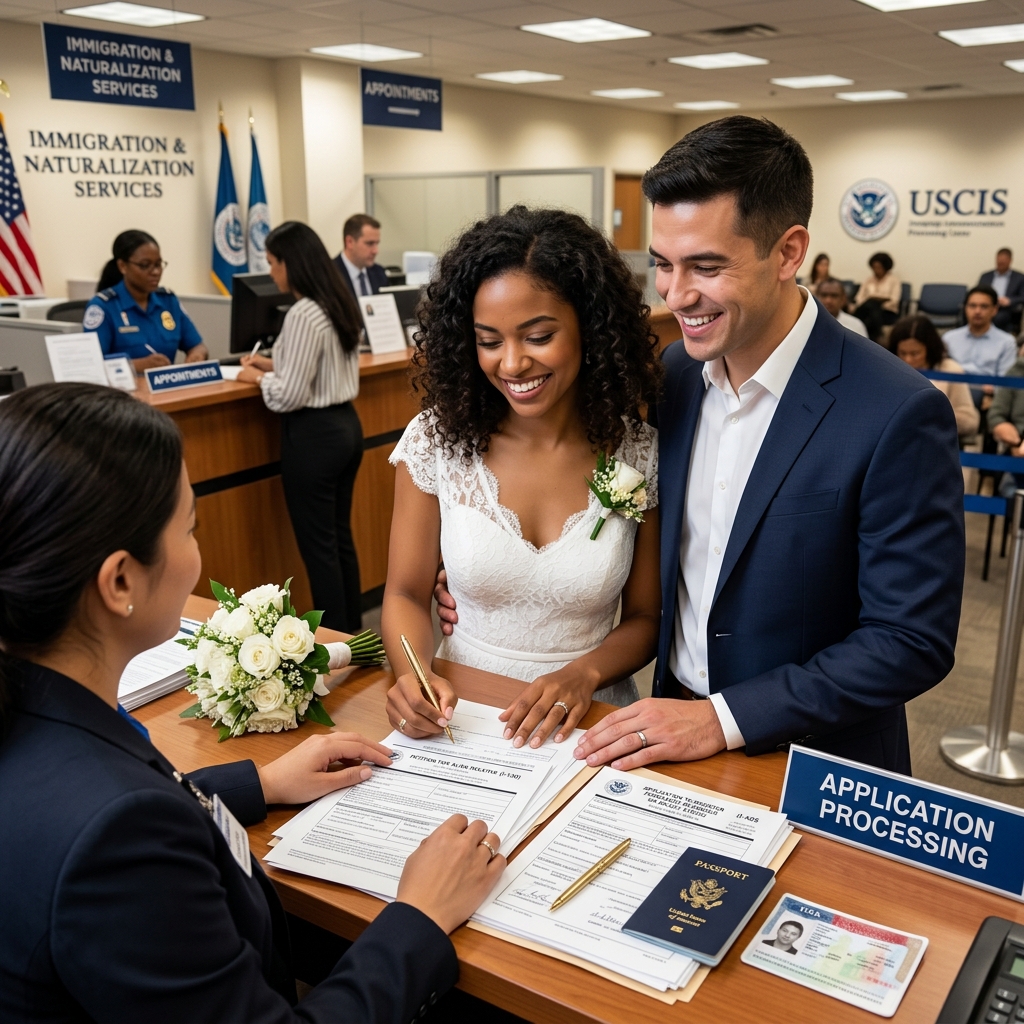
Marriage to a U.S. citizen or lawful permanent resident can open a pathway to a green card, but it does not automatically change a person’s immigration status. Marriage simply creates the basis for an immigration petition. The immigrant spouse must still go through a formal process with U.S. Citizenship and Immigration Services (USCIS) or a U.S. consulate to obtain lawful permanent residence.
This article explains, in practical terms, how marriage can lead to a change of immigration status, focusing on adjustment of status inside the United States, required forms, core eligibility rules, and how to prepare for the interview and the evidence needed to show a real marriage.
1. Marriage and Immigration Status: What Actually Changes?
Many couples assume that once they marry, the immigrant spouse immediately becomes legal in the United States. That is incorrect. Marriage alone does not grant a visa, lawful status, or any right to work or travel.
- Marriage to a U.S. citizen or resident creates the legal relationship that allows the U.S. spouse to file an immigrant petition (Form I-130) for the foreign spouse.
- No automatic status: Until a proper application is filed and approved, the immigrant spouse’s status remains what it was before the marriage (including any prior overstays or violations).
- Protection while an application is pending: When an adjustment of status application is properly filed inside the U.S., the immigrant spouse is generally allowed to remain in the country while USCIS makes a decision, even if earlier status has expired.
This distinction is crucial: marriage enables the process, but does not replace it.
2. Two Main Paths: Adjustment of Status vs. Consular Processing
Changing immigration status after marriage usually happens through one of two processes:
- Adjustment of Status (AOS): Used when the immigrant spouse is in the United States and qualifies to apply for a green card without leaving.
- Consular Processing: Used when the immigrant spouse lives abroad or is otherwise required to complete the process at a U.S. embassy or consulate.
| Feature | Adjustment of Status (in U.S.) | Consular Processing (abroad) |
|---|---|---|
| Physical location of immigrant spouse | Must be in the United States | Lives outside the United States |
| Main government agency | USCIS | U.S. consulate and the National Visa Center |
| Typical key forms | I-130 and I-485, often with I-765 and I-131 | I-130, then immigrant visa forms and consular processing documents |
| Interview location | USCIS field office | U.S. embassy or consulate |
| Ability to remain in U.S. while case is pending | Yes, if AOS is properly filed | Generally no, unless another valid status allows it |
This article focuses on adjustment of status after marriage, which is the route many couples choose when the immigrant spouse is already in the United States.
3. Core Eligibility for Adjustment of Status Through Marriage
Not every married couple can use adjustment of status. USCIS applies several basic eligibility rules.
3.1 Relationship Requirements
- The marriage must be legally valid where it was performed (proper license, ceremony, and compliance with local law).
- The marriage must be bona fide, meaning the couple intended to create a real life together, not simply obtain an immigration benefit.
- If either spouse had prior marriages, those marriages must be legally ended (divorce, annulment, or death certificates).
3.2 Status and Admission Requirements
Most applicants must meet certain admission criteria to qualify for adjustment of status.
- The immigrant spouse must have entered the United States lawfully, after inspection and admission by an immigration officer (for example, with a valid visa or under the Visa Waiver Program).
- In general, the applicant should be in lawful status at the time of filing, but there is an important exception for spouses of U.S. citizens.
- When married to a U.S. citizen, many applicants can still use adjustment of status even if they overstayed a visa, as long as the original entry was lawful.
3.3 Admissibility to the United States
Even with a valid marriage, some issues can make a person inadmissible, such as certain criminal records or earlier immigration violations. In complex situations, couples should consider consulting a qualified immigration lawyer to review possible waivers or other options.
4. Main Forms Used in Marriage-Based Adjustment of Status
Changing status through marriage involves a package of USCIS forms and supporting documents. The key forms are:
4.1 Form I-130: Petition for Alien Relative
The U.S. citizen or permanent resident spouse files Form I-130 to prove there is a qualifying relationship with the immigrant spouse and that the marriage is genuine.
- Filed by: U.S. citizen or lawful permanent resident spouse.
- Purpose: Establish a real marriage and classify the immigrant spouse as an immediate relative or family preference immigrant.
- Evidence: Marriage certificate, proof of the petitioner’s citizenship or green card, and documents showing a bona fide relationship.
4.2 Form I-485: Application to Register Permanent Residence or Adjust Status
Form I-485 is the immigrant spouse’s primary application for permanent residence.
- Filed by: Immigrant spouse, typically at the same time as the I-130 (known as concurrent filing) when a visa is immediately available.
- Purpose: Request a green card from within the United States.
- Supporting documentation often includes:
- Copy of passport and visa.
- Form I-94 arrival/departure record, if available.
- Birth certificate.
- Two passport-style photographs.
- Form I-693 medical examination and vaccination record.
4.3 Form I-864: Affidavit of Support
The financial sponsorship form, I-864, shows that the immigrant spouse will have adequate financial support and is unlikely to rely primarily on public benefits.
- Filed by: Sponsoring spouse (and sometimes a joint sponsor).
- Evidence: Tax returns, W-2s, employment letter, pay stubs, or other proof of income meeting or exceeding the required threshold.
4.4 Forms I-765 and I-131: Work and Travel Authorization
Many applicants file supplementary forms together with the I-485:
- Form I-765: Application for Employment Authorization, allowing the immigrant spouse to work while the green card case is pending.
- Form I-131: Application for travel permission (advance parole), allowing certain travel outside the United States without abandoning the adjustment application.
5. Evidence of a Genuine Marriage: What USCIS Looks For
USCIS is focused on whether the marriage is real. Couples should prepare a solid collection of documents that reflect their shared life.
5.1 Common Types of Relationship Evidence
- Joint financial documents
- Joint bank account statements and credit card bills.
- Mortgage, lease, or property documents in both names.
- Joint car titles or loans.
- Insurance and beneficiary designations
- Health, auto, or renters insurance policies listing both spouses.
- Life insurance or retirement accounts naming the spouse as beneficiary.
- Household and lifestyle evidence
- Utility bills (electricity, gas, water, internet) for a shared address.
- Mail and correspondence addressed to each spouse at the same residence.
- Receipts for significant joint purchases, such as furniture, cars, or travel.
- Family and social proof
- Photos of the couple together over time, including with friends and family.
- Evidence of children together, such as birth certificates.
- Tickets or reservations showing trips taken together.
No single document proves a relationship by itself. USCIS reviews the full picture to decide whether the couple actually shares a life, finances, and future plans.
6. The Adjustment of Status Timeline After Marriage
Processing times vary based on USCIS workload, local field office, and case complexity. However, general patterns can be described.
- Receipt notices: After the package is filed, USCIS typically issues receipts confirming they received the I-130, I-485, and other forms.
- Biometrics appointment: Within a few weeks or months, the immigrant spouse is scheduled to provide fingerprints, photograph, and signature.
- Work and travel card: Many applicants receive a combined employment authorization and advance parole card several months after filing, allowing them to work and, in some cases, travel.
- Interview: A USCIS field office usually schedules an in-person interview to review the marriage and the immigrant’s eligibility. This may be around 8–14 months for spouses of U.S. citizens, and significantly longer for spouses of permanent residents, though times can change.
- Decision and green card: If approved, USCIS issues either a conditional or a regular green card depending on how long the couple has been married.
These time frames are estimates based on recent practice and can change over time. Couples should check USCIS processing time reports for the most current information.
7. Interview and Green Card: Conditional vs. Ten-Year Status
7.1 Purpose of the Interview
At the marriage-based interview, a USCIS officer typically aims to accomplish two things:
- Confirm that the marriage is authentic and ongoing.
- Verify that the immigrant spouse meets all legal requirements to become a permanent resident.
The officer may ask both spouses questions about how they met, their daily life, finances, family, and future plans. In some situations, the officer may speak to each spouse separately to compare answers, especially if there are concerns about fraud.
7.2 Conditional Permanent Residence
If the case is approved and the marriage is less than two years old on the day of approval, the immigrant spouse receives conditional permanent residence valid for two years.
- Conditional residents have the same basic rights as other permanent residents (to live, work, and study in the United States).
- Before the two-year card expires, the couple must jointly file a petition to remove conditions and submit updated evidence of a real, ongoing marriage.
7.3 Ten-Year Permanent Residence
If the marriage is at least two years old when USCIS approves the case, the immigrant spouse normally receives a ten-year green card, which is a standard permanent resident card.
- This card can be renewed periodically as needed.
- After meeting residency and other requirements, many permanent residents later become eligible to apply for U.S. citizenship through naturalization.
8. Practical Tips for Couples Preparing to Change Status
Because marriage-based cases involve both legal and personal details, preparation is essential. Consider the following practical steps:
- Organize documents early: Gather identity documents, proof of lawful entry, marriage certificates, prior divorce decrees, financial records, and relationship evidence before filing.
- Keep copies of everything: Maintain a complete copy of the entire filing package and any notices from USCIS.
- Update major records: If the immigrant spouse eventually becomes a lawful permanent resident or citizen, update their status with agencies such as the Social Security Administration, which may require a new application for a replacement card with the updated immigration status.
- Avoid travel without permission: Traveling outside the United States without approved advance parole while an adjustment application is pending can lead to serious problems or abandonment of the case.
- Seek legal help in complex cases: Prior immigration violations or criminal history can change a case dramatically. Professional guidance may be important when the facts are complicated.
9. Frequently Asked Questions (FAQs)
Does marriage automatically give my spouse a green card?
No. Marriage to a U.S. citizen or permanent resident does not automatically grant lawful status or a green card. The U.S. spouse must file an immigrant petition, and the immigrant spouse must complete either adjustment of status or consular processing.
Can my spouse stay in the U.S. while the adjustment of status is pending?
In many cases, yes. Once a properly filed adjustment of status application is received by USCIS, the immigrant spouse is generally allowed to remain in the United States while USCIS adjudicates the case, even if earlier nonimmigrant status has expired.
Is it possible to adjust status if my spouse overstayed a visa?
Often it is, if the spouse is married to a U.S. citizen and originally entered the United States lawfully. The overstay can still create challenges, but the law allows many such applicants to pursue adjustment of status.
What kind of evidence proves that our marriage is real?
USCIS looks at the total picture, including joint financial records, shared housing, insurance, mail, travel records, photos with family and friends, and evidence of children together. No single document is decisive; the stronger and more consistent the collection, the better.
How long does marriage-based adjustment of status take?
Time frames change, but many spouses of U.S. citizens see interviews and decisions within roughly 8–14 months, whereas spouses of permanent residents may wait significantly longer. Couples should always check current USCIS processing times, as these estimates can fluctuate.
References
- Adjustment of Status Through Marriage — Takhsh Law, P.C. 2023-06-01. https://www.takhshlaw.com/immigration-law/adjustment-of-status-through-marriage/
- Adjustment of Status after Marriage: Form I-485 — Immigration Help. 2023-02-15. https://immigrationhelpla.com/form-i485/
- Adjustment of Status – Marriage to U.S. Citizen — Serotte Reich, LLP. 2022-11-10. https://srwlawyers.com/adjustment-of-status-marriage-to-u-s-citizen/
- The Adjustment of Status Process, Explained — Boundless Immigration. 2024-01-05. https://www.boundless.com/immigration-resources/adjustment-status-process-explained
- Update Citizenship or Immigration Status — Social Security Administration. 2023-09-20. https://www.ssa.gov/personal-record/update-citizenship-or-immigration-status
Similar Articles








Read full bio of Sneha Tete


