
Changing Child Support Orders in New York
A practical guide to when and how New York parents can ask the court to raise, lower, or otherwise modify an existing child support order.
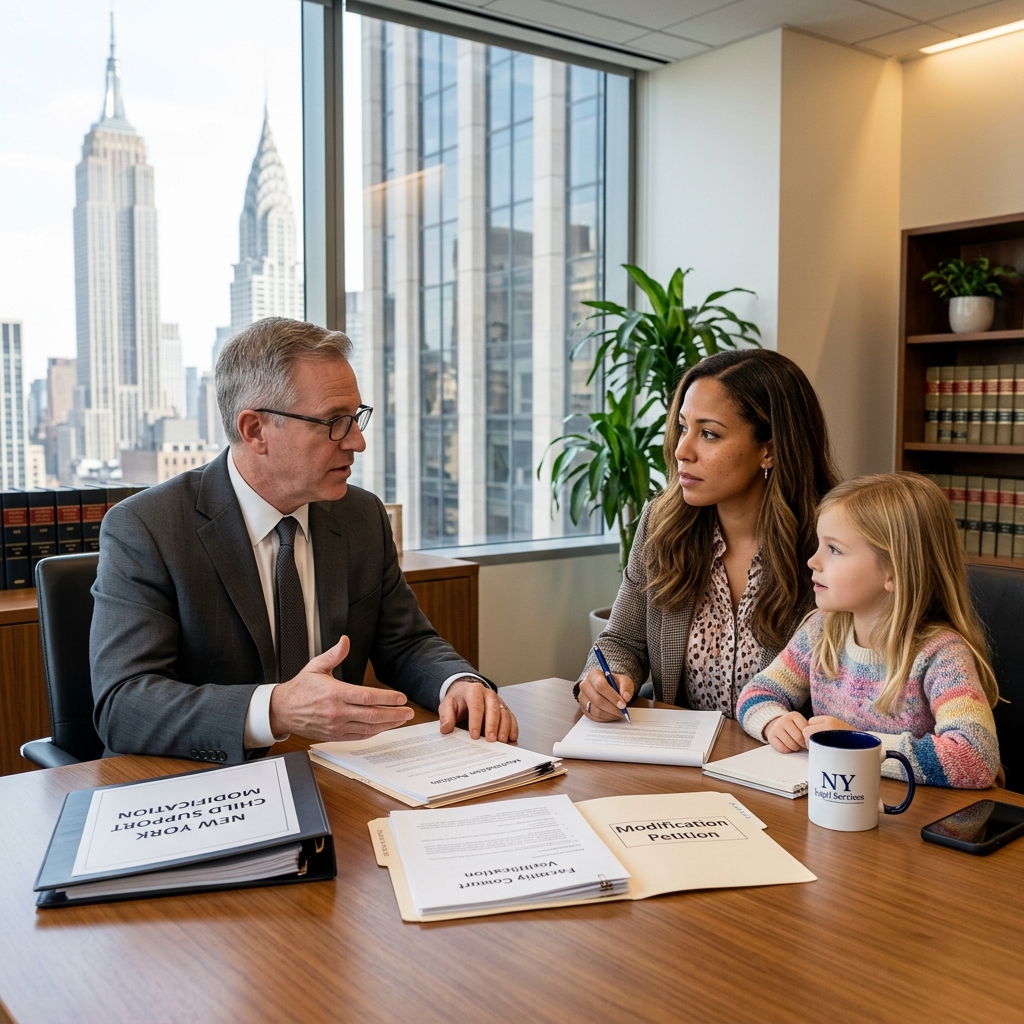
New York law allows parents to ask the court to modify an existing child support order when life circumstances meaningfully change. Parents may seek a higher amount when a child’s needs grow, or a lower amount when income drops for reasons beyond their control. Understanding when you can request a change, what the court looks for, and how to file correctly can prevent costly mistakes and protect your family’s financial stability.
Core Legal Rules Behind Child Support Changes
New York uses the Child Support Standards Act and several statutory rules to govern both the original support calculation and later modifications. While the initial order is based largely on parental income and number of children, any later change must meet specific thresholds designed to balance fairness, predictability, and the child’s best interests.
Key Grounds for Modification
Most modern New York child support orders can be modified if at least one of these triggers applies:
- Substantial change in circumstances since the original order, such as a major shift in income, health, or the child’s needs.
- Three-year review – at least three years have passed since the order was entered, last modified, or adjusted.
- 15% change in income for either parent, usually an involuntary change up or down.
These statutory bases make it easier for parents to access the court without proving extreme hardship, while still requiring meaningful justification for any adjustment.
Understanding “Substantial Change in Circumstances”
The phrase substantial change in circumstances is central to New York modification law. Courts look at whether events occurring after the original order make that order no longer fair or adequate.
Common examples include:
- A parent loses a job or suffers a serious drop in income not caused by their own voluntary choices (for instance, a layoff or medical disability).
- A custodial parent’s costs increase markedly, such as higher rent, childcare, or insurance premiums.
- A child develops significant medical, educational, or special needs that require greater financial support.
Courts generally require that the change be unforeseen and substantial, not just minor fluctuations or predictable events. For downward modifications, judges usually insist that the parent demonstrate they are actively seeking work and that any drop in income is involuntary.
When Time Alone Justifies a Review
Modern New York statutes permit review based on the passage of time or quantifiable changes in income, even if circumstances aren’t extreme.
Three-Year Rule
Parents can request a modification when three years or more have passed since the support order was first entered, last modified, or adjusted. This rule recognizes that financial situations, cost of living, and children’s needs evolve over time, and it gives families a predictable interval for reassessing support.
15% Income Change Rule
Another key trigger is a 15% or greater change in either parent’s income since the support order was entered or last modified. This may justify:
- An increase in support if the paying parent’s income rises substantially.
- A decrease if the paying parent experiences an involuntary 15%+ reduction and is making diligent efforts to secure appropriate employment.
Voluntary reductions—such as quitting a job without good cause or deliberately working less—usually do not support a downward modification.
Where and How to File a Modification Request
To change a New York child support order, a parent must file a formal request, known as a petition for modification, with the appropriate court.
Choosing the Right Court
The court you use depends largely on how the original order was issued:
| Type of Original Order | Where to File the Modification |
|---|---|
| Family Court support order | Family Court in the county where the order was entered, or where you and/or the child live. |
| Support order within a Supreme Court divorce judgment | You may still file in Family Court in the county where you or the child live. |
Step-by-Step Filing Process
Although each case is unique, most parents follow these core steps to seek a modification:
- Prepare financial documentation
Gather proof of income, expenses, and benefits, such as:
- Recent pay stubs and tax returns.
- Rent or mortgage statements.
- Child care, health care, and educational expenses.
- Records of unemployment, disability, or public benefits.
- Complete the petition and financial affidavit
Ask the court clerk for a child support modification petition and a Financial Disclosure Affidavit, or use New York’s do-it-yourself (DIY) forms online. The affidavit requires a detailed listing of income and household costs and must be signed before a notary.
- Explain the change in circumstances
In your petition, clearly state why you are requesting a modification and which legal basis applies (substantial change, three-year rule, or 15% income change). Attach supporting documentation to show the court that your situation meets the threshold.
- Serve the other parent
After filing, you must formally deliver a copy of the petition to the other parent, giving them notice and an opportunity to respond. Service is critical: without proper notice, your case may be delayed or dismissed.
- Attend the court hearing
The court will schedule a hearing where both parents can present evidence and arguments. Bring your completed affidavit, supporting documents, and any witnesses or expert reports, if relevant. The judge or support magistrate will then decide whether to modify the order and, if so, set the new amount.
What Courts Consider When Deciding a Modification
Judges and support magistrates focus on whether the proposed change is justified and consistent with the child’s best interests. They typically consider:
- The child’s current needs, including basic necessities (food, housing, clothing) and mandatory add-ons like health care and childcare.
- Each parent’s income and earning capacity, not just current wages if those wages could reasonably be higher.
- Whether the change in income is voluntary or involuntary, particularly for downward modifications.
- Any unforeseen events that have made the original order unfair or unworkable.
- Existing agreements or stipulations incorporated into prior orders and whether those assumed circumstances still apply.
Even when a technical trigger like the three-year rule or a 15% income change is met, the court retains discretion. A judge may deny modification if the existing order still reasonably meets the child’s needs and is not unfair under the new circumstances.
Special Considerations for Increasing or Decreasing Support
Requests for higher or lower support are both governed by the same legal framework, but the facts the court will focus on differ somewhat depending on the direction of the change.
Seeking an Increase in Child Support
A custodial parent may seek an increase when:
- The child’s expenses have grown substantially, for example due to schooling, medical care, or extracurricular activities.
- The noncustodial parent’s income has risen significantly, either triggering the 15% rule or otherwise supporting a larger contribution.
- New, unforeseen circumstances make the original order inadequate to cover basic needs.
In these cases, detailed records of the child’s costs and evidence of the other parent’s income are critical. Courts want to ensure that any increase matches real needs and legally recognized income, rather than speculative or temporary gains.
Requesting a Decrease in Child Support
Noncustodial parents seeking a lower obligation face careful scrutiny. They generally must show:
- An involuntary reduction in income (for example, termination without cause, court-documented disability, or industry-wide layoffs).
- Diligent efforts to find new or comparable employment.
- That keeping the current order would create genuine financial hardship, not just inconvenience.
Courts often look beyond current pay stubs to assess earning capacity, prior work history, and the reasons for any career changes. Parents who voluntarily reduce their income may find that the court continues to impute higher earnings for support purposes.
The Importance of Acting Promptly
One of the most critical aspects of New York child support law is that modifications are not retroactive. Payments generally continue at the existing rate until the court formally changes the order.
This means:
- If your income drops, you should file for a modification as soon as possible instead of waiting or assuming the obligation will later be forgiven.
- Any arrears that accrue before the court’s new order will usually remain owed and enforceable.
Timely filing protects both parents: the paying parent avoids unmanageable arrears, and the custodial parent ensures the child’s needs are addressed quickly if circumstances require an increase.
Support Services and Online Tools
New York offers several resources to help parents navigate modifications without having to manage the process entirely on their own.
Child Support Program and OCSS Assistance
The state’s Child Support Program and local Office of Child Support Services (OCSS) can help parents prepare petitions and, in some cases, work out new orders by consent.
- Parents may contact OCSS to discuss changing an order and, if both agree, finalize a new amount using the same formula applied in court.
- OCSS staff can assist with completing modification forms and understanding procedural requirements.
DIY Court Forms
The New York court system provides do-it-yourself (DIY) support modification forms online. These guided programs help users:
- Enter case details, including the existing order and parties’ information.
- Describe the change in circumstances and select the applicable legal basis.
- Generate a petition suitable for filing in Family Court.
Using these tools can reduce errors, clarify what information the court expects, and make the process more accessible for self-represented litigants.
Frequently Asked Questions About New York Child Support Modification
Can either parent ask for a modification?
Yes. Both custodial and noncustodial parents may request a change, whether they are seeking an increase or a decrease. The key issue is whether they can meet one of the legal grounds: substantial change in circumstances, three-year passage of time, or a 15% shift in income.
Do I need a lawyer to file for modification?
A lawyer is not legally required. Many parents file on their own using court-provided forms or assistance from the Child Support Program. However, legal counsel can be valuable when the case involves complex income, disputed facts, or high conflict, as an attorney can help present evidence effectively and anticipate legal arguments.
If I lose my job, will support automatically go down?
No. Support does not automatically adjust. You must file a petition and show that your job loss is involuntary and that you are actively seeking employment. Until the court issues a new order, you remain responsible for paying under the existing order, and arrears may accumulate.
Can we just agree privately to change the amount?
Private agreements that contradict a court order are risky and often unenforceable. To be safe, any change should be formally approved by the court or implemented through the state’s Child Support Program, ensuring that enforcement mechanisms and official records reflect the new amount.
What if my support order is part of a divorce judgment?
Even if the order is contained in a Supreme Court divorce judgment, you can usually seek modification in Family Court in the county where you or the child lives. The same legal standards for change apply.
How does the court decide the new amount?
Courts typically use the Child Support Standards Act formula—applying a percentage of combined parental income based on the number of children—and then consider add-ons and special circumstances. Judges may depart from the standard calculation if strict application would be unjust or inappropriate in light of the child’s needs and parents’ financial situations.
References
- Modification of Child Support Orders in New York State — JD Bar. 2017-03-01. https://jdbar.com/articles/child-support-modification/
- Modification of Child Support Order in New York — New York City Bar Association. 2021-06-15. https://www.nycbar.org/get-legal-help/article/family-law/child-support-modification/
- Modifying a Child Support Order in New York — Stephen Bilkis & Associates. 2022-04-10. https://familylawyer.1800nynylaw.com/practice-areas/new-york-family-lawyer/new-york-divorce-lawyer/new-york-child-support-lawyer/new-york-child-support-modification-lawyer/
- How can I change my child support payment? — LawHelpNY. 2023-02-20. https://www.lawhelpny.org/resource/how-can-i-change-my-child-support-payment
- Child Support In New York: Obligations, Modifications, and Enforcement — Joseph Law Group, P.C. 2022-09-05. https://josephlawpc.com/blog/child-support-in-new-york-obligations-modifications-and-enforcement/
- Change or Stop Your Child Support Order — NYC Human Resources Administration, Office of Child Support Services. 2021-11-01. https://www.nyc.gov/assets/hra/downloads/pdf/services/child_support/FLYER-Change-or-Stop-child-support.pdf
- Modify Order — New York State Child Support Services. 2023-03-15. https://childsupport.ny.gov/order/modify
Similar Articles








Read full bio of medha deb


