
Changing Child Custody and Visitation in Texas
A practical guide to modifying Texas custody and visitation orders when a child’s needs, safety, or living situation changes.
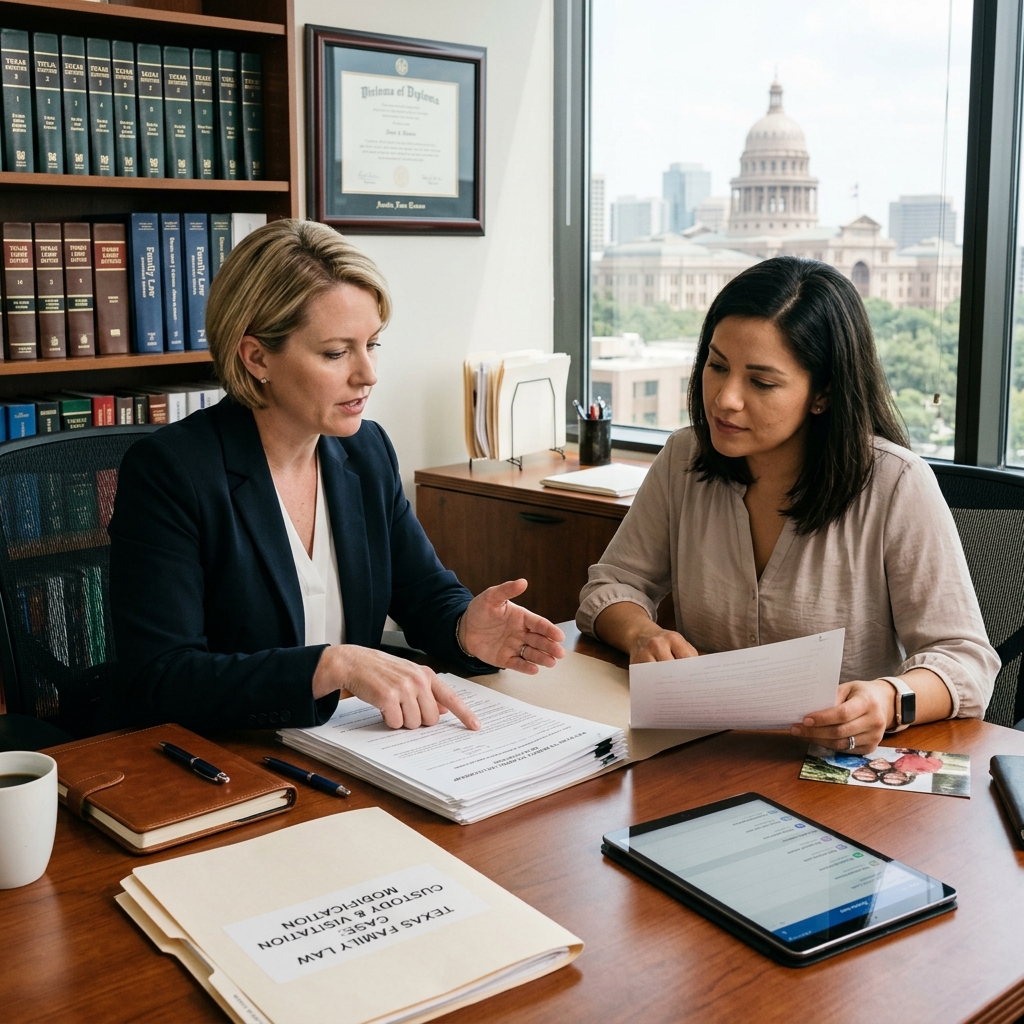
When a Texas custody or visitation order can be changed
In Texas, a child custody or visitation order is not permanently fixed, but it also cannot be changed just because one parent is unhappy with it. A judge must approve any modification, and the court will focus on whether the requested change fits the child’s best interests and satisfies the legal rules for modification.
That means a parent, guardian, or other eligible party must do more than ask for a new schedule. The person seeking the change usually needs to show a meaningful change in circumstances, a legal safety concern, or another ground recognized by Texas law.
- A modification is a formal court process, not an informal agreement between parents.
- The existing order remains enforceable until a judge signs a new one.
- The court’s main concern is the child’s welfare, not which parent wants a different outcome.
What counts as a valid reason for modification
Texas law requires a legal basis for changing custody, visitation, conservatorship, or related support provisions. One of the most common grounds is a material and substantial change in circumstances since the prior order.
Courts may consider many types of changes, including a parent’s relocation, instability in a household, medical incapacity, interference with visitation, persistent conflict, or concerns involving family violence or a child’s safety.
| Possible reason | Why it may matter to the court |
|---|---|
| Major change in a parent’s life | Can affect parenting ability, availability, or stability |
| Safety concerns | May show the child’s physical or emotional well-being is at risk |
| Repeated denial of visitation | Can justify changing access terms or enforcement strategy |
| Child’s living arrangement changed | May support a different custody structure if the child’s needs have shifted |
In some cases, a child who is old enough and mature enough may have a voice in the process, but the child’s preference is only one factor. The court still decides based on the overall best interest of the child.
The one-year rule for primary custody changes
Texas law gives extra protection to the stability of primary custody. If a person wants to change who has the right to determine the child’s primary residence, there is generally a one-year waiting period before filing again.
There are limited exceptions. A case may proceed within one year if the person with primary custody agrees to the change, if the child’s present environment may endanger the child’s physical health or significantly harm emotional development, or if the primary custodian has allowed someone else to have primary care and possession of the child for at least six months.
- The timing rule is designed to protect children from repeated litigation.
- The exception for danger requires specific facts, not general concerns.
- The six-month possession exception does not apply in certain military deployment situations.
Where the modification case must be filed
Most modification cases must be filed in the same Texas court that issued the original order. Even if a parent has moved to a different county or state, the original court usually keeps jurisdiction unless the case is properly transferred.
If the child has lived in another Texas county for at least six months, the case may be transferred to that county. This helps ensure the court handling the matter is connected to the child’s current home and daily life.
When filing, the person asking for the change becomes the petitioner, even if that person was the respondent in the original case. Everyone else who is already a party to the order becomes a respondent in the new proceeding.
How the modification process usually works
The basic process starts with a petition to modify the parent-child relationship. The petition tells the court what changes are requested and why the current order should be altered.
After filing, the other parent or involved party must be notified. The case may then move through settlement discussions, mediation, or a hearing before a judge. If the parents agree, they can sometimes present an agreed order for the court’s approval. If they do not agree, each side may need to present evidence and testimony.
- Prepare the modification petition and any required attachments.
- File the papers in the proper court.
- Serve or notify the other party as required by procedure.
- Attend mediation or a hearing if the court sets one.
- Obtain the judge’s signed order before relying on the change.
Evidence that can support your request
Successful modification cases are usually evidence-driven. Courts look for documentation that helps explain the change in circumstances and how the requested order would better serve the child.
Helpful evidence may include school records, medical records, text messages, emails, witness statements, police reports, therapy records, attendance logs, or a written chronology of visitation problems. The stronger the connection between the evidence and the child’s well-being, the more persuasive the request may be.
- Keep a detailed record of missed exchanges, late returns, and refusal to follow the order.
- Save written communications that show repeated conflict or refusal to cooperate.
- Collect documents that show changes affecting housing, health, education, or safety.
Custody changes, visitation changes, and support changes are related but different
Texas modification cases can involve more than one issue. A parent may ask to change custody, alter visitation or possession time, or adjust child support and medical support in the same proceeding if the facts justify it.
Still, each request is analyzed separately. A judge may agree that visitation should change but leave custody in place, or may modify support without changing conservatorship. The court can also require new forms or attachments depending on the issues raised.
| Issue | Typical focus |
|---|---|
| Custody or conservatorship | Who makes major decisions and where the child primarily lives |
| Visitation or possession | When each parent spends time with the child |
| Child support | Financial obligations tied to the child’s needs |
| Medical support | Coverage and payment responsibilities for healthcare |
What happens if parents disagree
Disagreement does not stop the modification process. If the parties cannot reach a settlement, the court can hold a hearing and decide the matter after reviewing sworn statements, live testimony, and documentary evidence.
Judges often look closely at whether the current order is working in real life. If one parent is repeatedly blocking court-ordered visitation, or if the child’s living situation has shifted in a significant way, the court may decide that a different arrangement is necessary.
If the dispute involves serious allegations such as abuse or danger, the court may treat the matter with added urgency and may consider protective measures or temporary orders while the case is pending.
Common mistakes to avoid
People often make avoidable errors when trying to change a Texas custody or visitation order. Some file in the wrong court, some rely on verbal agreements, and others file without enough evidence to support the legal standard.
- Do not assume a new schedule is valid unless the court approves it.
- Do not ignore the one-year rule if you are seeking a primary custody change.
- Do not file without facts that explain why the child would benefit from the new order.
- Do not forget that notice to the other party is usually required.
How a court decides the child’s best interest
Best interest is the central standard in Texas custody-related cases. The judge may consider stability, school and home environment, each parent’s ability to meet the child’s needs, the child’s safety, the history of cooperation or conflict, and any evidence showing the current order is no longer workable.
There is no single formula. A strong request usually shows both a legitimate legal reason for reopening the order and a practical reason why the proposed change would improve the child’s daily life.
Frequently asked questions
Can parents change custody or visitation on their own? Parents can agree in writing, but the court must approve the modification before it becomes enforceable.
Do I have to file in the same county as the original order? Usually, yes. Most modification cases begin in the court that issued the original order, although transfer may be possible if the child has lived elsewhere in Texas for at least six months.
What if the other parent keeps violating the schedule? Repeated interference with visitation may support a modification request, and it may also raise enforcement issues.
Can a child choose the new arrangement? A child’s preference may matter in some situations, but it does not control the outcome. The judge still applies the best-interest standard.
Is a relocation enough to change custody? Relocation can be part of a broader material change analysis, but the court still looks at the full impact on the child rather than the move alone.
What should I bring to court? Bring your filed petition, proof of service, supporting records, and any proposed order forms required by the court.
Why careful preparation matters
A Texas modification case is not just about asking for a different parenting arrangement. It is about showing the court that the proposed change is legally allowed, properly filed, and genuinely better for the child than the current order.
When parents document the problem clearly, follow the filing rules, and focus on the child’s needs rather than the conflict itself, they are in a stronger position to present a persuasive case to the judge.
References
- Changing a Custody, Visitation, or Child Support Order — Texas Law Help. 2024-06-01. https://texaslawhelp.org/article/changing-a-custody-visitation-or-child-support-order
- I need to change a custody, visitation, or support order (Modification) — Texas Law Help. 2024-06-01. https://texaslawhelp.org/guide/i-need-to-change-a-custody-visitation-or-support-order-modification
- How Do I Modify My Child Custody Agreement in Texas? — OWLawyers. 2024-02-01. https://www.owlawyers.com/firm-news/2024/february/how-do-i-modify-my-child-custody-agreement-in-te/
- Child Custody Modification Within One Year of Current Order — Texas Law Help. 2024-06-01. https://texaslawhelp.org/article/child-custody-modification-within-one-year-of-current-order
- Guides: Child Custody & Support: Modifying a SAPCR — Texas State Law Library. 2024-06-01. https://guides.sll.texas.gov/child-custody-and-support/modifying-a-sapcr
- Frequently Asked Questions – Texas Access — Texas Access. 2024-06-01. https://txaccess.org/faq
Similar Articles








Read full bio of Sneha Tete


