
Change of Venue in Criminal Trials: Rights, Rules, and Strategy
Learn when, why, and how criminal defendants can request a change of venue to protect the right to a fair and impartial trial.
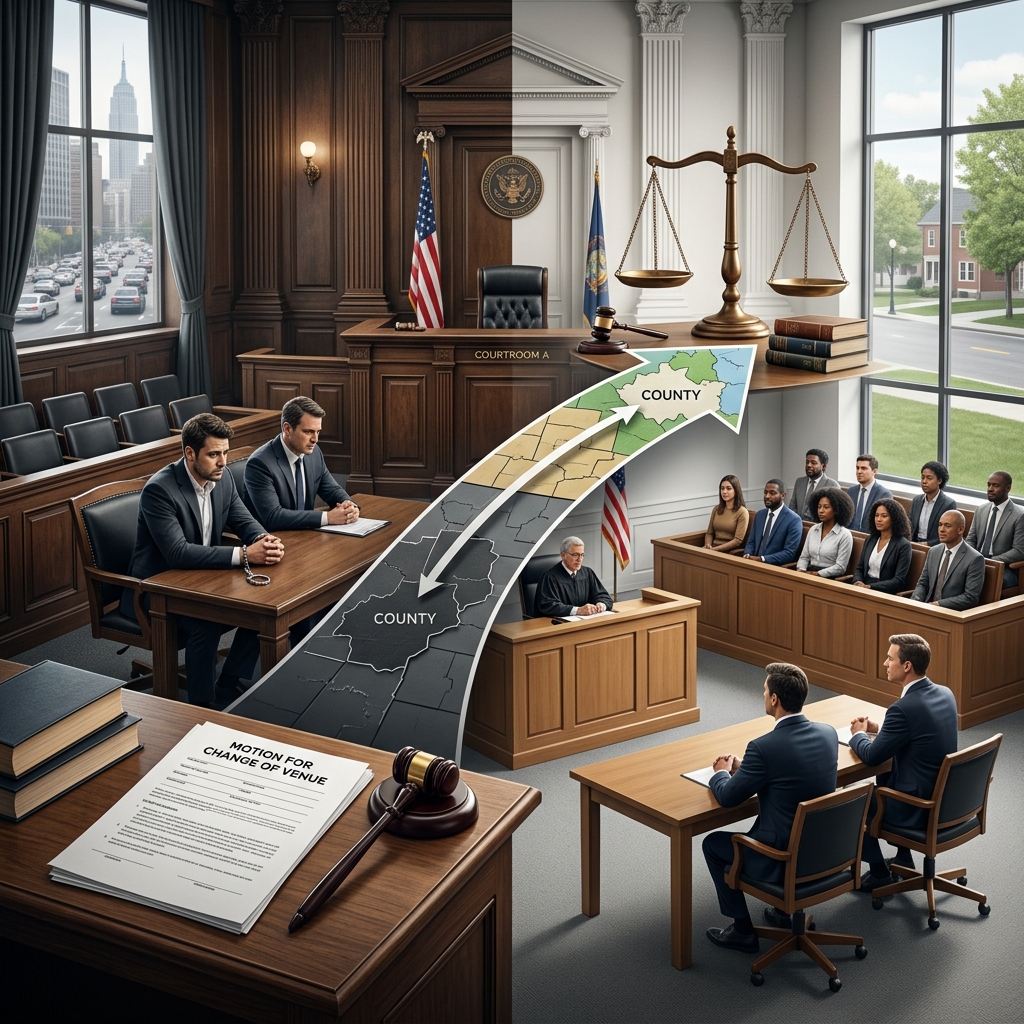
In criminal cases, change of venue is a critical tool to protect a defendant’s constitutional right to a fair and impartial trial when the original court location is compromised by prejudice, publicity, or practical obstacles. Understanding when and how to ask a court to move a case—and what must be proven—is essential for defendants, families, and practitioners navigating serious charges.
This guide explains what change of venue means, the legal standards courts apply, common reasons motions are granted or denied, and practical steps for requesting a transfer of the case to a different court.
What Does “Change of Venue” Mean in Criminal Law?
In criminal procedure, venue refers to the specific geographic location where a trial is held, typically the county or federal district in which the alleged crime occurred. A change of venue is the formal process of transferring the case from that original location to another court that has authority to hear it.
Venue is distinct from jurisdiction. Jurisdiction is the court’s power to hear a type of case; venue is about where within that system the case is tried. Most states and the federal system follow the basic rule that criminal cases should be tried where the offense was committed, but they also allow exceptions when fairness or other interests require moving the case.
- Standard rule: Trial in the county or district where the crime occurred.
- Exception: Transfer when the defendant cannot obtain an impartial jury or when convenience and justice justify a different location.
Core Legal Grounds for Changing Venue
Courts do not move criminal cases lightly. To obtain a change of venue, the moving party—most often the defendant—must satisfy specific legal standards set out in rules of criminal procedure, statutes, or case law. Although the details vary by jurisdiction, several core grounds recur across systems.
1. Prejudice and Inability to Obtain a Fair Trial
The most common basis is prejudice in the community such that an impartial jury cannot be impaneled. Under the Federal Rules of Criminal Procedure, for example, a court must transfer the proceeding on the defendant’s motion if it is “satisfied that so great a prejudice” exists in the district that a fair and impartial trial cannot be had there.
Prejudice may arise from:
- Extensive and inflammatory pretrial publicity about the case or defendant.
- Strong local feelings about the alleged offense (e.g., crimes involving local victims or controversial public events).
- Prior community exposure to the defendant’s other alleged misconduct.
- Small population size where nearly all potential jurors know the victim, defendant, or key witnesses.
Crucially, mere proof that jurors have seen news coverage is often not enough; the moving party must show that prospective jurors are actually influenced by that publicity such that a fair trial is not realistically possible.
2. Convenience of Parties and Witnesses
In some systems, venue can also be changed for convenience. Federal Rule 21(b) allows a transfer “for the convenience of the parties, any victim, and the witnesses, and in the interest of justice” upon the defendant’s motion. This ground is discretionary—the court may transfer but is not required to do so.
Factors that may support a convenience-based change of venue include:
- Most key witnesses live far from the original venue, making travel burdensome.
- The victim or critical evidence is located in another district, complicating trial logistics.
- Serious health or mobility issues for the defendant or counsel that make the current venue impractical.
3. Statutory “Good Cause” Provisions
Many state laws contain general “good cause” standards for venue changes. Michigan, for example, provides that venue may be changed “upon good cause shown by either party,” with the moving party bearing the burden of demonstrating good cause, especially regarding the effect of pretrial publicity on jurors.
Where a good cause standard applies, courts typically consider:
- Objective evidence of community bias or hostility.
- Outreach and media saturation related to the case.
- Practical trial administration concerns, such as courtroom capacity and security.
Who Can Request a Change of Venue?
The right to request a venue change differs between federal and state systems, but defendants almost always have a path to raise the issue.
| System | Who may move for change of venue? | Key rule or statute |
|---|---|---|
| Federal criminal cases | Defendant (for prejudice or convenience) | Federal Rule of Criminal Procedure 21(a), (b) |
| California criminal cases | Defendant (motion for change of venue) | Procedures addressed in California change of venue practice |
| Michigan felony cases | Either party, upon good cause shown | MCL 762.7 (venue changed on good cause) |
| North Carolina felony cases | Defendant or prosecutor, or by written waiver | G.S. 15A-952 and related provisions on venue and transfer |
| Indiana criminal cases | State or defendant, for cause with supporting affidavit | Indiana Criminal Rule 2.4 (change of venue or judge) |
In federal court, the rules explicitly limit motions to the defendant; the prosecution does not hold a parallel right under Rule 21. By contrast, several states allow either party to request a transfer when statutory standards are met.
Burden of Proof: What Must Be Shown?
Whether the legal standard is “so great a prejudice,” “good cause,” or “necessity to receive a fair trial,” the moving party carries the burden of proof. Courts generally require more than speculation or generalized concern.
Evidence Commonly Used to Support a Motion
Defense attorneys often gather a range of evidence to demonstrate why an impartial trial cannot be had in the original venue, such as:
- Media coverage analysis: Examples of repeated, sensational, or prejudicial news articles, broadcasts, and social media posts about the case.
- Community sentiment: Affidavits or survey evidence showing strong local hostility or preconceived opinions about guilt.
- Prior jury experiences: Data from prior trials involving the same parties or subject matter in the venue, showing difficulties in finding unbiased jurors.
- Population factors: Evidence that the community is too small or closely connected for jurors to be untainted by relationships with those involved.
Courts often focus on whether a fair jury can be impaneled through voir dire. In some jurisdictions, judges prefer to attempt jury selection first and rule on the motion afterward, based on actual juror responses.
Timing Requirements: When Must the Motion Be Filed?
Timing is critical. Many states treat venue objections and motions to change venue as issues that must be raised early, or they may be deemed waived.
- Federal: Rule 21 does not specify an exact deadline, but motions must be filed sufficiently in advance to allow meaningful consideration before trial.
- North Carolina: Venue challenges in felony cases must generally be made at or before arraignment, or within a set period after indictment, with failure to act constituting waiver.
- Indiana: Changes of venue or judge must usually be requested within 30 days after the initial hearing, or within 30 days after appearance following an appellate remand.
Because late motions are often denied on procedural grounds, defendants should consult counsel promptly about whether venue raises fairness concerns and how long they have to make a timely request.
How the Court Chooses a New Venue
Once a change of venue is granted, the case must be reassigned to another appropriate court that can handle the trial. The process varies by jurisdiction but often involves coordination with higher judicial bodies to identify suitable courts.
California provides a detailed example of how courts select a new venue in high-profile cases:
- The judge granting the motion informs the Judicial Council and describes the case, basis for transfer, and suggested sites.
- The Judicial Council consults presiding judges of potential courts to identify venues with adequate facilities and manageable workload, considering trial length, security, and costs.
- At least three candidate courts are proposed, and a hearing is held to choose among them, with input from both prosecution and defense.
In other states, the trial judge may directly select the new county based on statutory rules—for example, moving a case to a neighboring county in the same judicial district or another county unaffected by the prejudicial factors.
Practical Steps for Defendants Seeking a Change of Venue
While procedural details differ, defendants and counsel typically follow a structured approach when pursuing venue transfer.
Step-by-Step Overview
- 1. Assess prejudice and practical obstacles early. Immediately analyze local sentiment, media coverage, and witness logistics to determine whether venue is likely to affect fairness.
- 2. Gather supporting evidence. Collect articles, broadcasts, social media records, community surveys, and affidavits illustrating bias or inconvenience.
- 3. Draft and file a motion to change venue. Prepare a formal written motion citing relevant rules and statutes, such as Rule 21 in federal court or applicable state provisions.
- 4. Include sworn statements. Attach affidavits from the defendant, counsel, experts, or community members detailing specific facts showing prejudice or hardship.
- 5. Prepare for a hearing. Be ready to present evidence and legal argument; the prosecution may contest the motion and argue that voir dire can cure any bias.
- 6. Address jury selection plans. Consider how juror questionnaires, expanded voir dire, or peremptory challenges might mitigate prejudice if the motion is denied.
Key Risks and Strategic Considerations
Seeking a change of venue is not always advantageous. Defendants and attorneys should weigh both potential benefits and risks before filing.
Potential Benefits
- Greater likelihood of an unbiased jury pool.
- Reduced impact of intense local media coverage.
- Improved logistics when witnesses and evidence are closer to the new venue.
- Perception of fairness for both the defendant and the public.
Possible Downsides
- Travel and lodging burdens on the defendant, family, and defense team.
- Loss of familiarity with local court practices and juror demographics.
- Uncertainty about whether the new community will be more or less sympathetic.
- Delay in the proceedings due to administrative steps required to transfer the case.
Frequently Asked Questions (FAQs)
Can the prosecution request a change of venue?
In the federal system, change of venue under Rule 21 is available only on the defendant’s motion, not the prosecution’s. Several states, however, allow either party to request a transfer for good cause or prejudice, as in Michigan’s statute or North Carolina’s provisions.
Is pretrial publicity alone enough to justify moving the trial?
Not usually. Courts often require proof that publicity has actually influenced prospective jurors, not merely that the case has received coverage. Detailed evidence of biased reporting, inflammatory commentary, and community reaction is more persuasive than simple circulation figures.
What happens if a motion to change venue is filed too late?
In many jurisdictions, failing to raise venue issues by the prescribed deadline leads to waiver, meaning the court may refuse to consider the motion. Defendants should consult counsel promptly to avoid missing critical timelines.
Does changing venue affect the law that applies to the case?
No. Changing venue usually affects only where the case is tried, not the substantive law that governs the charges. A state prosecution remains subject to that state’s criminal law, and a federal case continues under federal statutes and rules.
Will the jury be drawn from the new venue?
Yes. Once venue is transferred, jurors are summoned from the new county or district. The goal is to access a jury pool that has not been significantly exposed to the prejudicial influences present in the original location.
References
- Federal Rules of Criminal Procedure, Rule 21: Transfer for Trial — Legal Information Institute, Cornell Law School. 2023-01-01. https://www.law.cornell.edu/rules/frcrmp/rule_21
- Change of Venue in California — Judicial Council of California, Courts Newsroom. 2019-06-01. https://newsroom.courts.ca.gov/branch-facts/change-venue-california
- Change of Venue — EBSCO Research Starters, Law. 2018-01-01. https://www.ebsco.com/research-starters/law/change-venue
- Motion to Change Venue — Michigan Courts Criminal Proceedings Benchbook. 2022-01-01. https://www.courts.michigan.gov/…/Motion_to_Change_Venue.htm
- 102.2 – Challenges and Motions to Change Venue — North Carolina Prosecutors’ Manual, UNC School of Government. 2021-01-01. https://ncpro.sog.unc.edu/manual/102-2
- Indiana Criminal Rule 2.4: Change of Venue or Judge — Indiana Court Rules. 2020-01-01. https://rules.incourts.gov/Content/criminal/rule2-4/current.htm
Similar Articles








Read full bio of Sneha Tete




