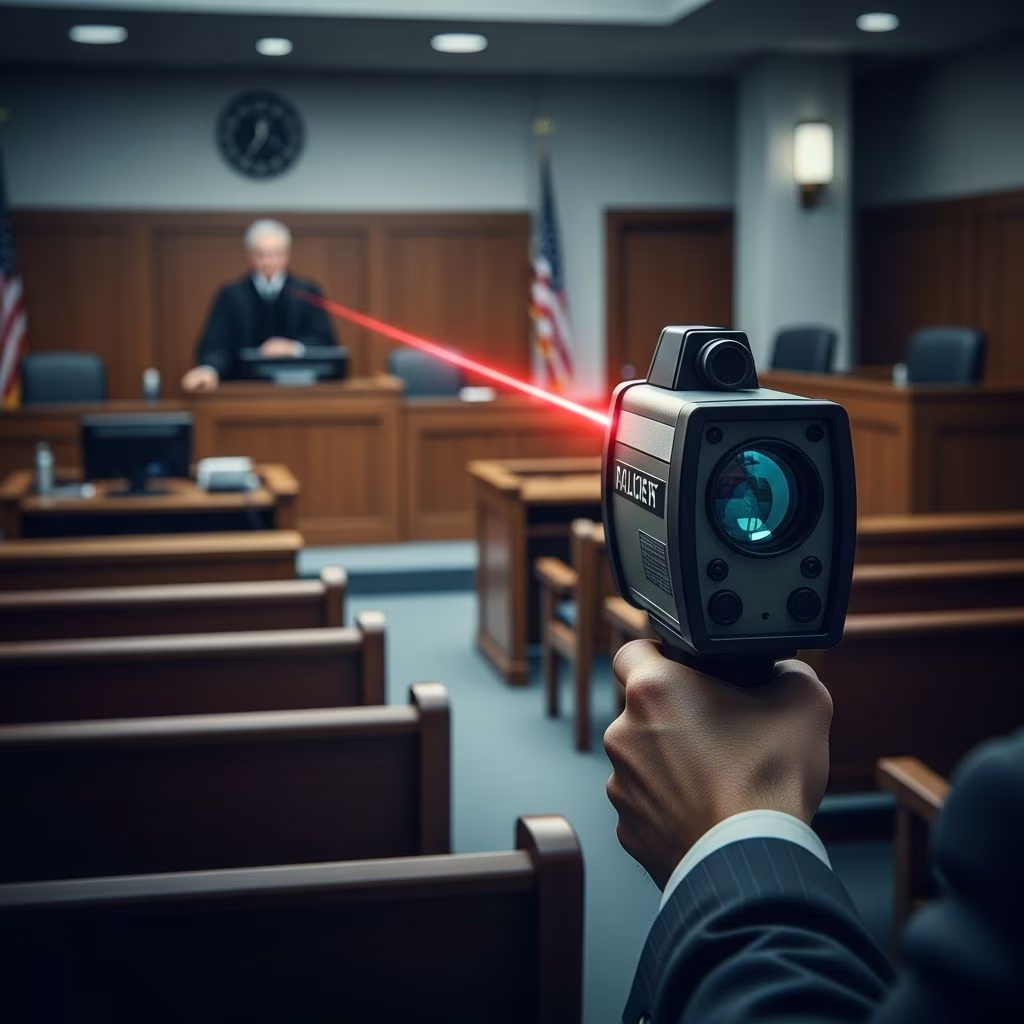
Many speeding tickets are based on readings from radar or laser (LIDAR) devices. These tools are widely accepted in courts, but that does not mean every reading is accurate or every ticket is unassailable. When the device is not used or maintained correctly, you may be able to challenge the radar gun evidence and weaken the case against you.
This guide explains how radar guns work, why courts usually accept their results, and the specific weaknesses you may be able to target—such as calibration problems, operator error, and poor testing conditions—when contesting a speeding citation.
1. Radar and LIDAR Basics: What the Device Is Really Measuring
To effectively question radar or laser evidence, you need a basic understanding of what these devices do and how they can go wrong.
1.1 How police radar works
Traditional police radar uses radio waves and the Doppler effect to measure speed. The device emits a radio wave that bounces off a moving vehicle. By measuring the frequency shift between the outgoing and returning signal, the radar calculates the vehicle’s speed.
- Stationary radar: Mounted on a vehicle or tripod; measures passing traffic.
- Moving radar: Operated from a moving patrol car and must calculate both the patrol car’s speed and the target’s speed.
1.2 How police LIDAR (laser) works
LIDAR uses pulses of laser light instead of radio waves. The device sends rapid light pulses at a target and calculates how long they take to return. Multiple measurements over a fraction of a second are used to compute speed.
- Narrower beam: Easier to aim at a specific vehicle.
- Line-of-sight dependent: Requires a clear path between device and vehicle.
1.3 Why courts generally accept radar and LIDAR
Many courts treat the underlying science of radar and LIDAR as generally reliable. For example, the Supreme Court of Ohio held that radar and laser device results may be admitted without expert testimony about the scientific principles, leaving disputes about how a particular device was used to the factfinder. Similar approaches exist in many states: once courts accept the basic technology, arguments tend to focus on the accuracy of the specific device and operator in your case.
2. When Radar Evidence Becomes Vulnerable
Even if the technology is accepted, the reading in your case may be open to challenge. Common weak points include calibration, maintenance, operator training, environmental conditions, and identification of the correct vehicle.
2.1 Calibration and maintenance problems
Courts often require proof that the radar or LIDAR unit was properly calibrated and tested within a reasonable time frame before use.
- Many agencies must follow manufacturer schedules for calibration and internal checks.
- Officers may be required to perform tuning fork or internal diagnostic tests at the start and end of a shift.
- Agencies commonly maintain calibration logs and certificates.
If the records are missing, outdated, or inconsistent, you may argue that the reading cannot be trusted.
2.2 Operator training and certification
Most departments require specific training before an officer can use radar or LIDAR in the field. Training typically covers aiming, tracking a target, interpreting readings, and recognizing interference.
- If the officer lacks up-to-date certification or cannot describe the testing procedures, that may support a challenge.
- Mistakes in setting up the unit or misunderstanding its limitations can introduce error.
2.3 Environmental and traffic conditions
Real-world conditions can affect speed readings. Legal defense guides and practitioner sources describe multiple potential issues:
- Heavy traffic: Radar beams can reflect off multiple vehicles; an officer may inadvertently clock the wrong one.
- Adverse weather: Rain, snow, or fog can interfere with radar or affect laser visibility and range.
- Obstructions and angles: Curves, hills, signs, and other objects may affect line-of-sight or the angle of the beam, impacting accuracy.
2.4 Target identification and the “wrong car” problem
In busy traffic, an officer must visually identify which vehicle corresponds to the radar reading. If several vehicles are traveling close together, it may be unclear which car triggered the device.
- LIDAR’s tighter beam helps, but mis-aiming or movement can still result in an incorrect target.
- Courts may expect the officer to explain how they confirmed the reading belonged to your vehicle.
3. Legal Standards: Admissibility vs. Weight of the Evidence
It is crucial to distinguish between whether the radar reading is allowed into evidence at all (admissibility) and how convincing that evidence is (weight).
3.1 Admissibility of radar and LIDAR readings
Some appellate courts have ruled that radar or LIDAR readings are admissible without separate expert testimony on scientific reliability, once the technology is generally accepted. Typically, the prosecution must still show:
- The device used is an approved model.
- The officer has adequate training or experience with that device.
- The device was in proper working order and was tested according to established procedures.
3.2 Weight of the evidence in your specific case
Even when admitted, the factfinder (judge or jury) must decide whether the radar reading is reliable enough to support a conviction. Factors that may reduce its persuasive value include:
- Poor or missing calibration documentation.
- Officer’s inability to explain setup, testing, or targeting.
- Inconsistent or incomplete notes about location, weather, and traffic.
- Conflicting testimony from the driver or other witnesses.
3.3 Role of corroborating visual observation
In some jurisdictions, a radar reading alone is not enough; the officer’s visual estimate of speed is expected to corroborate the device. If the officer did not clearly observe your vehicle or cannot describe your driving, your attorney may argue that the required corroboration is missing.
4. Building a Strategy to Challenge Radar Evidence
If you decide to contest the ticket, you or your attorney should prepare systematically. This often starts with information-gathering and continues through targeted questioning in court.
4.1 Requesting records and evidence
Defense-oriented legal guides recommend requesting the documents that support the radar reading, often through discovery or public records laws.
- Device make, model, and serial number.
- Calibration certificates and service records.
- Daily or shift logs showing pre- and post-shift tests.
- Officer’s training and certification records for that device.
- Any dashcam or bodycam video, if available.
Missing or incomplete records may support a motion to exclude the reading or at least cast doubt on its reliability.
4.2 Common lines of cross-examination
A defense attorney may cross-examine the officer to highlight gaps or errors in the radar use. Typical areas include:
- When and how the officer tested the device that day.
- Whether the officer followed the manufacturer’s instructions.
- How the officer chose your vehicle as the target in traffic.
- Details about weather, road layout, and traffic volume.
- Any prior issues with that specific unit or location.
4.3 Considering expert testimony
In more serious cases (such as high-speed or reckless driving allegations), parties sometimes use expert witnesses to analyze radar data, calibration logs, or scene conditions. An expert may explain how small errors or improper alignment could change the recorded speed, especially where the alleged speed is just above a critical threshold.
4.4 Negotiation and plea options
Even if the radar evidence cannot be completely excluded, raising legitimate questions about its accuracy may encourage the prosecutor to negotiate:
- Reducing the speed on the citation.
- Amending the charge to a non-moving or less serious violation.
- Agreeing to traffic school in exchange for dismissal or reduced points, where allowed by law.
5. Sample Issues and Potential Arguments
The following table illustrates typical issues that arise in radar-based prosecutions and the types of arguments a defense might raise. This is for illustration only; available defenses depend on your state’s law and the facts of your case.
| Issue | What It Means | Possible Defense Argument |
|---|---|---|
| Outdated calibration certificate | Last formal calibration occurred long before the ticket date. | The device may not meet reliability standards; reading should be discounted or excluded. |
| No daily test recorded | Officer cannot show pre- or post-shift accuracy checks. | Failure to follow procedure undermines confidence in the reading on that day. |
| Heavy multi-lane traffic | Multiple vehicles were within the radar beam. | The officer may have clocked another vehicle; identification of your car is uncertain. |
| Officer lacks device-specific training | Officer trained on radar generally but not this model. | Misuse or misunderstanding of the device could lead to erroneous speed readings. |
| Poor visibility or obstructions | Curves, hills, weather, or objects partly blocked the line of sight. | Line-of-sight interference could distort or invalidate the measurement. |
6. Practical Tips If You Plan to Fight a Radar-Based Ticket
Every case is different, but several practical steps can improve your chances if you intend to challenge radar gun evidence.
6.1 Act quickly after receiving the ticket
- Note the date, time, and exact location of the stop.
- Write down weather conditions, traffic density, and anything unusual about the encounter.
- Take photos or videos of the area as soon as practical, especially if the road layout or signage is complex.
6.2 Learn your state’s rules
Traffic and evidence rules vary by state. Some jurisdictions provide specific procedures for challenging radar or require particular foundational testimony before admitting the reading. Researching local law—or consulting a local attorney—can identify arguments that are more likely to succeed in your court.
6.3 Consider professional legal help
While many drivers handle minor tickets themselves, contested radar cases can involve technical and procedural issues. Defense lawyers experienced with speeding cases often know:
- Which law enforcement agencies have a history of calibration or training problems.
- How local judges view common defenses and what evidence they expect.
- When expert testimony is worth the cost.
6.4 Weigh the costs and benefits
Before contesting a ticket, compare the potential benefits with the time, expense, and risk of a contested hearing. Factors to consider include:
- The number of points and potential insurance impact.
- Whether your job requires a clean driving record.
- The possibility of reduced charges through negotiation.
7. Frequently Asked Questions About Radar Gun Evidence
Q1: Can I always demand that radar evidence be thrown out?
No. In many states, courts routinely admit radar and LIDAR readings as evidence once a basic foundation is laid. Challenges usually focus on how the specific device was maintained and used, rather than on the general science of radar.
Q2: Do I have a right to see calibration and maintenance records?
Often yes. Through discovery or records requests, drivers can frequently obtain calibration certificates, testing logs, and related documents. The exact process and scope of your rights depend on your state’s law and court rules.
Q3: What if the officer only relied on radar and did not visually estimate my speed?
Some jurisdictions expect officers to corroborate a radar reading with visual observation. If the officer did not visually confirm your speed or cannot describe your driving, that may provide an argument that the evidence is insufficient, but it is very state-specific.
Q4: Are radar readings always precise down to the exact mile per hour?
No device is perfect. Radar and LIDAR units have a margin of error, and external factors such as angle, distance, and traffic conditions can introduce additional uncertainty. In close cases—such as when an alleged speed is just above a higher penalty threshold—arguing about this margin of error can be important.
Q5: Will challenging the radar automatically get my ticket dismissed?
Not automatically. A successful challenge may result in dismissal, a reduced charge, or no change at all, depending on how the judge evaluates all the evidence. Strong, well-documented arguments about calibration, training, or conditions are more likely to influence the outcome.
References
- Brook Park v. Rodojev (Supreme Court of Ohio decision summary) — Ohio Supreme Court / OhioAppeals.com. 2020-06-10. https://www.ohioappeals.com/2020/06/articles/criminal-law-and-procedure/merit-decision-court-oks-admissibility-of-radar-and-laser-speed-tests-without-expert-testimony-or-judicial-notice-of-the-science-brook-park-v-rodojev/
- How Radar and Lidar Guns Work (And How They Can Be Wrong) — Driving Defense Law. 2023-01-05 (approx.). https://www.drivingdefenselaw.com/how-radar-and-lidar-guns-work-and-how-they-can-be-wrong/
- Strategies for Fighting Speeding Tickets Based on Radar Calibration Errors — Jarrett & Price LLC. 2022-07-15 (approx.). https://jeffjarrettlaw.com/blog/strategies-for-fighting-speeding-tickets-based-on-radar-calibration-errors/
- Challenging the Accuracy of the Radar Gun — Kubosh Law. 2017-05-01 (approx.). https://www.kuboshlaw.com/blog/2017/may/challenging-the-accuracy-of-the-radar-gun/
- The Role of Radar Guns in Speeding Cases: Can You Challenge Their Accuracy? — LegalSurvival.com. 2022-09-20 (approx.). https://www.legalsurvival.com/the-role-of-radar-guns-in-speeding-cases-can-you-challenge-their-accuracy/
- How Data from Radar Guns Really Works — Stowe Law Firm, PLLC. 2021-11-10 (approx.). https://www.stowelawfirmnc.com/how-data-from-radar-guns-really-works/
- How to Request Radar Gun Calibration Records — Escort Radar. 2023-02-01 (approx.). https://www.escortradar.com/blogs/news/how-to-request-radar-gun-calibration-records