
Challenging DUI Breath Tests After a Key California Ruling
How a California Supreme Court decision reshaped DUI breath test challenges and what it means for drivers and attorneys.
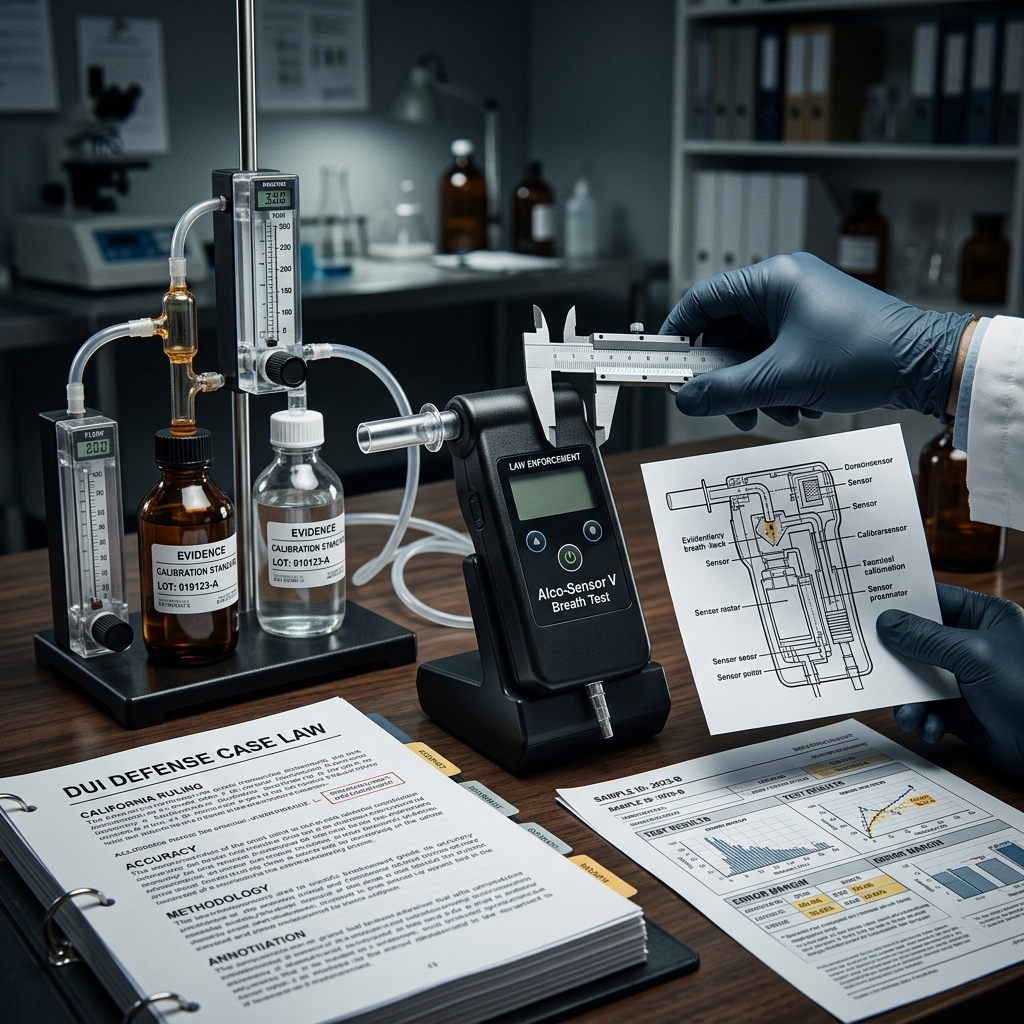
DUI cases in California often hinge on one crucial number: the driver’s reported blood alcohol concentration (BAC) based on a breath test. For years, these results were treated almost like scientific fact in courtrooms. A recent California Supreme Court decision, however, has clarified that juries may hear evidence about how those numbers can vary from person to person, opening a meaningful path to challenge breath test results in appropriate cases.
This article explains what breath tests measure, why they can be questioned, what the California Supreme Court changed, and how the ruling affects drivers, lawyers, and law enforcement.
Understanding DUI Breath Tests and BAC in California
In California, a driver can be prosecuted for DUI under both impairment-based and per se statutes. Under the per se provision, it is illegal to drive with a BAC of 0.08% or higher, regardless of visible impairment. Breath tests are a common way to estimate this BAC.
How Breath Tests Estimate BAC
Breath testing devices do not measure alcohol in the blood directly. Instead, they analyze alcohol concentration in deep-lung or alveolar breath and then apply a mathematical ratio to infer BAC. This ratio is often referred to as the blood-breath partition ratio.
- Breath alcohol concentration is measured by the device from air exhaled from the lungs.
- Partition ratio is a constant used by the device (commonly 2100:1) to convert breath alcohol into an estimated blood alcohol level.
- Estimated BAC becomes the number presented to the jury or used by the DMV in administrative proceedings.
California law recognizes breath tests as legally significant evidence of BAC, and the Vehicle Code includes presumptions that a certain test result implies a similar BAC at the time of driving if the test is performed within three hours.
Implied Consent and the Requirement to Test
California’s implied consent statute states that anyone who drives a motor vehicle in the state is deemed to have consented to chemical testing of breath or blood after a lawful DUI arrest. Under this framework:
- Drivers lawfully arrested for DUI must submit to a breath or blood test when requested.
- Refusal to test typically leads to automatic administrative penalties, including license suspension.
- The driver usually may choose between breath and blood, although a blood test can be required if drugs are suspected.
Because drivers are required to take these tests, the reliability and fairness of breath test evidence has major real-world consequences.
Why Breath Test Results Are Controversial
Even though breath tests are widely used, scientific and legal debates persist about how accurately they represent an individual’s true BAC. The core concern is variability: different people with the same actual BAC may show different breath test results because of biological and procedural factors.
Factors That Can Affect Breath Test Readings
Research and expert testimony have identified several influences on breath test results:
- Individual physiology – Age, gender, body composition, and lung capacity can affect how alcohol is partitioned between blood and breath.
- Breathing pattern – Hyperventilation, breath holding, or shallow breathing shortly before the test can change the concentration of alcohol in exhaled air.
- Body temperature – Elevated body temperature can increase breath alcohol readings relative to blood alcohol.
- Mouth alcohol – Residual alcohol from recent drinking, dental work, or regurgitation can contaminate the breath sample if observation protocols are not followed.
- Device calibration – Poor maintenance or calibration errors can cause systematic inaccuracies.
These factors do not make breath tests useless, but they highlight why a single reading should be understood as an estimate, not an exact blood measurement. The California Supreme Court decision addressed how this scientific variability can be considered in court.
The Partition Ratio: Central to the Debate
The partition ratio is the constant that converts breath alcohol to blood alcohol. In many legal contexts, a standardized ratio of 2100:1 is used, meaning that the device assumes the alcohol concentration in blood is 2100 times higher than in breath.
However, scientific studies have shown that the actual ratio can vary significantly between individuals and even for the same individual over time. Some people may have partition ratios well below or above the assumed constant, which means:
- A driver with a lower true partition ratio might have a breath test result overstating their actual BAC.
- A driver with a higher ratio could have a breath test result understating their true BAC.
This variability underlies the argument that breath test results should not be treated as irrefutable proof of a specific blood alcohol concentration.
The California Supreme Court Opens the Door
In a major ruling, the California Supreme Court held that evidence about the variability of partition ratios and breath test results is admissible to challenge DUI charges based on breath tests. The court joined a minority of jurisdictions that allow breath-test challenges grounded in scientific evidence about individual differences.
What the Court Actually Decided
The court addressed whether a defendant may introduce expert testimony on partition ratio variability to contest a per se DUI charge—specifically, the allegation that the driver had a BAC of 0.08% or more at the time of driving, based on a breath test result.
The key holdings included:
- Scientific evidence is relevant – Evidence about how partition ratios differ among individuals is relevant to whether a breath test accurately reflects a defendant’s true BAC.
- Evidence may go to the jury – Juries may consider this variability when deciding whether the prosecution has proved the BAC element beyond a reasonable doubt.
- Presumptions remain, but can be rebutted – The statutory presumption that a breath test reflects BAC at the time of driving is not eliminated, but defense evidence can be used to rebut it.
As Justice Carol Corrigan explained for the court, the defense is allowed to use scientific evidence to challenge the strength of the presumption, even though the law still recognizes breath tests as legally significant evidence.
Breath Tests Are Still Legally Significant
Importantly, the California Supreme Court did not declare breath tests unreliable or meaningless. Other legal analysis emphasizes that, despite widespread recognition of physiological variability, breath tests remain a central and legally valid tool for proving DUI.
The ruling therefore created a more nuanced framework:
- Breath test results can support a DUI conviction.
- Defendants may present scientific evidence to argue that the test is not accurate for them.
- Juries must weigh both the test result and the attack on its reliability when deciding guilt.
Practical Effects on DUI Prosecutions and Defenses
Allowing partition ratio evidence and other breath test challenges has practical consequences for every stage of a DUI case—from investigative decisions to plea negotiations and trial strategy.
Impact on Defense Strategy
Defense attorneys now have clearer authority to use expert testimony to contest breath test results in California courts. Common strategies include:
- Retaining forensic experts to explain partition ratio variability and device limitations in language accessible to jurors.
- Highlighting individual factors such as medical conditions, body temperature, or breathing patterns that may have skewed a particular test.
- Examining maintenance records and calibration logs to identify potential device malfunctions or procedural errors.
- Arguing reasonable doubt when the test result is close to the legal limit and variability could place the true BAC below 0.08%.
In borderline cases, these arguments can be decisive. When the recorded BAC is only slightly above 0.08%, partition ratio evidence may lead jurors to doubt whether the prosecution has proved the per se element beyond a reasonable doubt.
Consequences for Prosecutors and Law Enforcement
Prosecutors must now anticipate scientific challenges to breath tests and be prepared to defend the reliability of their devices and procedures. This can lead to:
- Stricter adherence to observation periods and testing protocols to minimize mouth alcohol and other contaminants.
- Improved documentation of calibration, maintenance, and officer training to support the reliability of the equipment.
- Greater attention to corroborating evidence such as field sobriety tests, officer observations, and driving patterns.
Law enforcement agencies may also face increased scrutiny when defective devices are discovered. In one documented incident, faulty breathalyzers resulted in hundreds of potentially wrongful DUI convictions in Ventura County, underscoring the importance of rigorous equipment maintenance.
Effects on Plea Bargaining and Case Outcomes
When breath test results can be actively challenged, both sides must reassess the strength of their cases. For example:
- Defendants with borderline BAC readings may have more leverage to negotiate reduced charges.
- Prosecutors may be more cautious about pursuing per se convictions based solely on breath tests when scientific challenges are anticipated.
- Judges may see more pretrial motions focused on the admissibility and scope of expert testimony about breath test variability.
In practice, the decision encourages a more evidence-rich and scientifically informed approach to DUI litigation.
Refusing a Breath Test: Separate but Related Issues
The ability to challenge breath test results does not mean that drivers can safely refuse testing. Under California’s implied consent laws, refusal itself carries serious consequences.
| Scenario | Key Consequences |
|---|---|
| Submit to breath test | Results can be used in criminal and DMV proceedings; may be challenged in court using expert evidence. |
| Refuse breath test after lawful arrest | Automatic license suspension (one year for first offense, longer for repeat refusals), potential additional fines and jail exposure. |
Refusing a test removes one piece of evidence from the case but often leads to more severe administrative penalties. The Supreme Court ruling on breath test challenges therefore interacts with, but does not override, the implied consent framework.
Key Takeaways for California Drivers
For motorists in California, the Supreme Court’s approach to breath test evidence means:
- Breath tests remain powerful evidence, but are no longer treated as beyond scientific question.
- In close cases, scientific variability can matter, and expert testimony may change outcomes.
- Refusing a breath test usually leads to automatic license consequences, regardless of future challenges.
- Legal advice from a qualified DUI attorney is essential, particularly when the recorded BAC is near the legal threshold.
The ruling ultimately promotes a more balanced system—one that respects the utility of breath tests but recognizes that scientific nuance belongs in the courtroom.
Frequently Asked Questions
Can breath test results be thrown out entirely because of partition ratio variability?
Generally no. The California Supreme Court did not require courts to exclude breath tests; instead, it allowed defendants to introduce scientific evidence about variability so juries can weigh that information when deciding whether the prosecution has proved BAC beyond a reasonable doubt.
Does the Supreme Court decision mean breath tests are unreliable?
No. The decision acknowledges that breath tests are legally significant and widely used. It simply recognizes that they estimate BAC based on assumptions that can vary among individuals, and that juries should be allowed to consider expert testimony about those assumptions.
Can I refuse a breath test in California without penalties?
After a lawful DUI arrest, refusal typically triggers automatic administrative penalties, including a license suspension, under California’s implied consent laws. These consequences can apply even if the driver is not ultimately convicted of DUI.
How do I challenge my breath test result in court?
Challenges usually involve retaining an expert and working with a DUI attorney to review the device records, testing procedures, and individual factors that may affect reliability. The Supreme Court decision clarifies that such expert testimony on partition ratio and variability is permissible and relevant.
Does this ruling affect blood tests for BAC?
The decision focuses on breath tests and partition ratios, which are not part of blood testing. Blood tests directly measure alcohol concentration in a blood sample. However, general principles about scientific reliability and expert testimony apply to all forms of chemical evidence.
References
- California Supreme Court holds that partition ratio evidence is admissible to challenge charge of driving under the influence of alcohol — National College for DUI Defense. 2015-08-13. https://www.ncdd.com/top-dui-attorneys-blog/california-supreme-court-holds-that-partition-ratio-evidence-is-admissible-to-challenge-charge-of-driving-under-the-influence-of-alcohol
- Are Breathalyzer Tests Meaningless? CA State Supreme Court Says No — Greg Hill & Associates. 2016-02-01. https://www.greghillassociates.com/are-breathalyzer-tests-meaningless-ca-state-supreme-court-says-n.html
- DUI 101: Common evidentiary issues in DUI trials, Part 2 — Daily Journal. 2017-05-05. https://www.dailyjournal.com/articles/386763-dui-101-common-evidentiary-issues-in-dui-trials-part-2
- The Consequences of Refusing a Breathalyzer Test — Zachary McCready Law. 2023-04-18. https://zacharymccreadylaw.com/blog/the-consequences-of-refusing-a-breathalyzer-test/
- Defective Breathalyzer Tests Cause Hundreds of Wrongful California DUI Convictions — Simmons Hanly Conroy. 2019-09-10. https://www.simmonsfirm.com/blog/defective-breathalyzer-tests-cause-hundreds-of-wrongful-california-dui-convictions/
- Does Refusing a Breath Test Help Your DUI Case in California? — Burglin Law Offices. 2020-07-14. https://www.burglin.com/blog/does-it-help-my-dui-case-if-i-refused-a-breath-test-in-ca
Similar Articles








Read full bio of Sneha Tete




