
Chain of Custody: Safeguarding Evidence Integrity
Understand how chain of custody protects the integrity of evidence from crime scene to courtroom and shapes the outcome of criminal cases.
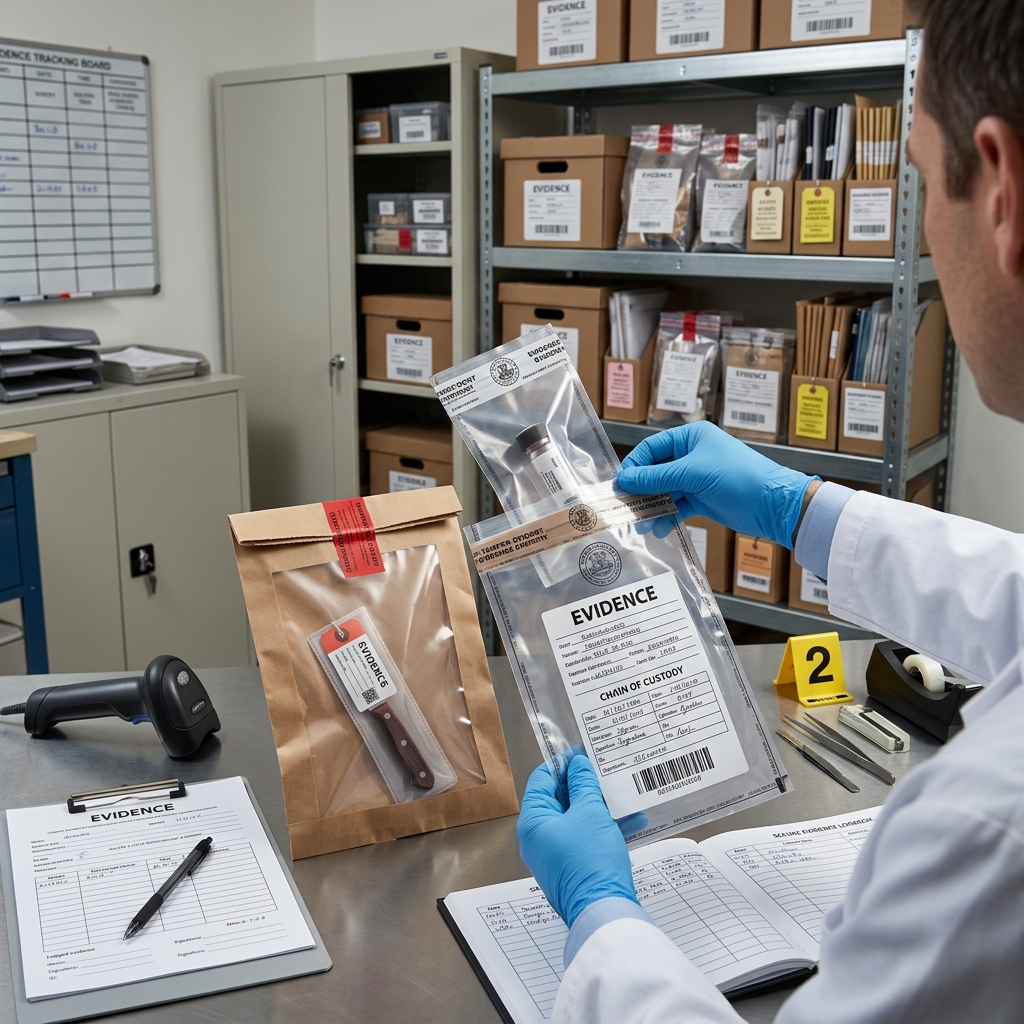
In every criminal case, the strength of the prosecution’s evidence depends not only on what was found, but on how it was handled from the moment of discovery to the moment it is shown to a judge or jury. That documented journey is known as the chain of custody, and it can determine whether critical evidence is admitted, questioned, or completely excluded from trial.
This article explains what chain of custody means, how it works in practice, why it matters to both prosecutors and defendants, and what can happen when custody procedures break down. It is written for non-lawyers, but includes enough detail to be useful for students, new practitioners, and anyone trying to understand how evidence is protected in criminal cases.
What Does “Chain of Custody” Mean?
In legal settings, chain of custody refers to the chronological documentation that tracks the collection, control, transfer, testing, storage, and final disposition of physical or digital evidence. Put simply, it is the paper or digital trail that answers the questions: Where has this evidence been? and Who has handled it? from start to finish.
Most official definitions emphasize two core ideas:
- Process – The practical steps taken to collect, package, transport, store, test, and present evidence.
- Documentation – The records that show, in order, each person who had custody of the evidence, when transfers occurred, and what was done with the item at each stage.
Although chain of custody is most commonly discussed in criminal investigations, the same concept applies in civil litigation, internal investigations, anti-doping controls, and even commercial supply chains where proof of origin or quality is required.
Why Chain of Custody Matters in Criminal Cases
Evidence only has value in court if the judge or jury can trust that it is authentic and unchanged. Chain of custody procedures exist to support that trust. When custody records are clear and complete, they help show that the item presented in court is the same item collected at the scene and that it has not been tampered with or contaminated.
Key Reasons Chain of Custody Is Important
- Authenticity – Custody documentation helps prove that a piece of evidence is genuine and directly connected to the case, rather than substituted or fabricated.
- Integrity – Detailed records reduce the risk that evidence has been altered, damaged, or mixed up with other items.
- Fairness – Proper custody procedures protect the accused’s right to a fair trial by ensuring that the evidence used against them is reliable and transparently handled.
- Admissibility – Courts may exclude evidence if the chain of custody appears broken or incomplete, meaning the item cannot be confidently accepted as accurate or untampered.
For prosecutors, a solid chain of custody strengthens the case by supporting the credibility of key exhibits. For defense attorneys, custody records offer opportunities to challenge evidence and, in some situations, to have it excluded.
Core Elements of a Strong Chain of Custody
While procedures vary by jurisdiction and agency, most law enforcement and forensic organizations follow similar principles. A robust chain of custody system generally includes the following elements.
| Element | Purpose | Typical Information Recorded |
|---|---|---|
| Identification | Uniquely label each item so it can be tracked without confusion. | Case number, item number, collector’s name, date/time, brief description. |
| Collection | Document where, when, and how the evidence was obtained. | Location, conditions, method of collection, initial custody holder. |
| Packaging & Sealing | Protect the item from damage, loss, or contamination. | Type of container, seals used, tamper-evident measures. |
| Storage | Maintain secure custody to prevent unauthorized access. | Storage location, access controls, entry logs, environmental conditions. |
| Transfer Logs | Track every handoff between people or facilities. | Names of sender and receiver, date/time, reason for transfer, signatures. |
| Analysis Records | Document tests performed and any changes to the evidence. | Laboratory, analyst, methods, results, changes in packaging or condition. |
| Disposition | Record the final outcome for the evidence. | Returned to owner, destroyed, or retained, with date and authorization. |
Step-by-Step: The Journey of Evidence
To understand how chain of custody operates in real cases, it helps to follow the typical path a single item of evidence might take.
1. Collection at the Scene
The chain of custody begins the moment an officer, investigator, or forensic technician takes possession of an item at a crime scene. From that point onward, every person who touches that item should be documented.
- Record the exact location and context where the item was found.
- Describe the item’s condition, appearance, and any relevant markings.
- Assign a unique case and item number.
- Note the date, time, and identity of the person who collected it.
2. Packaging and Labeling
Once collected, the evidence must be placed in suitable, tamper-evident packaging to protect it during transport and storage.
Effective packaging practices usually include:
- Using clean, appropriate containers (e.g., paper bags for biological evidence to reduce mold, rigid boxes for fragile items).
- Attaching labels with the case number, item description, and collector’s initials.
- Sealing the package with tape or other seals that show if the container has been opened.
3. Transport to Storage or Laboratory
Transport is another critical point in the chain. Each time evidence moves from one person or place to another, the transfer should be logged.
- Document the person releasing the evidence and the person receiving it.
- Record date, time, and reason for the transfer (e.g., “sent to crime lab for DNA testing”).
- Collect signatures or digital acknowledgments from both parties.
4. Secure Storage
When evidence is not actively being transported or tested, it should be stored in a secure facility such as a locked evidence room, with limited access and audited entry logs.
Good storage practices help maintain evidence in “legal custody” by preventing unauthorized handling, loss, or deterioration.
5. Testing and Analysis
Forensic laboratories often perform specialized testing on evidence: drug analysis, DNA profiling, fingerprint comparison, digital forensics, and more. Every action in the lab should be recorded in custody and laboratory records.
- When the lab receives the item, it logs the transfer and verifies seals.
- Analysts record the tests performed, the methods used, and any changes to the item or its packaging.
- After analysis, the evidence is re-packaged, re-sealed, and returned to secure storage, with a documented handoff.
6. Presentation in Court
At trial, the chain of custody is often explained through witness testimony and documentary records. Prosecutors may call officers, evidence custodians, or forensic experts to describe how they handled the item and to confirm that it has remained properly secured since collection.
If the chain appears complete and credible, judges are more likely to admit the evidence. If gaps, inconsistencies, or suspicious handling are revealed, defense counsel may argue that the evidence should be excluded or treated with caution.
Common Weak Points and Breakdowns
Because chain of custody depends on human actions and recordkeeping, errors and omissions can occur. Some weaknesses are minor and easily explained; others can seriously undermine the reliability of evidence.
Typical Problems in Chain of Custody
- Incomplete documentation – Missing dates, signatures, or transfer records that leave gaps in the item’s history.
- Unclear labeling – Poorly marked packages that make it difficult to distinguish one item from another.
- Unauthorized access – Evidence stored in locations where multiple people can enter without logging their access.
- Improper packaging – Packaging that does not protect the item or lacks tamper-evident features, raising the risk of unnoticed interference.
- Excessive handling – Too many people involved in transfers, increasing the chance of confusion or error.
Not every procedural slip will result in exclusion. Courts often look at the overall reliability of the evidence and whether the defense can show a realistic possibility of tampering or contamination. However, serious or unexplained gaps in custody records can be enough to cast doubt on the item and, in some cases, to remove it from the case entirely.
How Defense Attorneys Use Chain of Custody
For the defense, chain of custody is not just a technical formality—it is a strategic tool. By carefully reviewing custody forms, evidence logs, and laboratory records, defense lawyers may uncover issues that weaken or undermine the prosecution’s proof.
Defense Strategies Centered on Chain of Custody
- Identifying gaps – Pointing out periods when the evidence’s whereabouts or custodians are not clearly documented.
- Highlighting inconsistencies – Comparing reports, lab records, and testimony to expose conflicting descriptions of handling or timing.
- Questioning authenticity – Suggesting that an item may have been switched, mixed up, or altered due to poor procedures.
- Demanding exclusion – Arguing that unreliable custody records make the evidence inadmissible because it cannot be trusted.
- Creating reasonable doubt – Even if evidence is admitted, explaining custody problems to the jury to reduce its persuasive impact.
These strategies are particularly important in cases that rely heavily on physical or forensic evidence, such as drug prosecutions, DNA-based cases, and digital investigations.
Best Practices for Maintaining Reliable Custody
Law enforcement agencies, forensic laboratories, and evidence custodians use standardized procedures to reduce the risk of error and to create uniform, defensible custody records.
Practical Measures That Strengthen Chain of Custody
- Standardized forms – Using consistent evidence and transfer forms that require names, dates, times, and signatures for every handoff.
- Digital logs – Maintaining electronic databases or bar-code systems that automatically record movements and access.
- Limited access – Restricting storage facilities to trained personnel and recording every entry.
- Training – Teaching officers and technicians how to package, label, and document evidence properly.
- Audits – Periodically reviewing custody records and storage practices to identify and correct weaknesses.
- Minimizing handlers – Reducing the number of people involved with each item to lower the chance of error.
These measures not only protect evidence integrity but also make it easier for prosecutors and witnesses to explain the chain of custody clearly and confidently in court.
Beyond Criminal Law: Other Uses of Chain of Custody
While criminal cases are the most visible context for chain of custody, the concept is used in several other fields where proof of authenticity or proper handling is essential.
- Civil litigation – In product liability, environmental disputes, or medical malpractice cases, custody records may be used to show that samples, documents, or devices were properly preserved.
- Human rights documentation – Investigators who collect testimony, photos, or forensic samples often rely on chain of custody to show that material has not been manipulated and can be trusted in international or domestic proceedings.
- Anti-doping and drug testing – Sports organizations and testing laboratories keep detailed custody records for samples taken from athletes to prove that they have not been tampered with.
- Supply chain and quality assurance – Companies use custody-like records to demonstrate that materials come from approved sources and meet regulatory or certification standards.
FAQs: Chain of Custody in Plain Language
What is the main goal of chain of custody?
The main goal is to ensure that evidence used in legal or investigative proceedings is authentic, reliable, and untampered, by keeping a clear, chronological record of who handled it and when.
Can evidence be thrown out if the chain of custody is broken?
Yes, courts can exclude evidence when custody records are so incomplete or inconsistent that the item’s authenticity is doubtful. In other cases, judges may allow the evidence but permit the defense to argue that the custody problems reduce its weight.
Who is responsible for maintaining chain of custody?
Responsibility is shared. Police officers, forensic technicians, evidence custodians, and laboratory staff all play roles in documenting their handling of evidence. Agencies typically have written policies and training to guide these responsibilities.
Does chain of custody apply to digital evidence?
Yes. Digital files, devices, and logs can also be subject to chain of custody procedures. Documentation should show how data was collected, preserved, copied, and analyzed, and who had access at each stage, to prevent claims of manipulation.
How can a defendant or defense lawyer review chain of custody records?
Defense counsel usually obtains custody forms, evidence logs, and lab records through discovery. They then compare the written records with witness statements and investigative reports to identify any gaps or contradictions.
References
- Law 101: Legal Guide for the Forensic Expert – Chain of Custody — National Institute of Justice (U.S. Department of Justice). 2012-01-01. https://nij.ojp.gov/nij-hosted-online-training-courses/law-101-legal-guide-forensic-expert/pretrial/pretrial-motions/chain-custody
- Chain of Custody | Science | Research Starters — EBSCO Information Services. 2017-01-01. https://www.ebsco.com/research-starters/science/chain-custody
- Chain of Custody — The Engine Room. 2018-06-01. https://documentation-tools.theengineroom.org/resources-chain-of-custody/
- Chain of custody — Wikipedia Foundation (background source, not cited directly for legal definitions). 2024-01-01. https://en.wikipedia.org/wiki/Chain_of_custody
- Why Chain of Custody Makes or Breaks a Case — Keiser University. 2021-05-05. https://www.keiseruniversity.edu/articles/why-chain-of-custody-makes-or-breaks-a-case/
- Understanding Chain of Custody in Drug Evidence — The Law Office of Justin K. Hall. 2023-03-15. https://www.justinkhall.com/blog/understanding-chain-of-custody-in-drug-evidence/
- The Crucial Role of Chain of Custody: Ensuring Evidence Integrity and Quality Assurance — Evidence Management Institute. 2022-09-01. https://evidencemanagement.com/the-crucial-role-of-chain-of-custody-ensuring-evidence-integrity-and-quality-assurance/
Similar Articles








Read full bio of Sneha Tete




