
The Evolution of Fourth Amendment Warrants for Cell Phone Tracking
How landmark judicial rulings transformed digital privacy and the Fourth Amendment in the smartphone era.
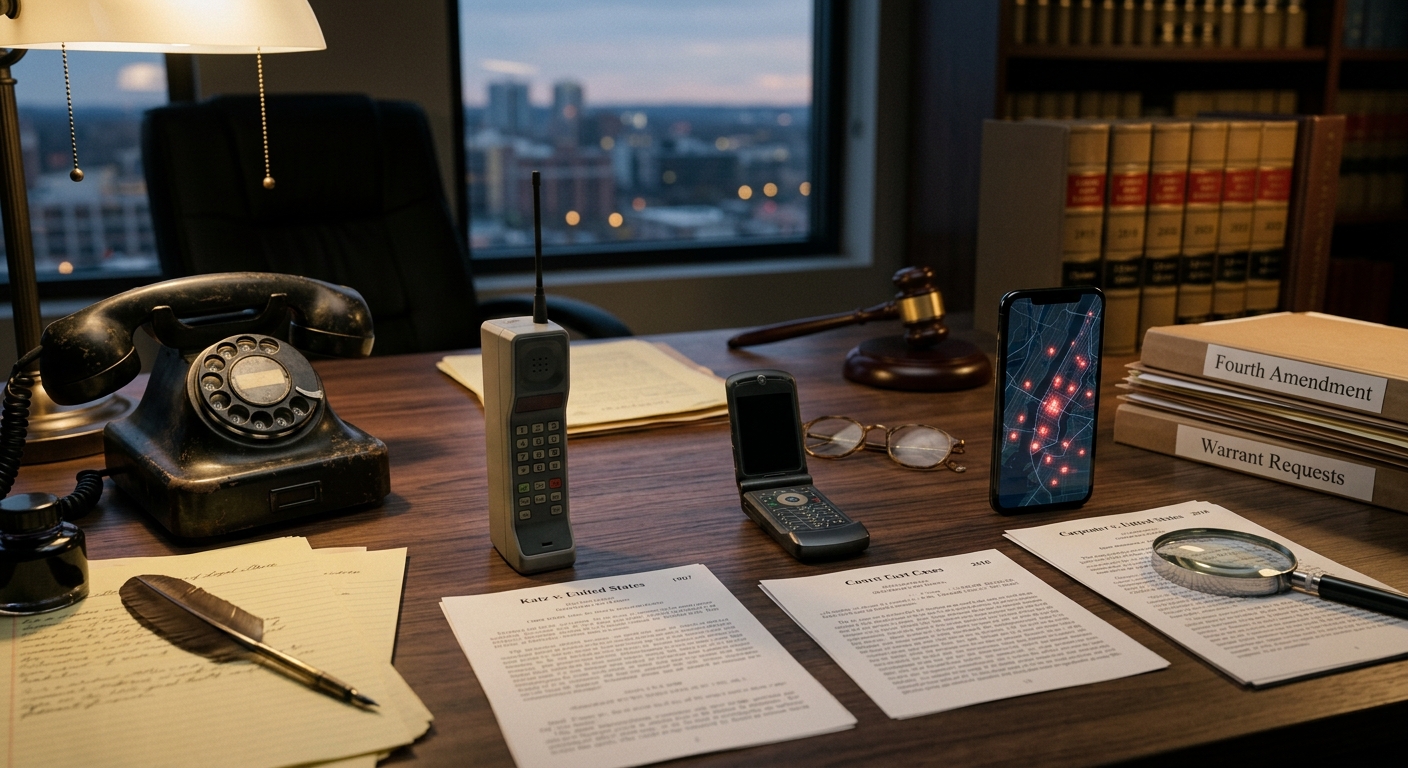
In the modern era, a cell phone is more than just a communication device; it is a profound digital extension of the human experience. As individuals go about their daily routinesommuting to work, visiting doctors, attending political rallies, or relaxing at homend their mobile devices silently chronicle their every movement. This continuous data generation has provided law enforcement with unprecedented investigative capabilities. However, this same technology has ignited one of the most significant constitutional debates of the 21st century: How does the Fourth Amendment’s protection against unreasonable searches and seizures apply to the digital breadcrumb trails we leave behind?
For years, a deep tension existed between federal investigators seeking rapid access to location data and civil liberties advocates demanding robust constitutional safeguards. The struggle over whether police should be required to obtain a warrant to track a person’s cell phone location did not resolve overnight. It was the result of a protracted legal evolution, beginning with quiet resistance from federal magistrate judges and culminating in landmark rulings by the United States Supreme Court. To understand this legal landscape, one must examine the intersection of statutory law, technological mechanics, and fundamental constitutional rights.
The Mechanics of Cell Site Location Information (CSLI)
To grasp the legal battles surrounding digital privacy, it is crucial to understand the technical realities of how mobile networks operate. Cell phones function by constantly seeking out the strongest available signal to maintain service. To do this, they periodically communicate, or “ping,” nearby radio antennas known as cell sites or cell towers. Each time a device connects to a tower, the wireless provider logs a time-stamped record of that connection. This data is known as Cell Site Location Information (CSLI).
Historically, cell sectors were large, meaning a ping could only place a user within a radius of several miles. However, as the demand for high-speed mobile data exploded, telecommunications companies rapidly densified their networks. Today, particularly in urban environments, cell towers and micro-antennas are clustered densely, sometimes mere blocks apart. Consequently, modern CSLI can pinpoint a device’s location with astonishing precision.
Wireless carriers retain these logs for their own commercial purposes, such as billing, network optimization, and roaming agreements. For law enforcement, these commercial databases act as a retrospective time machine. By obtaining a user’s historical CSLI, investigators can reconstruct a detailed map of a person’s movements over weeks, months, or even years, identifying where they sleep, who they associate with, and their daily habits. The ease with which this intimate data could be accessed became the focal point of intense legal scrutiny.
The 1986 Stored Communications Act and the Third-Party Doctrine
Before the judiciary intervened, the primary tool law enforcement used to access CSLI was the Stored Communications Act (SCA) of 1986. Enacted during the infancy of the internet, long before the proliferation of smartphones, the SCA was designed to update privacy protections for emerging digital networks. Under Section 2703(d) of the SCA, the government could compel a telecommunications provider to hand over customer records without securing a traditional search warrant.
Instead of demonstrating “probable cause”nd the rigorous standard required by the Fourth Amendmentnd prosecutors only needed to provide a judge with “specific and articulable facts” showing that the requested records were relevant and material to an ongoing criminal investigation. This lower legal threshold made it remarkably easy for investigators to sweep up vast amounts of location data.
The government’s reliance on the SCA was bolstered by a longstanding legal principle known as the “third-party doctrine.” Rooted in two 1970s Supreme Court cases United States v. Miller (involving bank records) and Smith v. Maryland (involving telephone dialing records) the doctrine holds that individuals do not have a reasonable expectation of privacy in information they voluntarily turn over to third parties. Prosecutors argued that by choosing to use a cell phone on a commercial network, users were voluntarily sharing their location with carriers, thereby forfeiting their Fourth Amendment protections.
The Judicial Rebellion: Magistrates Demand Probable Cause
As the invasiveness of CSLI tracking became more apparent in the late 2000s and early 2010s, a grassroots judicial rebellion began to take shape. Federal magistrate judges across the countrynd the first judicial officers to review government surveillance requestsnd started pushing back against the routine approval of SCA orders for location data.
In various jurisdictions, including notable rulings in Texas and New York, magistrate judges began issuing detailed opinions denying the government’s applications for warrantless cell phone tracking. These judges identified a fundamental flaw in the government’s reliance on the third-party doctrine: the assumption of “voluntary” disclosure. They argued that in modern society, carrying a cell phone is not a voluntary assumption of the risk of perpetual surveillance; it is a fundamental requirement for participation in contemporary economic, social, and professional life.
Furthermore, these early judicial pioneers pointed out that users do not actively choose to transmit CSLI. The phone generates these location pings automatically, often without any affirmative action by the user, simply by being powered on. Therefore, forcing a citizen to choose between participating in modern society and surrendering their constitutional right to privacy was deemed unacceptable. These magistrate judges began insisting that if the government wanted to map a citizen’s life via CSLI, they needed to return with a warrant backed by probable cause.
The Turning Point: Carpenter v. United States
The fragmented legal landscape, characterized by circuit splits and varying magistrate rulings, demanded resolution by the highest court in the land. That resolution arrived in 2018 with the landmark Supreme Court decision in Carpenter v. United States.
The case centered on Timothy Carpenter, a suspect in a string of armed robberies. Without obtaining a warrant, prosecutors used the Stored Communications Act to compel Carpenter’s wireless carriers to hand over 127 days of his historical CSLI. The data contained 12,898 distinct location points, averaging over 100 pings per day. This exhaustive digital trail was used to place Carpenter near the scenes of the robberies, leading to his conviction.
In a deeply impactful 5-4 decision authored by Chief Justice John Roberts, the Supreme Court ruled in favor of Carpenter. The Court declared that the government’s acquisition of historical CSLI constitutes a “search” under the Fourth Amendment, thereby explicitly requiring a probable cause warrant. Chief Justice Roberts emphasized the unique, pervasive, and deeply revealing nature of cell phone location data, noting that tracking a phone achieves “near perfect surveillance” akin to attaching an ankle monitor to the user.
Crucially, the Court declined to rigidly apply the third-party doctrine to this modern technology. The ruling recognized that the sheer volume and intimate nature of CSLI fundamentally differentiated it from the bank slips and telephone logs of the 1970s. Carpenter officially established that Americans retain a legitimate expectation of privacy in the physical record of their movements, even when that record is generated and held by a commercial wireless carrier.
Post-Carpenter: The Modern Landscape of Law Enforcement Tracking
The Carpenter decision profoundly altered how federal, state, and local law enforcement agencies conduct investigations. Today, before requesting historical CSLI from a telecommunications provider, police must draft a detailed affidavit outlining probable cause and secure a warrant signed by a judge. The days of routinely using subpoenas or low-threshold SCA orders to map a suspect’s historical movements are definitively over.
However, the Court did leave room for certain exceptions. In emergency situationsnd such as a kidnapping, an active shooter scenario, or a bomb threatnd law enforcement can invoke the “exigent circumstances” exception to the warrant requirement to obtain immediate access to location data to save lives or prevent imminent harm.
Comparison: Legal Thresholds for Digital Data
| Type of Legal Process | Burden of Proof | Typical Target Information | CSLI Applicability (Post-2018) |
|---|---|---|---|
| Grand Jury Subpoena | Relevance to investigation | Basic subscriber info (Name, address, billing) | Insufficient for historical location data. |
| SCA Order (2703(d)) | Specific & articulable facts | Non-content account records, IP logs | Unconstitutional for obtaining historical CSLI. |
| Search Warrant | Probable Cause | Emails, texts, physical property, CSLI | Required for historical cell location tracking. |
The Next Frontier: Geofence Warrants
While Carpenter settled the debate over historical CSLI tied to a specific suspect, technological advancements have already birthed new Fourth Amendment challenges. The most prominent among these is the “geofence warrant.” Unlike traditional warrants that target a known individual, a geofence warrant targets a specific geographic location and time frame. Law enforcement asks tech companies (frequently Google, utilizing its massive Sensorvault database) to identify all devices that were present in a specified area during a crime.
This “reverse location” tracking has sparked fierce legal debate. Critics argue that geofence warrants are inherently unconstitutional “general warrants” that sweep up the private data of countless innocent bystanders without individualized probable cause. As appellate courts currently grapple with the legality of these sweeping data requests, it is highly likely the Supreme Court will once again have to intervene to calibrate the Fourth Amendment for the next era of digital surveillance.
Frequently Asked Questions (FAQ)
What is the Third-Party Doctrine?
The third-party doctrine is a legal theory holding that people who voluntarily give information to third parties (like banks, phone companies, or internet providers) have no reasonable expectation of privacy in that information. Consequently, the government historically did not need a warrant to obtain it. However, the Supreme Court has recently limited this doctrine’s application regarding highly revealing digital data like cell phone location records.
Do police need a warrant to track my phone in real-time?
Generally, yes. Most federal and state courts have determined that utilizing a cell phone for real-time tracking (often called a “ping” or utilizing a cell-site simulator like a Stingray) intrudes upon a reasonable expectation of privacy and requires a probable cause warrant, absent extreme emergency circumstances.
What happens if law enforcement obtains CSLI without a warrant today?
If police illegally obtain historical cell site location information without a valid warrant or a qualifying exception, the defendant’s legal counsel can file a motion to suppress. Under the exclusionary rule, any evidence derived from that illegal search will likely be deemed inadmissible in a criminal trial.
What is the difference between GPS data and CSLI?
GPS data relies on satellite signals communicating directly with a device’s internal hardware to determine a highly precise location. CSLI (Cell Site Location Information) is generated by the phone communicating with terrestrial cellular towers maintained by wireless carriers. While CSLI used to be less precise than GPS, the dense clustering of modern cell towers has made CSLI nearly as accurate as GPS tracking.
Conclusion
The journey from the Stored Communications Act of 1986 to the Supreme Court’s ruling in 2018 highlights a critical feature of the American judicial system: the constant struggle to apply centuries-old constitutional principles to rapidly evolving technology. The early resistance by federal magistrates who refused to rubber-stamp warrantless tracking requests paved the way for a definitive recognition of digital privacy rights. While the requirement for a warrant to obtain historical cell site location data is now firmly established, the continuous advancement of tracking technologies ensures that the debate over the Fourth Amendment in the digital age is far from over.
References
- Carpenter v. United States, 585 U.S. 296 (2018) Supreme Court of the United States. 2018-06-22. https://www.supremecourt.gov/opinions/17pdf/16-402_h315.pdf
- 18 U.S. Code a7 2703 – Required disclosure of customer communications or records Legal Information Institute (Cornell Law School). 1986-10-21. https://www.law.cornell.edu/uscode/text/18/2703
- The Carpenter Chronicle: A Near-Perfect Surveillance Harvard Law Review / Susan Freiwald & Stephen Wm. Smith. 2018-11-10. https://harvardlawreview.org/forum/vol-132/the-carpenter-chronicle-a-near-perfect-surveillance/
- Geofence Warrants and the Fourth Amendment Harvard Law Review. 2021-05-10. https://harvardlawreview.org/print/vol-134/geofence-warrants-and-the-fourth-amendment/
Similar Articles








Read full bio of medha deb


