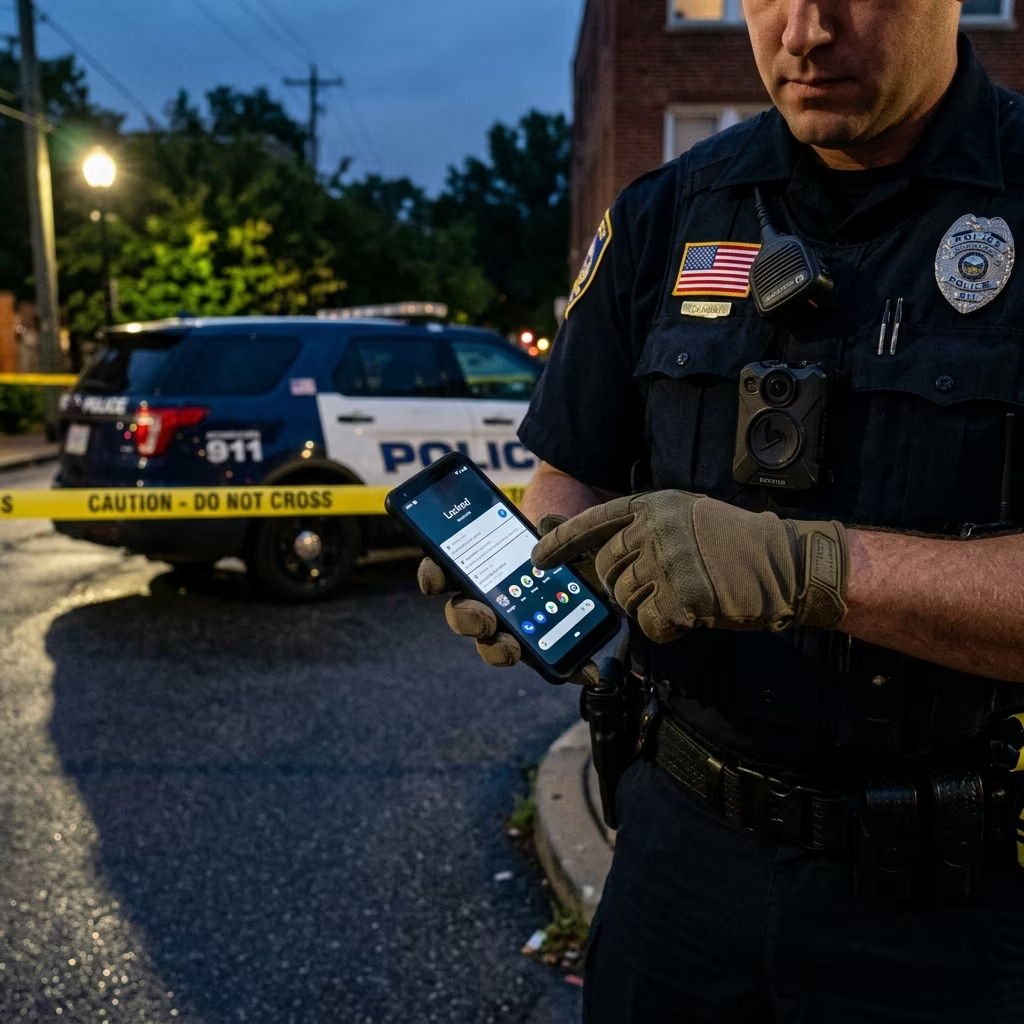
Smartphones hold an extraordinary amount of personal information, from messages and photos to financial records and precise location history. In the United States, courts have increasingly recognized that searching a cell phone is not comparable to checking someone’s pockets or wallet. Instead, it raises fundamental questions under the Fourth Amendment, which protects people against unreasonable searches and seizures by the government.
Over the past decade, the U.S. Supreme Court and other courts have issued major decisions that reshape when police must obtain a warrant, how specific those warrants must be, and what limits apply to digital searches.[10]
Why Cell Phones Trigger Special Constitutional Concerns
The traditional rule under the Fourth Amendment is that police generally need a warrant, approved by a neutral judge, before searching someone or their property. Courts have long recognized exceptions, such as searches incident to a lawful arrest, which allow officers to search a person and the area within their immediate control without a warrant to protect officer safety and prevent destruction of evidence.
However, modern smartphones differ from physical objects in several important ways:
- Vast storage capacity: Phones can contain years of emails, messages, photos, videos, and documents.
- Comprehensive personal records: Devices often reveal health information, religious practices, relationships, and finances.
- Continuous location tracking: Cell-site records and GPS logs can show where a person has been over long periods.[10]
- Interconnected data: Cloud backups and app integrations extend beyond what is physically on the device.
Because of these features, the Supreme Court has treated cell phone searches as qualitatively different from traditional physical searches.
Riley v. California: The Warrant Requirement for Phone Content
In Riley v. California, the U.S. Supreme Court issued a unanimous decision holding that, in most situations, police must obtain a warrant before searching the digital contents of a cell phone seized during an arrest. The Court considered two consolidated cases involving warrantless searches of phones taken from arrestees and evaluated whether the standard “search incident to arrest” exception should apply.
The Court concluded that applying that exception to the full contents of a smartphone would be a “constitutional bridge too far,” given the privacy interests involved. Chief Justice John Roberts emphasized several key points:
- Information stored on a phone generally does not pose a direct physical threat to officers.
- Concerns about remote wiping or encryption, while real, were not pervasive enough to justify a categorical rule allowing broad warrantless searches.
- Officers can use less-intrusive techniques, such as powering down a phone or placing it in a signal-blocking container, to preserve digital evidence while seeking a warrant.
Accordingly, the Court held that the police “must get a warrant” before accessing digital information on a phone taken during an arrest, except in limited circumstances where well-established exceptions—such as exigent circumstances—apply.
Scope and Limits of the Riley Decision
Riley is both significant and carefully limited:
- It applies to searches incident to arrest of a phone’s contents.
- It does not eliminate all warrant exceptions; exigent circumstances and other traditional exceptions remain available where justified.
- It sets a clear baseline rule for defense attorneys and law enforcement: no warrant, no digital phone search, absent a recognized exception.
In practical terms, after Riley, investigators must convince a judge that there is probable cause and specify the basis for searching a phone before they can access its data.
Carpenter v. United States: Location History and Third-Party Records
Another major step in digital privacy jurisprudence came in Carpenter v. United States, where the Supreme Court held that the government generally needs a warrant to obtain extended historical cell phone location records from a wireless carrier.[10] These records, known as cell-site location information, can show a person’s movements over time based on which cell towers their phone connected to.
In a 5–4 decision, the Court ruled that accessing detailed historical location data is a search under the Fourth Amendment and normally requires a warrant supported by probable cause.[10] The majority stressed several themes:
- Long-term location tracking reveals “the privacies of life,” including where people sleep, worship, work, and seek medical care.[10]
- Because carrying a phone is nearly unavoidable in modern life, people retain a reasonable expectation of privacy in the detailed location data it generates.[10]
- The old “third-party doctrine”—under which information voluntarily shared with a service provider is generally not protected—does not automatically apply to extensive digital location records.[10]
At the same time, the Court limited its ruling to the specific type of data at issue: historical location information. It expressly did not decide questions involving real-time tracking, national security, or other kinds of digital records.
Particularity: How Specific Must a Cell Phone Warrant Be?
Even when police secure a warrant, courts have grappled with how precise that warrant must be when it involves a cell phone. The Fourth Amendment’s particularity requirement demands that warrants describe the place to be searched and the items to be seized with reasonable specificity.
Some courts have allowed broad searches of devices so long as the warrant identifies the categories of evidence sought, such as communications or photos relevant to a suspected offense. Others have insisted that cell phone warrants be narrowly tailored to limit the risk of exposing unrelated private information.
For example, the Maryland Court of Appeals held that privacy concerns linked to the storage capacity and pervasiveness of cell phones persist even when officers obtain a warrant, and therefore warrants should be drafted to focus only on data connected to the probable cause supporting the search.
Examples of Narrow Tailoring Requirements
Court decisions and legal commentary suggest several ways that a cell phone warrant can satisfy particularity while respecting privacy:
- Limiting by time frame: Restricting the search to specified dates or periods relevant to the investigation.
- Limiting by data type: Defining which categories may be examined, such as text messages, call logs, or photos.
- Limiting by subject matter: Linking the search to particular contacts, events, or offenses described in the warrant affidavit.
- Describing specific applications: Identifying certain apps or storage locations where evidence is likely to be found.
Legal scholars have noted that lower courts remain divided on how strictly to enforce those limitations, but many decisions trend toward requiring more particularity for digital searches than for traditional physical searches.
Comparing Traditional and Digital Searches
| Aspect | Traditional Search (e.g., pockets, home) | Digital Cell Phone Search |
|---|---|---|
| Typical justification | Officer safety, preventing destruction of physical evidence, or warrant with probable cause. | Generally requires a warrant supported by probable cause; incident-to-arrest exception is limited. |
| Privacy impact | Reveals items physically present, such as documents or small personal effects. | Can expose years of communications, photos, documents, and location history.[10] |
| Scope of information | Bounded by physical spaces searched. | Potentially reaches cloud accounts and third-party data accessed through the device. |
| Particularity concerns | Warrants typically describe premises and general categories of items. | Courts increasingly demand narrower descriptions tied to time periods, data types, and specific apps. |
State-Level Guardrails on Cell Phone Warrants
In addition to Supreme Court decisions, state courts have begun to set their own guardrails for cell phone search warrants. Some state supreme courts have ruled that warrants must clearly specify what investigators are looking for on a phone and cannot authorize unrestricted exploration of all its contents.
These decisions often emphasize that:
- Cell phones are ubiquitous and deeply integrated into daily life.
- Broad, undefined warrants risk becoming general warrants, which the Fourth Amendment prohibits.
- Judges should ensure warrants direct officers to search only for evidence reasonably connected to the alleged crime.
Where courts find warrants overly broad, they may suppress resulting evidence or, in some cases, apply a “good faith” exception if officers reasonably relied on the warrant.
Practical Implications for Law Enforcement and Individuals
The evolving case law on cell phone searches has practical consequences for both investigators and the public.
Implications for Law Enforcement
- Need for detailed warrant applications: Officers must explain why specific phone data is relevant and describe the scope of the proposed search.
- Training on digital evidence preservation: Agencies must adopt procedures to secure phones and prevent data loss while waiting for a warrant.
- Awareness of location data rules: Requests for historical cell-site information generally require a warrant and must account for privacy concerns.[10]
Implications for Individuals and Defense Counsel
- Understanding rights at arrest: While police may seize a phone, they typically may not search its contents without a warrant or a recognized exception.
- Challenging overbroad warrants: Defense attorneys can question whether warrants were sufficiently particular and whether searches exceeded their authorized scope.
- Scrutinizing location-based evidence: Counsel can examine whether access to historical location data complied with the standards set in Carpenter.[10]
Frequently Asked Questions (FAQ)
Do police always need a warrant to search my cell phone?
In most situations, yes. Under Riley v. California, searching the digital contents of a phone seized during an arrest generally requires a warrant supported by probable cause. However, traditional exceptions, such as exigent circumstances—where there is an immediate risk to life or a need to prevent serious harm—may apply in rare cases.
Can officers look at my call log or text messages without a warrant?
As a rule, officers may not examine call logs, text messages, or other stored communications on your phone without a warrant, absent a valid exception. The Supreme Court has treated these records as part of the phone’s digital contents, which receive heightened protection.
What about my phone’s location history held by my wireless provider?
In Carpenter v. United States, the Supreme Court held that accessing extended historical location records from a provider is a search under the Fourth Amendment that typically requires a warrant.[10] Short-term or real-time tracking may raise different issues, which the Court has not fully resolved.
Can a warrant authorize a complete search of every file on my phone?
Courts are divided. Some decisions allow broad searches if the warrant describes categories of evidence related to a crime. Others require more precise limits—such as time frames or specific data types—to avoid exposing unrelated private information. Many recent rulings encourage judges to narrowly tailor warrants for digital devices.
What happens if police search a phone without a valid warrant or exception?
If a court finds that a search violated the Fourth Amendment, it may exclude the resulting evidence from trial under the exclusionary rule. However, in some cases, courts may apply a good-faith exception if officers reasonably relied on a warrant that later turns out to be defective.
Emerging Questions in Digital Search Law
Despite landmark rulings, several important questions remain unsettled:
- The limits on real-time location tracking using phones or apps.
- How rules apply to cloud-based content accessible through a device but stored on remote servers.
- Standards for bulk data seizures, where entire devices are imaged and reviewed over time.
Legal scholars expect continued litigation and further guidance from appellate courts as technology advances and new investigative tools emerge.
References
- The U.S. Supreme Court Says ‘No’ to Cell-Phone Searches Incident to Arrest — Illinois State Bar Association. 2014-09-01. https://www.isba.org/ibj/2014/09/ussupremecourtsaysnocell-phonesea
- State Supreme Court sets new guardrails for cell phone search warrants — WKAR News. 2025-07-31. https://www.wkar.org/wkar-news/2025-07-31/state-supreme-court-sets-new-guardrails-for-cell-phone-search-warrants
- US Supreme Court rules on warrantless cellphone searches — Joel Sogol, Attorney at Law. 2014-07-01. https://joelsogol.com/articles/us-supreme-court-rules-on-warrantless-cellphone-searches/
- Supreme Court Protects Cell Phones from Routine Searches — Brookings Institution. 2014-06-25. https://www.brookings.edu/articles/supreme-court-protects-cell-phones-from-routine-searches/
- Cops Need A Warrant To Search Your Cell Phone’s Location History — Vox (video via YouTube). 2018-06-22. https://www.youtube.com/watch?v=07YzpuDgvDM
- New Federal and State Court Rulings Show Courts are Divided on Scope of Cell Phone Warrants — Electronic Frontier Foundation. 2022-10-13. https://www.eff.org/deeplinks/2022/10/new-federal-and-state-court-rulings-show-courts-are-divided-scope-cell-phone
- Court Cases – Cell Phone Privacy — American Civil Liberties Union. 2018-06-22 (Carpenter case page). https://www.aclu.org/cases?issue=location-tracking-cell-phone-privacy