
Undefined CBD Law: 5 Essential Traveler Tips To Avoid Arrests
How a grandmother’s arrest at a major theme park exposed the confusing collision of CBD products, state drug laws, and traveler rights.
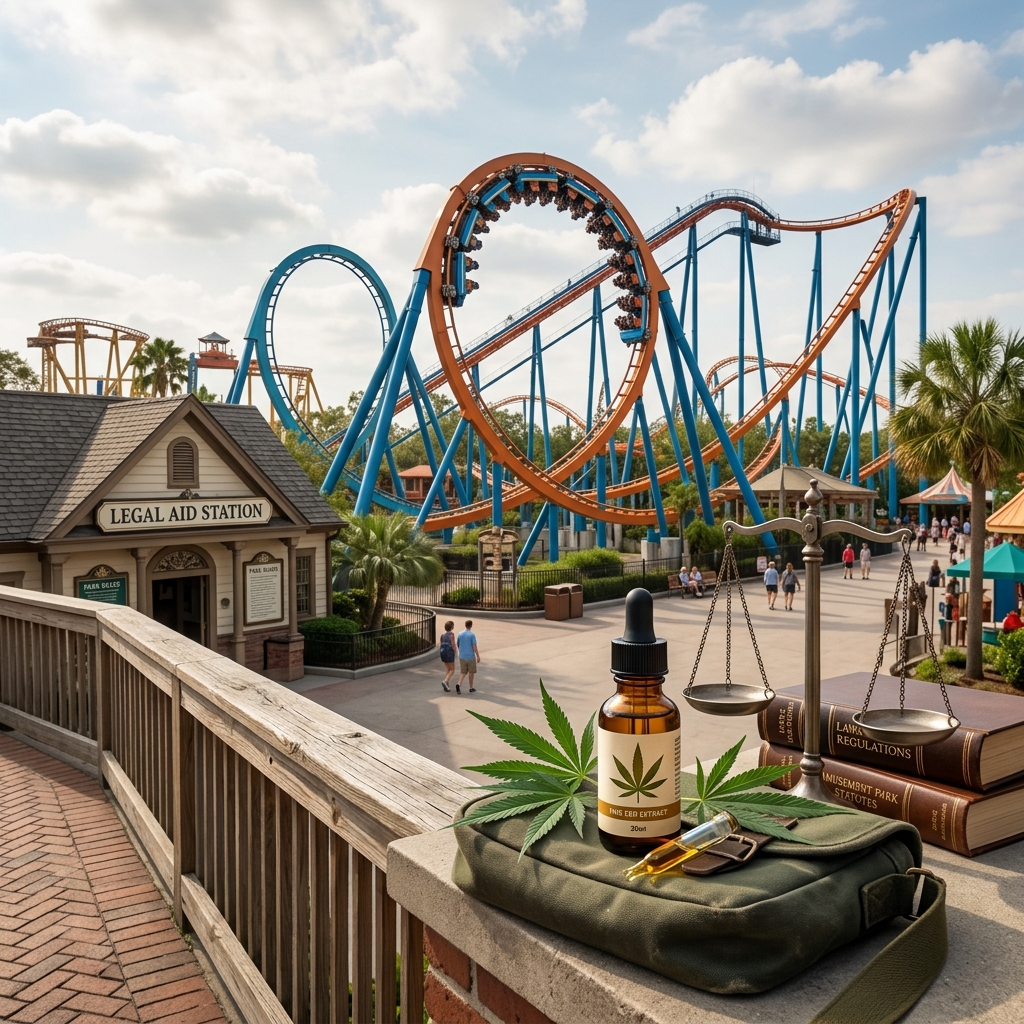
Cannabidiol (**CBD**) products are sold in gas stations, pharmacies, and wellness shops across the United States, yet people still face arrest for possessing them in certain places. One widely publicized incident involved a 69-year-old grandmother visiting a major Florida theme park who was arrested after security found CBD oil in her bag, a product she said was recommended by her doctor for chronic pain. This case illustrates how confusing the rules can be when federal law, state law, and private property policies intersect.
This article uses that incident as a starting point to explain the legal landscape around CBD, why arrests can happen despite widespread availability, and what visitors should understand before bringing cannabinoid products to crowded attractions like theme parks, airports, stadiums, and cruise terminals.
From Wellness Trend to Legal Minefield
CBD is a chemical compound found in the cannabis plant that does not produce the classic psychoactive “high” associated with tetrahydrocannabinol (**THC**). Many people use CBD oils, capsules, creams, or gummies for conditions such as arthritis, anxiety, or insomnia, often believing these products to be completely legal and risk-free.
However, the legal status of CBD is more complicated than its mainstream popularity suggests:
- Federal law distinctions: The 2018 Agriculture Improvement Act (Farm Bill) removed hemp (cannabis with less than 0.3% THC by dry weight) and its derivatives from the federal definition of marijuana, effectively legalizing hemp-derived CBD at the federal level when produced under approved conditions.
- Role of the FDA: The U.S. Food and Drug Administration (FDA) regulates CBD when it is added to food, dietary supplements, or marketed with medical claims. The FDA has repeatedly warned that many CBD products are misbranded, improperly labeled, or make unsupported health claims, and has issued enforcement actions against companies.
- State-level variability: States retain broad authority to regulate controlled substances and hemp products. Some states allow over-the-counter CBD; others permit only medical CBD with a prescription; and some have stricter rules about THC thresholds and testing.
Because of this patchwork, a product that is legal in one state may constitute a criminal offense in another, especially if local law enforcement or prosecutors treat all forms of CBD as suspect when THC content is unclear.
The Florida Theme Park Arrest: A Brief Overview
In 2019, a North Carolina grandmother visiting a large Florida theme park was stopped at bag check after security staff found a bottle of CBD oil in her purse. She said the oil was used for chronic pain related to arthritis and was recommended by her physician. Security referred the matter to local law enforcement, and a deputy conducted a field test on the oil to check for THC.
Key elements of the incident as reported by major news outlets included:
- Discovery of a one-ounce bottle labeled as CBD oil at the park entrance security checkpoint.
- Use of a field test kit that reported a positive result for the presence of THC, the psychoactive compound that can make a cannabis product illegal under Florida law.
- Arrest of the visitor on suspicion of felony cannabis possession, separation from her family, and transport to jail, where she reportedly spent about half a day in custody.
- Later dismissal of the criminal charge, followed by a civil lawsuit alleging false arrest, unlawful detention, and civil rights violations.
In public statements, the sheriff’s office argued that the deputy was following Florida law and acted on a substance believed to be illegal after a test indicated THC presence. The woman and her attorney, by contrast, emphasized that she believed she was carrying a federally legal, doctor-recommended product marketed as CBD.
Why CBD Can Trigger Arrests Despite Federal Hemp Legalization
To understand how someone can be arrested for CBD even after the federal legalization of hemp, it is necessary to look at state criminal statutes, enforcement practices, and the limits of roadside or on-site testing.
State Drug Laws and THC Content
Many state drug laws were drafted before hemp-derived CBD became widely available. Statutes often treat any substance containing “tetrahydrocannabinols” as a controlled substance unless specifically exempted. Where state law has not been updated to clearly distinguish hemp-derived CBD with less than 0.3% THC from higher-THC marijuana, law enforcement may treat ambiguous oils or tinctures as illegal until proven otherwise.
In Florida, reforms have been made to allow hemp and certain CBD products, but at the time of the incident, local officers cited state law as the basis for treating CBD oil as potentially illegal without appropriate medical authorization. Because the product was not verified as low-THC through a reliable laboratory test at the scene, a positive field test for THC was considered sufficient probable cause for a felony arrest.
Reliability Problems with Field Drug Tests
Field test kits used by police are designed to quickly indicate whether a substance may contain a controlled drug. They are small, inexpensive, and meant for on-the-spot decisions, but they are not as accurate as laboratory analysis. Reported problems include:
- False positives: Some tests can react to legal substances that share chemical characteristics with the targeted drug, leading to false positive results.
- Subjective interpretation: Officers must interpret color changes or reactions, which can be influenced by lighting and experience.
- Lack of THC concentration data: Even when a test indicates the presence of THC, it does not report the concentration, which is crucial for distinguishing legal hemp from illegal marijuana.
In the grandmother’s case, the field test was said to produce conflicting results, with law enforcement later acknowledging that the first test result was negative before a subsequent test indicated THC. Nevertheless, the positive result was treated as sufficient justification for a felony cannabis arrest.
Private Property Rules: Theme Parks and Visitor Bag Policies
Privately owned attractions such as theme parks, sports arenas, and concert venues maintain their own codes of conduct and prohibited items lists. These rules can be stricter than general state law. For instance, a park may ban any controlled substances, tobacco products, weapons, and certain medical items even if they are technically legal in the jurisdiction.
At large Florida theme parks, security checkpoints review bags and strollers before entry. When staff discover a product that may involve a controlled substance, they commonly defer to local law enforcement rather than make independent determinations about legality or medical necessity. That referral can trigger criminal procedures even if the guest believed their product was lawful.
Practical implications include:
- Visitors may be barred from bringing certain medical or wellness products inside even when lawfully possessed.
- Security staff are not medical professionals and may not accept packaging or a verbal statement from a guest as proof of medical use.
- Once police are involved, the interaction shifts from park policy enforcement to potential criminal investigation.
Traveler Risks: Crossing State Lines with CBD
CBD users often purchase products in one state and carry them into another, assuming that federal hemp legalization means their products are safe everywhere. That assumption can be risky.
Interstate Travel and Conflicting Laws
Because state statutes and enforcement priorities differ, CBD oil that is sold legally over the counter in one jurisdiction may be treated as a suspected controlled substance in another. Critical factors include:
- Labeling quality: Many products do not clearly disclose THC concentration, or the label may be inaccurate according to laboratory tests.
- Doctor recommendations vs. prescriptions: A doctor’s recommendation note is not the same as a state-issued medical cannabis prescription or registration, which may be required for legal possession in some states.
- Mode of travel: Airports, cruise ports, and bus stations have additional layers of security and, in some cases, federal jurisdiction, heightening scrutiny of any cannabis-related products.
Travelers who are older, medically fragile, or unfamiliar with legal nuances can be particularly vulnerable. In the widely reported Florida case, the arrested visitor was a great-grandmother on a family trip who said she relied on CBD oil to manage pain from advanced arthritis.
Legal Aftermath: Civil Rights Lawsuit and Policy Debates
Following dismissal of the criminal charge, the woman filed a civil lawsuit against both the theme park company and the county sheriff’s office. The complaint alleged wrongful arrest, unlawful detention, violation of civil rights, and emotional distress. Her lawyers sought substantial compensatory and punitive damages and used the lawsuit to highlight broader issues around law enforcement treatment of older or medically vulnerable individuals.
The case generated discussion about several policy questions:
- Should law enforcement rely on field tests alone before making felony arrests involving CBD products?
- Do current state statutes adequately distinguish between hemp-derived CBD and higher-THC marijuana?
- What training should security staff and officers receive on recognizing legitimately labeled hemp products versus illicit substances?
- How should parks balance safety considerations with the reasonable accommodation of guests’ medical needs?
While individual cases may settle or end without trial, the public controversy can prompt legislative or policy changes. Some states have moved to clarify hemp laws, improve lab testing protocols, or revise prosecutorial guidelines for low-level cannabis cases.
Understanding CBD Law: Federal and State Framework
| Level of Law | Main Rule About CBD | Practical Impact on Travelers |
|---|---|---|
| Federal (U.S.) | Hemp-derived CBD with <0.3% THC is not a controlled substance under the 2018 Farm Bill; FDA still regulates products and medical claims. | Products may be legal federally but can still be questioned by local officers, and medical or food uses may face FDA restrictions. |
| State Criminal Law | States differ widely; some explicitly allow CBD, others require medical authorization, and some treat unclear oils as marijuana until proven otherwise. | A bottle accepted in one state could lead to arrest in another, especially if testing suggests THC content above legal limits. |
| Private Property Rules | Parks, airports, and venues can ban cannabis-related items regardless of state law. | Security can deny entry or refer guests to police if they find CBD, even when it is lawfully possessed. |
Practical Tips for Visitors Carrying CBD Products
For travelers who rely on CBD for pain, anxiety, or other conditions, avoiding legal trouble requires planning and awareness of local rules. While this article is not legal advice, several practical steps can reduce risk.
Key Precautions Before Your Trip
- Check the destination’s laws: Review current state rules on hemp and CBD, focusing on whether over-the-counter products are permitted and whether any medical registration is required.
- Use clearly labeled products: Choose products from reputable manufacturers that list CBD and THC content, include batch numbers, and provide certificates of analysis from accredited labs.
- Carry documentation: Bring a copy of any doctor recommendation and product lab report, understanding that these documents may not guarantee acceptance but can help clarify medical purpose.
- Consider alternative medications: When visiting locations with strict security, speak with your physician about non-cannabis alternatives for short trips.
- Review venue policies: Read the theme park or venue’s official list of prohibited items, and contact guest services in advance if you rely on any medicine that could raise questions.
How to Respond if Security Finds Your CBD
- Remain calm and polite; confrontational behavior can escalate the situation.
- Explain that the product is CBD, describe its medical or wellness purpose, and show any documentation you have.
- Understand that staff may still involve law enforcement, particularly if their policies restrict any cannabis-related products.
- If officers appear, ask whether you are free to leave; if not, you may be in a detention scenario and should consider asking for a lawyer.
- Do not consent to field tests or searches without understanding the implications; however, refusing may have consequences in some jurisdictions, so individualized legal advice is important.
Frequently Asked Questions (FAQ)
Is CBD legal everywhere in the United States?
No. While hemp-derived CBD with less than 0.3% THC is not a controlled substance under federal law, states have different rules. Some allow broad retail sales; others restrict CBD to registered medical patients; and some impose stricter testing and labeling requirements.
Can I bring prescription or doctor-recommended CBD into a theme park?
Even when a doctor recommends CBD, a private venue may still prohibit it or treat any cannabis-derived product as subject to removal or police referral. A recommendation letter is not the same as being registered in a state medical cannabis program, and security staff may focus on policy compliance rather than medical nuance.
Why did a grandmother’s CBD oil lead to a felony arrest?
In the Florida case, law enforcement relied on state drug laws and a field test that indicated THC presence. Under those laws at that time, a substance believed to contain illegal THC could support probable cause for felony marijuana possession, even if marketed as CBD and allegedly used for chronic pain.
Are police field drug tests reliable?
Field tests are quick screening tools, not definitive laboratory analyses. They can yield false positives, do not report precise THC concentration, and require officer interpretation. They are often used to justify initial arrests, with more accurate testing done later, which can lead to dismissal of charges if lab results differ.
What should I do if I am arrested or detained over CBD?
If you are arrested or formally detained, you have the right to remain silent and to request an attorney. Avoid making detailed statements about the product or your medical history without legal counsel. Afterward, consult a lawyer about possible defenses and, if appropriate, civil remedies if rights were violated.
Balancing Safety, Health Needs, and Evolving Cannabis Policy
The grandmother’s arrest at a Florida theme park underscores a broader tension in U.S. drug policy. Many patients and older adults have turned to CBD as a non-opioid option for chronic pain, anxiety, and other conditions, encouraged by its availability and marketing as a benign wellness product. At the same time, law enforcement and venue security must operate within legal frameworks that still treat many cannabis-derived substances as controlled drugs.
Until federal and state laws more clearly align and testing technology improves, CBD users traveling across jurisdictions will remain exposed to legal uncertainty. Knowing the basics of the law, planning carefully, and respecting venue policies can reduce risk, but cannot eliminate it entirely. For people who depend on these products, especially vulnerable groups such as seniors with complex health needs, ongoing legal reform and improved guidance are crucial to prevent future incidents like the well-publicized arrest that drew national attention to CBD’s legal gray area.
References
- FDA Regulation of Cannabis and Cannabis-Derived Products, Including Cannabidiol (CBD) — U.S. Food and Drug Administration. 2023-01-23. https://www.fda.gov/news-events/public-health-focus/fda-regulation-cannabis-and-cannabis-derived-products-including-cannabidiol-cbd
- Grandmother sues after she was arrested at Disney with CBD oil in her purse — CNN. 2020-08-06. https://www.cnn.com/2020/08/06/us/disney-woman-sues-over-cbd-oil
- Woman arrested for having CBD oil at Disney raises legal debate — WFTV Channel 9 (YouTube). 2019-05-16. https://www.youtube.com/watch?v=vM9rOtWibMg
- Great-grandmother arrested at Disney’s Magic Kingdom for having CBD oil talks about incident — FOX 35 Orlando. 2020-08-06. https://www.fox35orlando.com/news/great-grandmother-arrested-at-disneys-magic-kingdom-for-having-cbd-oil-talks-about-incident
- Great-grandmother arrested at Disney World for CBD oil — TODAY (NBC News). 2019-05-16. https://www.today.com/video/great-grandmother-arrested-at-disney-world-for-cbd-oil-59442757847
Similar Articles








Read full bio of Sneha Tete




