
Car Accidents When You’re Uninsured: Legal Risks and Options
Understand the financial, legal, and licensing consequences of a car accident when you don’t have insurance—and what steps you can take next.
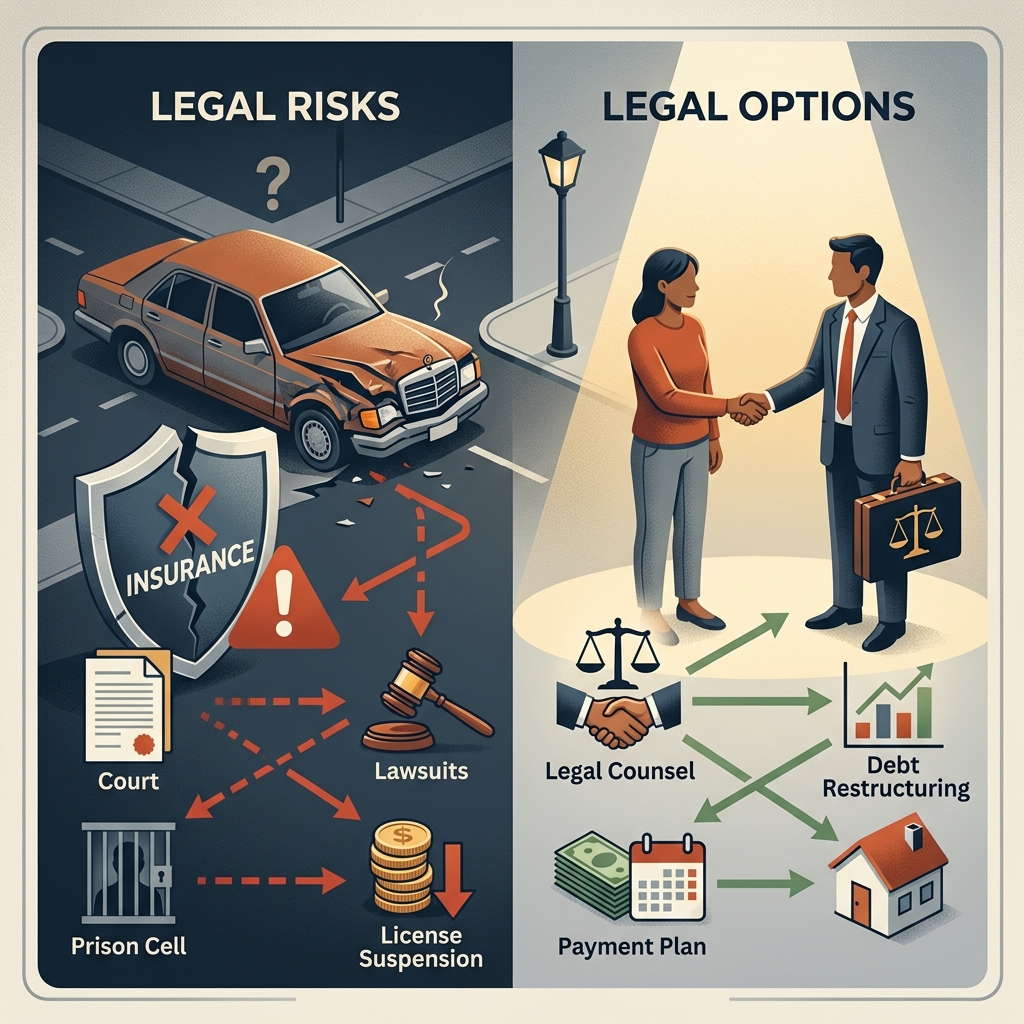
Being involved in a car accident is stressful under any circumstances. When you do not have auto insurance, the situation becomes far more serious, exposing you to legal penalties, heavy financial liability, and long-term consequences for your driving record. Most U.S. states require drivers to carry proof of financial responsibility—usually in the form of liability insurance—and impose penalties if you drive without it. This article explains what may happen after an accident when you are uninsured, how fault affects your exposure, and what steps you can take to protect yourself going forward.
1. Why Driving Without Insurance Is So Risky
Nearly every state in the U.S. requires drivers to maintain at least a minimum level of auto liability coverage before they operate a vehicle on a public road. These laws are often called financial responsibility laws, because they are designed to ensure drivers can pay for injuries and property damage they cause.
When you drive without insurance, two layers of risk exist:
- Legal risk from violating state insurance requirements.
- Civil (financial) risk from being personally responsible for damages after a crash.
The legal penalties for driving uninsured apply even if no accident occurs—for example, if you are pulled over during a traffic stop. If a collision does happen, those penalties typically become more severe, and you may face lawsuits from injured parties on top of government enforcement actions.
2. Immediate Aftermath of an Accident With No Insurance
Although being uninsured changes the long-term consequences, the initial steps after a crash are similar regardless of coverage. Safety and documentation remain critical.
2.1 Essential Steps Right After the Collision
- Check for injuries and call emergency services if anyone is hurt.
- Move vehicles to a safe location if possible and permitted by law.
- Call law enforcement to report the accident. In many states, police must be notified if there are injuries, fatalities, or significant property damage.
- Exchange names, addresses, driver’s license numbers, and vehicle information with the other driver.
- Document the scene with photos or video of vehicles, roadway conditions, visible injuries, and any relevant traffic signs.
- Collect contact information from witnesses who observed the crash.
If you lack insurance, you should still cooperate fully with law enforcement. Providing false or misleading information can lead to separate criminal charges and will undermine your credibility in any future legal proceedings.
2.2 Reporting to Insurance Companies
If you own another policy that might apply—for example, non-owner auto coverage or an employer’s coverage for a work vehicle—report the accident to that company promptly. When another driver is responsible for the crash, you may still file a liability claim with their insurer, even if you personally were uninsured. However, some states limit the types of damages uninsured drivers can recover, especially for pain and suffering.
3. Legal Penalties for Driving Uninsured
Every state sets its own penalties for driving without insurance, but common consequences include fines, suspension of your driver’s license or vehicle registration, and, for repeat or severe offenses, possible jail time.
3.1 Typical Penalties Across States
- Fines: Many states impose fines that can range from a few hundred dollars to several thousand dollars for operating a vehicle without coverage.
- License suspension: Your driver’s license may be suspended for failing to maintain required insurance, often until you provide proof of coverage and pay reinstatement fees.
- Registration suspension: States can suspend or revoke your vehicle registration, meaning you cannot legally operate the car until coverage and fees are addressed.
- Vehicle impoundment: Some jurisdictions authorize police to tow and impound uninsured vehicles, especially after accidents or repeated violations.
- SR-22 or financial responsibility filing: You may be required to file special proof-of-insurance forms (often called SR-22 filings) to demonstrate ongoing coverage before your license is reinstated.
- Criminal penalties for repeat offenders: In certain states, repeated violations can result in misdemeanor charges and even brief jail sentences.
These penalties can apply whether or not you caused the accident, because the underlying violation is driving without mandatory insurance coverage.
3.2 How an Accident Intensifies Penalties
When an uninsured driver is involved in a crash, states often impose additional sanctions beyond basic fines and suspensions. For example:
- You may be subject to longer license or registration suspensions if you fail to pay for the resulting damages and injuries.[10]
- Agencies may require you to post a security deposit or bond to cover potential claims, particularly when the accident involves bodily injury or substantial property damage.[10]
- If a court later enters a judgment against you and you do not satisfy it, your license can remain suspended for an extended period until you pay or otherwise resolve the debt.[10]
Because each state’s laws are unique, it is important to review local statutes or consult a legal professional in your jurisdiction to understand the exact penalties you face.
4. Financial Liability When You Are At Fault
The greatest risk of driving without insurance is not the fines—it is the potential for overwhelming civil liability if you cause an accident. Liability insurance normally pays for bodily injuries and property damage up to policy limits. Without coverage, you may be personally responsible for all losses.
4.1 What You May Have to Pay
If you are legally determined to be at fault, you can be held liable for:
- Medical expenses for injured drivers, passengers, or pedestrians, including emergency care, surgery, hospitalization, rehabilitation, and future treatment.
- Lost wages if injured parties cannot work due to accident-related injuries.
- Property damage to vehicles, structures, and personal belongings.
- Non-economic damages such as pain, suffering, and loss of enjoyment of life, depending on state law.
- Legal costs if someone sues you and obtains an attorney’s fee award.
Auto accidents that involve serious injuries or multiple vehicles can easily generate claims worth tens or hundreds of thousands of dollars. Without insurance, these amounts can become personal debt that may lead to wage garnishment, liens against property, or other collection efforts if a court enters a judgment against you.
4.2 Judgments, Payment Plans, and Bankruptcy
When injured parties or their insurers sue you and win, the court issues a judgment for the amount of damages. If you do not voluntarily pay, the judgment can be enforced through collection procedures and also affect your driving privileges.[10]
In some states, your license can be suspended until the judgment is satisfied, a payment plan is approved, or you negotiate a written agreement with the other side. In severe cases, people sometimes consider filing for bankruptcy to discharge certain accident-related debts, although not all obligations are dischargeable and doing so can have long-term credit implications.[10] Legal advice is essential before making such a decision.
5. What If You Are Not At Fault?
Being uninsured does not automatically make you responsible for an accident. Responsibility is determined by traffic laws, evidence, and sometimes comparative fault rules. If the other driver is at fault, you may still have options to recover damages despite not carrying your own policy.
5.1 Claiming Against the At-Fault Driver’s Insurance
When the other driver is legally liable, their insurer may owe you compensation for your injuries and property damage, subject to policy limits. You can file a third-party claim for:
- Reasonable and necessary medical expenses.
- Vehicle repairs or replacement costs.
- Lost income due to missed work.
- Other accident-related expenses that can be documented.
However, some states restrict uninsured drivers from recovering certain types of non-economic damages, such as pain and suffering, even when they are injury victims. This is sometimes referred to as a “no‑pay, no‑play” rule.
5.2 Uninsured or Underinsured Motorist Coverage
If you are a passenger or you occasionally drive someone else’s insured vehicle, you might be protected by uninsured/underinsured motorist (UM/UIM) coverage on that policy. UM/UIM coverage is designed to compensate injured people when the at‑fault driver has no insurance or insufficient limits. In some states, insurers must offer this coverage or drivers must sign a waiver to decline it.
UM/UIM claims usually require:
- Proof that the other driver was at fault.
- Evidence of injuries and medical treatment.
- Documentation of vehicle damage and other losses.
If no applicable policy exists, your remaining option may be to sue the at‑fault driver personally. Whether that is practical depends on their financial resources and assets.
6. How States Enforce Financial Responsibility After a Crash
Beyond criminal and administrative penalties, many states use special procedures to ensure uninsured drivers involved in accidents address the resulting claims. These are tied to financial responsibility laws and can affect your license even if no lawsuit has yet been filed.[10]
| Enforcement Tool | Purpose | Possible Outcome |
|---|---|---|
| Security or bond requirement | Requires uninsured driver to post money to cover potential claims after an accident.[10] | Failure to post may lead to license or registration suspension until security is provided. |
| Administrative license suspension | Allows the motor vehicle agency to suspend driving privileges when there are unpaid accident damages.[10] | License remains suspended until debt is paid, a settlement is reached, or sufficient time passes without lawsuits. |
| Proof‑of‑insurance filing (SR‑22) | Ensures that previously uninsured drivers maintain continuous coverage after reinstatement. | Non‑renewal or cancellation can trigger new suspensions. |
Often, you can challenge or appeal agency decisions within specific time limits. Ignoring notices from the motor vehicle department can make the situation worse, leading to longer suspensions and higher reinstatement costs.[10]
7. Practical Steps If You Are Uninsured and Have Had an Accident
If you have already been involved in an accident without insurance, you cannot undo the fact that you were uninsured. However, you can take steps now to reduce future harm and bring yourself into compliance with the law.
7.1 Address Immediate Legal Issues
- Read all paperwork from law enforcement and the motor vehicle agency carefully, noting deadlines for responses or appeals.[10]
- Consider consulting an attorney, especially if injuries are significant or you may face large damage claims.
- Respond promptly to any requests for information or security deposits from state authorities.[10]
- Keep copies of all accident-related documents, including police reports, medical bills, and repair estimates.
7.2 Obtain Insurance Before Driving Again
Once your license or registration can be reinstated, you will almost certainly need to show proof of insurance. Purchasing at least your state’s minimum liability coverage before you drive again is critical to avoid repeated violations and progressively harsher penalties.
In some states, reinstatement may require:
- Payment of fines and administrative fees.
- Presentation of an active insurance card or digital proof of coverage.
- Filing an SR‑22 or similar document showing that your insurer has notified the state of your policy.
8. Preventive Measures to Avoid Future Problems
The best way to protect yourself is to avoid driving uninsured in the first place. Even if you rarely drive, maintaining basic coverage can prevent catastrophic financial and legal consequences.
8.1 Maintain Continuous Coverage
- Set automatic payments or reminders so your policy does not lapse unintentionally.
- Notify your insurer if your vehicle will be stored or unused; in some situations, alternative forms of coverage may be available.
- Review your policy annually to confirm limits meet or exceed state minimums and reflect your financial risk tolerance.
8.2 Carry Proof of Insurance
Even insured drivers can face citations if they cannot prove coverage during a traffic stop or after an accident. Many insurers now offer digital ID cards that can be stored on your smartphone and are accepted in most states as valid proof.
- Keep a physical card in your vehicle’s glove compartment.
- Store a digital card in your insurer’s app or download it to your phone for offline access.
- Update your proof of insurance whenever your policy renews or changes.
9. Frequently Asked Questions
9.1 Can I go to jail for an accident without insurance?
For a first offense, many states impose fines and administrative penalties rather than jail, but some treat repeated or serious violations as misdemeanors that can carry possible jail time. Whether incarceration is realistic in your case depends on your state’s statutes and the severity of the incident.
9.2 Will my license be suspended automatically?
Not always automatically, but suspension is a common consequence of driving without insurance, especially after an accident with unpaid damages.[10] States often require proof of coverage and payment of fees before reinstatement.
9.3 What if I can’t afford to pay the accident damages?
If you cannot pay, injured parties or their insurers may sue you and seek a judgment. Some states allow courts to set payment plans or partial payment arrangements, and people in extreme situations sometimes consider bankruptcy to handle large debts.[10] Professional legal advice can help you understand the best option.
9.4 Can I still recover money if the other driver was at fault?
Yes. You may file a claim against the at‑fault driver’s liability insurance or, in some cases, under an applicable uninsured/underinsured motorist policy. However, certain states limit the ability of uninsured drivers to collect non‑economic damages like pain and suffering.
9.5 Will future insurance be more expensive?
Insurers often view uninsured accidents and coverage lapses as markers of higher risk, which can increase premiums. In addition, if you must file an SR‑22, the insurer supplying that filing may charge more because you are considered a high‑risk driver.
References
- Driving Without Insurance — Progressive Insurance. 2024-01-01. https://www.progressive.com/answers/driving-without-insurance/
- What Happens If You Have a Car Accident Without Insurance? — U.S. News & World Report. 2023-05-15. https://www.usnews.com/insurance/auto/accident-without-insurance
- What Happens If the At-Fault Party Doesn’t Have Car Insurance? — Ben Crump Law. 2022-09-01. https://bencrump.com/car-accident-lawyer/what-happens-if-the-at-fault-party-doesnt-have-car-insurance/
- I Got into an Accident and Am Uninsured — Washington Law Help. 2021-06-01. https://www.washingtonlawhelp.org/en/i-got-accident-and-am-uninsured
- Accidents with No (or Not Enough) Car Insurance — Iowa Legal Aid. 2020-10-01. https://iowalegalaid.org/resource/accidents-with-no-car-insurance/
- You Can’t Drive Without Insurance in Ohio — Ohio Department of Public Safety. 2019-01-01. https://publicsafety.ohio.gov/links/bmv3101.pdf
Similar Articles








Read full bio of medha deb




