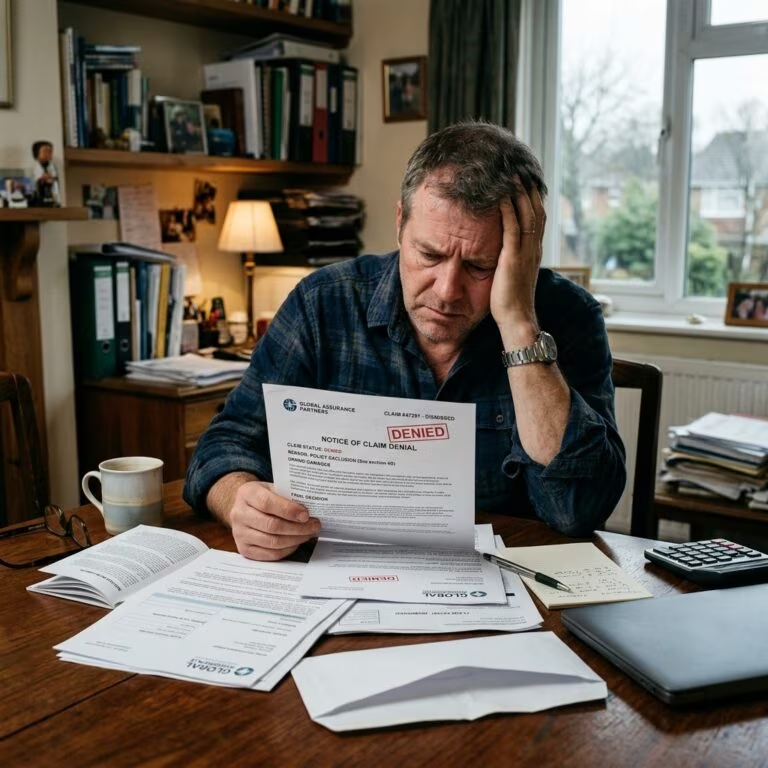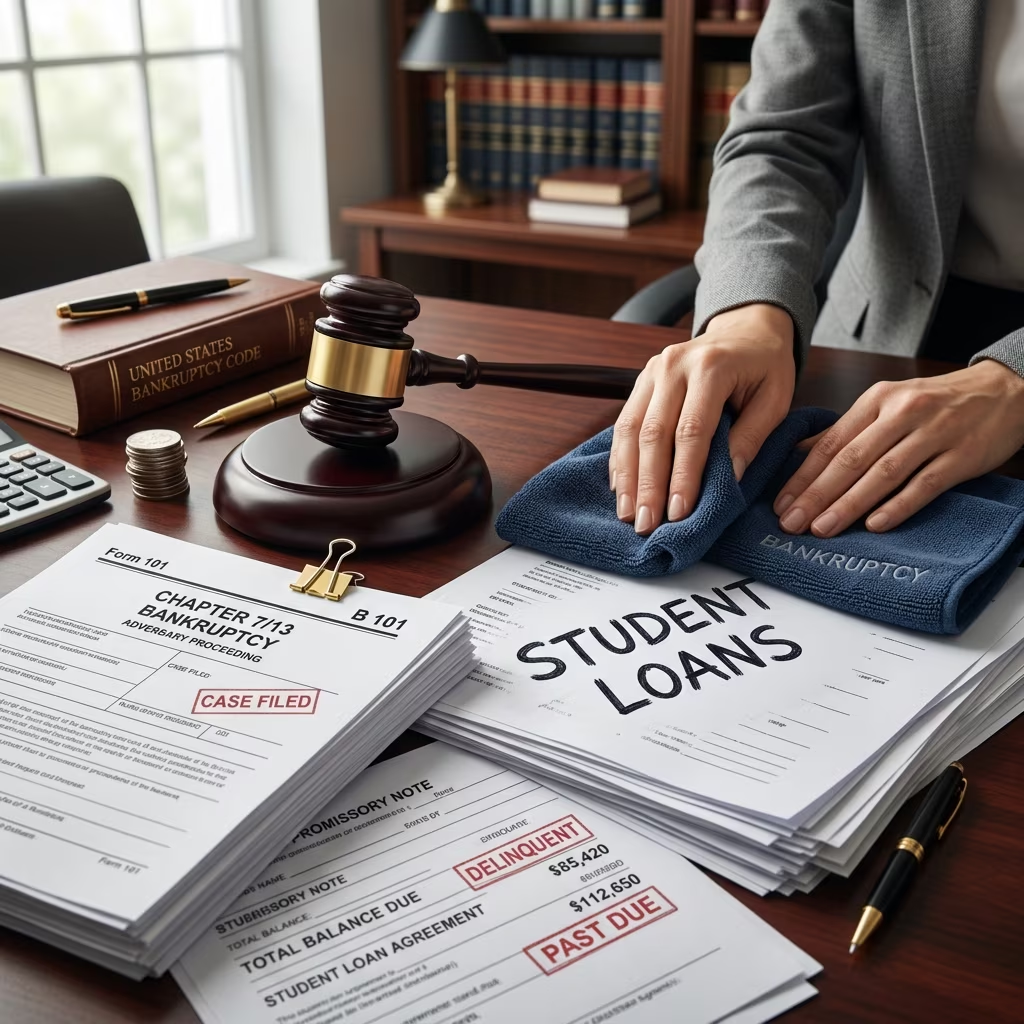
For decades, borrowers heard that student loans can never be erased in bankruptcy. That belief is widespread, but it is not entirely accurate. United States law makes student loans harder to discharge than most other debts, yet relief is possible in specific circumstances, especially under recent federal guidance that has simplified the process for many borrowers.
This article explains how student loans interact with bankruptcy, what the legal standard of undue hardship means, how the process works in practice, and how new policies from the Department of Justice (DOJ) and the Department of Education (ED) have improved outcomes for eligible borrowers.
Why Student Loans Are Treated Differently in Bankruptcy
Most unsecured consumer debts, such as credit cards and medical bills, can be discharged relatively straightforwardly in Chapter 7 or managed through Chapter 13 repayment plans. Student loans, however, are governed by Section 523(a)(8) of the Bankruptcy Code, which provides that educational loans are not automatically wiped out unless the borrower proves that repayment would cause an undue hardship.
This heightened standard grew out of concerns about abuse of the system: lawmakers feared that new graduates could take out loans, declare bankruptcy shortly after, and avoid repayment entirely. As a result, student loans became one of the few categories of debt requiring an additional legal showing before discharge is possible.
Types of Student Loans Covered
The undue hardship rule applies broadly, but the process differs depending on the type of loan:
- Federal loans held by the Department of Education, including Direct Loans and certain Federal Family Education Loan Program (FFELP) and Perkins loans that are owned by the government, are subject to the new DOJ/ED guidance.
- Federal loans not held by ED (for example, some older FFELP loans held by private entities) are still subject to the undue hardship standard, but not the streamlined federal guidance process.
- Private student loans are generally governed by the same undue hardship rule in Section 523(a)(8), but the new DOJ guidance does not apply; the lender will defend the case directly.
The Legal Test: What Is “Undue Hardship”?
The Bankruptcy Code does not define undue hardship, so courts rely on judicial tests developed over time. The most widely used is the Brunner test, first articulated in a 1987 federal appellate decision. Most courts, though not all, follow its three-part framework.
| Brunner Factor | What the Borrower Must Show |
|---|---|
| Minimum standard of living | Repaying the loans would prevent the borrower (and dependents) from maintaining a basic standard of living, considering reasonable expenses. |
| Persistence of hardship | The financial difficulties are likely to continue for a substantial portion of the repayment period, not just briefly. |
| Good faith efforts | The borrower has made genuine efforts to repay, such as attempting payment plans, consolidations, or income-driven repayment when feasible. |
Some courts use slightly different formulations, but the core inquiry is similar: whether forcing repayment would be more than a normal financial challenge and instead become an exceptional, long-term burden that the borrower cannot realistically overcome.
Examples of Factors Courts Consider
Courts and government attorneys might look at:
- Current income and employment prospects
- Necessary living expenses, including housing, food, transportation, health care and child care
- Age, disabilities, or chronic medical conditions affecting work capacity
- History of attempts to pay, defer, refinance, or enroll in income-based plans
- Whether the degree obtained has led to reasonable job opportunities
No single factor is decisive, and outcomes vary. Historically, that variability contributed to the perception that discharging student loans was nearly impossible. However, that picture is changing for federal loans held by the Department of Education.
How Student Loan Discharge Works Inside Bankruptcy
Filing a standard bankruptcy petition does not by itself address student loans. Borrowers must take an extra step: initiating an adversary proceeding, which is a lawsuit within the bankruptcy case, specifically asking the court to determine whether the student loan debt is dischargeable under the undue hardship standard.
Core Steps in the Process
- File Chapter 7 or Chapter 13: The borrower begins a typical consumer bankruptcy case, providing full financial information to the court and trustee.
- Identify student loan creditors: It is crucial to know whether loans are federal, ED-held, or private, and who currently owns or services them.
- File a complaint (adversary proceeding): Within the bankruptcy, the borrower files a separate complaint asking the court to determine dischargeability of student loans under Section 523(a)(8).
- Serve the defendants properly: Federal loans require service in accordance with Federal Rule of Bankruptcy Procedure 7004 and specific methods for serving the Department of Education and the United States.
- Litigate or settle: Historically, this meant contested litigation, including discovery, testimony, and trial. Now, for ED-held loans, a new attestation-based process often leads to negotiated recommendations rather than full trials.
Because this procedure involves technical pleading and service requirements, borrowers are strongly encouraged to work with an experienced bankruptcy attorney or legal aid clinic familiar with student loan issues.
The New DOJ/ED Guidance: A Streamlined Path for Federal Loans
On November 17, 2022, the Department of Justice, in coordination with the Department of Education, issued new guidance creating a standardized approach for handling federal student loan discharge requests in bankruptcy. The goals are to reduce the burden on debtors, make outcomes more consistent across regions, and help government attorneys identify cases where discharge is appropriate.
Key Features of the New Process
- Standardized attestation form: Borrowers complete a detailed form describing income, expenses, assets, health conditions, past payment attempts, and other factors relevant to undue hardship.
- DOJ evaluation: An Assistant United States Attorney (AUSA) reviews the attestation and other available information and applies the guidance criteria to recommend whether to support full discharge, partial discharge, or denial.
- Collaboration with ED: DOJ and ED jointly consider whether the borrower meets presumptive undue hardship factors; if so, DOJ may agree to concede undue hardship and recommend discharge to the court.
- Focus on net income: The guidance includes a structured calculation of allowed expenses and monthly net income. If allowable expenses exceed income, this can support a finding of present inability to repay.
Importantly, the guidance does not change the underlying law. Borrowers still must file an adversary proceeding and meet the undue hardship standard. However, it reshapes how the government evaluates and responds to those cases, leading to significantly higher success rates for many borrowers with ED-held federal loans.
Impact on Success Rates
Early data and academic analysis suggest that the guidance has materially improved outcomes. One study reported that borrowers using the DOJ process obtained discharge in roughly 87% of adversary proceedings, while the Department of Education has referenced success rates closer to 99% of adjudicated cases receiving full or partial discharge. Another review of cases filed in the first ten months similarly found that the vast majority of borrowers whose cases were decided obtained some level of relief.
These figures contrast with older research showing success rates closer to 39% before the guidance, when far fewer borrowers attempted the process due to the perceived difficulty and uncertainty.
Partial vs. Full Discharge of Student Loans
Discharge is not always all-or-nothing. Bankruptcy courts and the DOJ guidance recognize that some borrowers can manage a portion of their loan obligations but not the full amount. In those situations, a partial discharge may be appropriate.
Examples of Possible Outcomes
- Full discharge: The entire qualifying student loan balance is wiped out, freeing the borrower from further repayment obligations on those loans.
- Partial discharge: A portion of the principal or interest is eliminated, or the loan is restructured to a reduced amount that aligns with the borrower’s ability to pay.
- No discharge: If the borrower does not meet the undue hardship standard, the loans remain, though the bankruptcy might still resolve other debts and improve overall financial stability.
The DOJ guidance specifically contemplates partial discharge where the borrower’s calculated net income supports only some level of repayment. This flexibility allows courts and agencies to tailor relief to the individual circumstances.
Practical Considerations Before You File
Deciding whether to pursue bankruptcy and an adversary proceeding for student loans is a complex choice. Borrowers should weigh legal, financial, and personal factors carefully.
Questions to Ask Yourself
- Are your financial challenges temporary, or do they stem from long-term issues such as disability, chronic illness, or caregiving responsibilities?
- Have you explored income-driven repayment plans, consolidation, or other administrative options for federal loans?
- Are you primarily struggling with student loans, or do you also have substantial other debts such as medical bills or credit cards?
- Do you understand the consequences of bankruptcy, including impacts on credit, asset liquidation, and long-term financial planning?
- Can you access qualified legal assistance, either privately or through legal aid?
Because the student loan adversary process requires legal filings and procedural steps, expert guidance is especially important. Public law libraries, nonprofit legal organizations, and state bar referral services can often help connect borrowers with appropriate resources.
Frequently Asked Questions (FAQ)
1. Are student loans automatically discharged in bankruptcy?
No. Unlike most unsecured debts, student loans require a separate adversary proceeding and proof of undue hardship before a court can discharge them.
2. Does the new DOJ guidance guarantee that my federal loans will be wiped out?
No. The guidance provides a structured evaluation process and has led to high success rates for qualifying borrowers, but discharge still depends on your specific financial circumstances and a court decision.
3. Does the guidance apply to private student loans?
No. The streamlined DOJ/ED process applies to federal loans held by the Department of Education. Private loans can still be challenged under the undue hardship standard, but the lender, not the government, will defend the case.
4. What if I am in an income-driven repayment plan?
Enrollment in an income-driven plan can demonstrate good faith efforts to repay. However, if even those reduced payments are unaffordable or your hardship is long-term, that may support an undue hardship claim.
5. Should I file bankruptcy solely to address student loans?
That decision depends on your broader financial picture. Because bankruptcy carries significant consequences, it is generally advisable to consider it as part of an overall debt strategy and consult an attorney before proceeding.
Key Takeaways for Borrowers
- Student loans are harder, but not impossible, to discharge. The law requires proof of undue hardship through an adversary proceeding.
- Federal policy has shifted. New DOJ and ED guidance provides a more predictable and often borrower-friendly path for ED-held federal loans.
- Success rates have improved. Recent data show much higher rates of full or partial discharge under the guidance compared with past years.
- Private loans remain more traditional. They are not covered by the federal guidance and may involve more contested litigation.
- Legal advice is critical. The process is technical, and strategic decisions can affect the outcome dramatically.
References
- New Process to Discharge Student Loans in Bankruptcy — National Consumer Law Center. 2023-02-01. https://library.nclc.org/article/new-process-discharge-student-loans-bankruptcy
- New Process Eases Discharge of Student Loan Debt in Bankruptcy — Purdue Global Law School. 2023-09-13. https://www.purduegloballawschool.edu/blog/news/student-loan-debt-bankruptcy
- What Does it Take to Discharge Student Loans in Bankruptcy? — Dworken & Bernstein Co., LPA. 2021-06-10. https://dworkenlaw.com/what-does-it-take-to-discharge-student-loans-in-bankruptcy/
- Navigating the New Student Loan Discharge Process: Overview and Additional Resources — U.S. Bankruptcy Court, Western District of Washington. 2023-05-02. https://www.wawb.uscourts.gov/content/navigating-new-student-loan-discharge-process-overview-and-additional-resources
- The Effective but Underutilized Way to Discharge Student Loan Debt in Bankruptcy — Kentucky Law Journal Blog. 2024-01-15. https://www.kentuckylawjournal.org/blog/the-effective-but-underutilized-way-to-discharge-student-loan-debt-in-bankruptcy
- Student Loan Guidance — U.S. Department of Justice. 2022-11-17. https://www.justice.gov/ust/student-loan-guidance
- Discharging Student Loans in Bankruptcy (Webinar) — Public Counsel / LA Law Library. 2023-09-18. https://www.youtube.com/watch?v=0QWMp82xGYw