
Can You Drink and Fly a Drone? Legal & Safety Rules Explained
A practical guide to how alcohol and drug rules apply to recreational and commercial drone pilots in the United States.
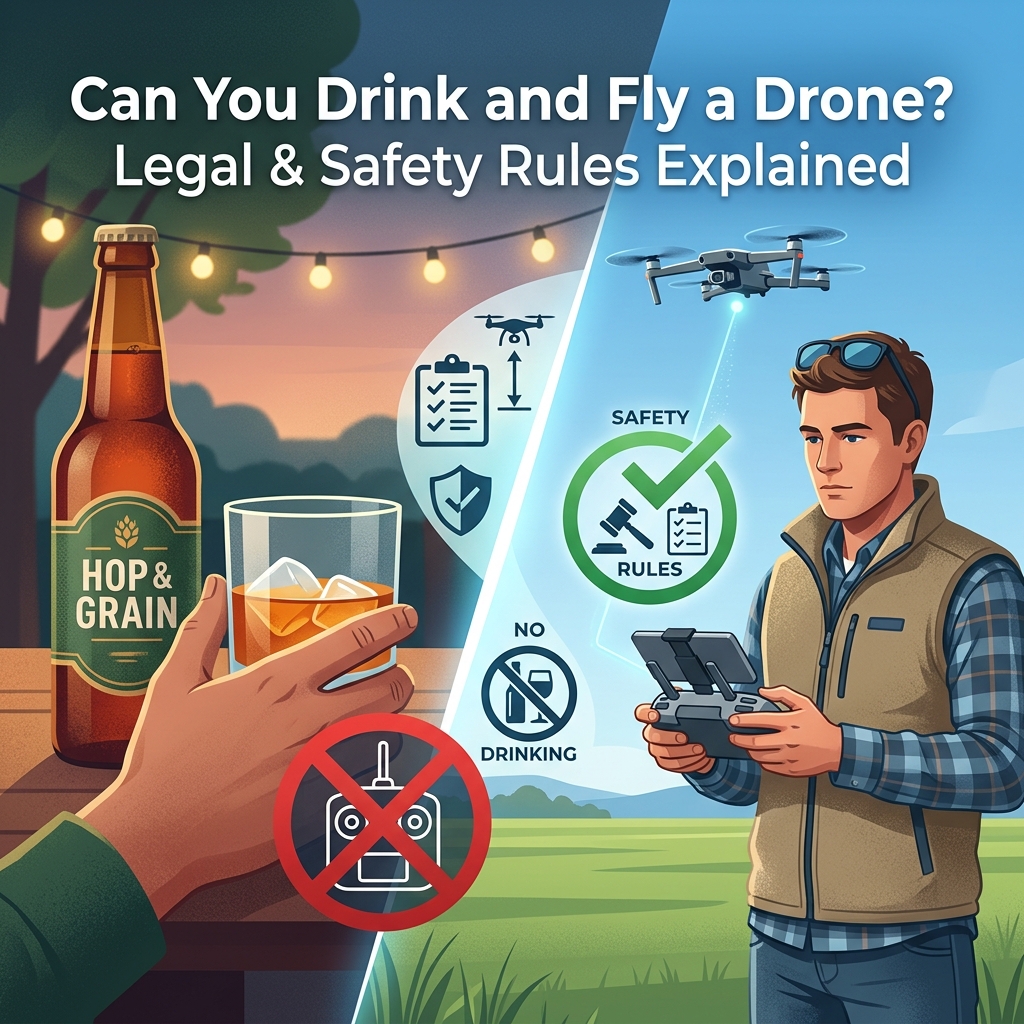
Flying a drone looks harmless next to driving a car or piloting an airplane, but United States law increasingly treats drinking and droning as a serious safety issue. Federal aviation regulations, community safety codes, and some state criminal statutes now restrict or outright prohibit operating an unmanned aircraft while under the influence of alcohol or drugs.
This article explains how alcohol rules apply to both recreational and commercial drone pilots, when drunk droning becomes a crime, and what penalties you might face if you mix flying with drinking.
Why Lawmakers Care About Drinking and Droning
Consumer drones can weigh several pounds, travel hundreds of feet in the air, and reach high speeds. In the wrong hands, they can collide with people, property, or manned aircraft. Safety regulators view a drone pilot as part of the broader aviation system and assume that impaired judgment at the controls can endanger others just as it does in a car or airplane.
- Reduced reaction time: Alcohol slows responses, making it harder to avoid obstacles, sudden wind gusts, or other aircraft.
- Poor decision-making: Impairment encourages risky flights, like flying close to crowds or beyond visual line of sight.
- Coordination issues: Fine motor skills and spatial awareness decline, increasing the chance of losing control.
- Overconfidence: Intoxicated pilots may ignore warnings, rules, or weather conditions.
Because of these risks, aviation authorities have imported familiar alcohol rules from manned aviation into the world of drones.
Federal Rules: How the FAA Regulates Alcohol for Drone Pilots
In the United States, the Federal Aviation Administration (FAA) is responsible for the safety of the national airspace. When it created Part 107—the rule set governing small commercial drones—it explicitly tied drone pilots to the existing alcohol and drug provisions in 14 CFR § 91.17 and § 91.19.
Core FAA Alcohol Limits for Drone Operations
Under these regulations, anyone acting as a remote pilot in command, manipulating the drone’s controls, or serving as a visual observer is treated like a crewmember of a civil aircraft.
| Rule | Requirement | Applies To |
|---|---|---|
| 8-hour waiting period | No flying within 8 hours of consuming any alcoholic beverage. | Part 107 pilots and crew |
| Under the influence | No flying while under the influence of alcohol or any drug that affects faculties contrary to safety. | Part 107 pilots and crew |
| Blood alcohol limit | No flying with an alcohol concentration of 0.04% or greater in blood or breath. | Part 107 pilots and crew |
| Transporting drugs | No knowingly carrying illegal narcotics or similar substances on a civil aircraft unless expressly authorized. | Part 107 pilots and crew |
These limits are stricter than the typical legal driving standard of 0.08% BAC used for cars in many states, reflecting aviation’s lower tolerance for impairment.
Testing and FAA Enforcement
Under Part 107 and incorporated rules, the FAA can require testing if it has a reasonable basis to believe a drone pilot violated the alcohol provisions.
- Remote pilots and visual observers may be asked to submit blood or breath samples to determine alcohol concentration.
- Refusing or failing the test can lead to enforcement action, including civil penalties and suspension or revocation of any airman certificate.
- Separate criminal prosecution may follow if drugs or other illegal conduct are involved under federal or state law.
Even if you fly a small drone for business, the FAA expects you to follow professional pilot standards regarding alcohol.
Recreational Drone Pilots: Community-Based Safety Codes
Recreational flyers often assume they are exempt from strict alcohol rules because they are not flying under Part 107. Instead, they are covered by 49 U.S.C. § 44809, which creates a special framework for model aircraft flown for fun.
This law does not list a specific blood alcohol limit, but it includes two important conditions:
- Recreational pilots must fly in accordance with the safety guidelines of a recognized community-based organization (CBO) developed in coordination with the FAA.
- It does not limit FAA enforcement against any unmanned aircraft operator who endangers the safety of the national airspace system.
In practice, major CBO codes, including those of the Academy of Model Aeronautics, prohibit operating a drone under the influence of alcohol or drugs. Violating those guidelines can push a recreational pilot outside the protection of § 44809 and into the scope of Part 107 rules, including the alcohol limits described above.
Practical Takeaways for Recreational Flyers
- Assume impairment is prohibited: If you are drinking, you are almost certainly violating community safety codes if you fly.
- Endangerment triggers enforcement: If your impaired flying threatens other aircraft or people, the FAA can pursue enforcement regardless of your recreational status.
- Local laws still apply: Even if federal law treats your flight as recreational, state or municipal drunk droning laws can still impose criminal penalties.
State-Level Laws: Example of New Jersey’s Drunk Droning Statute
Beyond federal rules, some states have moved to criminalize drinking and droning explicitly. New Jersey offers a clear example.
New Jersey’s Prohibition on Drunk Droning
New Jersey enacted a law making it a disorderly persons offense to operate an unmanned aircraft system while under the influence of intoxicating liquor, narcotics, hallucinogenic, or habit‑producing drugs, or with a blood alcohol concentration of 0.08% or more. The 0.08% threshold mirrors the state’s standard limit for driving a motor vehicle.
If convicted in New Jersey of drunk droning, a person may face:
- Up to six months in jail
- Up to $1,000 in fines
- A criminal record for a disorderly persons offense
While not every state has a specific drunk droning statute, many have broader laws related to reckless endangerment, public safety, or aviation that could be applied to impaired drone pilots.
Comparing Key Alcohol Rules for Drone Pilots
| Scenario | Legal Framework | Alcohol Limit / Rule | Potential Consequences |
|---|---|---|---|
| Commercial drone pilot (Part 107) | FAA Part 107, 14 CFR § 91.17, § 91.19 | 8 hours from last drink; no flying under influence; BAC < 0.04%. | Civil penalties; certificate suspension or revocation; possible criminal charges. |
| Recreational pilot following CBO rules | 49 U.S.C. § 44809; community-based safety code | No flying under influence of alcohol or drugs (CBO prohibition). | Loss of § 44809 protections; FAA enforcement for unsafe operations. |
| Pilot in New Jersey flying drunk | New Jersey drunk droning statute | Illegal at BAC ≥ 0.08% or while impaired by liquor or drugs. | Up to 6 months jail; up to $1,000 fine; disorderly persons conviction. |
Safety Guidance: Best Practices Around Alcohol and Drone Flying
Regulations set minimum requirements, but safety experts often recommend going further. The FAA’s own materials emphasize avoiding alcohol entirely when planning or performing a flight.
FAA Safety Brochure Recommendations
The FAA has published guidance highlighting how even low levels of alcohol can impair performance and lead to serious errors.
- Adhere at minimum to the 8‑hour rule and the 0.04% limit.
- Consider waiting 24 hours after intoxication before any aviation activity.
- Do not rely on coffee, showers, or oxygen; none can speed up the body’s elimination of alcohol.
- Be aware that hangovers can still degrade performance even if your BAC is below legal limits.
Although written for traditional pilots, these recommendations apply logically to drone operations, where situational awareness and quick reactions are also critical.
Practical Rules of Thumb for Drone Pilots
- Plan flights for sober periods: Schedule drone operations earlier in the day, before any drinking.
- Keep roles sober: Ensure the remote pilot, anyone manipulating the controls, and visual observers are all unimpaired.
- Avoid mixed responsibilities: Do not treat a drone flight as a casual activity during social drinking—finish flying before opening a drink.
- Respect local law: Research state or municipal drone regulations, especially if you fly near airports or populated areas.
Legal and Practical Risks of Drinking While Flying a Drone
Mixing alcohol and drone operation can expose you to multiple layers of risk, even when no accident occurs.
- Civil penalties from FAA: Violating Part 107 or incorporated alcohol rules can result in fines and administrative actions.
- Loss of certification: The FAA may suspend or revoke your airman certificate, affecting your ability to conduct commercial drone work.
- Criminal charges: In states with drunk droning laws or general endangerment statutes, impaired flying can lead to jail time and a criminal record.
- Civil liability: If your impaired flight causes injury or property damage, you could be sued for negligence.
- Insurance issues: Intoxication may void coverage under some liability or hull insurance policies.
The combined impact of these consequences makes it clear that treating drones like toys while drinking is a serious miscalculation.
Frequently Asked Questions (FAQ)
Is it always illegal to drink and fly a drone in the United States?
Under federal rules, anyone flying under Part 107 must comply with strict alcohol limits, including the 8‑hour rule and a 0.04% maximum BAC. Recreational pilots are bound by community safety codes that generally prohibit flying under the influence and may face FAA enforcement if their impaired flying endangers the airspace. In some states, like New Jersey, drunk droning is specifically criminalized at 0.08% BAC or while impaired.
What does “8 hours bottle to throttle” mean for drone pilots?
“Bottle to throttle” is aviation shorthand for the rule that pilots must wait at least eight hours after consuming alcohol before acting as a crewmember of an aircraft. In the drone context, this applies to anyone who is the remote pilot in command, manipulates the drone’s controls, or serves as a visual observer under Part 107.
Is the legal limit for drone pilots the same as for driving?
Not necessarily. FAA rules tie drone pilots to a 0.04% blood alcohol limit, which is more stringent than the 0.08% limit used for driving in many states. Some state drunk droning laws, however, may adopt the familiar 0.08% threshold for criminal liability, as New Jersey does.
Can I fly recreationally after drinking if I feel fine?
Community-based safety codes and general aviation principles strongly discourage any flying under the influence. Feeling fine is not a reliable indicator of safe performance; research shows serious errors increase at or above 0.04% BAC and can occur below that level. Flying impaired may also expose you to FAA enforcement or state-level penalties if someone is harmed.
Could I lose my drone pilot certificate for alcohol violations?
Yes. If the FAA finds that you violated alcohol or drug provisions while operating a drone, it can pursue enforcement that may include civil penalties and suspension or revocation of your airman certificate. This can significantly impact your ability to earn income from drone operations or other aviation activities.
Does it matter if I am carrying drugs on the drone itself?
FAA regulations prohibit knowingly carrying illegal narcotic drugs or similar substances on a civil aircraft unless authorized by law or government agency. Using a drone for transporting illegal drugs would raise significant legal issues, including potential criminal prosecution beyond aviation-specific enforcement.
Key Points for Responsible Drone Pilots
- Treat drones as aircraft: Regulations view you as part of the aviation system, not just a hobbyist.
- Know your framework: Understand whether you are flying under Part 107, § 44809 recreational rules, or local statutes.
- Avoid alcohol before flying: Respect the minimum 8‑hour rule, and consider more conservative waiting periods.
- Stay below 0.04% BAC: For Part 107 operations, any BAC of 0.04% or higher is prohibited.
- Research state law: States like New Jersey add criminal penalties for drunk droning, including jail and fines.
In short, while consumer drones may look like recreational gadgets, drinking and droning engages real aviation law. The safest and legally sound approach is straightforward: fly sober, or don’t fly at all.
References
- Don’t Drink and Drone! Drunk Droning is Now Illegal in New Jersey — Eric J. Mark, Attorney at Law. 2018-01-16. https://ericmarklaw.com/blog/dont-drink-and-drone-drunk-droning-is-now-illegal-in-new-jersey/
- Is It Illegal To Drink and Drone? — Super Lawyers. 2018-01-26. https://www.superlawyers.com/resources/dui-dwi/dui-life-impacts-and-other-areas/is-it-illegal-to-drink-and-drone/
- Don’t Drink and Drone – FAA Regulations on Drones & Alcohol — Rupprecht Law. 2020-02-18. https://jrupprechtlaw.com/dont-drink-and-drone/
- Section 107.27 Alcohol or drugs — Rupprecht Law. 2016-08-29. https://jrupprechtlaw.com/section-107-27-alcohol-drugs/
- Alcohol and Flying — Federal Aviation Administration. 2008-01-01. https://www.faa.gov/pilots/safety/pilotsafetybrochures/media/alcohol.pdf
Similar Articles








Read full bio of medha deb




