
Can Police Get Location Data Without a Warrant?
A clear look at how courts treat cellphone location records and why warrants matter.
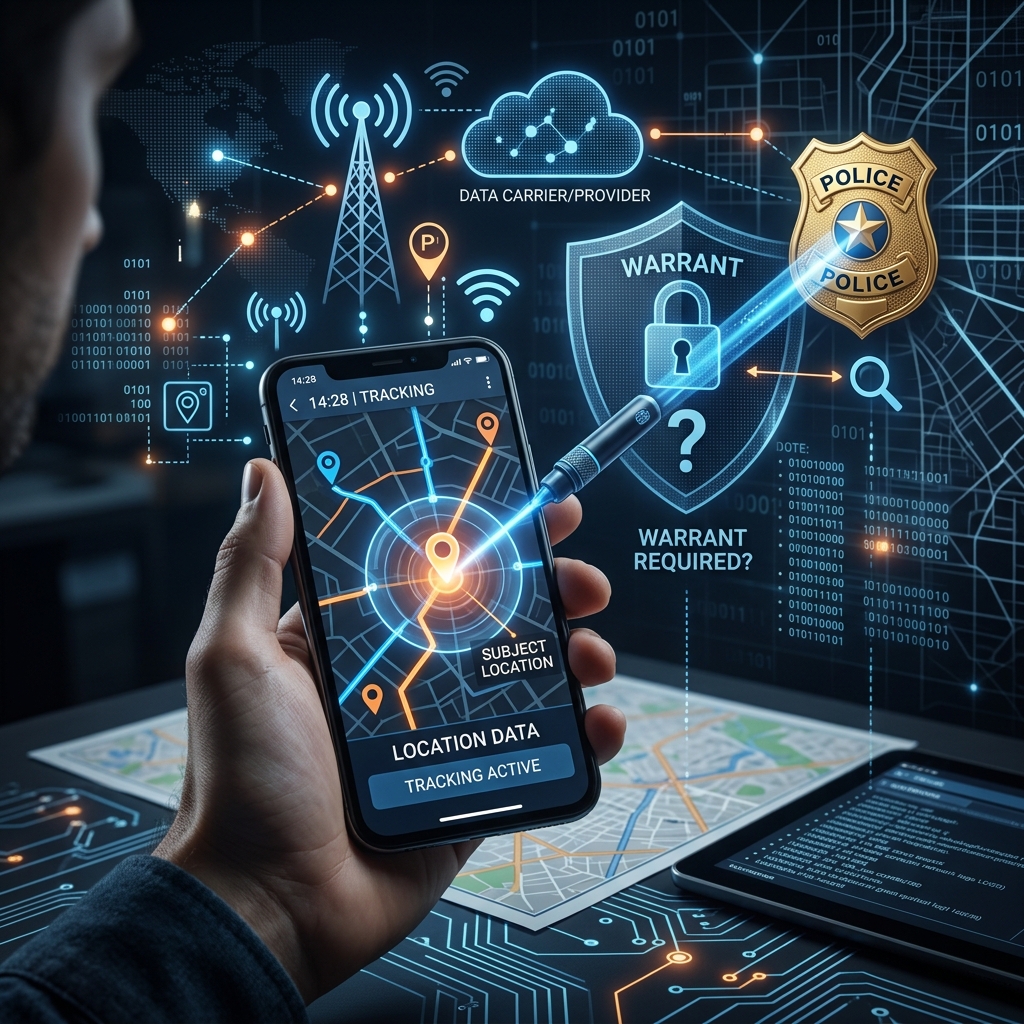
Why location data has become a major legal issue
Cellphone location records can reveal where a person lives, works, worships, shops, travels, and spends time with others. That makes them far more revealing than many people assume, which is why courts have increasingly treated them as sensitive private information rather than routine business records. The central legal question is whether police may obtain that data without first convincing a judge that probable cause exists for a search warrant.
The issue matters because modern phones continuously generate location information through cell towers, app services, and location histories stored by technology companies. When law enforcement seeks this information, it can expose not only the movement of a suspect but also the movements of innocent bystanders who were nearby at the wrong time.
The constitutional rule that frames the debate
The Fourth Amendment protects people against unreasonable searches and seizures, and courts generally require a warrant supported by probable cause before police can search private information. In the context of cellphone location records, the Supreme Court has recognized that long-term digital tracking can intrude deeply into personal privacy.
That constitutional protection is especially important because location data is often collected automatically, not by choice. A person may carry a phone for ordinary daily use without realizing how much data is being generated and preserved by service providers.
| Legal question | Privacy concern | Typical constitutional answer |
|---|---|---|
| Can police get historical location records? | Records may reconstruct days or months of movement | Usually a warrant is required |
| Can police use a geofence search? | Search may sweep in many innocent people | Courts have treated such searches as highly suspect under the Fourth Amendment |
| Can records be obtained like ordinary business data? | Location information can reveal intimate details of life | Supreme Court precedent limits that theory in this setting |
What the Supreme Court has said about phone tracking
The most important modern precedent is the Supreme Court’s decision in Carpenter v. United States, where the Court held that accessing a person’s cell phone location history is a search under the Fourth Amendment and therefore generally requires a warrant. That ruling rejected the idea that the government may freely obtain such data simply because a company holds it.
The underlying dispute involved months of location records obtained from a wireless provider without a probable-cause warrant. The Court concluded that the sheer volume and sensitivity of the data made it different from many ordinary business records. In practical terms, the decision means police usually cannot bypass the warrant process when they want detailed historical location information.
Although the Court strengthened privacy protections, it did not eliminate all questions. Lower courts still handle details such as how much data is enough to trigger constitutional protection and whether a particular warrant application was sufficiently specific.
Why geofence searches raise additional concerns
Geofence searches are a newer and more controversial form of digital surveillance. In a geofence investigation, police identify a geographic area and a time window, then ask a technology company to identify devices that were present there. That method can capture data about many people who were merely near a location, even if they had no connection to any crime.
Advocates for privacy argue that geofence warrants function like modern general warrants because they allow law enforcement to search first and narrow suspects later. In other words, instead of identifying a particular person before seeking data, police may use the data itself to find people of interest.
That approach creates a serious risk of overbreadth. If the search area is large or the time frame is broad, the request can include dozens, hundreds, or even more devices, turning a targeted investigation into a dragnet.
- Geofence requests can collect information on people who are never suspected of wrongdoing.
- The search may reveal attendance at sensitive places such as clinics, religious services, political events, or homes.
- Even when police want a single suspect, the method may expose everyone nearby.
Why police argue for access without a warrant
Law enforcement has often argued that location data is valuable in solving serious crimes and that providers already store the records, making them easier to request. Police also contend that location information can help confirm or rule out suspects, identify patterns, and reconstruct events after the fact.
In some investigations, historical location data may provide the only clear link between a suspect and a crime scene. Prosecutors therefore view access to digital records as an important investigative tool, especially when there are no eyewitnesses or physical traces left behind.
But the constitutional problem is not whether the data is useful. The key issue is whether the government can obtain it without the judicial oversight that the Fourth Amendment ordinarily requires. The Supreme Court’s location-data precedent answers that question cautiously, favoring warrants in most cases.
How courts balance privacy and public safety
Courts evaluating location-data disputes generally weigh the depth of the privacy intrusion against the government’s investigative needs. Historical tracking can reveal an intimate portrait of a person’s life, while geofence requests can pull in large numbers of uninvolved people. Those features push courts toward stricter limits and more careful warrant review.
The warrant process matters because it forces police to show a judge that the request is grounded in probable cause and limited in scope. Judicial review can require narrowing the date range, reducing the geographic area, or specifying the device information sought.
That narrowing function is one reason warrants are such a central safeguard. Without them, location surveillance can become routine, broad, and difficult for citizens to detect.
What this means for ordinary smartphone users
For most people, the most important takeaway is simple: a smartphone can create a detailed map of daily life, and the law increasingly recognizes that fact. A person’s movements may be protected even when the data is stored by a third-party company rather than on the phone itself.
At the same time, protections are not absolute. The exact rules can depend on the type of data, the time period involved, the degree of detail requested, and how the government presents its application to a court. That is why legal disputes over location records continue to appear in trial courts and appellate courts nationwide.
Practical questions people often ask
Location-data law can feel technical, but the core issues are straightforward. The following questions capture the main concerns that arise in real investigations and privacy disputes.
- Is historical cellphone location data private? Yes. Supreme Court precedent treats it as protected by the Fourth Amendment in ordinary circumstances.
- Do police always need a warrant? In most cases involving detailed location history, yes, because courts view the data as highly revealing.
- Are geofence searches allowed? They face strong constitutional objections because they can sweep up many innocent people and resemble broad, suspicion-light searches.
- Does it matter if a company holds the data? Yes. The fact that a business stores the records does not automatically remove constitutional protection.
What the broader privacy debate is really about
The debate over cellphone location data is about more than one criminal case. It reflects a larger question about how constitutional law should respond to digital surveillance. Traditional search rules were developed in a world of paper files, physical spaces, and limited recordkeeping. Modern smartphones create continuous streams of data that can reconstruct a person’s life with extraordinary precision.
That shift has forced courts to adapt old doctrine to new technology. The result so far is a strong signal that location information deserves serious Fourth Amendment protection, even when the government argues that it is simply collecting records from a third party.
Where the law may continue to evolve
Although the basic rule now favors warrants for location history, future disputes will likely focus on the boundaries. Courts may continue to refine how much data is too much, when a geofence request becomes too broad, and what level of specificity a warrant must contain to satisfy constitutional standards.
Technology will also keep changing faster than doctrine. As apps, devices, and service providers collect more precise data, judges will be asked to decide whether the same constitutional principles apply to newer forms of tracking. The underlying concern, however, is unlikely to change: when the government can trace where someone has been, it can also learn a great deal about who that person is.
Frequently asked questions
Can police get my location history from Google or my phone carrier?
They can seek it, but Supreme Court precedent indicates that accessing detailed historical location data generally requires a warrant supported by probable cause.
What is a geofence warrant?
It is a request that seeks location data for devices present within a defined area during a defined time period, often capturing many people who are not suspected of any crime.
Why do privacy groups oppose geofence searches?
They argue that such searches are too broad, too invasive, and too close to the kind of general search the Fourth Amendment was designed to prevent.
Does the Constitution protect data stored by a company?
Yes, at least in the location-data context. The fact that a company stores the information does not by itself make the data freely available to law enforcement.
Is location data always protected in every situation?
No. The precise rules can depend on the kind of data sought, how much is requested, and whether a court finds the request properly limited and supported by probable cause.
References
- ACLU Applauds Important Supreme Court Decision Making Clear Location Data is Protected by the Fourth Amendment — American Civil Liberties Union. 2018-06-22. https://www.aclu.org/press-releases/aclu-applauds-important-supreme-court-decision-making-clear-location-data-is-protected-by-fourth-amendment
- Supreme Court to Hear First Cell Phone Location Data Case — American Civil Liberties Union. 2017-06-05. https://www.aclu.org/press-releases/supreme-court-hear-first-cell-phone-location-data-case-0
- Rights Groups to Supreme Court: Reject Privacy-Invasive Geofence Warrants — American Civil Liberties Union. 2024-02-28. https://www.aclu.org/press-releases/rights-groups-to-supreme-court-reject-privacy-invasive-geofence-warrants
- ACLU challenges police geofence searches in Supreme Court — American Civil Liberties Union. 2024-02-28. https://www.facebook.com/aclu/posts/the-supreme-court-heard-a-case-today-that-will-decide-whether-police-can-conduct/1438021298360986/
- Court Cases | Location Tracking — American Civil Liberties Union. 2026-07-10. https://www.aclu.org/cases?issue=location-tracking
- ACLU at Supreme Court Wednesday to Argue in Cellphone Tracking Case — American Civil Liberties Union. 2017-12-04. https://www.aclu.org/press-releases/aclu-supreme-court-wednesday-argue-cellphone-tracking-case
- EFF to Supreme Court: Shut Down Unconstitutional Geofence Searches — Electronic Frontier Foundation. 2025-07-01. https://www.eff.org/press/releases/eff-supreme-court-shut-down-unconstitutional-geofence-searches
Similar Articles








Read full bio of medha deb


