
Can Police Block Journalists From Covering Protests?
Understanding when officers may restrict reporting at demonstrations, and what legal protections journalists still have.
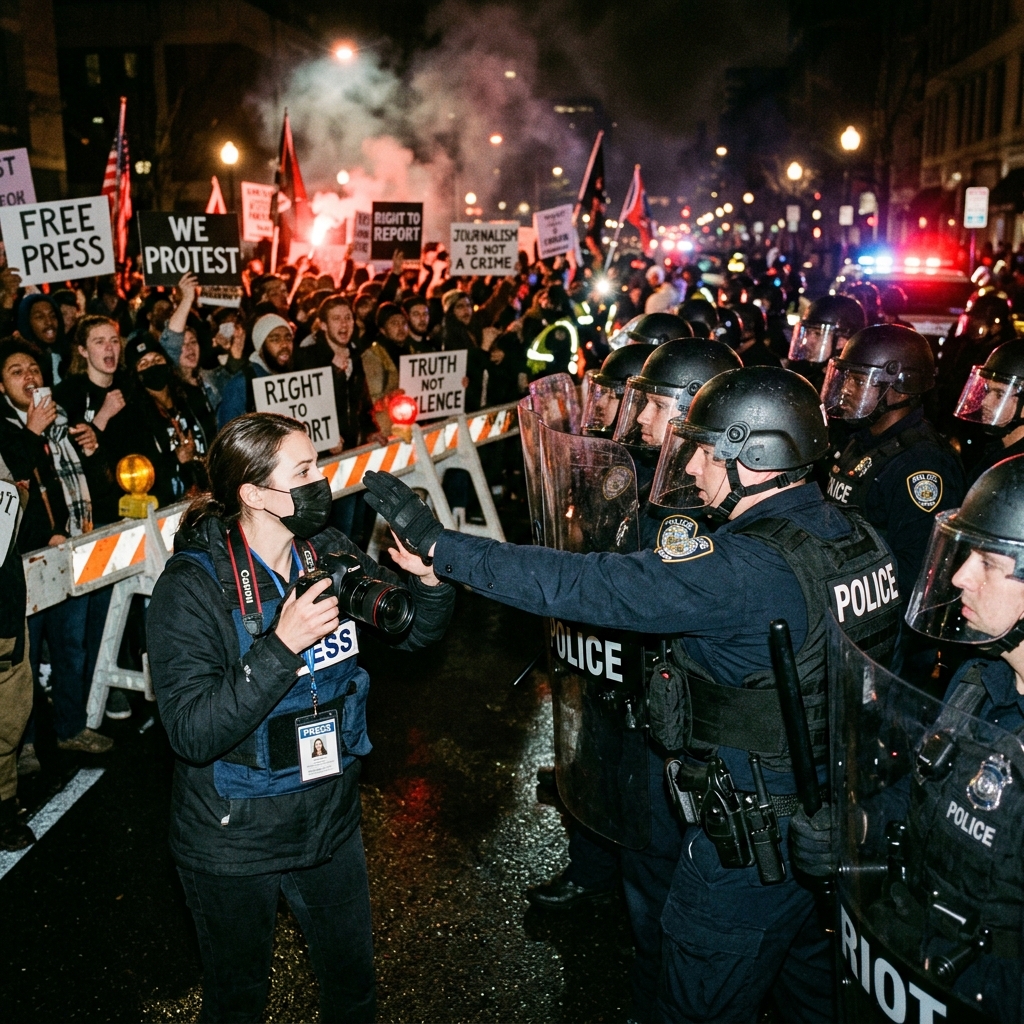
When protests erupt in streets, parks, and public squares, journalists often stand between the public and the events unfolding in real time. That role can create tension with law enforcement, especially when officers attempt to limit access or order reporters to stop recording. This article explains when police may lawfully restrict journalistic activity at protests, what legal protections journalists have, and how both professional and citizen journalists can minimize risk while gathering news.
The Legal Foundation: Press Freedom and Public Protests
In the United States, protest coverage is primarily governed by the First Amendment, which protects both freedom of speech and freedom of the press. Courts have repeatedly recognized that journalists may enter public spaces that are open to everyone else in order to observe, photograph, and record what happens there. The same basic principle appears in international human rights law: journalists have a right to seek, receive, and share information about protests and official responses to them.
However, these protections are not unlimited. Journalists generally must follow the same neutral, content-independent laws that apply to everyone else in the same space. That means they can be subject to reasonable restrictions on where they stand, when they must move, and how they conduct themselves, as long as those restrictions are not aimed at silencing or punishing their reporting.
Press Rights vs. Public Rights
Courts in the United States have often emphasized that, in public places, journalists usually have the same rights as other members of the public, not special or elevated rights. While this may sound limiting, it also means the government cannot arbitrarily single out journalists for harsher treatment because of their profession or what they publish.
- What the press generally can do: Observe protests from public sidewalks, photograph events visible from public vantage points, record audio and video of police performing official duties in public, and report on government actions.
- What the press generally cannot do: Ignore lawful orders that apply to everyone, cross police lines without authorization, trespass on private property, or demand special access where the public is excluded.
Key Rights of Journalists at Protests
Although details can vary by jurisdiction, several rights have been widely recognized in U.S. law and in international standards when journalists cover protests.
Right to Be Present in Public Spaces
Journalists have a protected right to be physically present in public places that are open to the general public, such as streets, sidewalks, and parks, to observe and record protests. This right typically continues even if a protest later becomes unlawful or is subject to dispersal orders, although journalists may have to relocate if authorities close an area to everyone.
International guidance from the United Nations stresses that law enforcement officers should actively safeguard journalists’ ability to monitor assemblies, including when demonstrations are chaotic or violent. States are considered to have a positive obligation not only to refrain from interfering with peaceful newsgathering, but also to protect journalists from harm by both state and non-state actors during protests.
Right to Record and Photograph Police Activity
Most U.S. federal courts that have considered the issue have recognized a First Amendment right to record police officers performing their duties in public, including during protests. This includes taking photographs, shooting video, and recording audio as long as the journalist is not physically obstructing officers or creating a safety risk.
The same principle is reinforced in international standards: journalists are understood to have the right to observe and record how authorities respond to assemblies, regardless of whether the protest is peaceful.
| Activity | Generally Protected? | Typical Conditions |
|---|---|---|
| Filming police from a public sidewalk | Yes | Must not physically interfere or ignore lawful orders. |
| Photographing a protest in a public park | Yes | Subject to neutral rules (e.g., park closing times). |
| Crossing police tape to get closer footage | No | Access can be restricted to everyone for safety/crime scene reasons. |
| Recording inside a private business without consent | Often No | Private property rules apply; trespass laws may be enforced. |
| Refusing all police orders that apply to the crowd | No | Press must comply with lawful time, place, and manner restrictions. |
Protection From Retaliatory Arrests or Violence
Officers may not lawfully arrest or assault a journalist simply because they dislike the journalist’s coverage or want to prevent news from reaching the public. When police use their authority for retaliatory or censorial purposes, they risk violating constitutional rights under the First Amendment and, in some situations, the Fourth Amendment’s protections against unreasonable seizures.
United Nations guidance similarly emphasizes that authorities must prevent, investigate, and remedy attacks or abuses against journalists at protests, whether those abuses come from police or from private individuals.
When Police May Lawfully Limit Journalistic Activity
There are circumstances in which officers can impose restrictions that incidentally affect journalists, as long as those restrictions are justified, neutral, and proportionately tailored.
Time, Place, and Manner Restrictions
In U.S. constitutional law, the government may enforce content-neutral time, place, and manner restrictions on speech and assembly in public spaces. For protest coverage, that can include rules like:
- Requiring people to stay behind barricades during an arrest or use of force.
- Temporarily closing streets or sidewalks for safety reasons.
- Setting curfews during large-scale unrest.
These restrictions must be:
- Content neutral – not aimed at suppressing particular viewpoints or punishing the press.
- Narrowly tailored – closely adapted to a substantial government interest, such as safety or preventing interference with police duties.
- Leave open alternatives – there must remain meaningful ways to gather and share information about the protest and police response.
Courts have criticized blanket dispersal orders that leave no way for the press or public to document how law enforcement is handling a protest.
Orders Based on Safety or Interference
Officers may order journalists to move if they are standing in a location that genuinely interferes with law enforcement operations or endangers themselves or others. For example, an officer might require a reporter to step back from an arrest scene, clear a route for emergency vehicles, or leave an area where serious violence is occurring.
To be lawful, such orders must be grounded in legitimate safety or operational concerns, not dissatisfaction with coverage. Reporters can generally ask officers where they may relocate while still being able to observe and record events.
Crime Scenes and Restricted Zones
Police may lawfully restrict all members of the public, including journalists, from entering active crime scenes, secured perimeters, and other restricted zones created for safety or investigative reasons. The press typically cannot demand special access to locations that are closed to everyone else.
However, journalists are generally free to photograph and report on what can be seen from public vantage points outside those restricted areas. There is no general “right not to be photographed” for individuals visible from public spaces.
Arrests, Searches, and Seizure of Equipment
One of the most fraught questions is what happens when police detain journalists or attempt to search their equipment.
Can Journalists Be Arrested at Protests?
Journalists can be arrested if they violate laws that legitimately apply to everyone, such as trespassing, refusing to obey lawful orders, or participating in certain forms of disorderly conduct. However, arrests cannot be used as a pretext to punish or silence reporting.
Some legal scholarship has argued that the Press Clause of the First Amendment should impose heightened requirements before journalists are arrested at protests, such as requiring officers to consider less intrusive alternatives and to treat press identification as a factor against arrest. While not all courts have adopted such a specific standard, the idea reflects a broader recognition of the press’s crucial role in documenting public demonstrations.
Limits on Searching Notes, Cameras, and Phones
U.S. law contains important protections against searches of journalistic materials. Under federal statute and constitutional case law:
- The Privacy Protection Act restricts law enforcement from searching newsrooms or seizing journalists’ work product and documentary materials in most situations; they are often required to use subpoenas or court orders instead.
- The Supreme Court has held that officers generally must obtain a warrant to search the digital contents of a cellphone, reflecting strong privacy protections for electronic data.
These protections apply to journalists as they do to other citizens, but they are especially important for safeguarding confidential sources and unpublished work product gathered at protests.
Destruction or Deletion of Recordings
Police do not have lawful authority to delete recordings, destroy cameras, or demand that journalists erase photographs or video footage. Any such conduct can raise serious constitutional issues and may lead to civil liability for the officers and their agencies.
Digital-Age Challenges: Data, Encryption, and Evidence
Modern protest coverage often relies on smartphones, live streaming platforms, and cloud storage. These tools provide powerful ways to document events but also introduce new risks and considerations.
Protecting Digital Materials
Journalists may want to adopt practices that reduce the risk of losing sensitive material if equipment is seized or damaged:
- Backing up photos and videos to secure cloud services or external drives as soon as possible.
- Using device encryption and strong passcodes to protect stored data.
- Separating personal and professional devices when feasible.
Even with legal protections in place, technical safeguards can help ensure that critical documentation of police-protester interactions survives potential confiscation or damage.
Journalists as Witnesses
Because journalists often capture high-quality recordings of protests, law enforcement or litigants may later seek access to that material as evidence. In the United States, many courts recognize a qualified privilege under the First Amendment that can protect journalists from being compelled to turn over unpublished materials or identify confidential sources, although the strength of that privilege varies by jurisdiction.
Practical Safety and Compliance Tips for Journalists
Legal rights are most valuable when journalists understand how to exercise them safely on the ground. Several press-freedom organizations publish practical guides for reporters covering demonstrations.
Before You Go
- Research local laws and any announced restrictions on the protest route or area.
- Carry press identification if available, and consider having a backup hard copy in case your phone becomes inaccessible.
- Inform an editor or trusted contact where you will be and how to reach you.
At the Protest
- Stay clearly identifiable as press if possible (e.g., clothing marked “PRESS”).
- Keep a safe distance from police operations and avoid physically interfering with arrests or crowd management.
- Comply with lawful orders to move while calmly asserting your role as a journalist.
- Document interactions with authorities when safe to do so, including badge numbers and locations.
If Police Stop or Detain You
- Remain calm, keep your hands visible, and avoid physical resistance.
- Politely identify yourself as a journalist and, if safe, show press credentials.
- Ask whether you are free to leave or are being detained or arrested.
- If officers seek to search your equipment, clearly state that you do not consent to a search, while avoiding physical obstruction.
- Request to contact your editor, lawyer, or a legal hotline that assists journalists where available.
International Perspective: Beyond the U.S. Context
While this article focuses on U.S. law, international human rights standards provide a broader framework for understanding how police should interact with journalists at protests. The United Nations and other bodies underline that journalists must be free to monitor, document, and report on assemblies, including protests that become tense or violent.
Key international principles include:
- Journalists may observe and record protests even if the assembly is declared unlawful or is being dispersed.
- Any restrictions on journalistic activity must be based on clear law, pursue a legitimate aim such as public safety, and be necessary and proportionate.
- States must investigate and remedy human rights violations against journalists, including excessive force, arbitrary arrest, or harassment.
These standards, while not identical to U.S. law, reinforce the idea that the presence of journalists is a vital safeguard for transparency and accountability during public demonstrations.
Frequently Asked Questions
Can police completely exclude journalists from a protest area?
Police may restrict access to specific locations for safety or operational reasons, but they generally cannot enact blanket bans that prevent any meaningful documentation of protests and law enforcement activity. There should remain reasonable alternative vantage points from which journalists and the public can observe events.
Do journalists have more rights than ordinary protesters?
In public spaces, journalists usually have the same rights as other members of the public, not special access rights. The difference is that journalistic activity—observing, recording, and reporting—is itself strongly protected, and governments may not single out the press for retaliation.
Is it legal to record police officers without their consent?
In most of the United States, federal appellate courts recognize a First Amendment right to record on-duty police officers in public places, so long as the recording does not interfere with their work. State wiretapping or eavesdropping laws generally cannot be used to criminalize recording events where there is no reasonable expectation of privacy.
Can officers order me to stop filming if they arrest me?
If officers are lawfully arresting a journalist, they may order the journalist to stop recording and may temporarily seize the device as part of the arrest process, subject to constitutional and statutory protections governing searches and seizures. However, the underlying arrest must be lawful; it cannot be used simply as a pretext to stop recording.
What should I do if an officer tells me to delete my footage?
Officers do not have legal authority to demand deletion of lawful recordings or to destroy journalistic material. If ordered to delete footage, a journalist should avoid confrontation, clearly state that they do not consent, and seek legal assistance as soon as possible, documenting the incident if safe to do so.
References
- Police, Protesters, and the Press — Reporters Committee for Freedom of the Press. 2020-06-01. https://www.rcfp.org/resources/police-protesters-and-the-press/
- A Press Clause Right to Cover Protests — RonNell Andersen Jones, Washington University Journal of Law & Policy. 2018-01-01. https://openscholarship.wustl.edu/cgi/viewcontent.cgi?article=2203&context=law_journal_law_policy
- Human Rights in the Context of Protests for Journalists — Office of the United Nations High Commissioner for Human Rights. 2022-01-01. https://www.ohchr.org/sites/default/files/documents/publications/Briefer-Human-Rights-Context-Protests-Journalists.pdf
- Know Your Rights When Covering a Protest — Student Press Law Center. 2020-07-01. https://splc.org/protests/
- Guide to Legal Rights in the U.S.: Journalists Covering Protests — Committee to Protect Journalists & Thomson Reuters Foundation. 2024-06-01. https://cpj.org/wp-content/uploads/2024/06/TRF-KYR-Guide-for-Journalists-US.pdf
- Know Your Rights: Tips for Journalists Covering Protests — Global Freedom of Expression, Columbia University (GFAF). 2025-06-01. https://gfaf.org/wp-content/uploads/2025/06/GFAF_KnowYourRights_Journalists_Covering_Protests.pdf
Similar Articles








Read full bio of medha deb




