
Can Lawsuits Reach Your 401(k)? Understanding Retirement Asset Protection
A practical guide to how lawsuits and creditors interact with 401(k)s, IRAs, and other retirement accounts—and what you can do to protect them.
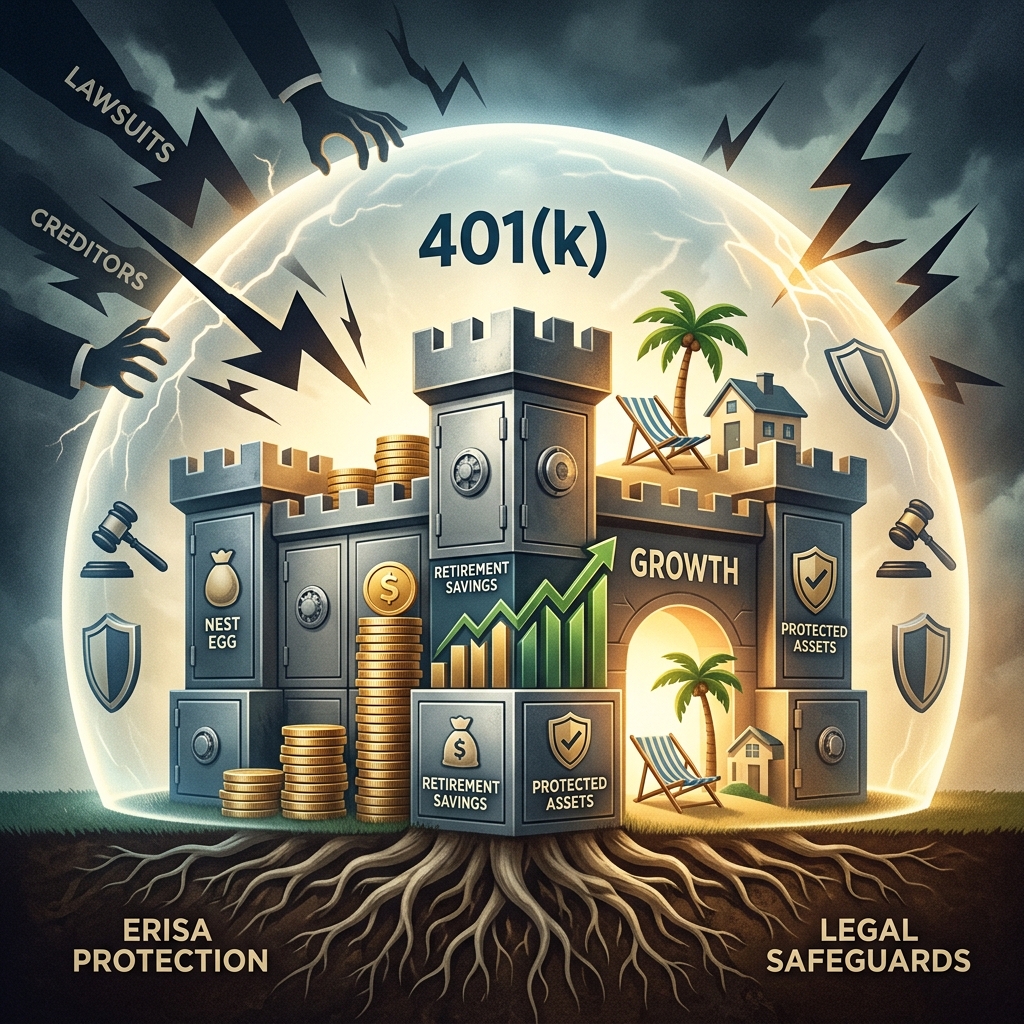
Your retirement savings may be one of your largest assets, so it is natural to worry whether a lawsuit or unpaid debt could jeopardize your 401(k) or other retirement accounts. The answer depends heavily on the type of account, the nature of the claim, and whether federal or state law applies.
This guide explains, in clear terms, how creditor protection works for employer plans and IRAs, what exceptions exist, and the practical steps you can take to better shield your retirement savings from future claims.
Big Picture: How Protected Are Retirement Accounts?
In the United States, retirement assets receive special treatment under both federal and state law. Some accounts are strongly shielded, while others may be partially or not at all protected from lawsuits.
- Most 401(k) and employer-sponsored plans are generally well protected from private creditors under federal law.
- IRAs usually have strong protection in bankruptcy, but their protection outside bankruptcy is largely determined by state statutes and court decisions.
- Withdrawn funds (such as cash in a bank account from a retirement distribution) usually lose special protection and can be reached by creditors.
To understand what a lawsuit can and cannot reach, you must look first at the type of retirement account you have.
Employer Plans vs. IRAs: Why the Distinction Matters
Not all retirement accounts are treated the same. Employer-based plans fall under a comprehensive federal law called the Employee Retirement Income Security Act of 1974 (ERISA), which is central to their protection from creditors.
ERISA-Governed Employer Retirement Plans
ERISA sets minimum standards for employer-sponsored plans such as 401(k)s, many 403(b) plans, pension plans, and profit-sharing plans. A key feature of ERISA is the anti-alienation rule, which generally prohibits the assignment or garnishment of plan benefits by creditors.
- Most traditional and Roth 401(k) plans sponsored by employers are ERISA plans.
- Many defined benefit pensions and profit-sharing plans are also ERISA-governed.
- These plans are typically fully protected from ordinary creditor judgments, including lawsuits over consumer debts and many civil claims.
Because of this federal protection, commercial creditors usually cannot directly seize or garnish your 401(k) balance when they obtain a judgment against you.
IRAs and Other Non-ERISA Accounts
Individual Retirement Accounts (IRAs), including traditional and Roth IRAs, are not generally governed by ERISA. While federal bankruptcy law offers important protections, non-bankruptcy lawsuits are primarily controlled by state law.
- Traditional and Roth IRAs are protected in bankruptcy up to a federal dollar limit (over $1.5 million, periodically adjusted for inflation).
- Outside bankruptcy, state law determines whether and to what extent IRAs are exempt from creditor claims.
- Inherited IRAs often receive less protection under federal bankruptcy law, and their treatment may be more vulnerable.
This distinction means that two people with the same account balance may face very different risk levels depending on whether their funds are in an employer plan or an IRA, and where they live.
Can a Lawsuit Take Your 401(k)? Key Rules and Exceptions
As a general rule, a civil lawsuit brought by private creditors—such as a credit card company, medical provider, or landlord—cannot reach your ERISA-qualified 401(k). However, certain types of claims and circumstances create important exceptions.
Typical Lawsuits That Cannot Reach ERISA 401(k)s
Under federal law, ERISA plans enjoy broad protection from most civil judgments.
- Consumer debt lawsuits (credit cards, personal loans, medical bills)
- Tort claims such as personal injury suits, provided they result in money judgments from private parties
- Contract disputes with businesses or individuals, unrelated to domestic relations or taxes
In these situations, creditors may secure a judgment and attempt to garnish wages or place liens on non-exempt property, but they generally cannot directly access 401(k) funds held in an ERISA plan.
Important Exceptions: When Retirement Assets May Be Tapped
Even ERISA-qualified plans are not universally exempt. Several categories of obligations can pierce these protections.
- Federal tax debts: The Internal Revenue Service can levy qualified retirement accounts to collect delinquent federal taxes.
- Domestic relations orders: Court-approved Qualified Domestic Relations Orders (QDROs) can assign part of a retirement benefit to a former spouse or child for alimony or child support.
- Criminal penalties and restitution: The federal government can access certain retirement funds to satisfy criminal fines or restitution obligations.
These exceptions mean that while commercial creditors are generally blocked, governmental claims and family law judgments can penetrate the protective layer around your 401(k).
What Happens If You File for Bankruptcy?
Bankruptcy introduces another important layer of protection. The Bankruptcy Abuse Prevention and Consumer Protection Act (BAPCPA) strengthened safeguards for retirement savings.
Employer Plans in Bankruptcy
ERISA-qualified employer plans—such as 401(k)s and pensions—are generally fully excluded from your bankruptcy estate. This means the bankruptcy court typically does not treat those assets as available to pay creditors.
- Your 401(k) balance usually remains intact during and after a bankruptcy proceeding.
- Creditors cannot force distributions from these plans to satisfy pre-bankruptcy debts.
IRAs in Bankruptcy
IRAs receive significant—but not unlimited—protection in bankruptcy.
- Traditional and Roth IRAs are exempt up to a federal cap (over $1.5 million, indexed for inflation).
- Rollover IRAs funded from employer plans can be completely excluded and do not count toward that cap.
- Inherited IRAs typically do not qualify for the same exemption and may be more exposed in bankruptcy.
While precise dollar limits change over time, the core principle remains: bankruptcy law prioritizes protecting retirement savings to preserve financial security in old age.
Outside Bankruptcy: State Law Drives IRA Protection
When you are facing lawsuits but not filing for bankruptcy, the fate of your IRA is largely governed by your state of residence. Some states broadly exempt IRAs from creditor claims, while others apply narrower standards.
State-by-State Variations
Examples from different jurisdictions illustrate how varied IRA protections can be:
- States with broad protection often treat IRAs similarly to employer plans, fully shielding them from most civil judgments.
- States with conditional protection may exempt only the portion of IRA funds necessary to support you and your dependents in retirement.
- States with timing limitations may deny protection for recent contributions (for instance, deposits made within a specified number of years before a claim).
Because of these differences, someone with an IRA in one state might be nearly judgment-proof, while the same balance in another state could be partially or fully exposed.
Self-Employed 401(k)s and Non-ERISA Plans
Employer-based protection is not automatic for all 401(k)-type plans. In some states, solo or self-employed 401(k)s that are not covered by ERISA may be treated more like IRAs for lawsuit purposes.
Where ERISA does not apply, state exemption laws become critical to understanding how safe your retirement assets really are.
Comparison Table: Protection by Account Type
| Account Type | ERISA Coverage | Protection in Bankruptcy | Protection in Non-Bankruptcy Lawsuits |
|---|---|---|---|
| Employer 401(k) | Yes, generally ERISA-qualified | Fully excluded from bankruptcy estate | Strong protection from most private creditors; exceptions for IRS and QDROs |
| Traditional/Roth IRA | No, typically non-ERISA | Protected up to a federal dollar cap | Varies by state; some broad, some limited protection |
| Rollover IRA (from employer plan) | No ERISA outside bankruptcy | Often fully excluded from bankruptcy and separate from IRA cap | Protection depends on state law; ERISA protections do not apply outside bankruptcy |
| Inherited IRA | No | Typically less protected in bankruptcy | Subject to state exemption rules; often more exposed |
When Protection Disappears: Distributions and Transfers
Even a strongly protected 401(k) can become vulnerable after you withdraw funds. Once money leaves the plan and is held in a regular bank or investment account, it usually loses its special status.
- Lump-sum distributions are generally subject to creditor claims once received and deposited outside the retirement plan.
- Required minimum distributions and periodic withdrawals are also exposed after payment, unless protected under separate exemption laws.
- Transfers from ERISA plans to IRAs may change the level of creditor protection, especially outside of bankruptcy.
From an asset protection perspective, keeping funds inside qualified retirement plans as long as feasible may provide stronger security against judgments.
Practical Strategies to Strengthen Retirement Asset Protection
While no plan can eliminate all risk, certain steps can improve the likelihood that your retirement savings remain intact if you face lawsuits or debts.
1. Understand Your Account Types and Applicable Laws
- Confirm whether your 401(k) or pension is ERISA-qualified (most employer plans are).
- Identify which of your accounts are IRAs and review your state’s exemption laws for non-ERISA plans.
- Distinguish between contributory IRAs, rollover IRAs, and inherited IRAs, as they may be treated differently.
2. Avoid Last-Minute Transfers to Evade Creditors
Courts often scrutinize transfers made when a lawsuit or claim is pending. Moving assets into protected accounts or trusts at the last minute can be treated as a fraudulent transfer, undermining your asset protection strategy.
3. Coordinate Retirement Planning With Legal Advice
- Consider consulting a lawyer knowledgeable in asset protection and debtor-creditor law before problems arise.
- Ask how state exemptions interact with your retirement accounts, home equity, and other assets.
- Ensure your estate planning tools (such as trusts and beneficiary designations) complement, rather than conflict with, retirement account protections.
4. Maintain Adequate Insurance
Since lawsuits often arise from accidents, professional liability, or property issues, insurance can serve as a front-line defense that may prevent creditors from ever seeking your retirement assets.
- Liability coverage through auto and homeowners policies
- Umbrella liability policies for higher limits
- Professional liability insurance (malpractice, errors and omissions) where appropriate
5. Preserve ERISA Status Where Valuable
Rolling funds out of ERISA-governed plans into IRAs might offer more investment choices, but it can reduce creditor protection outside bankruptcy. Weigh the trade-offs carefully before transferring large balances.
Frequently Asked Questions
Can a credit card company garnish my 401(k)?
Ordinary commercial creditors, such as credit card issuers, generally cannot garnish an ERISA-qualified 401(k) account. They may pursue other assets or wages but your plan balance is usually off-limits.
Are all 401(k)s protected, including those for self-employed individuals?
Protections are strongest for employer-sponsored, ERISA-governed 401(k)s. Some solo or self-employed 401(k)s may not be covered by ERISA, and in those cases state law governs their exposure to lawsuits.
What happens if I roll my 401(k) into an IRA?
In bankruptcy, rollover IRAs can still receive strong protection and may be fully excluded from the estate. Outside bankruptcy, however, the account will typically be treated as an IRA and its protection will depend on your state’s exemption laws rather than ERISA.
Can the IRS take money from my retirement accounts?
Yes. The IRS can levy qualified retirement accounts, including 401(k)s, to collect unpaid federal taxes. Tax claims are among the recognized exceptions to otherwise strong retirement account protections.
Are my IRAs safe from lawsuits if I never file for bankruptcy?
The answer is highly state-specific. Some states provide broad protection for IRAs against most civil judgments, while others protect only amounts deemed necessary for your support in retirement. Reviewing your state’s exemption statutes is essential.
References
- Creditor Protection of Retirement Assets — Rosenblatt Law Firm. 2021-09-01. https://rosenblattlawfirm.com/blog/creditor-protection-of-retirement-plan-assets/
- Retirement Accounts Provide Protection Against Creditors — Mesirow Financial. 2024-03-01. https://www.mesirow.com/wealth-insights-hub/retirement-accounts-provide-protection-against-creditors
- IRA Asset and Creditor Protection by State — IRA Financial. 2025-01-15. https://www.irafinancial.com/blog/ira-asset-and-creditor-protection/
- Are Retirement Accounts Protected From Lawsuits? — Experian. 2023-08-07. https://www.experian.com/blogs/ask-experian/are-retirement-accounts-protected-from-lawsuits/
- Asset Protection — Bogleheads Wiki. 2019-06-30. https://www.bogleheads.org/wiki/Asset_protection
- Can Creditors Go After My Retirement Accounts? — Equifax. 2022-11-10. https://www.equifax.com/personal/education/life-stages/articles/-/learn/protect-retirement-account-from-creditors/
- Asset Protection Planning — Helsell Fetterman LLP. 2018-01-01. https://www.helsell.com/wp-content/uploads/FAQ_Asset_Protection.pdf
Similar Articles








Read full bio of medha deb




