
Can Domestic Abusers Legally Buy or Own Guns?
How federal and state gun laws treat domestic violence convictions, restraining orders, and the evolving effort to close deadly legal loopholes.
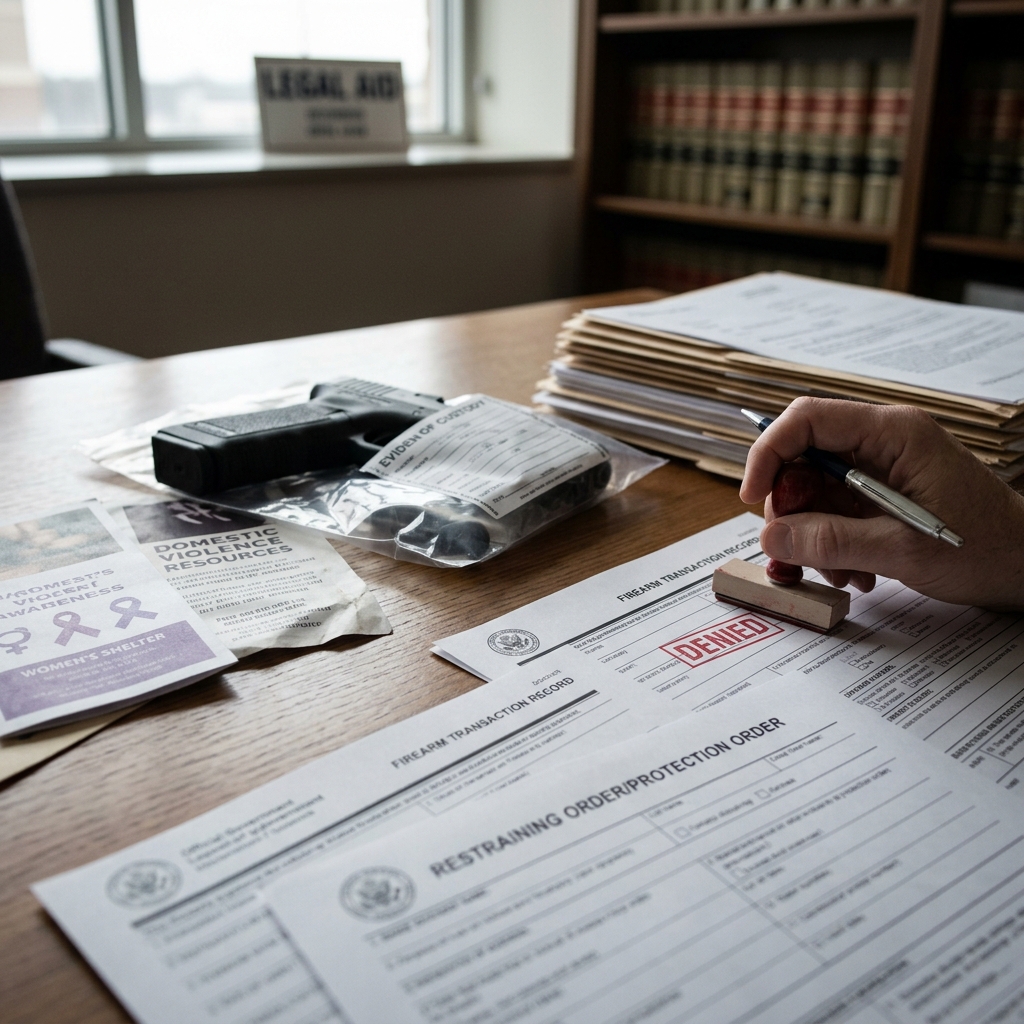
In the United States, domestic violence and firearms intersect in particularly deadly ways. Researchers have found that when an abusive partner has access to a gun, the risk that a woman will be killed increases by about five times. This reality has driven decades of legal reforms aimed at keeping guns out of the hands of people with a history of domestic abuse, while still navigating Second Amendment protections.
This article explains, in clear language, when domestic abusers are legally barred from buying or possessing guns, why some abusers still obtain firearms despite these rules, and how courts and lawmakers are responding to remaining gaps in the law.
Key Takeaways At a Glance
- Federal law prohibits many people convicted of certain domestic violence misdemeanors or subject to qualifying restraining orders from buying or possessing firearms.
- State laws can be stronger or weaker; some add extra protections, while others leave significant loopholes.
- The Lautenberg Amendment and the Bipartisan Safer Communities Act expanded federal firearm bans to reach many misdemeanor domestic violence crimes and dating partners.
- Even when people are legally prohibited, poor enforcement and background-check gaps can still allow gun access.
- Recent court decisions have largely upheld laws disarming dangerous domestic abusers against Second Amendment challenges.
Why Domestic Abuse and Guns Are a Deadly Combination
Domestic violence is a pattern of behaviors used to gain and maintain power and control over an intimate partner. When firearms are present in these situations, minor conflicts can escalate into homicides within seconds.
Public health research highlights several concerns:
- Homicide risk: Access to a firearm in an abusive relationship increases the likelihood that a woman will be killed by about five times.
- Escalation of threats: Guns make threats more credible, often forcing victims to remain in dangerous situations.
- Collateral harm: Children, family members, and bystanders are also at heightened risk when an abusive individual has a gun.
Because of these risks, lawmakers at both the federal and state level have created special firearm rules for people with domestic violence histories.
How Federal Law Treats Domestic Abusers and Firearms
Federal firearm restrictions are primarily found in the Gun Control Act of 1968 and later amendments, now codified at 18 U.S.C. § 921 and § 922. These statutes list categories of people who cannot possess or purchase firearms under federal law.
People Convicted of Domestic Violence Misdemeanors
The Lautenberg Amendment, enacted in 1996, filled a major gap by extending federal firearm prohibitions to many misdemeanor domestic violence convictions. Before this amendment, only felons were generally barred from having guns, which meant many abusers with misdemeanor records still had legal access.
Under 18 U.S.C. § 922(g)(9), a person is generally prohibited from possessing firearms if they have been convicted of a misdemeanor crime of domestic violence that meets these criteria:
- The offense involves the use or attempted use of physical force, or the threatened use of a deadly weapon.
- The victim is a current or former spouse, cohabiting partner, co-parent, or someone in a similar intimate or guardianship relationship.
This prohibition applies even to old convictions; there is no sunset date simply because the crime occurred years ago.
People Subject to Certain Restraining Orders
Federal law also prohibits firearm possession by some people who are subject to qualifying domestic violence protective orders (DVPOs), including certain restraining orders.
To trigger the federal ban under 18 U.S.C. § 922(g)(8):
- The order must restrain the person from harassing, stalking, or threatening an intimate partner or their child.
- The order usually must be issued after notice and a hearing, meaning the person had a chance to appear in court.
- The order must contain specific findings or prohibitions related to threats, violence, or the use of force.
Temporary or emergency orders sometimes do not meet the full federal criteria, but state law may still restrict firearms during those periods.
Impact of the Bipartisan Safer Communities Act
Historically, federal law focused on spouses, co-parents, and cohabitants, leaving a significant gap known as the “boyfriend loophole.” In 2022, Congress enacted the Bipartisan Safer Communities Act (BSCA), which partly closed this loophole.
Key changes under the BSCA included:
- Extending the firearm prohibition to certain misdemeanor domestic violence convictions involving dating partners.
- Imposing a five-year firearm prohibition for some first-time misdemeanor domestic violence convictions in dating relationships.
- Providing that repeat misdemeanor domestic violence convictions involving dating partners can lead to an indefinite prohibition on firearm possession.
These changes recognize that serious domestic violence also occurs outside marriage and cohabitation, and that dating partners can be at comparable risk.
Who Is Not Covered by Federal Law?
Despite these expansions, federal law still does not cover every scenario. Examples that may fall outside federal firearm bans include:
- Some emotional or economic abuse cases that do not involve threats or use of physical force.
- Restraining orders issued without notice and a hearing, such as certain ex parte emergency orders (though state law may still apply).
- Some family or household relationships that do not meet federal definitions.
These gaps are one reason why state-level gun laws and enforcement practices are so important.
How State Laws Can Strengthen or Weaken Protections
While federal law sets a nationwide baseline, individual states can provide broader protections. Many have enacted additional restrictions on firearm access for people with domestic violence histories.
Typical State Approaches
States may address domestic abusers and guns in several ways:
- Additional prohibitions: Some states bar firearm possession for people convicted of a wider range of domestic violence or violent misdemeanor offenses, or for longer periods than federal law.
- Broader relationship definitions: States may cover dating partners, extended family, or roommates more comprehensively than federal law.
- Mandatory firearm surrender: Many states require people who become prohibited (for example, upon issuance of a qualifying protective order) to surrender guns they already own.
- Extreme Risk Protection Orders: Some states, like New York, allow courts to temporarily remove firearms from individuals who pose a serious risk to themselves or others, including in domestic violence situations.
Example: Contrasting Federal and State Rules
| Issue | Federal Law | Stronger State-Style Approach |
|---|---|---|
| Domestic violence misdemeanor | Ban if crime involves physical force or threats with a deadly weapon against intimate partner/guardian-type relationship. | Ban for a broader set of violent misdemeanors or for any domestic violence offense, including some that do not involve physical force. |
| Dating partners | BSCA covers certain dating relationships for five years after some misdemeanor convictions. | Some states permanently prohibit abusers with dating-partner convictions or include them broadly in protective order firearm bans. |
| Protective orders | Ban applies only to certain qualifying protective orders after notice and hearing. | Many states extend firearm bans to temporary orders and require surrender of existing firearms. |
| Existing firearms | Federal law prohibits possession but does not specify detailed surrender procedures. | States may mandate surrender to law enforcement or dealers and establish compliance checks. |
Common Loopholes and Enforcement Challenges
Even when laws are on the books, abusers sometimes manage to keep or obtain firearms. Researchers and advocates point to several recurring problems.
Background Check Gaps
Background checks are designed to stop prohibited individuals from buying guns from licensed dealers. However:
- Not all domestic violence convictions or protective orders are correctly entered into the databases used for background checks.
- In some states, private sales or transfers may occur without any background check, allowing prohibited abusers to purchase guns from unlicensed sellers.
Incomplete Surrender of Existing Firearms
When a restraining order is issued or a conviction occurs, a person may already own firearms. Without clear procedures and active enforcement, these guns may never actually be turned in.
Stronger state laws often require that:
- Court orders explicitly state firearm surrender obligations.
- Law enforcement or courts verify compliance, such as through receipts or follow-up checks.
Relationship Definition Gaps
Before the BSCA, many dating partners were not covered under federal domestic violence firearm prohibitions, despite facing similar risks as spouses. While the law has improved, definitions of who qualifies as a “dating partner” or “intimate partner” still vary, and some abusive relationships may fall outside statutory language.
Recent Court Decisions and Constitutional Questions
Gun laws affecting domestic abusers have been challenged on Second Amendment grounds. In 2024, the U.S. Supreme Court upheld the federal law that prohibits individuals subject to certain domestic violence restraining orders from possessing firearms.
The Court’s majority concluded that disarming people who pose a clear danger to others is consistent with historical traditions of firearm regulation, especially when the person has been found by a court to be a credible threat. This decision supports the continuing use of protective order–based firearm prohibitions, though other legal challenges may still arise.
Practical Scenarios: Can an Abuser Buy or Have a Gun?
Because law is applied case-by-case, the answer to “Can this specific person legally have a gun?” often depends on their exact history and which jurisdiction’s laws apply. The following scenarios illustrate some typical outcomes under U.S. law.
Scenario 1: Misdemeanor Domestic Violence Conviction Against a Spouse
- Federal law: A qualifying misdemeanor conviction against a spouse that involves physical force or threatened use of a deadly weapon typically triggers a lifetime federal firearm prohibition.
- State law: Some states may impose parallel or additional prohibitions, sometimes with their own time limits. Others mirror federal law closely.
- Practical effect: The person should not be able to legally buy or possess a gun. Attempting to purchase through a licensed dealer should result in a failed background check, and possessing a firearm could be a felony offense under federal law.
Scenario 2: Civil Protective Order, No Criminal Conviction
- Federal law: If the protective order meets the criteria in 18 U.S.C. § 922(g)(8) (notice, hearing, specific findings), the person is prohibited from possessing firearms for the duration of the order.
- State law: Many states also require those under protective orders to surrender firearms and may include temporary orders or broader relationship categories.
- Practical effect: This person generally cannot lawfully buy guns and may have to turn in existing firearms, depending on state rules and court orders.
Scenario 3: Dating Partner Convicted of a Misdemeanor Assault
- Federal law: After the BSCA, certain misdemeanor crimes of domestic violence involving dating partners trigger a five-year firearm prohibition, and repeat offenses may lead to a longer or indefinite ban.
- State law: States may treat dating partner violence on par with spousal violence or may leave gaps that federal law partially fills.
- Practical effect: For at least five years after a qualifying conviction, this person may not lawfully purchase or possess firearms under federal law.
What Victims and Families Should Know
If you are concerned about an abusive partner’s access to guns, understanding both federal and state law is critical. While this article cannot provide individualized legal advice, there are general steps people often consider.
Questions to Discuss With a Lawyer or Advocate
- Has the abuser been convicted of any offenses that might qualify as domestic violence or violent misdemeanors?
- Is there, or could there be, a protective order that might trigger firearm restrictions?
- Does your state require or allow judges to order firearm surrender as part of a protective order?
- Are there Extreme Risk Protection Orders or similar tools available in your state?
Local legal aid organizations, domestic violence shelters, and victim advocates can often clarify how your state’s laws interact with federal protections and what safety planning options exist.
Frequently Asked Questions
Does a domestic violence arrest alone bar someone from having guns?
Generally, an arrest by itself does not create a federal firearm prohibition. Federal law usually requires either a qualifying conviction or a qualifying protective order. However, state laws and specific court orders (such as conditions of release or bail) may temporarily restrict firearm access in some circumstances.
Can a prohibited domestic abuser ever get gun rights back?
In some situations, rights may be restored if a conviction is expunged, set aside, or pardoned, or if civil rights are fully restored under state law and firearm rights are not expressly withheld. The exact rules vary by jurisdiction, and restoration is often difficult. Anyone considering this route should speak with a qualified attorney.
Are police officers or military personnel exempt from these rules?
No. The Lautenberg Amendment removed the prior law enforcement exemption for people with qualifying domestic violence misdemeanor convictions. This means a police officer or service member who is prohibited under federal law may not possess firearms, even while on duty. Some narrow exceptions may exist under federal law for officers subject only to certain protective orders, but not for those with disqualifying convictions.
What if an abuser lies on a background check form?
Lying on the federal background check form (ATF Form 4473) is a separate crime. If a prohibited person falsely claims they are eligible to purchase a firearm, they can face federal charges in addition to any underlying domestic violence offenses. Whether such cases are prosecuted depends on enforcement priorities and available evidence.
Do all states enforce domestic violence firearm bans equally?
No. Some states have comprehensive systems for entering records into national databases, notifying prohibited individuals, and enforcing firearm surrender, while others lag behind. The effectiveness of domestic violence firearm laws depends heavily on state-level implementation and coordination with federal authorities.
Where Research Says We Still Need Improvement
Public health and legal scholars have identified several policy areas that could further reduce lethal domestic violence:
- Complete record reporting: Ensuring that all qualifying convictions and protective orders are promptly and accurately entered into the databases used for background checks.
- Universal background checks: Applying background checks to all gun sales, including private transactions, so prohibited abusers cannot bypass the system.
- Robust surrender procedures: Requiring clear, enforceable processes to make sure prohibited individuals actually turn in weapons they already own.
- Broader coverage of dangerous behaviors: Extending firearm prohibitions to other high-risk violent behaviors, not just narrowly defined domestic violence offenses.
Evidence suggests that states with stronger domestic violence firearm laws and better enforcement tend to have lower intimate partner homicide rates, particularly homicides involving guns.
References
- Ban on domestic violence abusers owning guns upheld by Supreme Court — Associated Press via YouTube summary of Supreme Court decision. 2024-06-21. https://www.youtube.com/watch?v=sVK3igguL-U
- Restrictions on the Possession of Firearms by Individuals Convicted of a Misdemeanor Crime of Domestic Violence — U.S. Department of Justice, Criminal Resource Manual §1117. 1997-09-30. https://www.justice.gov/archives/jm/criminal-resource-manual-1117-restrictions-possession-firearms-individuals-convicted
- Texas State Gun Laws: I am a victim of domestic violence and the abuser has a gun. Is that legal? — WomensLaw.org / Legal Resource Center on Violence Against Women. Updated 2024. https://www.womenslaw.org/laws/tx/state-gun-laws/all
- Closing the Gap: The Need to Eliminate Loopholes in Legislation at the Intersection of Gun Violence and Intimate Partner Violence — If/When/How-referenced article in a peer-reviewed public health journal (PMC12360288). 2024. https://pmc.ncbi.nlm.nih.gov/articles/PMC12360288/
- Prohibition for Convicted Domestic Abusers — Everytown for Gun Safety Support Fund. 2023. https://everytownresearch.org/rankings/law/prohibition-for-convicted-domestic-abusers/
- Domestic Violence — New York State Gun Safety, NY.gov. Updated 2023. https://gunsafety.ny.gov/domestic-violence
- Domestic Violence and Firearms — Johns Hopkins Center for Gun Violence Solutions, Johns Hopkins Bloomberg School of Public Health. 2023. https://publichealth.jhu.edu/center-for-gun-violence-solutions/solutions/domestic-violence-and-firearms
- Domestic Violence — Everytown for Gun Safety Support Fund. Updated 2024. https://www.everytown.org/issues/domestic-violence/
Similar Articles








Read full bio of medha deb


