
Can a DUI Stop You From Getting a Passport?
Learn when a DUI matters for passport approval, travel restrictions, and foreign entry rules.
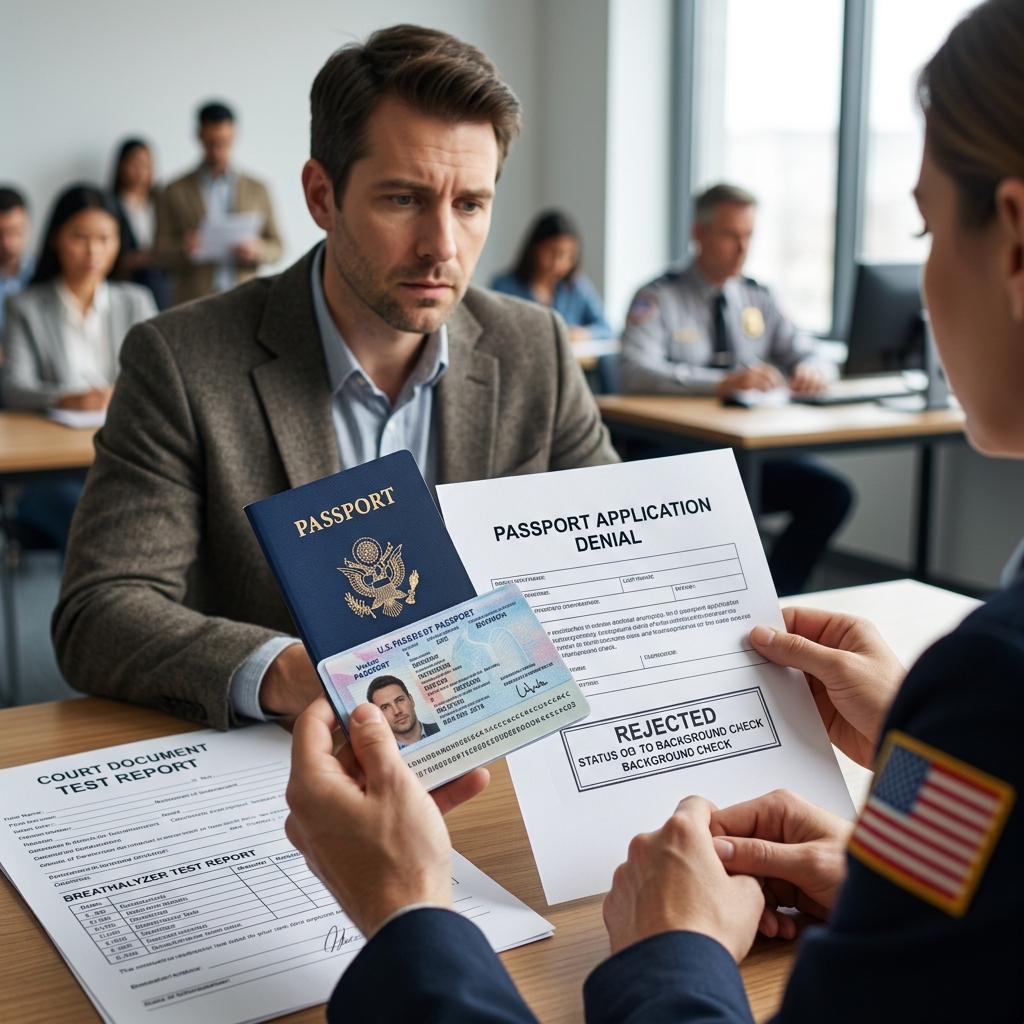
A DUI or DWI conviction usually does not keep a U.S. citizen from getting a passport. The more important issue is often not passport issuance itself, but whether a court order, warrant, probation condition, or foreign border rule limits travel after the passport is approved.
That distinction matters because people often assume a criminal driving offense is automatically recorded on a passport or scanned when they travel. In reality, a passport is a citizenship and identity document, not a criminal-history file. The legal consequences of a DUI can still affect travel, but usually in indirect ways rather than through the passport application alone.
Why a DUI usually does not block passport approval
The U.S. Department of State does not generally deny passports simply because an applicant has a state-level DUI on their record. A standard DUI is usually prosecuted under state law, while passport denial rules focus on specific federal concerns such as unresolved warrants, certain drug offenses, child support delinquency, or court-ordered travel restrictions.
That means a person with a first-time DUI, multiple DUIs, or even a DUI-related license suspension can often still submit a normal passport application and receive approval if no other disqualifying issue exists.
What a passport does and does not reveal
A passport is designed to establish identity and citizenship for international travel. It contains personal details such as the holder’s name, date of birth, photograph, and nationality, but it does not list criminal charges, arrests, or driving history.
Because of that, a DUI does not appear on the passport itself, and officials scanning a passport at an airport do not see a summary of the holder’s criminal record through the passport document alone.
Situations that can still cause passport problems
Although a DUI by itself is usually not a passport disqualifier, other legal issues connected to the case can create obstacles. These are the situations that tend to matter most:
- Outstanding warrants: A felony warrant or other active arrest warrant can lead to denial or delay.
- Court-ordered travel limits: A judge may restrict leaving the country during probation, parole, or another supervised release period.
- Unpaid child support: Federal law can restrict passport issuance when qualifying child support debt is unpaid.
- Drug-related convictions: Some drug offense situations can trigger passport restrictions even when the underlying matter is not a DUI alone.
- Legal incompetence determinations: Certain legal status findings can affect passport eligibility.
In practice, these issues matter more than the DUI label itself. If the DUI case is resolved cleanly and no other restrictions exist, passport approval is usually possible.
How probation or parole can affect travel
One of the most common misunderstandings is thinking that a valid passport automatically means a person may board a plane and leave the country. That is not always true. A court can forbid international travel as a condition of probation or parole, and violating that condition can create new criminal problems even if the passport remains valid.
For example, someone may have a passport in hand but still be unable to use it because a judge has not authorized travel. In those situations, the issue is not passport issuance; it is compliance with the criminal case or sentence.
Do multiple DUIs change the result?
Multiple DUI convictions generally do not change the basic passport rule. The presence of more than one DUI still does not automatically disqualify a person from getting or renewing a U.S. passport.
What can change the result is whether repeated offenses led to more serious legal consequences, such as incarceration, supervised release, or an order limiting movement. Those consequences, not the number of DUI convictions alone, are what may trigger passport problems.
Can a DUI affect passport renewal?
In most cases, no. Renewal usually follows the same general principle as a first application: a DUI alone is not a standard reason for denial. The State Department focuses on the applicant’s legal status, not on ordinary state traffic convictions by themselves.
Still, renewal can become complicated if the applicant has unresolved legal matters, missing identifying information, or a restriction tied to an old case. If the person is trying to renew while under court supervision or while owing significant support arrears, those issues may matter more than the DUI conviction itself.
Will a DUI show up when you travel abroad?
Even if a U.S. passport is issued, foreign countries can still decide whether to allow entry under their own laws. A passport proves identity and nationality, but it does not guarantee admission to another country.
Some countries ask about criminal records in visa applications or at the border, while others do not. A traveler with a DUI may enter some destinations without difficulty and face screening, questioning, or denial elsewhere depending on local immigration rules.
Common misconceptions about DUI and passports
People often confuse three separate questions: whether a DUI blocks a passport, whether a DUI affects leaving the country, and whether a DUI affects entry into a foreign nation. Those are not the same issue.
| Question | Typical answer |
|---|---|
| Can you get a U.S. passport with a DUI? | Usually yes, if no other disqualifying issue exists. |
| Can a court still stop you from traveling? | Yes, if probation, parole, or another order limits travel. |
| Can another country deny entry because of a DUI? | Yes, depending on that country’s immigration rules. |
This is why a person may be legally eligible for a passport but still have trouble using it for a specific trip.
What to check before applying
If you have a DUI history and want to apply for a passport, it helps to review a few practical questions first:
- Is there an active warrant or unresolved court matter?
- Are you on probation, parole, or supervised release?
- Does your court paperwork limit international travel?
- Do you owe qualifying child support arrears?
- Are there any related felony or drug offense issues that might matter?
If the answer to any of these is yes, the issue may not be the DUI itself but the broader legal status surrounding it.
Practical steps if you need to travel soon
When travel is time-sensitive, the safest approach is to confirm both passport eligibility and travel permission before making reservations. A person should verify that no court order restricts departure and that no federal denial ground applies.
If a DUI case is still open, it may also be wise to ask whether the court requires permission before leaving the state or country. A valid passport cannot override a criminal-court condition.
Frequently asked questions
Can I get a passport if I was arrested for DUI but not convicted?
Usually yes, because an arrest alone is not generally a standard passport bar. The larger concern is whether the arrest is tied to an active warrant, court restriction, or another unresolved legal issue.
Does a felony DUI automatically prevent passport approval?
Not automatically. A felony DUI by itself is not typically listed as a routine passport disqualifier, but related consequences such as incarceration, supervised release, or other restrictions can affect eligibility.
Can my passport be revoked because of a DUI?
A DUI alone usually does not trigger revocation. Revocation concerns are more likely when there are federal grounds, outstanding obligations, or court-ordered limits that affect travel.
Will border officers see my DUI when they scan my passport?
No. The passport itself does not store DUI information. However, immigration authorities may still ask questions or review other records depending on the destination country’s rules.
What if I am on probation and need to leave the country?
You may need court approval before traveling internationally. A passport does not replace the requirement to comply with probation or parole terms.
Bottom line for travelers with a DUI history
A DUI record usually does not stop a U.S. passport from being issued or renewed. The bigger risks are unresolved legal obligations, active warrants, court-imposed travel limits, and foreign entry rules that operate separately from U.S. passport law.
For someone planning a trip, the best approach is to check both sides of the equation: whether the federal government can issue the passport and whether any court order or foreign law could still prevent the trip from happening.
References
References
- Can a DUI Disqualify You From Getting a Passport? — FindLaw. 2026-07-09. https://www.findlaw.com/dui/cases/can-a-dui-disqualify-you-from-getting-a-passport.html
- Can I Get a Passport With a DUI Conviction? — Gabriel Law Team. 2025-08-14. https://www.gabriellawteam.com/can-i-get-a-passport-with-a-dui-conviction/
- Can You Get a Passport With a DUI Conviction? — The Law Place. 2025-03-12. https://www.thelawplace.com/faqs/can-you-get-a-passport-with-a-dui-conviction/
- Does A DUI Show Up On Your Passport? — Evan E. Zelig, Esq. 2025-01-20. https://eezlaw.com/blog/does-a-dui-show-up-on-your-passport/
- Does a DWI Show Up on Your Passport? — Rossen Law Firm. 2025-02-11. https://www.rossenlawfirm.com/blog/does-a-dwi-show-up-on-your-passport/
- How Criminal Records Affect Passports and Your Right to Travel — Georgia Justice Project. 2022-09-08. https://www.gjp.org/wp-content/uploads/2022/09/2022.9.8-Passport-1-pager-Final-2.pdf
Similar Articles








Read full bio of medha deb




