
California Traffic Laws In 2025: Key Rules Every Driver Needs
A practical guide to California driving rules, penalties, and everyday road obligations.
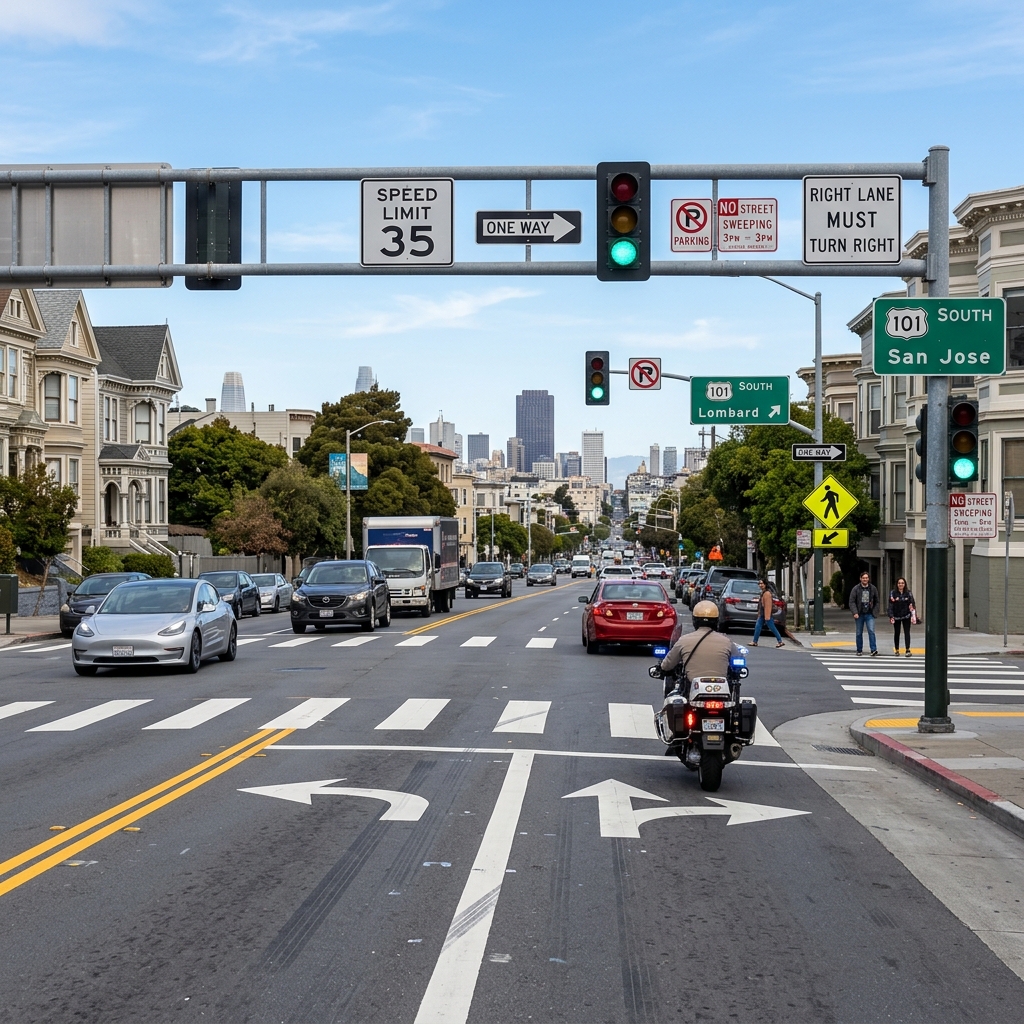
California driving rules are designed to keep traffic moving safely, protect pedestrians and cyclists, and define the consequences for common violations. Drivers who understand the state’s road rules are better prepared to avoid tickets, reduce crash risk, and respond correctly to traffic signs, signals, and right-of-way situations.
This guide presents the most important parts of California traffic law in a practical format. It focuses on everyday driving duties, common violations, and the kinds of penalties that can follow when a driver breaks the rules.
What California traffic laws are meant to do
Traffic laws in California cover far more than speeding. They regulate how drivers enter intersections, share the road with pedestrians and bicyclists, use devices in the car, and handle hazards such as school zones, railroad crossings, and blocked lanes.
In general, the rules aim to reduce collisions and make driver behavior predictable. That means stopping where required, yielding when another road user has the right-of-way, and using caution whenever visibility or traffic flow is limited.
Core rules every California driver should know
Several basic rules shape daily driving in the state. Drivers must obey posted signs and signals, remain alert for pedestrians and bicyclists, and avoid actions that block intersections or create confusion for other road users.
- Do not enter an intersection unless there is enough room to clear it before the light changes.
- Look left, right, and ahead before moving through intersections.
- Yield to pedestrians in marked and unmarked crosswalks.
- Yield to vehicles, bicyclists, or pedestrians when the law assigns them the right-of-way.
- Use caution when merging, turning, or entering traffic.
These basic duties appear simple, but they are often the foundation of traffic citations after crashes or close calls.
Right-of-way rules at intersections
Intersection law is one of the most important parts of California road rules because it governs who moves first. When no stop or yield signs are present, the driver who reaches the intersection first normally has the right-of-way. If two road users arrive at about the same time, the driver on the right generally gets priority.
At all-way stop intersections, the same logic applies after each vehicle stops. Through traffic on a T-intersection has the right-of-way when no sign says otherwise. Drivers turning left must yield to oncoming vehicles that are close enough to pose a danger, and drivers turning right must check for pedestrians, motorcycles, and bicycles before making the turn.
These rules are especially important because many intersection collisions happen when one driver assumes another vehicle will stop or yield. California law places the burden on the driver making the maneuver to proceed cautiously.
Pedestrian safety and crosswalk duties
California law gives strong protection to pedestrians. Drivers must slow down or stop when necessary to let a pedestrian cross safely, whether the crossing is marked or unmarked. Where a limit line is painted before a crosswalk, the vehicle must stop at the line rather than in the crosswalk itself.
Drivers should also remember that some pedestrians need more time to cross, including older adults, children, and people with disabilities. Flashing lights at crosswalks do not remove the duty to watch for people in the roadway.
From a practical standpoint, many pedestrian citations and civil claims arise not from speed alone, but from failing to notice someone entering the road or turning too soon while a person is still crossing.
Speed limits and when they change
Speeding is one of the most common traffic violations in California, but speed limits are not limited to the numbers posted on highway signs. The state also uses default speed rules for different types of roads and special zones.
| Road or area | Typical limit |
|---|---|
| Business and residential districts | 25 mph |
| School zones | Often 25 mph, sometimes lower |
| Two-lane undivided highways | 55 mph |
| Highways and interstates | Often 65 to 70 mph |
School zones are especially strict. When children are present near a school, the limit may drop to 25 mph or even lower if signs require it. Near certain railroad crossings with poor visibility, the limit may also be reduced to 15 mph.
Because speed rules depend on the exact road and conditions, a driver can be ticketed even when the speed feels normal for the area. California law expects drivers to adapt to the posted or implied limit, not simply follow the flow of traffic.
Phone use, distracted driving, and visibility rules
California is a hands-free state. Drivers may not use an electronic device to text, read, or write messages while operating a vehicle, and the state’s rules are intended to limit distraction behind the wheel.
Other visibility-related requirements matter as well. Headlights must be used during specific low-light periods, and high beams must be turned off when approaching another vehicle within the distance set by law. Drivers are also expected to keep loads secured so they do not create a hazard for other motorists.
These rules reflect a broader principle: a driver must be able to see clearly and must not do anything inside or outside the vehicle that makes the road less safe for others.
Lane use, passing, and turning behavior
California drivers are generally expected to drive on the right and pass on the left. Passing on the right is allowed only in the situations the law permits, such as when a roadway is clearly marked for multiple lanes moving in the same direction.
U-turns are allowed only when conditions and signs permit them. That can include certain intersections, divided highways with openings, or locations where a turn is otherwise legal and safe. A driver should never treat a U-turn as automatically allowed just because traffic is light.
Lane discipline also matters when turning. A driver turning left must check for oncoming traffic, while a driver turning right must yield to pedestrians and cyclists near the curb or shoulder. Failing to look carefully before turning is a common cause of avoidable violations and collisions.
Seat belts, passengers, and equipment concerns
California traffic law reaches beyond moving violations. It also addresses how vehicles are equipped and how passengers are carried. Drivers are expected to keep a valid license with them and follow equipment rules that reduce hazards on the road.
Some rules affect the vehicle itself. For example, loads must be secured, and items extending far beyond the vehicle may require special warnings or lights. Passengers are also restricted from riding in some parts of a vehicle unless the vehicle is set up for that purpose.
These requirements may not lead to attention every day, but they can matter in traffic stops, crash investigations, and insurance disputes when the vehicle setup contributed to the violation or injury.
Common traffic violations and what penalties can look like
California traffic penalties vary depending on the violation, the driver’s history, and the court’s assessment of fees and assessments added to the base fine. A citation may begin with a modest base amount, but the total cost can become much higher once additional charges are included.
- Speeding: Base fines commonly range from $35 to $100, depending on how far over the limit the driver was traveling.
- Red light violations: The base fine is $100, and total costs are usually much higher after added fees.
- Cell phone violations: A first offense carries a lower base fine, while repeat violations cost more.
- Parking tickets: Penalties vary widely by location and the type of parking violation.
- Extreme speeding or racing: Very high-speed conduct can trigger larger fines and possible license suspension.
Because court assessments can raise the final bill substantially, the amount printed on a citation is often not the amount a driver ultimately pays.
More serious violations and license consequences
Some conduct is treated much more harshly than a routine moving violation. Driving under the influence can lead to license suspension and other legal consequences, even for a first offense. The exact outcome depends on the facts of the case, but DUI enforcement is a major part of California traffic law.
Very dangerous behavior such as racing or other extreme-speed incidents may also lead to harsher punishment than ordinary speeding. California law treats these actions as especially risky because they threaten everyone on the road, not just the driver who is cited.
When a violation involves injury, death, or repeated misconduct, the consequences can extend beyond traffic court into criminal court or administrative action by the DMV.
New and evolving California driving rules
California traffic law is not static. Recent updates have expanded some safety requirements and changed enforcement tools. For example, updated rules now require drivers to slow down or change lanes for stationary vehicles displaying hazard lights, not just emergency vehicles in some older versions of the law.
Other newer changes include broader rules for e-bike visibility, stronger consequences for some DUI-related offenses, and new authority for local governments to address certain parking and safety issues. These changes show that California continues to refine its traffic code around road safety, enforcement, and local control.
Drivers should not assume the traffic rules from a few years ago still fully apply today. When a rule concerns safety equipment, lane changes, or emerging vehicle types, the law may have been updated more recently than a driver expects.
How to reduce the risk of a ticket
The easiest way to avoid a traffic citation is to drive predictably and pay close attention to the road environment. That means watching for signs, obeying school and pedestrian zones, limiting distractions, and giving other road users space to move safely.
- Check the posted limit before assuming a road has a standard speed.
- Scan for pedestrians before turning or entering an intersection.
- Keep your phone out of hand while driving.
- Slow down near schools, crosswalks, and work zones.
- Make sure your vehicle equipment and load do not create hazards.
Small habits matter because many tickets come from routine driving errors rather than major misconduct. A cautious, observant approach is usually the best defense.
Frequently asked questions
Is the posted speed limit always the only limit that applies? No. California also uses default limits for places such as residential areas, school zones, and certain highways, so drivers should not rely only on the nearest sign.
Can I use my phone if I am stopped at a light? California’s hands-free rules are strict, and the safest approach is to avoid holding or actively using the device while in control of the vehicle.
Who has the right-of-way at a crosswalk? Pedestrians have strong protection in both marked and unmarked crosswalks, and drivers must slow down or stop as needed to let them cross safely.
Why do traffic ticket totals cost so much more than the base fine? California counties add penalty assessments and other fees to the base fine, which can raise the final amount significantly.
Do new traffic laws matter if I already know the old rules? Yes. California updates its traffic rules regularly, and new safety laws can change driver duties, equipment requirements, or enforcement standards.
References
- Section 7: Laws and Rules of the Road – California DMV — California Department of Motor Vehicles. 2025-01-01. https://www.dmv.ca.gov/portal/handbook/california-driver-handbook/laws-and-rules-of-the-road/
- California Driver’s Handbook — California Department of Motor Vehicles. 2025-01-01. https://www.dmv.ca.gov/portal/handbook/california-driver-handbook/
- Driving in California | Road Rules & Driving Tips — SIXT. 2025-01-01. https://www.sixt.com/magazine/tips/driving-tips-california/
- 2025 California Vehicle Code, Division 11 – Rules of the Road — Justia. 2025-01-01. https://law.justia.com/codes/california/code-veh/division-11/
- New California Traffic Laws for 2026: What Drivers Need to Know — Harris Personal Injury. 2026-01-01. https://harrispersonalinjury.com/new-california-traffic-laws-for-2026-what-drivers-need-to-know/
- California Traffic Laws – FindLaw — FindLaw. 2025-01-01. https://www.findlaw.com/state/california-law/california-traffic-laws.html
Similar Articles








Read full bio of medha deb


