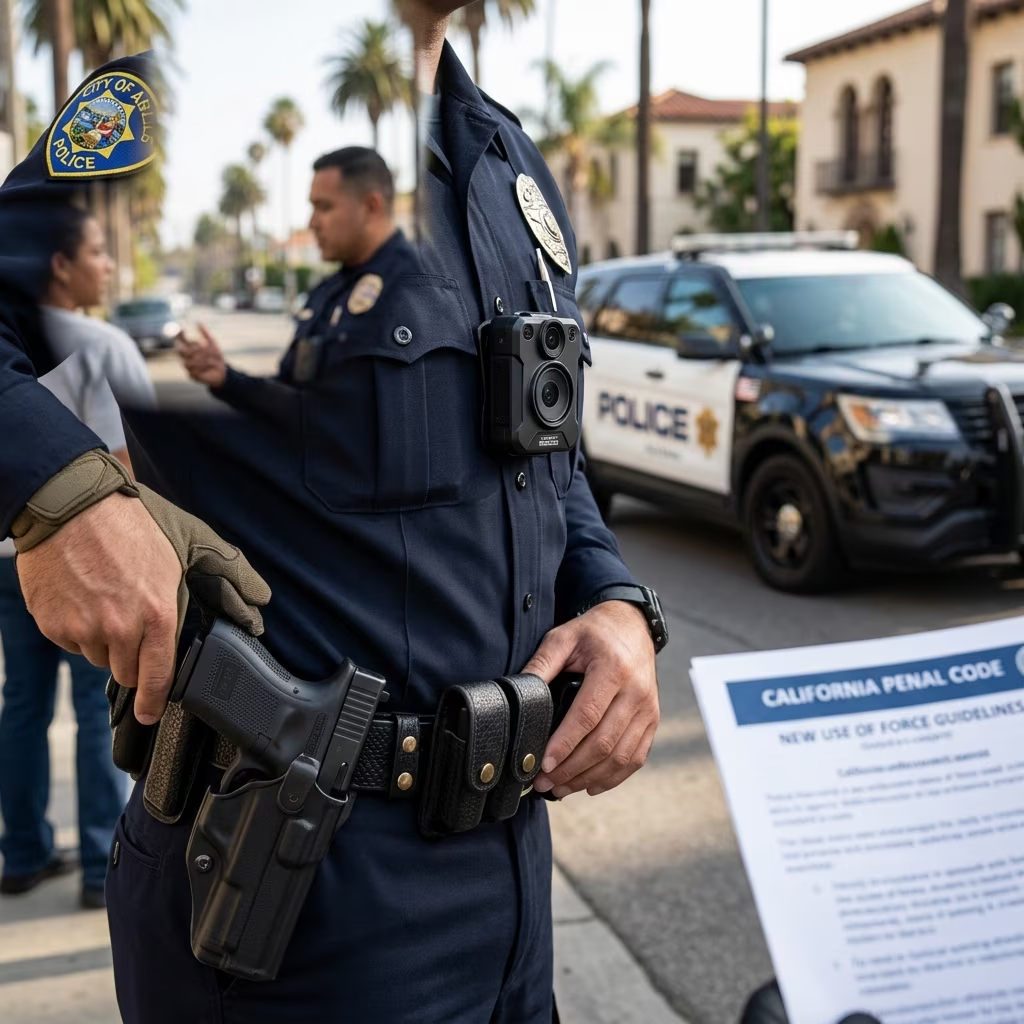
California has adopted one of the most demanding legal standards in the United States for when police may lawfully use deadly force. The reforms move the focus from whether an officer’s actions were merely reasonable to whether they were truly necessary to prevent death or serious bodily harm, reshaping both police training and accountability.
From “Reasonable” to “Necessary”: What Changed?
For decades, courts and police agencies relied on a broad “objective reasonableness” test: officers could use deadly force if a hypothetical reasonable officer might have done the same in similar circumstances. Under this older approach, judges and investigators often concentrated on the instant the trigger was pulled, paying less attention to earlier tactical decisions that may have escalated the situation.
Recent reforms, particularly California Assembly Bill 392 (AB 392), amended Penal Code section 835a to narrow this justification. Under the updated statute, a peace officer is justified in using deadly force only when the officer reasonably believes, based on the totality of the circumstances, that such force is necessary for limited, clearly defined purposes.
- Defending life: Protecting the officer or another person from an imminent threat of death or serious bodily injury.
- Apprehending dangerous felons: Stopping a fleeing person suspected of a felony that threatened or resulted in serious bodily injury or death, but only if there is a reasonable belief the person will cause such harm if not immediately captured.
This shift places legal emphasis on necessity and requires a fuller examination of the events leading up to a use of force incident, not just the final split-second decision.
Legal Foundations: Penal Code 835a and AB 392
The central legal framework for police use of force in California is Penal Code § 835a, which codifies when officers may use physical or deadly force in making arrests or preventing escape. AB 392 revised this statute, adding detailed guidance and restrictions.
Key elements of the statute include:
- Totality of the circumstances: Evaluations must consider all facts known to the officer, including their own actions, tactics, and available alternatives.
- Necessity standard: Deadly force is justified only if, after considering reasonable alternatives, it is necessary to prevent imminent death or serious bodily injury.
- Limits on fleeing suspects: Deadly force against a fleeing person is restricted to serious felonies that involve or threaten severe harm, coupled with an imminent risk that the person will hurt others if not quickly apprehended.
- Restrictions in self-harm situations: Officers cannot use deadly force solely because a person poses a risk to themselves, when an objectively reasonable officer would believe there is no imminent threat to others.
California’s approach is notable because only a very small number of states explicitly adopt this kind of necessity-focused standard in statute, rather than relying entirely on court-developed tests.
Defining “Deadly Force” and “Imminent Threat”
Understanding the law requires clear definitions of key concepts. Policies across California agencies, often mirroring state guidance, define deadly force as any use of force that creates a substantial risk of causing death or serious bodily injury, including—but not limited to—the discharge of a firearm.
The term imminent threat is equally crucial. Under Penal Code 835a and related departmental policies, an imminent threat exists when a reasonable officer would believe that a person has:
- The present ability to cause death or serious bodily injury.
- The opportunity to act on that ability.
- The apparent intent to immediately carry out the harmful act.
In other words, an imminent threat must be immediate and demands instant attention. An officer’s subjective fear of future harm—without these concrete elements—does not satisfy the legal threshold.
Core Circumstances Where Deadly Force May Be Used
California law and agency policies now describe a narrow set of situations where deadly force can be lawful.
1. Defense of Self or Others
Officers may use deadly force to defend themselves or another person when they reasonably believe there is an imminent threat of death or serious bodily injury.
- The threat must be immediate, not speculative or distant.
- Officers must consider whether other tactics—such as retreat, cover, or less-lethal tools—could safely resolve the situation first.
- Investigators will review not only the moment of the shooting, but also whether the officer’s prior decisions unnecessarily heightened the danger.
2. Apprehending a Fleeing Person
Deadly force against a fleeing suspect is severely constrained. It is permitted only if:
- The suspect is believed to have committed a felony that threatened or resulted in serious bodily injury or death.
- The officer reasonably believes the person will cause death or serious bodily injury to another unless immediately apprehended.
- No reasonable alternative exists to prevent the harm, such as containment, coordination with other units, or later arrest.
This framework is stricter than older case law that sometimes allowed deadly force against fleeing felons based mainly on the seriousness of the crime.
Explicit Limits: When Deadly Force Is Prohibited
California’s reforms do not merely outline when deadly force is allowed; they explicitly describe situations where it must not be used.
- Danger only to the subject: Officers may not use deadly force when the person poses a danger solely to themselves and does not present an imminent threat to others, as judged by an objectively reasonable officer.
- Threats to property alone: Deadly force is prohibited if the person’s actions threaten property but not lives, unless their conduct creates an imminent danger of death or serious injury to people nearby.
- Speculative future risks: An officer’s subjective fear that the person might harm someone in the future, without the present ability, opportunity, and intent, is insufficient to justify deadly force.
Some agencies also adopt specific rules—for example, limiting firearm use against moving vehicles to circumstances where the vehicle itself poses an imminent threat and no reasonable alternative exists.
Policy Changes: De-escalation and Tactical Responsibilities
In addition to statutory reforms, California requires law enforcement agencies to incorporate minimum use of force standards into their written policies, including de-escalation principles and clearer guidance on deadly force.
Typical policy expectations include:
- Use of the least force necessary: Officers should use only the amount of force reasonably necessary, given the totality of the circumstances, to accomplish lawful objectives.
- Duty to consider alternatives: Prior to using deadly force, officers are expected to assess options such as verbal persuasion, time and distance, backup, or less-lethal tools when feasible.
- Training on threat assessment: Agencies train officers to distinguish between imminent threats and situations that are dangerous but controllable through lower levels of force.
- Documentation and review: Incidents involving deadly force trigger thorough reporting requirements and internal reviews to assess compliance with law and policy.
These changes serve both to clarify expectations for officers and to provide more concrete standards for oversight bodies and courts when evaluating incidents.
Table: Old vs. New Approach to Deadly Force in California
| Aspect | Earlier “Reasonable” Standard | Current “Necessary” Standard |
|---|---|---|
| Core test | Could a reasonable officer have used deadly force in similar circumstances? | Was deadly force necessary to prevent imminent death or serious bodily injury, considering alternatives? |
| Scope of review | Focus mainly on the instant of the shooting. | Evaluate the totality of circumstances, including officers’ prior decisions. |
| Fleeing suspects | Permitted in broader range of serious felonies. | Limited to felonies involving serious harm and an imminent risk if suspect is not immediately captured. |
| Self-harm only situations | Less explicit statutory guidance. | Deadly force prohibited when danger is only to the person themselves and no imminent threat to others exists. |
| Property-only threats | Often governed by general reasonableness. | Deadly force barred unless actions pose imminent danger to life or serious physical safety. |
Practical Implications for Officers and Communities
The redefined standard has significant day-to-day consequences for law enforcement and the public.[10]
- Training and culture: Officers must internalize the idea that deadly force is a last resort, reserved for extreme situations where no reasonable alternative exists.
- Incident evaluation: Prosecutors, internal affairs units, and civilian oversight bodies now review whether deadly force was necessary in light of all circumstances, not simply whether the officer’s fear was plausible at the final moment.[10]
- Public expectations: Communities can point to clear legal rules—such as restrictions on shooting fleeing suspects or people who threaten only themselves—when assessing whether an incident complied with the law.
- Policy alignment: Local department policies, such as those of major urban agencies and university police, generally mirror Penal Code 835a’s language to ensure consistency in enforcement and training.
Early analyses of the impact of AB 392 suggest that changes in law alone are not sufficient; they must be accompanied by robust implementation, data tracking, and transparent investigations if they are to reduce unnecessary uses of deadly force and increase public trust.[10]
Frequently Asked Questions (FAQs)
Is deadly force ever allowed for property crimes alone?
No. California law and departmental policies state that deadly force cannot be used against a person whose actions threaten only property, unless those actions create an imminent danger of death or serious physical injury to people nearby.
Can officers use deadly force when someone is only threatening self-harm?
Generally, no. Penal Code 835a specifies that deadly force is not justified based solely on the danger a person poses to themselves, if an objectively reasonable officer would believe the person does not pose an imminent threat of death or serious bodily injury to others. Agencies echo this limitation in their policies.
How is “imminent threat” different from a general fear of danger?
An imminent threat requires present ability, opportunity, and apparent intent to immediately cause death or serious bodily injury. A general fear that someone might become dangerous in the future is not enough.
Are all California police departments required to follow these rules?
Yes. Penal Code 835a is a statewide statute, and separate state government guidance requires all California law enforcement agencies to incorporate minimum use of force standards—including the deadly force provisions—into their policies.
Does the new standard apply to non-firearm deadly force?
Yes. Deadly force includes any use of force that creates a substantial risk of causing death or serious bodily injury, whether through firearms or other methods. The necessity and imminent threat requirements apply across the board.
References
- California Code, Penal Code § 835a — State of California / FindLaw. 2023-01-01. https://codes.findlaw.com/ca/penal-code/pen-sect-835a/
- Defining Necessary Deadly Force for Police — Cardozo Law Review (LARC). 2020-01-01. https://larc.cardozo.yu.edu/cgi/viewcontent.cgi?article=2646&context=clr
- POST Use of Force Standards & Guidelines — California Commission on Peace Officer Standards and Training. 2020-11-04. https://www.phillca.gov/DocumentCenter/View/19771/POST—Use-Of-Force-Standards-Guidelines
- Use of Force Policy — UCI Police Department. 2023-01-01. https://www.police.uci.edu/how-do-i/_img/use_of_force_policy.pdf
- Policy on the Use of Force – Revised — Los Angeles Police Department. 2021-01-01. https://www.lapdonline.org/newsroom/policy-on-the-use-of-force-revised/
- Use of Force Policy — Office of Law Enforcement Support, California. 2021-07-01. https://www.oles.ca.gov/wp-content/uploads/2021/07/Use_of_Force.pdf
- What Happened after California Changed the Rules Related to Police Use of Deadly Force? — Public Policy Institute of California (PPIC). 2024-03-01. https://www.ppic.org/blog/what-happened-after-california-changed-the-rules-related-to-police-use-of-deadly-force/