
Unpacking California’s Rules on Handwritten Holographic Wills
How California treats informal handwritten wills, why they can be risky, and what you should know before relying on one.
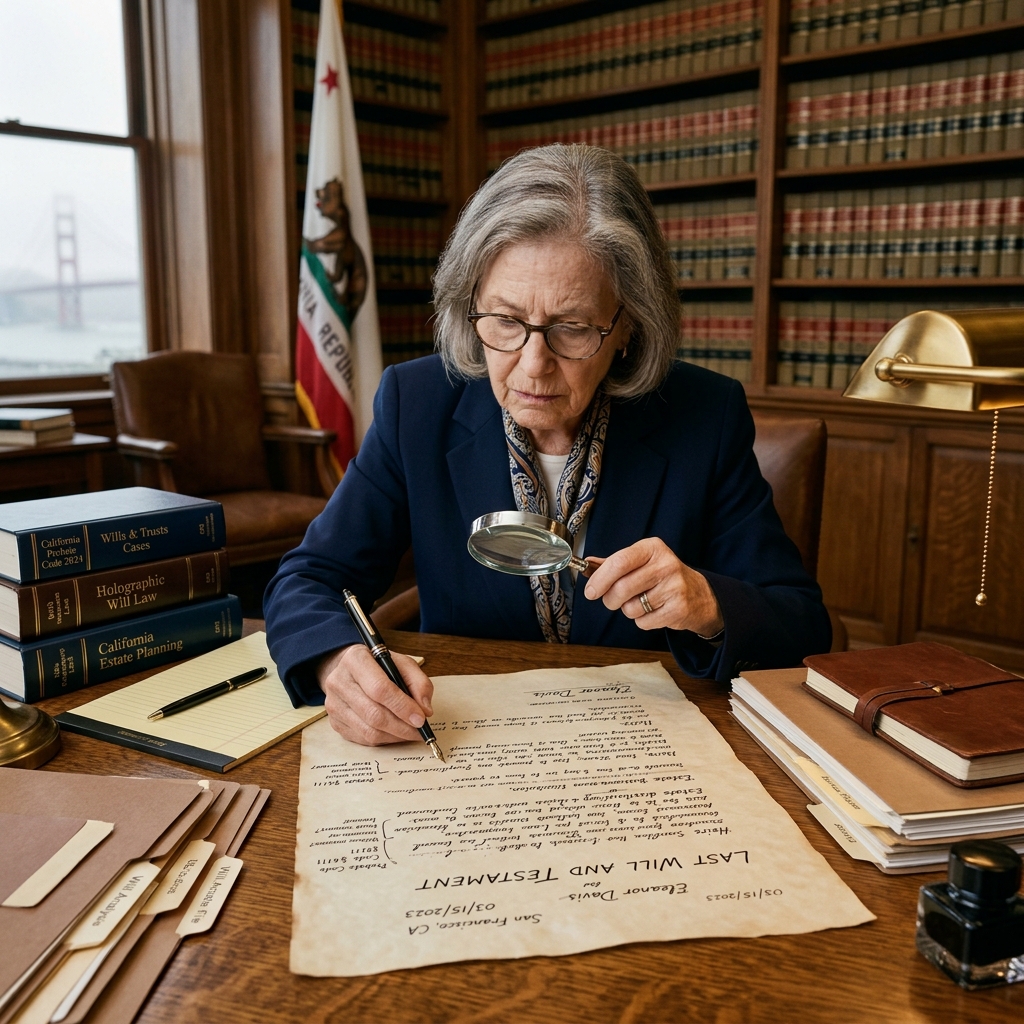
California is one of the states that explicitly recognizes holographic wills — informal wills written by hand, usually without witnesses or attorneys involved. While this flexibility can be comforting for people who want to quickly record their wishes, it also opens the door to what some lawyers call “rogue wills”: sudden, handwritten notes that may or may not reflect a person’s true, final intentions. These documents can become the focus of intense probate litigation.
This article explains how California law treats handwritten wills, what the courts look for when deciding if a “rogue” will is valid, and why relying on a holographic will can be risky despite being legally possible.
From Formal Wills to Handwritten Notes: Two Paths in California
California law offers two main routes for creating a last will and testament:
- Attested (formal) wills: Typically typed documents that comply with formal signing and witnessing rules.
- Holographic (handwritten) wills: Informal documents written by hand that can be valid even without witnesses if specific statutory conditions are met.
Both types aim to memorialize a person’s wishes, but the evidentiary rules and risks differ sharply.
| Feature | Formal Attested Will | Holographic Handwritten Will |
|---|---|---|
| Form | Typed or printed document | Written in the testator’s handwriting |
| Witnesses | Requires at least two competent, disinterested witnesses signing with the testator. | May be valid with no witnesses at all. |
| Key legal reference | California Probate Code § 6110 (formal wills) | California Probate Code § 6111 (holographic wills) |
| Common use | Planned estate documents drafted with legal help | Emergency or informal writings, letters, notes, or pre-printed forms filled in by hand |
| Litigation risk | Lower when properly drafted | Higher due to ambiguity and proof problems |
What Exactly Is a Holographic Will?
A holographic will in California is a will that qualifies under Probate Code § 6111 rather than the standard formal-will section. In practice, lawyers often describe it as:
- A will that is written in the testator’s handwriting.
- Signed by that same person.
- Containing the key provisions about how property should be distributed after death.
The crucial point is that the statute allows a will to be valid “whether or not witnessed” if the signature and material provisions are in the testator’s handwriting. This is what makes holographic wills attractive when someone does not have time or resources to create a formal document.
Material Provisions: The Heart of the Document
Courts and practitioners emphasize the phrase “material provisions” because it determines whether a handwritten document is treated as a will. The material provisions generally include:
- Who the beneficiaries are (who receives property).
- What assets are being disposed of.
- Any appointment of an executor or guardian, if clearly expressed.
If these core elements are in the person’s handwriting and the document is signed, the statute allows the court to treat it as a holographic will even if the rest of the page includes printed words or pre-printed language.
Key Legal Requirements for a Valid Handwritten Will
Though less formal, holographic wills must still satisfy several substantive requirements. According to California law and commentary from estate practitioners, a handwritten will is more likely to be upheld if all of the following are present:
1. Handwriting of the Testator
The signature and material provisions must be in the testator’s handwritten script. Courts often rely on handwriting experts or witnesses to verify authenticity, especially when family members dispute whether a note was genuinely written by the decedent.
- Pre-printed forms can be used, but the key filled-in parts must be in the testator’s handwriting.
- Printed text that is not part of the handwritten material provisions generally does not affect validity as long as the handwritten sections meet statutory requirements.
2. Signature of the Testator
The document must be signed by the person whose will it purports to be. The signature can appear in various locations (top, middle, or bottom), as long as it was written with the intention of authenticating the document as a will.
- Courts look at whether the writer intended the signature to finalize the document as a will, not merely to sign a letter or memo.
- If the signature is disputed, witness testimony or expert analysis may be necessary to establish validity.
3. Testamentary Intent
The writing must clearly show that the person intended the document to function as a will. Phrases like “This is my last will and testament” can help, but they are not strictly required if the overall content clearly indicates an intent to dispose of property upon death.
When courts analyze “rogue” handwritten documents, they frequently ask:
- Is the writing describing how property should be distributed after death?
- Is the language more than a casual note or list of wishes?
- Does the document reflect a final decision rather than a tentative plan?
4. Capacity and Voluntariness
As with any will, the person must have testamentary capacity and must not be under undue influence or coercion.
- The testator must be of sound mind, understand the nature of their property and the natural objects of their bounty (typically family and close relations).
- The writing must be made freely, without improper pressure from someone who stands to benefit from the will.
5. Date: Helpful but Not Always Essential
Unlike formal attested wills, California’s statute does not always require a date for a holographic will to be valid. However, a date is highly recommended:
- It helps courts determine which of multiple documents is the most recent expression of the testator’s intent.
- It can clarify issues related to capacity (for example, whether the will was written before or after a period of documented incapacity).
Estate attorneys commonly advise testators to date holographic wills even though the statute allows undated documents to be valid in some circumstances.
Why “Rogue” Holographic Wills Create Probate Problems
Though holographic wills are legal, many lawyers discourage relying on them unless absolutely necessary. Informal handwritten documents can generate complex and expensive disputes because:
- Ambiguity: Handwritten notes often lack clear structure, leading to conflicting interpretations of what the testator meant.
- Multiple writings: People sometimes leave several notes over time, forcing courts to determine which writing is the controlling will.
- Capacity concerns: Informal notes are more likely to be challenged on the basis of mental capacity or undue influence, especially when they drastically change prior formal estate plans.
- Absence of witnesses: Without witnesses, courts must rely heavily on expert testimony and circumstantial evidence to confirm authenticity and voluntariness.
The central tension is that California wants to respect handwritten expressions of a person’s wishes, but also must protect against fraud, coercion, and misinterpretation. When a “rogue” will appears late in a person’s life, disinheriting some relatives or altering a carefully drafted estate plan, litigation is common.
California Courts’ Approach: Balancing Flexibility and Proof
Probate judges in California operate under the statutory framework of Probate Code §§ 6110–6111, but their day-to-day work often involves interpreting messy, real-world documents rather than cleanly drafted wills. To decide whether a holographic writing is valid, courts typically focus on several analytical steps:
- Authenticity: Was the document written and signed by the decedent?
- Intent: Did the decedent intend it to operate as a will, not merely as a note or draft?
- Consistency: How does it interact with prior wills or estate planning documents?
- Context: Were there circumstances suggesting pressure, confusion, or impaired judgment?
Evidence can include handwriting analysis, testimony from friends and family, medical records, and earlier estate planning documents. Courts are generally reluctant to ignore clear statutory requirements, but within those requirements, they have significant discretion in weighing conflicting evidence.
Interaction with Prior Formal Wills
Sometimes a person with a formal will later writes a short handwritten note that appears to change beneficiaries or asset distribution. In that scenario, courts must decide whether the subsequent writing constitutes:
- A valid new holographic will that revokes or supersedes the earlier formal will.
- A codicil, or amendment, to the existing will, if it meets formal or holographic requirements.
- An invalid or non-testamentary document that has no legal effect.
California law allows wills to be revoked or amended if new documents meet the required formalities, including for holographic codicils. That is why later handwritten changes can legally alter an estate plan—sometimes in unexpected ways.
Practical Guidance: When Is a Holographic Will Appropriate?
Estate planning organizations and attorneys often treat holographic wills as a last-resort option rather than a primary strategy. Despite their risks, there are situations where they may be the only practical choice.
Situations Where Handwritten Wills Commonly Arise
- Emergencies – When someone faces imminent danger or medical crisis and lacks access to legal help, they may write down their wishes by hand in an effort to ensure some direction for their estate.
- Remote or resource-limited contexts – For people with limited access to attorneys or online tools, a handwritten note may feel like the most accessible solution.
- Last-minute changes – Testators occasionally add handwritten changes or new documents very late in life, sometimes without consulting their attorney, resulting in “rogue” holographic writings that conflict with prior plans.
In each of these cases, the holographic will is better than leaving no instructions at all, but it may still create significant uncertainty for survivors.
Best Practices If You Must Use a Holographic Will
Anyone considering a handwritten will in California can reduce risk by following conservative practices consistent with the law and professional guidance.
- Clearly state that the document is your “last will and testament”.
- Write the entire document in your own handwriting, including beneficiaries and asset descriptions.
- Sign and date the document.
- Describe major assets and beneficiaries in a way that is specific enough to avoid confusion.
- Consider asking non-beneficiary witnesses to observe you writing or sign a statement confirming your capacity and voluntariness, even if witnesses are not strictly required.
- Store the document in a safe, known location and communicate its existence to a trusted person.
These steps do not guarantee that a court will uphold the document, but they provide stronger evidence that the writing reflects genuine, considered testamentary intent.
Why Formal Estate Planning Still Matters
Even in a state that accepts holographic wills, most estate planners strongly recommend formal wills or comprehensive estate plans. Formal documents offer several advantages:
- Clarity – Structured, attorney-drafted wills are carefully worded to minimize ambiguity.
- Coordination – Professional planning considers beneficiary designations on accounts, trusts, tax implications, and guardianship issues together, rather than piecemeal.
- Reduced litigation risk – Clear formalities and witnesses provide better evidence against claims of forgery, coercion, or incapacity.
- Integration with other tools – Wills can be coordinated with living trusts, powers of attorney, and healthcare directives to manage incapacity as well as death.
Holographic wills can play a role as emergency or stopgap measures, but they are rarely the ideal long-term solution, especially for estates with substantial assets or complex family relationships.
Frequently Asked Questions
Are holographic wills legal in California?
Yes. California law recognizes holographic wills under Probate Code § 6111. A will that does not comply with the formal requirements of § 6110 can still be valid as a holographic will if the signature and material provisions are in the testator’s handwriting.
Do holographic wills need witnesses?
No. A holographic will can be valid even without witnesses or notarization, as long as the statutory handwriting and intent requirements are met. However, having witnesses may help prove authenticity and capacity if the will is later challenged.
Does a handwritten will have to be dated?
California does not always require a date on a holographic will, but a date is strongly recommended because it helps determine whether the document is the testator’s most recent binding expression of intent and may clarify capacity issues.
Can a handwritten note override a formal will?
It can, if the handwritten note qualifies as a valid holographic will or codicil and clearly shows an intent to revoke or modify the earlier will. Courts will closely examine authenticity, capacity, and consistency with prior estate planning documents before treating such a note as controlling.
Is using a holographic will a good idea?
Estate attorneys often caution against relying solely on holographic wills because they are more likely to generate disputes, particularly in complex families or larger estates. They may be appropriate in emergencies or as temporary measures, but formal, attorney-drafted wills generally offer much greater certainty.
References
- California Code, Probate Code § 6111 — California Legislative Information. 2023-01-01. https://codes.findlaw.com/ca/probate-code/prob-sect-6111/
- Are Holographic Wills Legal in California? — Mackay Dressler Law Firm. 2022-05-10. https://mackaydressler.com/are-holographic-wills-legal-in-california/
- What Makes a Handwritten Will Valid in California? — The Grossman Law Firm. 2021-08-15. https://www.grossmanlaw.net/valid-will/
- Holographic wills are only valid in California in 4 situations — Pedder, Hesseltine, Walker & Toth. 2018-12-01. https://www.pedderlaw.com/blog/2018/12/holographic-wills-are-only-valid-in-california-in-4-situations/
- Writing a last will and testament in California — FreeWill. 2023-06-20. https://www.freewill.com/learn/california-last-will-and-testament
- Holographic Wills Can Lead to Problems in Probate Court — Rita Holder Law. 2020-03-05. https://www.ritaholderlaw.com/blog/holographic-wills-can-lead-to-problems-in-probate-court/
- Can a Handwritten Will Hold Up in Court? Understanding Holographic Wills — YouTube, Law Office educational video. 2022-09-01. https://www.youtube.com/watch?v=8UUPJsm9pc0
Similar Articles








Read full bio of Sneha Tete


