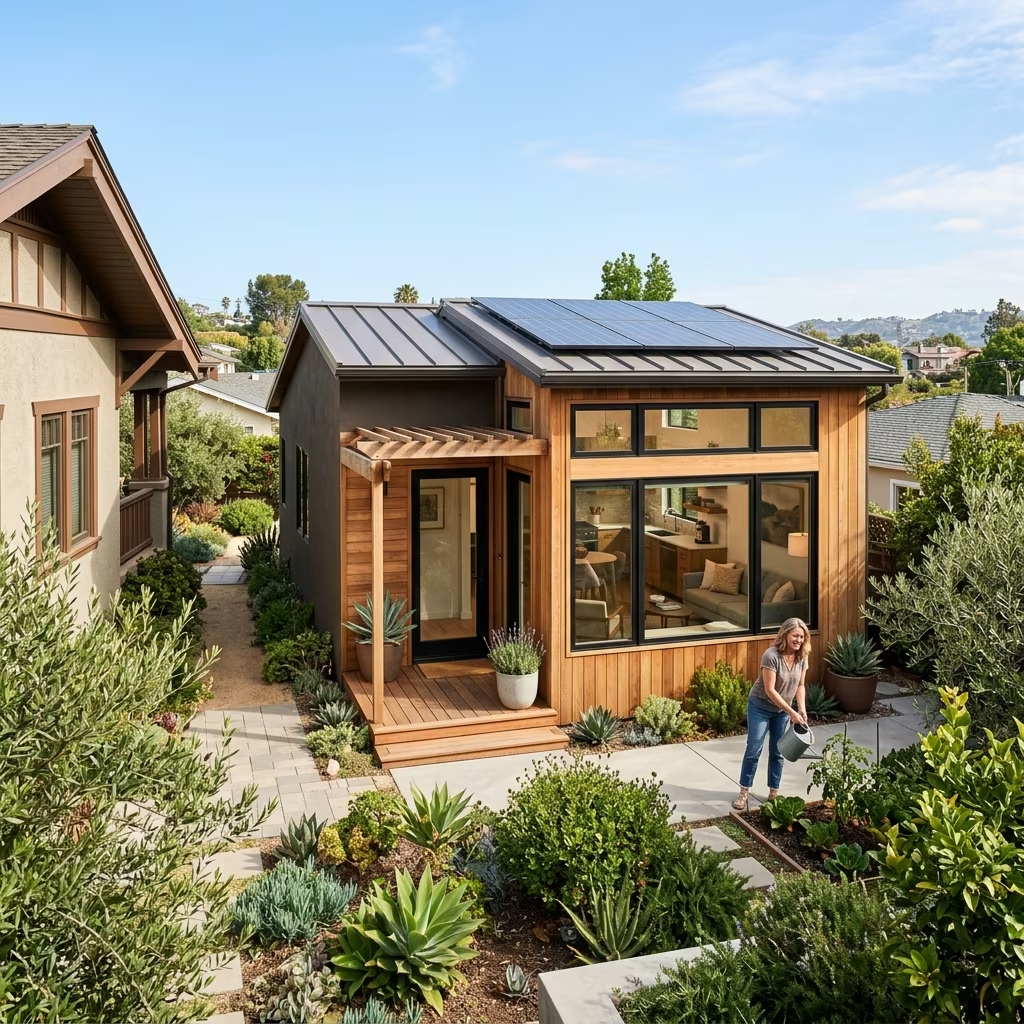
Accessory dwelling units, often called granny flats, backyard cottages, in-law units, or secondary units, have become a central part of California’s strategy to address its housing shortage. State law now makes it much easier for homeowners to add a small, self-contained home on the same lot as their main house, but there are detailed rules you must follow.
This guide explains the essentials of California ADU laws in clear, practical terms so you can decide whether building an ADU is right for your property and understand the steps needed to stay compliant.
What Counts as an ADU in California?
Under California law, an Accessory Dwelling Unit (ADU) is a smaller, independent residential unit located on the same parcel as a primary dwelling. It can be attached to the main home, built as a separate structure, or created by converting existing space, such as a garage or basement.
To qualify as a lawful ADU, the unit typically must include:
- Kitchen facilities capable of supporting independent living (sink, cooking appliance, storage).
- Bathroom facilities with a toilet, sink, and bathing area.
- Sleeping space that meets building and safety standards.
- Independent living arrangement so the occupant can reside there without relying on the main home.
- Permanent utility connections for water, power, and sewer (either shared or separate).
California also recognizes Junior Accessory Dwelling Units (JADUs), which are very small units created within the existing footprint of the primary house and subject to special size and occupancy rules.
Where ADUs Are Allowed
State law requires local governments across California to allow ADUs in most residential contexts, even when local zoning rules might otherwise limit density or building count.
| Property Type | ADU Eligibility (General State Rules) |
|---|---|
| Single-family residential lot | At least one ADU is allowed; often a combination of a detached or attached ADU plus a JADU, subject to local limits. |
| Multifamily residential lot | Multiple detached ADUs may be allowed, up to statewide caps that reference the number of existing units. |
| Minimum lot size | No minimum lot size under state ADU law; small lots cannot be excluded solely because of size. |
However, certain areas with special environmental or coastal protections may have additional constraints, although state ADU laws still apply in the California Coastal Zone, subject to consistency with coastal policies.
ADU Sizes, Height, and Setbacks
California has adopted statewide baselines for ADU dimensions, while giving local agencies limited room to impose stricter rules. If local ordinances conflict with state thresholds, the state rules prevail.
Minimum and Maximum Size Limits
Key state-level protections include:
- Minimum ADU size: Many local rules reference a minimum of around 150 square feet of living area, consistent with building code standards for efficiency units.
- Protected minimums: Cities and counties generally cannot set maximum sizes below 850 sq ft for a studio or one-bedroom ADU and 1,000 sq ft for an ADU with two or more bedrooms.
- Universal allowance: State law requires all jurisdictions to allow at least one ADU of 800 sq ft that meets basic height and setback standards, regardless of some local size or lot coverage limits.
- Attached ADUs: Often limited to a percentage (commonly 50%) of the primary dwelling’s floor area, subject to the statewide minimums above.
- JADUs: Explicitly limited to a maximum of 500 sq ft of interior livable space.
Height and Setbacks
Height and distance from property lines are critical for compliance:
- Height: Local agencies must allow detached ADUs up to at least 16 feet in height, and in some situations up to 18 feet (for example, near major transit or on certain multifamily lots).
- Side and rear setbacks: State law requires all jurisdictions to permit ADUs with setbacks of no more than 4 feet from side and rear property lines.
- Front setbacks: Typically governed by the local zoning district, but they cannot be applied in a way that effectively bans the state-protected 800 sq ft ADU that meets side and rear setbacks.
If your local ordinance imposes stricter rules than these statewide protections, those local rules may be legally unenforceable. Checking both state and local standards before designing an ADU is essential.
Types of ADUs You Can Build
California law supports several different ADU configurations. Understanding the main categories will help you choose a design that fits both your property and your budget.
Detached Backyard Cottages
A detached ADU is a standalone structure separate from your main house, often built in the backyard.
- Offers maximum privacy for occupants.
- Can be built as a new structure or by converting an existing outbuilding that meets residential standards.
- Subject to height, setback, and size limits, but protected up to at least 800 sq ft statewide and often up to 1,200 sq ft, depending on local rules.
Attached Additions
Attached ADUs share a wall with the primary home and can be built as a side or rear extension.
- Often limited by the percentage of the primary dwelling’s floor area (commonly 50%).
- Can be less expensive than a fully detached structure because some structural and utility systems are shared.
- Useful where lot size or setbacks make a detached cottage impractical.
Conversion ADUs
Conversion ADUs repurpose existing spaces such as garages, basements, or unused portions of the home.
- Take advantage of existing walls and roof, potentially lowering construction costs.
- Must still meet residential building standards for fire safety, egress, ventilation, and insulation.
- Help preserve yard space when outdoor area is limited.
Junior Accessory Dwelling Units (JADUs)
JADUs are small units created entirely within the existing footprint of the primary dwelling.
- Maximum 500 sq ft of interior space.
- May share bathroom facilities with the main home or have their own, with different owner-occupancy rules depending on the configuration.
- Cannot be used as short-term rentals under state law.
- Offer a low-cost way to create a rental or extended-family unit without building a separate structure.
Owner Occupancy, Rental Rules, and Fees
California has progressively liberalized ADU laws to encourage more units, changing how owner occupancy and fees work.
Owner-Occupancy Requirements
- ADUs: State law now generally prohibits local governments from requiring the owner to live in either the primary dwelling or the ADU for most ADUs, making them easier to use as long-term rentals.
- JADUs: Owner occupancy may be required if the JADU shares bathroom facilities with the main house; if it has its own bathroom, the owner-occupancy requirement may not apply.
This has opened opportunities for multi-generational living, long-term tenant housing, and more flexible property usage.
Short-Term Rentals
- JADUs cannot be used as short-term rentals under state law.
- Local cities may independently restrict ADUs from being rented for short terms (for example, under 30 days), even when state law permits long-term renting.
Impact Fees and School Fees
California law limits how much local agencies can charge in fees for ADU construction:
- No impact fees may be charged for ADUs 750 sq ft or smaller; JADUs are exempt from impact and school fees.
- For ADUs larger than 750 sq ft, impact fees must be proportional to the ADU’s size relative to the primary home, rather than flat full-house fees.
- ADUs under 500 sq ft may not increase assessable space for certain property tax and school fee calculations, depending on local rules.
The ADU Permit and Approval Process
Although the state sets the legal framework, your city or county still manages planning, plan review, inspections, and final approval. California law standardizes the permit process to reduce delays.
Ministerial Review and Deadlines
- Ministerial approval: ADU permits must be reviewed ministerially, meaning they are handled through a checklist-like process without discretionary public hearings or subjective design reviews.
- Completeness check: Within 15 business days, the city must decide whether your application is complete and provide written notice.
- Detailed feedback: If your application is incomplete, the city must identify exactly what is missing and explain how to correct it; once you resubmit, they cannot introduce new requirements.
- Decision timeline: After receiving a complete application, the jurisdiction generally must approve or deny it within 60 days.
These rules are designed to prevent ADU projects from stalling in lengthy, discretionary planning processes and to ensure consistent treatment across different properties.
Typical Steps to Secure an ADU Permit
Although specific requirements vary by city and county, most homeowners will follow a similar sequence:
- Confirm zoning: Make sure your property is zoned for single-family or multifamily residential use and has an existing or proposed primary dwelling.
- Choose ADU type: Decide whether you will build a detached cottage, attach an addition, convert existing space, or create a JADU.
- Check state and local standards: Review California’s protections for size, height, and setbacks, and then compare them with your city’s ADU ordinance.
- Prepare plans: Work with a designer or architect to create plans that comply with objective building, zoning, and fire-safety standards.
- Submit permit application: Provide required forms, plans, and supporting documents to the building department, including site plans, structural drawings, and energy compliance reports where needed.
- Respond to corrections: If the city identifies missing items or code issues, revise your plans and resubmit promptly.
- Schedule inspections: After permits are issued and construction begins, pass all required inspections (foundation, framing, electrical, plumbing, final occupancy).
- Obtain final approval: When all work is complete and passes inspection, secure final sign-off to legally occupy or rent the ADU.
Recent Legislative Changes Affecting ADUs
California continues to update ADU laws to increase housing supply and standardize local compliance. Several bills taking effect in 2025 and beyond further refine the rules.
- New statewide consistency requirements: Legislation such as AB 2533 and SB 1211 requires local ADU ordinances to fully align with updated state law; nonconforming local rules may become legally invalid if not updated by required dates.
- More ADUs on multifamily lots: SB 1211 increases the number of detached ADUs allowed on lots with existing multifamily dwellings, up to eight or a number tied to existing primary units, whichever is lower.
- Clarified JADU rules: State updates explicitly cap JADUs at 500 sq ft and refine owner-occupancy and sanitation-sharing requirements.
Because state law periodically changes, homeowners should check the most recent guidance from the California Department of Housing and Community Development (HCD) and their local planning department before finalizing plans.
Benefits and Risks of Building an ADU
While this guide focuses on legal and technical rules, it is also important to weigh the broader implications of adding an ADU to your property.
Potential Benefits
- Additional housing: Provides a home for relatives, caregivers, or tenants, supporting multigenerational living and community stability.
- Rental income: A compliant ADU can generate steady long-term rental revenue.
- Property value: A well-designed ADU may increase overall property value by adding legal living space.
- Flexibility: Use the unit as a home office, guest suite, or future downsizing option while renting out the main house.
Key Risks and Considerations
- Upfront cost: Construction, permits, impact fees (for larger units), and utility upgrades can be substantial.
- Long-term maintenance: Additional roofs, systems, and appliances require ongoing upkeep.
- Neighborhood impact: Parking, privacy, and noise concerns may arise, even though state law limits how neighbors can influence approvals.
- Regulatory changes: Future adjustments to rental rules or tax treatment could affect your long-term strategy.
Frequently Asked Questions About California ADU Laws
1. Do I need an existing house on my lot to build an ADU?
Yes. State ADU law assumes a lot with a proposed or existing primary dwelling; ADUs are accessory to that main home, not stand-alone primary houses.
2. How many ADUs can I build on a single-family lot?
State rules generally guarantee the ability to build at least one ADU on a single-family lot, and often a combination such as one ADU plus one JADU, subject to local standards and recent legislative changes. Always confirm the current allowances with your local planning department, because multifamily lots can have different, often higher, caps.
3. Can my city deny my ADU because of neighborhood opposition?
Local agencies must review ADU applications ministerially, without discretionary hearings or subjective design debates. If your plans comply with objective standards for building codes, safety, size, and setbacks, your city generally must approve them regardless of neighbor opposition.
4. Do I have to live on the property if I rent out the ADU?
For most ADUs, state law now prohibits owner-occupancy requirements, meaning you do not have to reside in either the main house or the ADU to rent one or both as long-term housing. JADUs, however, may still trigger owner occupancy depending on how they share sanitation facilities.
5. Is there a minimum lot size for building an ADU?
No. California ADU law specifically prevents local governments from using minimum lot size rules to block otherwise compliant ADUs. Even small parcels can host an ADU if they meet building and safety standards.
6. How long will the permit process take?
Once you submit a complete ADU application, your city or county generally must approve or deny it within 60 days. Within the first 15 business days, they must tell you whether your application is complete and explain any corrections needed.
7. Where can I find official guidance on ADU rules?
The California Department of Housing and Community Development (HCD) publishes an official ADU handbook and maintains web pages summarizing statewide requirements and recent legislative changes. Your local planning or building department should also provide its own ADU ordinance and checklists.
References
- Accessory Dwelling Units — California Department of Housing and Community Development. 2026-03-01. https://www.hcd.ca.gov/building-standards/adu
- ACCESSORY DWELLING UNIT HANDBOOK — California Department of Housing and Community Development. 2026-03-01. https://www.hcd.ca.gov/sites/default/files/docs/policy-and-research/adu-handbook-update.pdf
- California ADU Laws & Requirements [2026 Guide] — Good Life Construction. 2026-01-10. https://www.goodlifeconstruction.com/blog/adu-laws-in-california/
- California ADU Regulations – Understanding 2025 Rules — Snap ADU. 2025-02-15. https://snapadu.com/california-adu-regulations-zoning/
- California ADU Guide: Laws & Regulations — Container Stop. 2025-05-20. https://containerstop.com/blog/california-adu-laws-explained-a-complete-guide-to-accessory-dwelling-units/
- ADU Regulations In California (2026 Guide) — Zook Cabins. 2026-02-01. https://www.zookcabins.com/regulations/adu-regulations-in-california
- Governor Newsom Signs Three New Accessory Dwelling Unit Bills — Best Best & Krieger LLP. 2024-10-01. https://bbklaw.com/resources/la-100124-governor-newsom-signs-three-new-accessory-dwelling-unit-bills