
Broadcast Censorship vs Parental Controls
Should the government dictate what we watch, or is it a parent's duty?
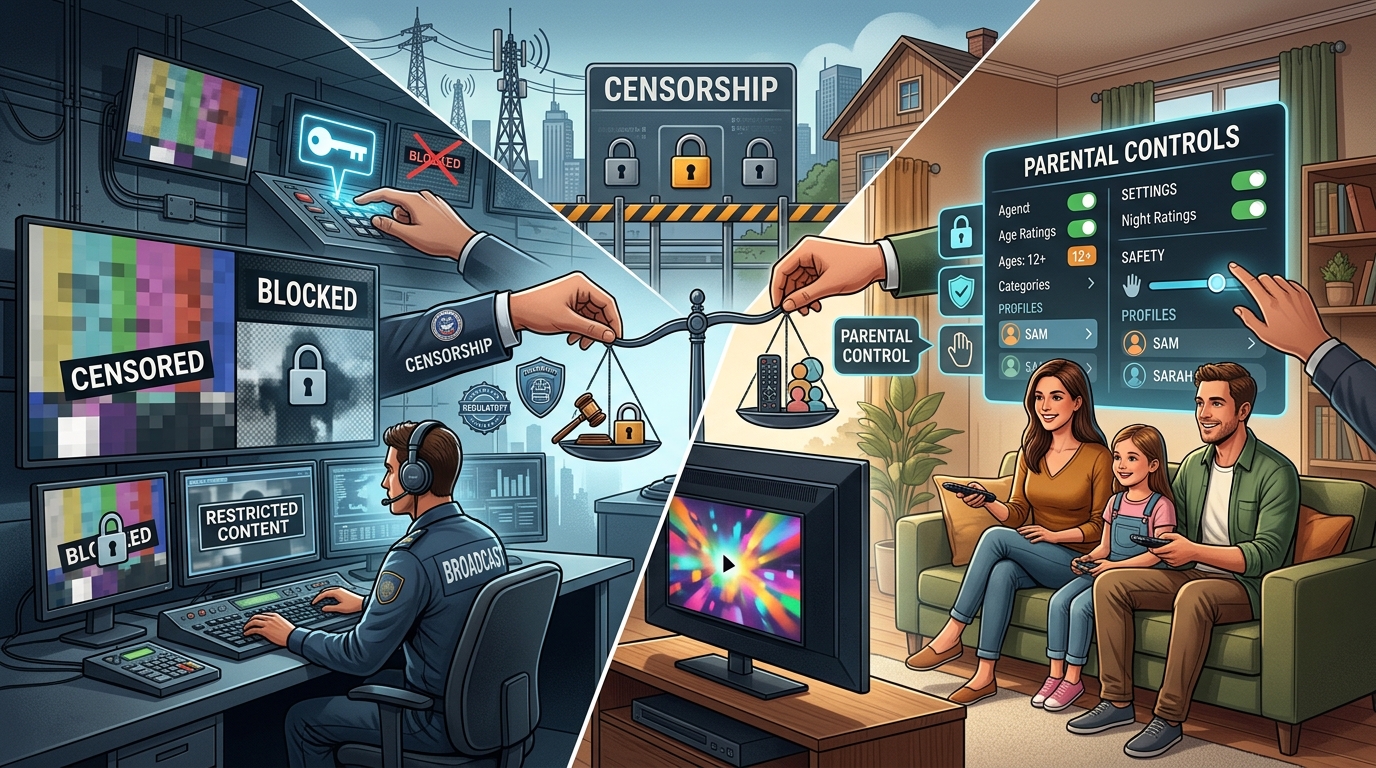
The Intersection of Media, Policy, and Family Autonomy
The intersection of media consumption, government regulation, and family autonomy has long been a primary battleground for legal and cultural debates in the United States. As televisions became an ever-present staple of the American living room in the mid-twentieth century, profound anxieties regarding the impact of broadcast programming on young, impressionable minds surged across the nation. This widespread apprehension gave rise to a persistent, highly debated question: Should the federal government possess the authority to dictate what is appropriate for broadcast audiences, or does that immense responsibility reside firmly and exclusively with parents and local communities?
While the underlying desire to protect children from graphic, violent, or intensely mature content is universally understood and supported, the administrative methods used to achieve this societal goal frequently collide directly with fundamental First Amendment protections. When the state assumes the overarching role of a national surrogate parent, it risks imposing a singular, homogenized moral standard on a deeply diverse and pluralistic population. Today, as rapid technological advancements provide modern families with unprecedented, granular control over their own media environments, the foundational justification for sweeping federal censorship of the public airwaves is becoming increasingly difficult to maintain and legally defend.
The Regulatory Framework and Its Origins
To fully comprehend the ongoing tension between constitutional free speech and media regulation, one must meticulously examine the historical role and evolution of the Federal Communications Commission (FCC). Established initially by the Communications Act of 1934, the FCC was strictly tasked with managing the scarce resource of public airwaves, ensuring that licensed broadcasters operated in the broad “public interest, convenience, and necessity.” Over several decades, however, this administrative mandate steadily evolved into the strict, active policing of broadcast content, particularly concerning any material deemed legally obscene, indecent, or profane.
According to the FCC’s official regulatory guidelines, explicit “obscenity” is fundamentally unprotected by the First Amendment and is unconditionally prohibited on broadcast television and radio at all times of day. However, the slightly broader category of “indecency”—which the agency defines as material that depicts or describes sexual or excretory organs or activities in a patently offensive manner—is where the primary legal friction consistently occurs. Indecent speech is fully protected under the Constitution for adult audiences, but the FCC heavily restricts its broadcast between the specific hours of 6:00 a.m. and 10:00 p.m. in an ongoing effort to shield children who might unintentionally be in the viewing audience.
This temporal restriction, frequently referred to in legal circles as the “safe harbor” rule, was largely validated and cemented by the landmark 1978 Supreme Court case, FCC v. Pacifica Foundation. This highly influential case centered entirely around a midday public radio broadcast of legendary comedian George Carlin’s provocative “Filthy Words” monologue. The Supreme Court ultimately ruled in favor of the FCC, forcefully arguing that traditional broadcasting is a “uniquely pervasive” medium that seamlessly intrudes into the localized privacy of the home, making it easily accessible to unsupervised children. This specific ruling cemented the federal government’s authority to levy massive financial fines and actively threaten the operating licenses of commercial broadcasters who violated these fluid decency standards, effectively setting the long-term stage for decades of robust regulatory oversight.
The First Amendment Dilemma
While the monumental Pacifica decision established a firm legal precedent for regulating broadcast indecency, it simultaneously ignited enduring, valid concerns regarding the preservation of free expression in America. The First Amendment was specifically designed to protect subjective speech from heavy-handed government interference, particularly speech that challenges mainstream cultural sensibilities or pushes artistic boundaries. When a centralized federal agency is unilaterally granted the authority to determine what qualifies as “patently offensive,” the highly subjective nature of that judgment becomes a profound vulnerability for the concept of free speech.
The fundamental, inescapable issue with government-mandated decency standards is their inherent, undeniable ambiguity. What one regional community finds deeply offensive, another may view as completely harmless entertainment, brilliant artistic expression, or vital social commentary on the human condition. When national broadcasters continuously fear exorbitant monetary fines or the devastating revocation of their operational licenses, they frequently resort to aggressive, preemptive self-censorship. This chilling psychological effect does not merely scrub the public airwaves of casual profanity; it actively suppresses controversial political discourse, edgy comedic performances, and nuanced narratives that dare to explore the messy, unfiltered realities of human life.
Furthermore, historical applications of state censorship often reveal a highly disproportionate, negative impact on minority and marginalized groups. Network programming that features LGBTQ+ relationships, non-traditional family structures, or unapologetic counter-cultural themes is frequently the absolute first to draw the organized ire of powerful decency advocates. By passively allowing the federal government to function as an unchecked arbiter of public morality, we continuously risk creating a heavily sanitized, sterile media landscape that caters exclusively to the most sensitive viewers, stifling the vibrant diversity of thought and expression that the First Amendment is explicitly meant to aggressively protect.
The Shift to Technological Empowerment
Recognizing the inherent limitations and severe constitutional pitfalls of broad government censorship, lawmakers and technologists eventually sought pragmatic solutions that would directly empower families rather than drastically expand federal authority. A pivotal, transformative moment in this cultural shift occurred with the historic passage of the Telecommunications Act of 1996. This landmark piece of legislation represented a concerted, bipartisan effort to successfully leverage consumer technology as a primary means of parental empowerment, formally introducing the federal mandate for the V-chip.
The V-chip (which stands for “violence chip”) was a strict technological requirement for all modern television sets manufactured for the United States market. This built-in hardware feature seamlessly allowed parents to automatically block scheduled programming based on a heavily encoded rating system, functioning much like the familiar ratings used for theatrical film releases. By instantaneously reading the age-based ratings silently transmitted alongside standard broadcast signals, the V-chip finally enabled parents to proactively and efficiently curate their own household’s daily television viewing experience without relying on government bans.
The nationwide introduction of the V-chip fundamentally altered the long-standing dynamics of media regulation. It deliberately shifted the immense burden of filtering content away from the state and placed it directly into the capable hands of individual caregivers. This massive transition was celebrated as a victory for both family autonomy and free speech. It ultimately meant that commercial broadcasters could theoretically produce a much wider array of mature content tailored to diverse, adult audiences without the constant looming threat of FCC sanctions, provided the programming was accurately and honestly rated. The underlying philosophy was abundantly clear: if a parent finds a specific program objectionable, they possess the technological means to quietly block it, rendering aggressive government intervention totally redundant.
Modern Parenting in a Connected World
Decades after the initial introduction of the V-chip, the foundational concept of parental controls has evolved exponentially into a complex digital science. Today’s hyper-connected parents are not merely blocking specific terrestrial television channels; they are actively managing massive, complex digital ecosystems that include personal smartphones, internet-connected tablets, video game consoles, and infinite streaming applications. Contemporary operating systems currently offer incredibly sophisticated, granular controls that effortlessly allow parents to set strict screen time limits, restrict specific application downloads, and aggressively filter web content based purely on age-appropriateness.
Recent sociological data heavily underscores exactly how actively parents are managing this wild digital frontier. According to comprehensive research published by the Pew Research Center, the overwhelming majority of modern parents are deeply, continuously engaged in monitoring and regulating their children’s daily screen time and digital media access. This extensive study highlights that proactive parents utilize a dynamic combination of built-in software restrictions, regular open communication regarding digital citizenship, and the physical confiscation of devices to effectively guide their children’s developing digital habits.
This incredibly proactive, hands-on approach demonstrates clearly that contemporary families are highly capable of navigating the modern media landscape without blindly relying on a centralized, slow-moving government censor. Caregivers are actively seeking out highly educational content, setting firm digital boundaries, and utilizing the robust filtering tools enthusiastically provided by tech companies. The outdated narrative that innocent children are entirely helpless victims of a pervasive, unstoppable media machine, desperately requiring the FCC to continuously sanitize the airwaves, completely ignores the incredible agency, dedication, and resourcefulness of modern parents.
The Fallacy of a Universal Standard
The core argument against maintaining aggressive FCC indecency regulations is certainly not an argument against prioritizing child safety; rather, it is a deeply philosophical argument against the efficacy, practicality, and morality of enforcing a “one-size-fits-all” federal standard on a complex nation. The United States is an incredibly vast, pluralistic society directly comprising hundreds of millions of individuals possessing wildly differing religious beliefs, distinct cultural backgrounds, and deeply personal parenting philosophies.
Attempting to artificially distill these incredibly diverse viewpoints into a single, cohesive, nationally enforced standard of “decency” is a functionally impossible task. For some progressive families, early exposure to mild profanity or mature sociopolitical themes is viewed heavily as a valuable opportunity for open dialogue, critical thinking, and real-world preparation. For others, strict, unyielding adherence to highly conservative media consumption is absolutely paramount to their way of life. A solitary government agency sitting in Washington, D.C., simply cannot adequately accommodate these vastly contrasting core values without severely alienating massive segments of the population.
When the state broadly mandates what is exclusively suitable for broadcast, it invariably ends up catering directly to the most vocal, hypersensitive, and restrictive elements of American society. This patronizing approach treats fully grown adults like children, artificially reducing the overall quality, nuance, and thematic depth of available programming to a simplistic level deemed globally acceptable for unsupervised toddlers. By legally trusting parents to utilize available consumer technologies to personally enforce their own household standards, our society can successfully maintain a vibrant, unrestricted marketplace of ideas that simultaneously respects both child welfare and essential adult autonomy.
The Digital Age and Regulatory Obsolescence
Perhaps the single most compelling, undeniable argument against maintaining strict FCC broadcast regulations is the profound, unstoppable transformation of the global media landscape itself. The original *Pacifica* legal decision was firmly rooted in a bygone era when traditional broadcast television and terrestrial radio were the undisputed, dominant, uninvited guests securely stationed in the American home. There were incredibly limited channel options, and actively avoiding objectionable content required constant, grueling physical vigilance from exhausted parents.
Today, the historic concept of “uninvited” pervasive broadcasting is largely a relic of the past. Modern consumers actively, intentionally curate their entire media consumption strictly through massive subscription-based streaming services. These digital platforms operate entirely outside the legal jurisdiction of the FCC’s legacy indecency rules, simply because they are not utilizing the scarce public airwaves. Furthermore, these highly advanced digital services offer incredibly customizable individual profiles, allowing parents to instantly lock mature, R-rated content securely behind complex PIN codes and sophisticated algorithmic walls.
Because the vast majority of families now rely entirely on high-speed broadband internet and on-demand streaming applications rather than traditional metal terrestrial antennas, the FCC’s aggressive, occasional policing of broadcast channels feels increasingly anachronistic and bizarrely arbitrary. It heavily creates a highly disjointed, illogical regulatory environment where a terrestrial television network can be inexplicably fined millions of dollars for a fleeting, accidental expletive, while a digital streaming platform can instantly deliver entirely unfiltered, incredibly graphic content directly to the exact same television set. This massive legal disparity perfectly highlights the total futility of desperately maintaining outdated broadcast censorship in an overwhelmingly digital, on-demand world.
Conclusion
The intense, ongoing national debate over media regulation heavily requires a incredibly delicate, thoughtful balance between genuinely protecting vulnerable youth audiences and fiercely preserving the foundational constitutional right to free expression. While the FCC historically played a significant role in attempting to sanitize the public airwaves for general consumption, the massive technological and cultural shifts of the past several decades have rendered this heavy-handed approach largely unnecessary and highly constitutionally suspect.
The massive proliferation of robust parental control technologies—initially sparked by the mandated V-chip and eventually perfected by modern, sophisticated digital operating systems—has successfully, permanently transferred the awesome power of content curation from distant federal bureaucrats directly to individual American households. Empowering dedicated parents with the tools to make highly informed, personal decisions for their own specific children is a far more effective, democratic, and legal solution than blindly imposing a universal, government-mandated standard of subjective decency. Ultimately, successfully safeguarding the innocence of youth should never fundamentally require sacrificing the precious First Amendment rights of the general public.
Frequently Asked Questions (FAQs)
- What is the difference between obscenity and indecency according to the FCC?
Obscenity is an extreme, graphic form of explicit content that must meet a very strict, three-pronged legal test established by the Supreme Court, and it is entirely unprotected by the First Amendment. It is banned completely from broadcast at all times. Indecency involves potentially offensive, but less graphic, descriptions of sexual or excretory activities. Indecency is fully protected speech for adults but is heavily restricted by the FCC during daytime and early evening hours (6:00 a.m. to 10:00 p.m.) when children are most likely viewing. - How did the V-chip change television consumption?
Federally mandated by the Telecommunications Act of 1996, the V-chip allowed parents to instantly block television programming automatically based on a standardized, age-based rating system. This incredible technology deeply empowered families to personally filter out extreme violence, sexual content, and strong language in their own homes, massively reducing the ongoing need for direct government censorship. - Does the FCC regulate modern streaming services?
No. The FCC’s specific legal authority regarding indecency and profanity applies strictly to traditional broadcast television and radio stations that actively utilize the public electromagnetic airwaves. Subscription-based digital streaming platforms operate under entirely different, much looser legal frameworks and rely completely on voluntary subscriber opt-ins and robust internal parental controls. - Why is broadcast media regulated differently than print or internet media?
The historical legal justification, primarily established in the 1978 case FCC v. Pacifica Foundation, heavily argued that broadcast media is “uniquely pervasive” and automatically enters the home uninvited. However, many modern legal scholars and tech experts argue that this specific rationale is increasingly outdated and irrelevant in the modern digital era of on-demand content.
References
- Obscene, Indecent and Profane Broadcasts — Federal Communications Commission. 2021-01-13. https://www.fcc.gov/consumers/guides/obscene-indecent-and-profane-broadcasts
- Telecommunications Act of 1996 — Federal Communications Commission. 2013-06-20. https://www.fcc.gov/general/telecommunications-act-1996
- How Teens and Parents Approach Screen Time — Pew Research Center. 2024-03-11. https://www.pewresearch.org/internet/2024/03/11/how-teens-and-parents-approach-screen-time/
- FCC v. Pacifica Foundation, 438 U.S. 726 (1978) — Justia U.S. Supreme Court Center. 1978-07-03. https://supreme.justia.com/cases/federal/us/438/726/
Similar Articles








Read full bio of medha deb


