
Breach of Contract: Rights, Remedies, and Next Steps
Understand what a breach of contract really means, how to respond strategically, and which legal remedies may be available when a promise on paper is broken.
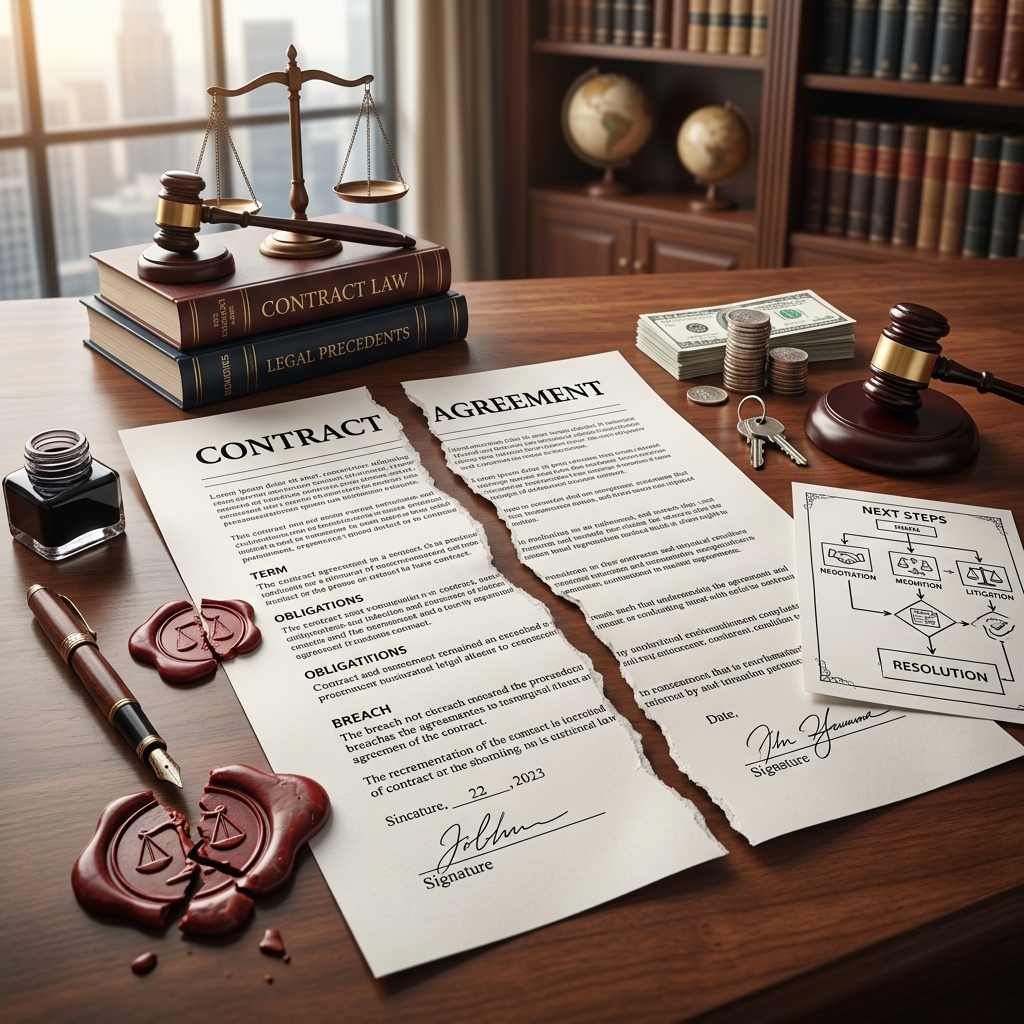
Contracts underpin most business relationships: they allocate risk, define obligations, and give each side confidence that promises will be honored. When one party fails to do what the contract requires, a breach of contract occurs and a series of legal and practical questions immediately arise. This guide explains what a breach of contract is, how to evaluate your situation, and the options available to address it.
1. Understanding Breach of Contract in Simple Terms
At its core, a breach of contract is a failure to perform a contractual obligation without a valid legal excuse. This failure can involve not performing at all, performing late, or performing defectively.
1.1 When does a contract exist?
Before you can talk about a breach, you must first have an enforceable contract. Courts generally look for several elements:
- Offer – One party proposes clear terms.
- Acceptance – The other party agrees to those terms.
- Consideration – Each side gives something of value (money, services, goods, or a promise).
- Capacity – Parties are legally capable of contracting (for example, not minors and mentally competent).
- Legal purpose – The agreement does not involve unlawful activity.
These requirements apply to both written and verbal contracts, although proving the terms of a verbal agreement can be more difficult and may be subject to shorter time limits in court.
1.2 Types of contract breach
Not all breaches are equal. The type of breach can influence your remedies and strategy.
- Minor (partial) breach – A small deviation from the contract terms, often correctable, that does not destroy the whole deal.
- Material breach – A serious failure affecting the core of the agreement, depriving the non-breaching party of the main benefit they expected.
- Fundamental breach – A breach so severe that it may justify stopping your own performance and seeking damages or termination.
- Anticipatory breach – One party signals in advance that they will not perform, for example by stating they will not deliver or by taking actions making performance impossible.
Understanding which category your situation falls into helps you decide whether to pursue repair of the relationship, a renegotiation, or formal legal action.
2. First Steps After a Breach: Assess, Document, and Communicate
The way you respond in the early stages after a breach can significantly affect the outcome. Acting thoughtfully, rather than emotionally, is critical.
2.1 Confirm the breach against the contract terms
Start by carefully reviewing the agreement:
- Identify the clause you believe has been breached.
- Check any conditions precedent (things that must happen before duties arise).
- Look for deadlines, quality standards, and performance milestones.
- Review notice provisions (how and when you must notify the other party of a problem).
- Check limitation-of-liability, liquidated damages, or dispute resolution clauses.
Comparing what was promised to what occurred helps you determine the seriousness of the breach and whether the other party may claim a legal excuse (for example, force majeure in some contracts).
2.2 Gather and preserve evidence
If the dispute escalates, you will need evidence to prove your position. Begin organizing:
- Signed contracts and any amendments or side letters.
- Emails, letters, and messages relating to performance or delays.
- Invoices, receipts, delivery notes, and payment records.
- Photographs, inspection reports, or technical documentation showing defects.
- Internal notes and meeting minutes documenting discussions about the breach.
Good documentation makes it easier to negotiate, mediate, or litigate if necessary.
2.3 Evaluate business impact
Beyond legal theory, focus on the practical effects:
- Has the breach disrupted operations or supply chains?
- What direct costs have arisen (replacement suppliers, overtime, repair costs)?
- Are you facing lost sales, reputational harm, or penalties with your own customers?
- Is this a one-off problem or part of a broader pattern?
This impact assessment will inform whether you should prioritize continued cooperation or decisive separation.
2.4 Communicate strategically with the other party
In many cases, open communication can resolve the dispute without litigation. Consider:
- Sending a formal notice describing the breach and requesting correction.
- Offering reasonable time to cure, if consistent with the contract.
- Proposing adjusted timelines or partial performance where practical.
- Making clear that you reserve your legal rights while exploring solutions.
Document all communications and avoid emotional or accusatory language that could complicate later proceedings.
3. Legal Remedies: What Courts Can Do About a Breach
If informal efforts fail, the law offers a range of remedies. Courts generally aim to compensate the non-breaching party rather than punish the breaching party.
3.1 Monetary damages
The default remedy in most breach-of-contract cases is money damages designed to put the injured party in the position they would have been in if the contract had been properly performed.
| Type of damages | Purpose | Typical examples |
|---|---|---|
| Expectation damages | Place the injured party where they would be if the contract were fully performed. | Lost profit on sales, difference between contract price and cover price. |
| Reliance damages | Reimburse expenses incurred in reliance on the contract. | Marketing spend, preparation costs, or setup expenses undertaken because the contract was expected to be performed. |
| Restitution | Disgorge benefits the breaching party received, preventing unjust enrichment. | Return of advance payments or value of services provided but not paid for. |
| Consequential & incidental damages | Cover foreseeable indirect losses and extra costs caused by the breach. | Lost downstream business, extra shipping costs, storage fees, or emergency replacement purchases. |
| Liquidated damages | Pre-agreed amount payable on breach, if reasonable and not purely punitive. | Daily delay charges in construction contracts or specified penalties for late delivery. |
Only rarely are punitive damages awarded in contract cases, and usually only when the breach involves fraud or other serious misconduct.
3.2 Equitable remedies
When money alone cannot adequately address the harm, courts may order equitable remedies.
- Specific performance – A court order requiring the breaching party to carry out their contractual obligations, often used in unique property or specialized asset cases.
- Injunctions – Orders to do or refrain from doing something, such as enforcing non-compete or confidentiality obligations.
- Rescission and restitution – Cancellation of the contract and restoration of each party to their pre-contract position.
Equitable remedies are discretionary and typically require the plaintiff to show that money damages would be inadequate.
3.3 Who can sue, and when?
In most systems, only parties to the contract (or their legal successors) can bring a breach-of-contract claim. Third parties with no contract generally cannot sue for breach, except where specific laws or third-party beneficiary doctrines apply.
There are also time limits known as statutes of limitation. For example, in one U.S. jurisdiction, claims on a written contract often must be filed within several years from the date of breach, while verbal contract claims may have shorter deadlines. Missing these deadlines can result in dismissal even if the underlying claim is valid.
4. Options for Resolving a Contract Dispute
Not every breach needs to end in court. You have a spectrum of options, from informal negotiation to litigation.
4.1 Direct negotiation
Negotiation is typically the first and often the most cost-effective step:
- Clarify misunderstandings around contract terms or expectations.
- Agree on revised deadlines or performance standards.
- Negotiate partial refunds, discounts, or additional services to offset harm.
- Document the resolution, ideally in a written amendment or settlement agreement.
For ongoing business relationships, a fair renegotiation may be preferable to adversarial litigation.
4.2 Mediation and arbitration
If direct talks fail, alternative dispute resolution (ADR) can provide a structured forum to resolve disputes.
- Mediation – A neutral mediator helps the parties explore settlement options. Outcomes are typically non-binding unless the parties enter a settlement agreement.
- Arbitration – A neutral arbitrator (or panel) issues a decision, which is usually binding and enforceable similar to a court judgment.
Many contracts contain clauses requiring mediation or arbitration before litigation, or as the exclusive method of dispute resolution. These processes can be faster and more private than court proceedings.
4.3 Filing a lawsuit
When other options fail or the breach is severe, litigation may be necessary. A breach-of-contract lawsuit generally seeks to enforce the agreement and recover damages. To succeed, the plaintiff must prove several elements:
- There was a valid, enforceable contract.
- The plaintiff performed, or was excused from performing, their obligations.
- The defendant failed to perform as required.
- The breach caused measurable damages.
The defendant may respond with defenses such as lack of capacity, illegality, mistake, prior material breach by the plaintiff, or expiration of the limitation period.
5. Practical Risk Management: Preventing and Limiting Breaches
While no contract can eliminate risk entirely, careful planning and drafting can reduce the likelihood and impact of breaches.
5.1 Draft clearer contracts
Ambiguity is a common source of disputes. You can improve contract clarity by:
- Defining duties, timelines, and performance standards in measurable terms.
- Including detailed specifications, service levels, and acceptance criteria.
- Describing consequences for late or defective performance (for example, liquidated damages or price adjustments).
- Specifying governing law, jurisdiction, and dispute resolution mechanisms.
5.2 Build in prevention and cure mechanisms
Contracts can include tools that help manage problems before they become crises:
- Notice and cure clauses giving the breaching party a defined period to fix issues.
- Escalation procedures that require discussions at senior management level before litigation.
- Performance review meetings and reporting obligations.
- Termination rights for persistent or material breach.
5.3 Use legal review for high-risk arrangements
For major contracts, legal review can identify hidden risks and suggest protective language. Counsel can:
- Evaluate liability caps and indemnity provisions.
- Ensure compliance with sector-specific regulations.
- Align dispute resolution and governing law with business strategy.
- Advise on whether proposed liquidated damages are enforceable and reasonable.
6. Frequently Asked Questions About Breach of Contract
6.1 Is breach of contract a crime?
Ordinarily, breach of contract is a civil matter, not a criminal offense. The typical consequences are financial or equitable remedies, not jail time. Criminal liability may arise only if the conduct also involves separate crimes such as fraud, theft, or certain regulatory offenses.
6.2 Can I stop performing my obligations if the other side breaches?
In the case of a material or fundamental breach, the non-breaching party may be entitled to suspend or terminate performance and seek damages. However, stopping performance prematurely can itself be treated as a breach. Legal advice is advisable before taking such steps.
6.3 Do I need a written contract to sue?
Many jurisdictions allow lawsuits based on verbal contracts, provided the necessary elements of contract formation are present. However, written contracts are easier to prove, and some types of agreements (for example, real estate sales) may be required by law to be in writing. Time limits for suing may also differ between written and verbal agreements.
6.4 What if the other party claims the breach was not their fault?
Contract law often focuses on whether the obligation was performed, not just on fault. However, some legal systems and specific clauses (such as force majeure) may excuse non-performance when certain events occur beyond a party’s control. The availability of such defenses depends on contract language and governing law.
6.5 How do courts calculate damages?
Courts aim to award damages that fairly reflect the loss caused by the breach, subject to rules on foreseeability, causation, and mitigation. You will generally need evidence of your losses (such as financial records, expert reports, and contracts with third parties) to support the amount claimed.
7. When to Seek Professional Legal Advice
While many minor breaches can be handled through business negotiation, certain situations merit prompt legal consultation:
- High-value contracts involving major financial exposure.
- Disputes with cross-border elements or complex regulatory issues.
- Threats of litigation or arbitration.
- Potential reputational or operational damage to your business.
A lawyer can help you understand your rights under the applicable law, evaluate your evidence, and choose the most effective course of action—whether that is negotiation, mediation, arbitration, or court proceedings.
References
- breach of contract | Wex | US Law — Legal Information Institute, Cornell Law School. 2023-05-01. https://www.law.cornell.edu/wex/breach_of_contract
- When a contract is broken (breach of contract) — California Courts Self-Help Center. 2023-04-10. https://selfhelp.courts.ca.gov/civil-lawsuit/breach-contract
- Understanding Breach of Contract: Types, Legal Issues, and Examples — Investopedia. 2024-02-15. https://www.investopedia.com/terms/b/breach-of-contract.asp
- Contract Breaches: Legal Consequences and Available Remedies — Educational video summary. 2023-11-20. https://www.youtube.com/watch?v=JcEE43Zz7kY
- Consequences of Breaking a Contract — Haber Law. 2022-09-01. https://www.haber.law/consequences-of-breaking-a-contract/
- What Is the Penalty for Breach of Contract? A Comprehensive Guide — SirionLabs. 2023-08-30. https://www.sirion.ai/library/contract-management/penalty-for-breach-of-contract/
Similar Articles








Read full bio of Sneha Tete


