
Bookkeeper vs Accountant: Key Distinctions for Businesses
Uncover the essential differences between bookkeepers and accountants to optimize your business's financial management and growth strategies.
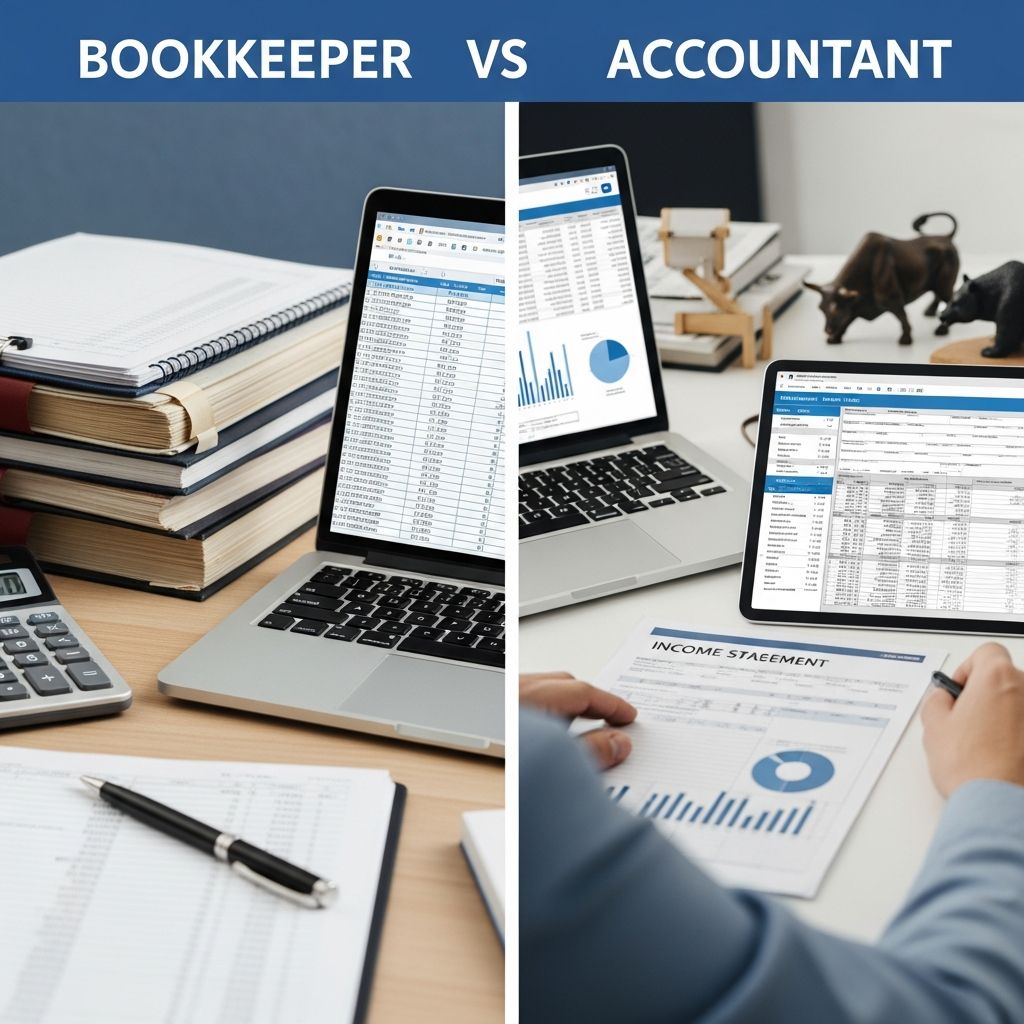
Navigating the world of financial professionals can be challenging for business owners.
Bookkeepers
focus on daily transaction recording, whileaccountants
deliver in-depth analysis and strategic guidance. Understanding these roles ensures efficient financial operations and informed decision-making.Defining the Core Roles in Financial Management
Financial health forms the backbone of any successful enterprise. Two primary specialists handle this: the bookkeeper and the accountant. Each contributes uniquely to maintaining order and driving growth.
The Bookkeeper’s Daily Operations
Bookkeepers serve as the frontline guardians of financial data. They systematically log every incoming payment, outgoing expense, and internal transfer. This involves categorizing transactions into ledgers, reconciling bank statements, and processing payroll. Their work creates a real-time snapshot of cash flow, essential for operational stability.
- Enter sales receipts and vendor bills promptly.
- Track accounts receivable to follow up on overdue payments.
- Manage inventory adjustments and petty cash.
- Prepare preliminary reports like profit and loss summaries.
Without precise bookkeeping, businesses risk overlooked errors that compound into major issues.
The Accountant’s Strategic Oversight
Accountants elevate raw data into actionable intelligence. They scrutinize records for accuracy, compile formal statements such as balance sheets and income reports, and interpret trends. Their expertise extends to compliance, forecasting, and advisory services.
- Conduct variance analysis to explain performance deviations.
- Develop budgets and long-term financial models.
- Advise on cost-saving measures and investment opportunities.
- Represent the business in audits and regulatory filings.
This higher-level involvement positions accountants as key partners in scaling operations.
Responsibilities Breakdown: A Side-by-Side Comparison
To clarify overlaps and boundaries, consider this detailed table outlining typical duties.
| Task Category | Bookkeeper Focus | Accountant Focus |
|---|---|---|
| Transaction Handling | Daily entry, invoicing, payments | Review and verification |
| Reporting | Basic monthly summaries | Comprehensive financial statements |
| Analysis | Limited to discrepancies | Trend identification, forecasting |
| Compliance & Taxes | Basic record prep | Full preparation and strategy |
| Advisory | Rarely | Strategic planning, risk assessment |
This comparison highlights how bookkeepers provide the foundation, upon which accountants construct strategic frameworks.
Educational Paths and Professional Credentials
Entry into these fields demands distinct preparations. Bookkeepers often start with vocational training or associate degrees, supplemented by certifications like QuickBooks ProAdvisor. Accountants pursue bachelor’s degrees in accounting, frequently culminating in CPA licensure, which requires passing rigorous exams and gaining experience.
CPAs hold a prestigious edge, enabling services like audit representation. In 2025, demand for certified professionals surges amid complex regulations.
- Bookkeeper: Certificate programs (6-12 months), on-the-job training.
- Accountant: 4-year degree + 150 credit hours for CPA, ongoing education.
Compensation Insights: What to Budget
Salary reflects expertise levels. Bookkeepers average around $46,000 annually, varying by experience and location. Accountants command $65,000 or more, with CPAs exceeding $80,000 due to advanced skills.
| Role | Average Annual Salary (USD) | Freelance Hourly Rate |
|---|---|---|
| Bookkeeper | $46,080 | $20-40 |
| Accountant | $65,255 | $50-150 |
| CPA | $80,000+ | $100-250 |
Businesses weigh these costs against value: bookkeepers economize routine tasks, accountants justify premiums through savings and growth.
When Your Business Needs a Bookkeeper
Startups and small operations benefit most from bookkeepers. If you’re dedicating over 5 hours weekly to finances or revenue dips below $500K, prioritize transactional accuracy. They streamline invoicing, prevent cash crunches, and enable focus on core activities.
Signs include mounting unpaid bills or disorganized receipts. Outsourcing here yields immediate efficiency.
Why Bring in an Accountant
As revenue climbs past $500K or expansion looms, accountants become indispensable. They navigate tax complexities, optimize deductions, and model scenarios for loans or investments.
Critical triggers: upcoming audits, funding pursuits, or profitability plateaus. Their insights can unlock 20-30% efficiency gains.
Harmonizing Both Roles for Peak Performance
Optimal setups feature collaboration. Bookkeepers feed clean data to accountants, who refine it into strategies. This tandem reduces errors by 40% and enhances forecasting accuracy.
Many firms employ full-time bookkeepers overseen by part-time accountants, blending cost-effectiveness with expertise.
DIY vs Professional: Weighing Options
Software like Xero or QuickBooks empowers solo bookkeeping for solopreneurs. However, pros mitigate risks of non-compliance, which fines average $10K annually for small businesses.
Accountants remain irreplaceable for nuanced advice. Hybrid models—software plus periodic pros—balance affordability and precision.
Frequently Asked Questions
Can a bookkeeper perform accounting tasks?
Bookkeepers handle basics but lack training for advanced analysis or tax filing. Consult accountants for compliance-heavy work.
Is certification mandatory for bookkeepers?
No, but credentials like NACPB boost credibility and employability.
How often should I review financials with an accountant?
Quarterly for growing businesses; monthly during tax season.
What’s the cost of hiring both?
Combined: $5K-15K yearly for small firms, scaling with complexity.
Can one person fulfill both roles?
Possible in tiny operations, but separation ensures quality as business grows.
Future Trends Shaping These Professions
Automation via AI handles routine entries, elevating bookkeepers to oversight roles. Accountants leverage data analytics for predictive insights. By 2026, 70% of firms will adopt integrated platforms, demanding hybrid skills.
Businesses adapting to these shifts gain competitive edges in volatile markets.
References
- Bookkeeper vs. accountant: Your complete guide to finance pros — Rightworks. 2024. https://www.rightworks.com/blog/bookkeeper-vs-accountant/
- Accountant vs. Bookkeeper: 2025 Key Differences — FinOptimal. 2025. https://www.finoptimal.com/resources/bookkeeper-accountant-difference
- What is the Difference Between Bookkeeping and Accounting — Xero. 2025. https://www.xero.com/us/glossary/accounting-bookkeeping/
- Bookkeeper vs. Accountant: What’s the Difference? — Indeed. 2025. https://www.indeed.com/career-advice/finding-a-job/bookkeeper-vs-accountant
- Bookkeeping vs Accounting: Understanding the Differences — U.S. Career Institute. 2024. https://www.uscareerinstitute.edu/blog/difference-between-bookkeeping-accounting
- Accountants vs. Bookkeepers: What’s the Difference? — Business.com. 2025. https://www.business.com/articles/accountant-vs-bookkeeper/
Similar Articles








Read full bio of Sneha Tete


