
Birdnesting After Divorce: A Practical Guide for Co-Parents
Explore how nesting custody keeps kids in one home while parents rotate, with real-world pros, cons, and planning tips.
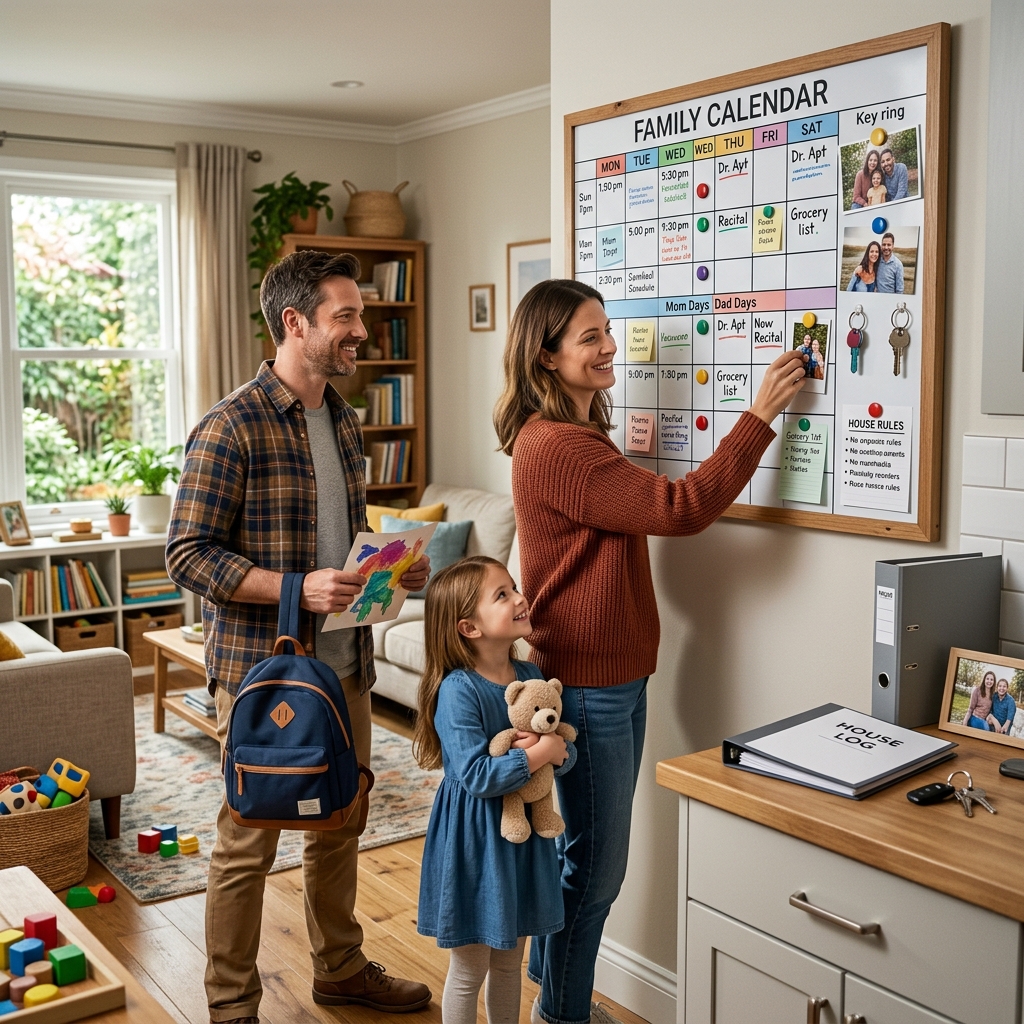
When parents separate, one of the hardest questions is how to give children stability while everyone learns to live in a new family structure. One option getting more attention in recent years is birdnesting, sometimes called nesting custody or bird’s nest parenting. In this arrangement, children stay in one home full-time while parents rotate in and out according to a schedule.
This guide explains what birdnesting is, why some families choose it, where it can go wrong, and how to decide if it might work in your situation. It draws on emerging research, expert commentary, and practical experience from families who have tried nesting.
Understanding Birdnesting: The Basics
Birdnesting reverses the usual post-divorce reality. Instead of children packing bags and moving between two households, the parents are the ones who move. Children stay in the familiar family home, while each parent takes turns living there during their parenting time and lives elsewhere when they are off-duty.
| Traditional joint custody | Birdnesting arrangement |
|---|---|
| Children move between two homes | Children remain in one primary home |
| Parents stay in their separate residences | Parents alternate living in the “nest” and an off-duty residence |
| Kids adapt to two sets of routines and environments | Kids keep one set of routines and neighborhood, parents adapt around them |
Key Features of a Nesting Arrangement
- One stable home for children – typically the former family home.
- Rotating parents – each parent lives in the nest during scheduled parenting time, then leaves when the other parent arrives.
- Off-duty housing – parents may share a small second residence, each have their own place, or stay with friends/family when not in the nest.
- Structured schedule – rotations follow a clear, agreed parenting plan to avoid confusion and conflict.
Why Some Families Choose Birdnesting
Nesting is often described as a child-centered custody model designed to protect children from the practical and emotional disruption that can come with moving homes after divorce. Instead of asking kids to adjust to new bedrooms, new rules, and new neighborhoods, parents absorb more of the upheaval themselves.
Potential Benefits for Children
Recent qualitative research on children’s experiences in nesting arrangements reports several perceived advantages.
- Continuity of daily life – Children keep their usual bedroom, school, neighborhood, and routine, which can ease the transition to life after separation.
- Greater emotional security – Staying in a familiar physical space can reduce stress, especially in the early phase of a divorce.
- Stable sibling relationships – Siblings remain together in one home, which can be particularly comforting as family changes unfold.
- Sense of autonomy – Some children report feeling more independent when they are not constantly traveling between households and can manage their own routines within one space.
Experts in co-parenting note that nesting can serve as an emotional buffer for children after divorce, giving them time to process changes while daily life feels familiar. This can be especially useful in the first months after separation, when emotions tend to be most intense.
Potential Advantages for Parents
Although nesting is primarily framed around children’s needs, parents sometimes identify practical benefits too.
- Time to plan long-term housing – Nesting can be a temporary bridge while parents sort out finances, housing markets, and legal issues before selling or refinancing the family home.
- Reduced logistics for children – Packing bags, coordinating school supplies, and keeping track of belongings can be exhausting for kids. Nesting shifts that burden away from them.
- Opportunity to practice cooperative co-parenting – Sharing one household (even on a rotating basis) can motivate parents to develop clear communication and problem-solving habits.
Realistic Drawbacks and Risks
Despite its appeal, birdnesting is not a simple solution and may not be appropriate for many families. Experts and researchers caution that it can introduce new tensions, delay healing, or create financial strain.
Emotional and Relationship Challenges
- Delayed separation – For some parents, continuing to share the same home (even at different times) can keep conflicts alive and make it harder to emotionally move on.
- Boundary issues – Using the same bedroom, personal spaces, or household items can feel invasive, especially when new romantic partners eventually appear.
- Unresolved conflict – Nesting does not erase the history of the relationship. Without deliberate changes in communication, old arguments can simply continue in a new format.
Practical and Financial Concerns
- Cost of multiple homes – Maintaining the family home plus a second residence or two separate off-duty homes can be expensive, and may only be realistic for families with sufficient resources.
- Household management – Cleaning, groceries, maintenance, and bill-paying must be coordinated carefully so one parent does not feel unfairly burdened.
- Complex legal planning – Property ownership, tax implications, and estate planning can be more complicated when parents remain tied to one shared residence.
Large population studies from Sweden suggest that, in many cases, children’s mental health in standard joint physical custody can be comparable to those in two-parent intact families, raising questions about whether nesting offers substantial long-term mental health advantages over well-managed traditional arrangements. This does not mean nesting cannot help in the short term, but it underscores that it is one option among many, not a guaranteed superior model.
Is Birdnesting Right for Your Family?
Deciding whether to nest requires honest reflection on your co-parenting relationship, finances, and long-term goals. Nesting tends to work best when it is:
- Time-limited – Many experts recommend nesting as a transitional arrangement, not an indefinite solution.
- Supported by clear agreements – Success often depends on detailed written rules about money, chores, boundaries, and decision-making.
- Backed by genuine cooperation – Parents need at least a baseline ability to communicate and compromise, even if the relationship itself is over.
Questions to Ask Before You Commit
- Can we communicate calmly about schedules, finances, and household expectations?
- Do we both truly put the children’s needs ahead of “winning” or punishing each other?
- Can we afford the combination of the family home and off-duty housing?
- Are we willing to put clear nesting terms into a parenting plan or separation agreement?
- How long do we expect to maintain this arrangement, and what is our exit strategy?
Designing a Nesting Plan: Key Elements
A nesting plan should be as detailed and practical as any other parenting plan, ideally with input from legal and financial professionals. Clear rules reduce misunderstandings and protect both parents and children.
Core Components of a Nesting Agreement
- Parenting schedule – Exact days and times each parent will live in the nest, including holidays and school breaks.
- Financial arrangements – Who pays the mortgage or rent, utilities, groceries, insurance, and maintenance. How unexpected repairs will be handled.
- Household responsibilities – Cleaning routines, laundry expectations, yard work, and how supplies are replenished.
- Use of private spaces – Which bedrooms or storage areas are reserved for each parent, and rules for personal belongings.
- Technology and communication – How parents will share calendars, notes, and updates (e.g., shared app, physical notebook in the kitchen).
- Conflict-resolution process – What happens when parents disagree or one violates the plan (e.g., mediation, therapist, return to court).
Practical Tips for Day-to-Day Nesting
Families who have tried birdnesting, along with professionals who support them, highlight several practical strategies that make day-to-day life smoother.
Keep the Household Running Smoothly
- Create shared systems – Use a visible cleaning schedule, grocery list, and bill-tracking system so both parents see the same information.
- Duplicate essential items – If you frequently carry certain things between the nest and off-duty home (work laptop, toiletries), consider duplicates to reduce stress.
- Respect each other’s space – Whenever possible, give each parent a separate bedroom or corner of the home to personalize, reducing feelings of intrusion.
Protect Children from Adult Conflict
- Discuss disagreements privately – Avoid arguing in front of the children or using them to relay messages between parents.
- Maintain consistent rules – Agree on basic expectations around homework, chores, bedtime, and screen time, and follow them consistently.
- Check in on their feelings – Ask children what is working and what feels confusing. Be open to adjusting the arrangement if they are distressed.
- Consider professional support – Therapists or co-parenting coaches can help parents manage conflict and refine the nesting plan over time.
How Long Should Birdnesting Last?
There is no single right timeline for nesting, but many families and experts treat it as short- to medium-term, not permanent. For example, some parents nest until the school year ends, the house can be sold, or one parent secures long-term housing.
Over time, children may benefit from transitioning to a more typical two-home arrangement, especially as parents start new relationships or move to different communities. The most important factor is not the format itself, but whether children experience predictable routines, low conflict, and loving involvement from both parents.
Frequently Asked Questions About Birdnesting
Does nesting always require the former family home?
No. While many families use their existing home as the nest, some rent a new primary residence for the children and continue to rotate in and out. The defining feature is that children have one main home while parents move.
Can nesting work if parents do not get along?
Nesting depends on a minimum level of cooperation. If communication is hostile or unsafe, most professionals advise against a nesting arrangement because the household tension can harm children and parents alike.
Is nesting recognized in court orders?
Yes. A nesting arrangement can be written into a parenting plan or custody order, specifying schedules, responsibilities, and how long the arrangement is expected to last. Courts may be more comfortable with nesting when it is well-defined and clearly focused on children’s best interests.
What happens when one parent wants to end nesting?
Your agreement should anticipate this possibility. A common approach is to build in review dates (for example, every six months) and specify the steps for transitioning to a new arrangement if either parent or the children are struggling.
Is birdnesting better than traditional joint custody?
Research does not yet show that nesting is inherently better than well-managed joint custody. Instead, it appears to be one of several viable child-focused options. Its success depends on family dynamics, resources, and how thoughtfully it is implemented.
References
- Children’s experiences of bird’s nest parenting arrangements — H. Toros. 2024-03-01. https://www.sciencedirect.com/science/article/abs/pii/S0190740924001567
- Birdnesting Divorce: Co-Parenting in the Same House — Custody X Change. 2023-05-10. https://www.custodyxchange.com/topics/divorce/special-circumstances/birdnesting.php
- Bird Nesting Co-Parenting Arrangements After Divorce Help Kids — Good Housekeeping. 2023-10-18. https://www.goodhousekeeping.com/life/parenting/a46444043/bird-nesting-divorce/
- Birdnesting: The divorce trend where parents rotate homes — BBC Worklife. 2021-08-04. https://www.bbc.com/worklife/article/20210804-birdnesting-the-divorce-trend-in-which-parents-rotate-homes
- The Benefits Of Birdnesting After Divorce — NPR, 1A. 2023-09-07. https://www.npr.org/2023/09/07/1198335037/the-benefits-of-birdnesting-after-divorce
- Divorce expert Christina McGhee explains “bird nesting” — CBS News / YouTube. 2022-04-15. https://www.youtube.com/watch?v=FeqLyXSv3zQ
Similar Articles








Read full bio of Sneha Tete


