
Bicycle Traffic Laws and Accident Liability
Learn how bicycle traffic laws affect fault, insurance claims, and your rights after a bike accident on public roads.
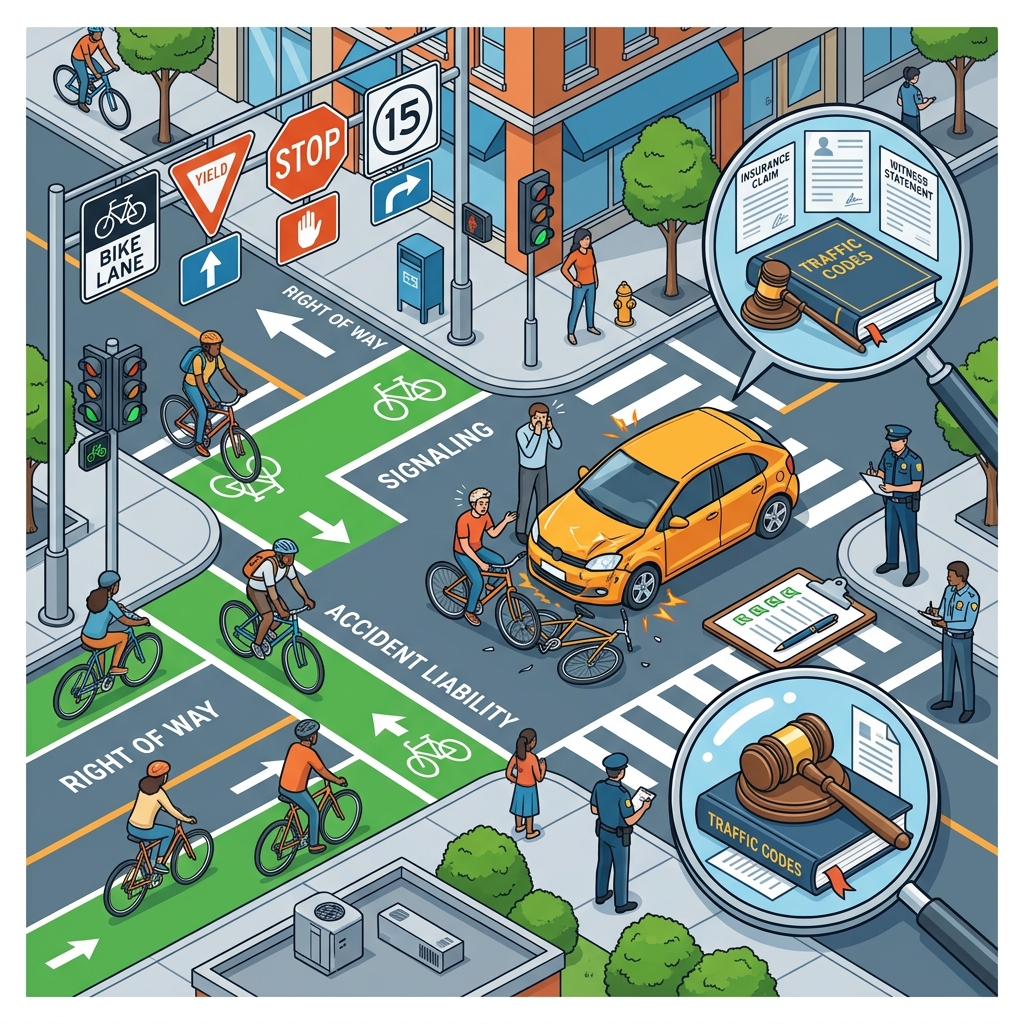
Bicycling has grown rapidly in cities, suburbs, and small towns alike, but the law has not always kept pace with changing road use. In most U.S. states, bicycles are treated as vehicles, which means cyclists must follow many of the same rules as drivers of cars and trucks. Understanding these rules is critical not only for safety, but also for determining who is legally at fault when a crash occurs.
This article explains how bicycle traffic laws work, why cyclists must obey them, how fault and compensation are decided after an accident, and what practical steps riders can take to protect themselves both physically and legally.
How the Law Treats Bicycles on the Road
Across the United States, state laws generally recognize a bicycle as a vehicle when it travels on public roads. This has two important consequences:
- Cyclists gain many of the same rights as drivers, including the right to use most roadways and be given reasonable space when passed.
- Cyclists also incur the same basic duties as drivers, such as obeying traffic control devices and exercising reasonable care to avoid harming others.
Some jurisdictions explicitly define bicycles as vehicles for purposes of traffic laws, while others create separate but parallel rules for cyclists. In either case, the outcome is similar: a person riding a bicycle must generally follow the rules of the road designed for motor vehicles.
Key Legal Rights of Cyclists
Recognizing a bicycle as a vehicle gives cyclists several important rights:
- Right to use the travel lane: Cyclists are usually allowed to ride in the same lanes as motor vehicles unless a specific rule prohibits bikes (for example, interstate highways in some states).
- Right to safe passing distance: Many states require drivers to give cyclists a minimum clearance—often three or four feet—when overtaking and passing them.
- Right-of-way protections: When a cyclist is lawfully in a lane or crosswalk, drivers must yield according to the same right-of-way rules that apply between motor vehicles.
Core Duties Imposed on Cyclists
With those rights come responsibilities. Common duties imposed by state traffic codes include:
- Riding in the same direction as traffic on the right side of the road, except when making a left turn or avoiding hazards.
- Stopping at red lights and stop signs, and obeying all other traffic control devices.
- Yielding to pedestrians at crosswalks and following general right-of-way rules at intersections.
- Using hand signals to indicate turns and lane changes where required by local law.
- Using lights and reflectors at night or in low visibility conditions as mandated by the state’s vehicle code.
Failing to follow these duties does not automatically make a cyclist responsible for a crash, but it can strongly influence how fault is evaluated.
Typical Bicycle Traffic Rules That Affect Accident Claims
When a crash occurs, insurance companies and courts look closely at whether any traffic rules were broken. Below are some key categories of rules that often matter in bicycle accident cases.
Position on the Roadway
Many states require cyclists to ride as far to the right as is practicable, with important exceptions. Riders may move farther left when:
- Preparing for a left turn;
- Avoiding debris, parked cars, or potholes;
- The lane is too narrow to safely share side-by-side with a motor vehicle; or
- Passing another slower cyclist or vehicle.
In some states, riding in a designated bike lane is encouraged when available, but cyclists are typically not required to stay in the bike lane if it is unsafe (for example, blocked by parked cars or debris).
Passing and Being Passed
Safe passing rules apply to both drivers and cyclists:
- Drivers must allow a minimum passing distance—commonly three or four feet—and may be permitted to cross a double yellow line briefly to pass a bicycle when safe.
- Cyclists passing other vehicles must do so only when it can be done safely and without crossing solid lines or ignoring traffic signals.
- Sudden maneuvers into traffic, such as weaving between cars or passing on the right without caution, can weigh against a cyclist when fault is evaluated.
Helmet and Equipment Laws
State laws differ on helmet requirements. Some states mandate helmets for all riders, others only for minors, and a few have no statewide helmet law at all. Even in states where adult helmets are not legally required, wearing one is widely recognized as a critical safety measure, and failure to use a helmet can sometimes affect damage calculations if the injury is related to head trauma.
Equipment rules also commonly require:
- Front white light and rear red light or reflector when riding at night;
- Functioning brakes capable of skidding on dry level pavement;
- Reflective material or side reflectors on wheels or pedals.
Sidewalks and Crosswalks
Local rules often govern whether cyclists may ride on sidewalks. In many cities, riding on sidewalks in business districts is prohibited, while residential sidewalks may allow it. When riding on a sidewalk or in a crosswalk, cyclists are often required to yield to pedestrians and may be treated more like pedestrians than vehicles for some purposes.
| Issue | Cyclist Duty | Motorist Duty |
|---|---|---|
| Obey signals & stop signs | Must stop and obey lights/signs | Must stop and obey lights/signs |
| Direction of travel | Ride with traffic on right side | Drive in proper lane in traffic direction |
| Passing bicycles | Pass only when safe, typically on left | Give at least 3–4 feet and pass only when safe |
| Yielding to pedestrians | Yield at crosswalks and on shared paths | Yield at crosswalks and when turning |
| Night visibility | Use lights and reflectors as required | USE headlights, taillights; watch for bikes |
Negligence, Fault, and Bicycle Crashes
Most bicycle accident cases are governed by the law of negligence. To obtain compensation, an injured cyclist usually must show that someone else acted unreasonably and caused their injuries.[10]
Elements of Negligence in Bike Accidents
Courts typically break negligence down into four parts:
- Duty of care: Drivers owe a duty to operate their vehicles with reasonable care toward others on the road, including cyclists; cyclists owe a similar duty toward drivers and pedestrians.
- Breach of duty: A breach occurs when someone fails to act as a reasonably careful person would—for example, by running a red light, texting while driving, or riding in the wrong lane.
- Causation: The breach must be a direct cause of the accident and resulting injuries; if the crash would have happened regardless of the breach, liability may be reduced or eliminated.
- Damages: The injured person must have real losses, such as medical bills, lost wages, or pain and suffering.
Traffic laws are often used as benchmarks for what constitutes reasonable behavior. Proving that a driver violated a traffic law—such as speeding, failing to yield, or passing too closely—can strongly support a negligence claim.[10]
When Cyclists Are Partly at Fault
In many crashes, both the driver and the cyclist may have made mistakes. A cyclist might be:
- Riding against the flow of traffic;
- Ignoring a stop sign or red light;
- Failing to use required lights at night;
- Weaving unpredictably between lanes.
How this affects compensation depends on the state’s fault rules:
- Comparative negligence states: Damages are reduced by the cyclist’s percentage of fault. A rider 20% at fault may recover 80% of total damages.[10]
- Contributory negligence states: In a few jurisdictions, if the cyclist is even slightly at fault, they may be barred from recovering anything. This makes compliance with traffic laws especially critical in those states.
Common Causes of Bicycle Crashes and Legal Implications
While every accident is unique, certain patterns appear repeatedly in police reports and legal claims. Understanding them can clarify how traffic rules are applied after a crash.
Left-Turn and Right-Hook Collisions
Two frequent crash patterns involve turning vehicles:
- Left-cross: A driver turning left fails to see an oncoming cyclist and turns across the rider’s path.
- Right-hook: A driver turning right overtakes a cyclist, then turns directly in front of them without leaving enough space.
In both situations, fault often depends on whether the driver properly checked for cyclists and whether the cyclist was where the law allowed them to be (for example, in a bike lane or traveling in the correct direction).
Dooring Incidents
“Dooring” occurs when a parked driver or passenger opens a car door into the path of a cyclist. Many states require motorists to check before opening doors into traffic, and violation of this duty can lead to liability when a cyclist is struck.
Sidewalk and Crosswalk Collisions
When cyclists ride on sidewalks or crosswalks, crashes may involve pedestrians or turning vehicles. The legal analysis often focuses on:
- Local rules about whether sidewalk riding is permitted;
- Whether the cyclist was traveling at a safe speed and yielding to pedestrians;
- Whether a turning driver reasonably should have anticipated a cyclist entering the crosswalk.
What to Do After a Bicycle Accident
The steps taken in the minutes and days after a crash can strongly affect both health outcomes and the success of a legal claim.
Immediate Safety and Medical Care
- Move to a safe location if you can do so without worsening injuries.
- Call emergency services or ask someone else to do so.
- Accept medical evaluation at the scene; even seemingly minor injuries can be more serious than they appear, especially head and internal injuries.[10]
Emergency records and follow-up medical documentation often serve as key evidence linking the crash to your injuries.
Documenting the Scene
When possible, collect information before vehicles or bikes are moved:
- Names, contact information, and insurance details for all drivers involved.
- Contact information for any witnesses.
- Photos of the roadway, traffic signals, skid marks, debris, and damage to vehicles and the bicycle.
- Photos of visible injuries.
Police reports can play an important role as well, capturing statements and observations shortly after the crash.[10]
Reporting and Legal Follow-Up
- Report the crash to the police if they did not come to the scene.
- Notify your own insurer and the driver’s insurer, but avoid detailed recorded statements without legal advice.
- Consider speaking with a personal injury attorney experienced in bicycle cases, especially if injuries are significant or fault is disputed.[10]
Each state has a statute of limitations—a deadline for filing a lawsuit. In many states, this is two or three years for personal injury claims, but it can be shorter for claims against government entities.[10] Missing that deadline can permanently bar recovery.
Maximizing Safety and Reducing Legal Risk
While no one can eliminate all risk, following best practices reduces both the chance of a crash and the likelihood that you will be found at fault.
Practical Safety Tips for Cyclists
- Be predictable: Ride in a straight line, signal turns, and avoid sudden swerves between parked cars and the travel lane.
- Make yourself visible: Use front and rear lights, reflective gear, and bright clothing, particularly at dawn, dusk, and night.
- Guard intersections: Assume drivers may not see you; make eye contact where possible and be cautious of turning vehicles.
- Avoid blind spots: Do not linger alongside large vehicles at intersections or in heavy traffic.
- Wear a helmet: Even where not legally required, helmet use significantly reduces the risk of serious head injury in a crash.
Good Habits for Drivers Sharing the Road with Bicycles
- Allow ample space when passing—at least three feet, and more at higher speeds.
- Check mirrors and blind spots carefully before turning or changing lanes.
- Open doors with the hand farthest from the door (often called the “Dutch reach”) so your body naturally turns to check for cyclists.
- Slow down in areas with heavy bike traffic, school zones, and near multi-use trails.
Frequently Asked Questions About Bicycle Traffic Laws
Do cyclists really have to stop at stop signs and red lights?
In most states, yes. Cyclists are required to obey traffic signals and stop signs just like drivers, and failure to do so can be used as evidence of negligence if a crash occurs. A few states have special rules that allow cyclists to treat stop signs as yield signs, but these are the exception, not the rule.
Can I ride my bike on the sidewalk if I feel safer there?
It depends on local law. Some cities allow sidewalk riding outside business districts, while others prohibit it entirely. Even where it is allowed, you must yield to pedestrians and ride at a safe speed. If a crash occurs on a sidewalk where bike riding is prohibited, that may affect how fault is assigned.
If I was not wearing a helmet, can I still bring a claim?
Usually yes. Helmet laws vary by state, and in many places adults are not legally required to wear a helmet. However, if you suffer a head injury, the absence of a helmet may influence how damages are evaluated, especially if experts believe a helmet would have significantly reduced the severity of the injury.
What if the driver says I was riding in the wrong place?
Whether your lane position was legal depends on specific state rules about where cyclists must ride and any exceptions that apply. An attorney can help review statutes and local ordinances, as well as crash scene evidence, to determine whether your positioning was reasonable and lawful.
Do I need a lawyer for a minor bike accident?
For minor property-only claims, some people handle matters directly with insurance. However, if you have physical injuries, ongoing symptoms, or disputes about fault, consulting a personal injury attorney can help you understand your rights, the value of your claim, and the applicable deadlines.[10]
References
- North Carolina Bicycle Accident Laws – All You Need to Know — Bill Corbett Law. 2023-05-01. https://www.billcorbettlaw.com/blog/north-carolina-bicycle-accident-laws/
- Understanding Bicycle Accident Laws in South Carolina — Cavanaugh & Thickens, LLC. 2022-08-10. https://www.cclawfirm.com/understanding-bicycle-accident-laws-in-south-carolina/
- North Carolina Bicycle Laws (2nd Edition) — North Carolina State University Institute for Transportation Research and Education. 2019-01-01. https://transportation.ncsu.edu/wp-content/uploads/sites/46/2021/06/BIKELAW_RG_NC_2019_WEB.pdf
- Bike Accident Law — FindLaw. 2024-02-15. https://www.findlaw.com/injury/car-accidents/bike-accidents.html
- Accident 411 – What to Do if You Have a Bike Crash — Bike Law. 2023-03-20. https://www.bikelaw.com/learn/
- North Carolina Bicycle Passing Law — Hendren, Redwine & Malone. 2017-10-12. https://raleighbikelawyer.com/north-carolina-bicycle-passing-law/
- Bicycle Accident Laws: Rights & What to Do After a Crash — Shapiro, Injury Lawyers. 2022-11-07. https://sihattorneys.com/blog/bicycle-accident-laws-your-rights-what-to-do-and-when-to-call-a-lawyer/
Similar Articles








Read full bio of Sneha Tete


