
Becoming a U.S. Citizen Through Marriage
A practical, step-by-step guide to gaining U.S. citizenship through marriage to a U.S. citizen, from green card to naturalization.
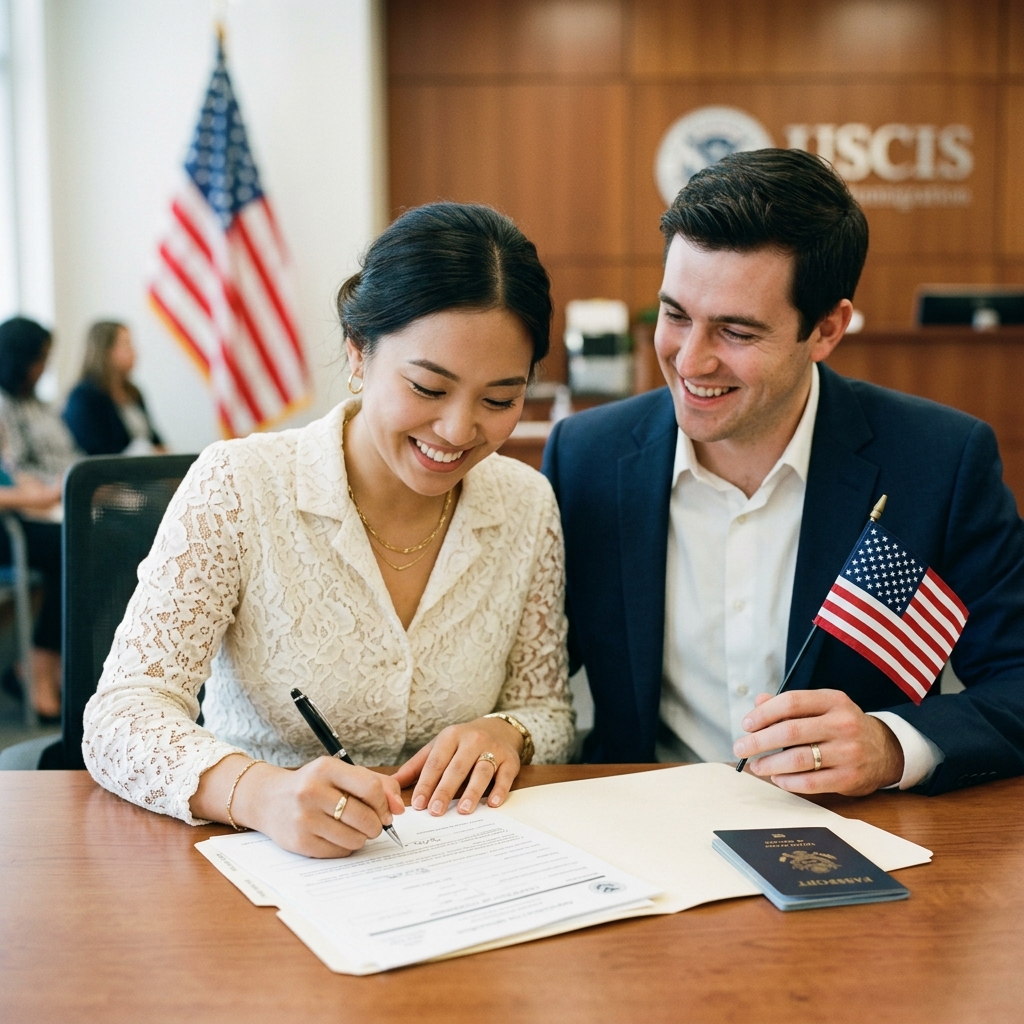
Marriage to a U.S. citizen can create a faster pathway to U.S. citizenship, but it does not make anyone a citizen automatically. Instead, it allows certain permanent residents to apply for naturalization after three years of holding a marriage-based green card, rather than the usual five years required for most other immigrants. This guide walks through the journey from marriage, to permanent residence, and finally to citizenship.
1. How Marriage Fits Into the U.S. Citizenship Process
U.S. immigration law treats marriage to a U.S. citizen as a basis for a family immigration benefit, not as automatic citizenship. The typical sequence is:
- Marry a U.S. citizen in good faith (a real, bona fide marriage).
- Obtain a marriage-based green card (lawful permanent residence).
- Maintain permanent residence for a required period.
- Apply for naturalization using Form N-400 to become a U.S. citizen.
Being married to a U.S. citizen shortens one key step: the permanent residence period before naturalization can be as little as three years if specific conditions are met.
2. From Marriage to Marriage-Based Green Card
Before you can seek citizenship through marriage, you generally must first become a lawful permanent resident (LPR), commonly known as a green card holder. Marriage is one way to qualify for this status.
2.1 Basic Route to a Marriage Green Card
Depending on whether the foreign-born spouse is already in the United States or abroad, the steps vary. In many cases, the U.S. citizen spouse files a petition and the foreign spouse applies for permanent residence:
- Petition by the U.S. citizen: The citizen typically files Form I-130, Petition for Alien Relative.
- Adjustment of status (inside the U.S.): The foreign spouse files Form I-485, Application to Register Permanent Residence or Adjust Status, after marriage.
- Consular processing (outside the U.S.): If abroad, the foreign spouse usually goes through immigrant visa processing at a U.S. embassy or consulate, based on the approved I-130.
These forms must be supported by documents establishing identity, the legitimacy of the marriage, and the termination of any prior marriages. Once approved, the foreign spouse becomes a permanent resident and receives a green card.
2.2 Conditional Versus Regular Permanent Residence
If the couple has been married for less than two years at the time permanent residence is granted, the foreign spouse usually receives conditional permanent residence valid for two years. The couple must later jointly file to remove conditions. After conditions are removed, the spouse holds regular permanent residence, which counts toward the three-year or five-year naturalization timeline.
3. Eligibility for Citizenship Through Marriage
Naturalization is the legal process through which a permanent resident becomes a U.S. citizen. The U.S. government sets eligibility rules, and marriage is one of the recognized categories.
3.1 Core Requirements for the Marriage-Based Three-Year Path
To apply for naturalization after three years of permanent residence, the applicant must typically meet all of the following.
| Requirement | Three-Year Marriage-Based Path |
|---|---|
| Permanent residence | Lawful permanent resident for at least 3 years |
| Marital relationship | Married to and living with the same U.S. citizen spouse for those 3 years (marital union) |
| Spouse’s status | Spouse must have been a U.S. citizen for at least 3 years at the time of filing |
| Physical presence | Present in the U.S. for at least 18 months during the 3-year period |
| Residency in state/USCIS district | Living for a required period (commonly 3 months) in the filing jurisdiction |
| Age | At least 18 years old at the time of filing |
| Good moral character | Demonstrated for the relevant statutory period, including no serious crimes |
| Civics and English | Ability to pass the English and U.S. history/government tests |
If any of these elements are missing, the applicant may need to follow the standard five-year path instead.
3.2 Five-Year Path Versus Three-Year Path
Not all spouses of U.S. citizens qualify for the accelerated timeline. Many will still become citizens through the regular five-year rule. In summary:
- Three-year rule: For permanent residents married to and living with a U.S. citizen for a continuous three-year period before filing, with physical presence and other requirements met.
- Five-year rule: Applies to most other permanent residents, including those who are separated, divorced, or not living in marital union with their U.S. citizen spouse.
If a couple separates or divorces before the three-year mark, the spouse usually loses eligibility for the early filing option and must instead wait until they reach five years of permanent residence.
4. Proving the Marriage and Marital Union
Marriage-based citizenship claims require strong documentation. U.S. Citizenship and Immigration Services (USCIS) examines whether the relationship is genuine and whether the couple has lived together in a marital union for the required period.
4.1 Key Evidence Requested
When filing Form N-400 based on marriage, applicants commonly need to provide:
- Proof of spouse’s citizenship, such as:
- U.S. birth certificate.
- Certificate of Naturalization or Certificate of Citizenship.
- Consular Report of Birth Abroad (Form FS-240).
- Biographical page of a U.S. passport.
- Marriage documentation:
- Current marriage certificate.
- Divorce decrees, annulment orders, or death certificates for prior spouses, if any.
- Evidence of marital union over three years:
- Joint bank or credit card statements.
- Lease agreements or mortgage documents in both names.
- Birth certificates or adoption records of children.
- Insurance policies listing both spouses.
- Tax transcripts for both spouses for the last three years.
This documentation helps USCIS confirm that the marriage is not just legal on paper, but also a real, shared life.
5. Naturalization Through Marriage: Step-by-Step
Once you meet eligibility requirements, you will go through a structured naturalization process. Official government resources describe this in multiple steps.
5.1 Check Eligibility
First, confirm you qualify for either the three-year marriage-based path or the five-year standard path. You should review factors such as:
- Length of time as a permanent resident.
- Length and continuity of marriage to the U.S. citizen.
- Time physically spent in the United States.
- Criminal history and overall conduct.
- Ability to meet English and civics requirements.
5.2 File Form N-400, Application for Naturalization
Naturalization begins with filing Form N-400 with USCIS. This form can be filed online or by mail and requires detailed biographical, residence, and marital information.
Along with the form, you typically submit:
- Copy of your green card (front and back).
- Marriage certificate.
- Evidence your spouse is a U.S. citizen (such as a passport or birth certificate).
- Tax returns or transcripts for recent years, especially for the three-year path.
- Passport-style photographs if required, particularly in certain filing scenarios.
5.3 Biometrics Appointment
USCIS usually schedules a biometrics appointment where your fingerprints, photograph, and signature are taken to verify your identity and run security checks.
5.4 Naturalization Interview and Tests
The interview is a central part of the process. A USCIS officer will review your N-400, ask questions about your background and eligibility, and administer the required tests.
The naturalization test generally includes:
- Civics test: Questions on U.S. history and government.
- English test: Assessment of reading, writing, and speaking ability.
Some applicants may qualify for exemptions or reduced requirements based on age or disability, but marriage alone does not exempt anyone from the tests.
5.5 Oath of Allegiance and Certificate of Naturalization
If approved, USCIS will schedule an Oath of Allegiance ceremony. In some places, this can occur the same day as the interview; in others, it may happen later.
During the ceremony:
- You complete the oath notice form (often Form N-445).
- You return your green card.
- You take the Oath of Allegiance to the United States.
- You receive your Certificate of Naturalization, which serves as official proof of citizenship.
6. Common Pitfalls and How to Avoid Them
Many applicants eligible through marriage encounter problems not because of the law itself, but due to missing documentation, misunderstandings, or changes in marital status. Being aware of common issues can help prevent delays or denials.
6.1 Changes in Marital Status
A key risk for the three-year path is the breakdown of the marriage. If the couple divorces or stops living together before the required three-year period is completed, the applicant typically loses eligibility for the accelerated timeline and must wait for the five-year rule.
Applicants should:
- Be honest and transparent about any separation.
- Update USCIS if marital status changes.
- Re-evaluate eligibility before filing if the relationship has ended.
6.2 Insufficient Evidence of Marital Union
Another common problem is failing to show that the couple truly lived together and shared finances and responsibilities. USCIS can question a marriage if supporting evidence is thin or inconsistent.
Good practices include:
- Keeping joint financial documents over time (bank statements, leases, mortgages).
- Maintaining consistent addresses and explaining any temporary separations.
- Retaining copies of tax returns showing the couple’s filing status.
6.3 Legal and Moral Character Issues
Naturalization requires a showing of good moral character. Certain actions—such as serious crimes, false claims to U.S. citizenship, or unlawful voting in U.S. elections—can lead to denial and, in some cases, more serious consequences.
Applicants should review their history carefully and consider seeking legal advice if they have concerns about past conduct.
7. Frequently Asked Questions (FAQs)
7.1 Does marriage to a U.S. citizen make me a citizen immediately?
No. Marriage alone does not grant citizenship. It allows you to pursue a family-based immigration process to obtain a green card, and later, to apply for naturalization once you meet all requirements.
7.2 How long must I be a permanent resident before applying for citizenship through marriage?
Most spouses of U.S. citizens following the marriage-based path must be lawful permanent residents for at least three years, living with the same U.S. citizen spouse during that time. If this condition is not met, the usual five-year permanent residence rule applies.
7.3 What if my spouse became a citizen only recently?
For the three-year path, your spouse generally must have been a U.S. citizen for at least three years at the time you file and you must have been married and living together during that period. If not, you may still be able to naturalize under the standard five-year rule.
7.4 Do I have to take the English and civics tests even if I’m married to a U.S. citizen?
Yes. Marriage does not exempt you from the naturalization tests. Most applicants must demonstrate basic English abilities and pass the civics test, unless they qualify for an age or disability-related exception under general naturalization rules.
7.5 How long does naturalization through marriage usually take?
Processing times can vary by location and over time. Resources indicate that naturalization, from filing Form N-400 through the oath ceremony, can take close to a year or more in many cases. It is important to review current USCIS processing times for your specific jurisdiction.
8. Key Takeaways for Planning Your Path
Citizenship through marriage to a U.S. citizen is best understood as a structured journey, not an automatic benefit. Successful applicants generally:
- Enter into a genuine, good-faith marriage.
- Obtain a marriage-based green card and maintain permanent residence.
- Meet the three-year or five-year residence and presence requirements.
- Document their marital union thoroughly with financial and residential records.
- Prepare carefully for the N-400 application, interview, and tests.
Understanding each step and gathering strong evidence from the start can make the process smoother and help ensure that marriage leads not only to a shared life in the United States, but also to shared citizenship.
References
- Become a U.S. citizen through naturalization — USAGov. 2024-01-10. https://www.usa.gov/naturalization
- U.S. Citizenship Through Marriage | Naturalization Guide — ImmigrationHelp.org. 2026-01-05. https://immigrationhelpla.com/us-citizenship-through-marriage/
- Marriage Green Card to U.S. Citizenship: N-400 – 2025 Guide — Gozel Law Firm PC. 2025-03-01. https://www.gozellaw.com/blog/from-marriage-based-green-card-to-u-s-citizenship-2025-guide
- Permanent Residency (Green Card through Marriage) — University of Iowa International Student and Scholar Services. 2023-09-15. https://international.uiowa.edu/isss/current-students/permanent-residency-green-card-through-marriage
- Immigrant Visa for a Spouse or Fiancé(e) of a U.S. Citizen — U.S. Department of State. 2024-06-20. https://travel.state.gov/content/travel/en/us-visas/immigrate/family-immigration/immigrant-visa-for-a-spouse-or-fiance-of-a-us-citizen.html
Similar Articles








Read full bio of Sneha Tete


